Thanks for subscribing.
Your gift is on the way.



Every application reaching iPhone and iPad users ships through Apple’s controlled ecosystem, and the language those applications are written in shapes the hiring search from the start. Swift was released in 2014 as a modern replacement for Objective-C, with stricter safety features and cleaner syntax. iOS commands 31.6% of the global mobile operating system market, creating substantial demand for Developers who write production-ready Swift code. Several of the language’s design choices explain why that demand is specific rather than general. Compile-time type checking catches programming errors before the code reaches production, which shortens the bug-fix cycles that delay releases, and Automatic Reference Counting manages memory without manual intervention, removing a category of defects that affects applications written in less structured languages.
The programming language index ranks Swift among the top 20 languages in 2025, reflecting sustained adoption across the development community.
Finding qualified candidates takes time that internal HR teams rarely have, particularly for roles requiring experience with the UIKit or SwiftUI frameworks. Recruitment agencies specializing in technical placements address this gap through pre-screened candidate pools and practical coding assessments. The guide that follows walks through the screening criteria and salary benchmarks a business owner needs before opening a Swift Developer search, with agency-supported hiring covered in the closing sections.
Apple introduced Swift at the 2014 Worldwide Developers Conference as an open-source programming language. The design incorporated elements of Python and Ruby for readability, with C++ performance characteristics informing the compilation approach. iOS development represents the primary use case. Organizations building Mac desktop software use the same language, so a Swift Developer hired for iOS work covers desktop applications without a second hire. Apple Watch and Apple TV applications are written in Swift as part of the broader ecosystem.
The language interoperates with existing Objective-C codebases, allowing gradual adoption in legacy projects. Teams maintaining older applications add Swift files without requiring full rewrites. This compatibility reduces migration risk for organizations with established iOS products. Swift’s open-source status has attracted contributions from developers outside Apple, expanding the standard library and improving cross-platform support. Linux compatibility supports server-side applications via frameworks such as Vapor, though most production work targets Apple devices.
Do you have IT recruitment needs?
Evaluating Swift Developers requires understanding what distinguishes the language from alternatives used in mobile development.
According to Apple Inc., Swift runs 2.6 times faster than Objective-C and up to 8.4 times faster than Python, due to how the compiler transforms source code into machine instructions.
Almost every applicant lists Swift on a resume, and almost none of them mean the same thing by it. Technical screening is what separates a Developer who has shipped and maintained a production application from one who has followed a tutorial, and that separation shows up at the level of language detail rather than job history. The sections below outline the specific features hiring managers use as screening grounds when assessing candidate proficiency.
Swift’s syntax prioritizes clarity, reducing boilerplate code common in older languages. Variable declarations use var for mutable values and let for constants, with type inference automatically inferring data types from assigned values. Loops and functions read naturally, making codebases easier to maintain when team members change or projects scale.
The optionals system handles missing values at compile time rather than allowing null pointer exceptions at runtime. Variables marked as optional require explicit handling before use, forcing Developers to account for absent data throughout the codebase. Errors surface during development rather than reaching production environments, where they affect users.
Swift compiles through LLVM, a compiler infrastructure that transforms code into optimized machine instructions. Applications consume resources more efficiently than interpreted languages, which process code line by line at runtime. The performance advantage matters for applications that handle large datasets or require responsive user interfaces without noticeable lag.
Xcode displays live interface previews alongside the code that generates them, updating the visual output as the Developer types. SwiftUI components render in real time without requiring a full build cycle or a connected device. This feedback loop shortens iteration time on interface work, where visual precision matters more than in backend logic.
Read together, these features describe what a business actually buys when it hires for Swift. Safety mechanisms and compile-time checks move defect discovery earlier, where fixing a problem is cheap. Live previews shorten the loop between an idea and something a stakeholder can look at and react to. A candidate who can explain why optionals exist, rather than only how to unwrap them, is telling a hiring manager they have maintained an application long enough to care about the answer.
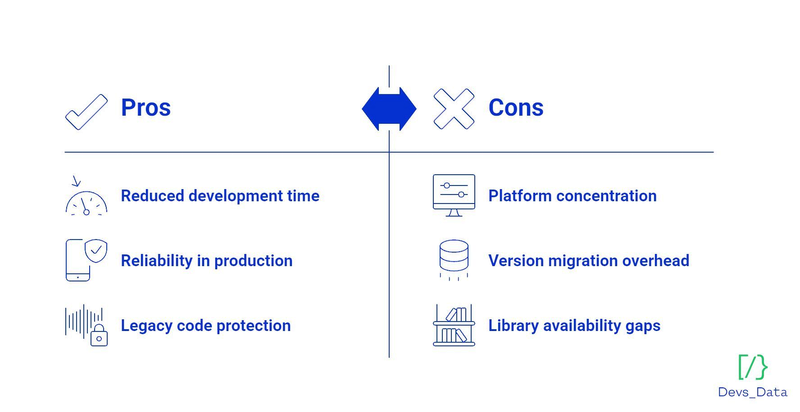
Organizations assessing Swift for upcoming projects weigh practical trade-offs alongside technical capabilities. Budget cycles, team composition, and target platforms all influence whether the language is a good fit for a specific use case. The advantages below reflect production experience from development teams, while the limitations address constraints hiring managers consider when structuring roles.
Swift’s syntax requires fewer lines than Objective-C to achieve the same result, which shortens the time Developers spend writing and reviewing code on each feature. New team members onboard faster because the language reads more naturally than older alternatives. Projects reach deployment milestones sooner when less time goes toward deciphering complex syntax patterns.
Swift’s optionals system and compile-time checks are designed to reduce post-release defects tied to null references or type mismatches. Compile-time checks catch errors before code reaches testing environments. The reduction in runtime failures translates to lower maintenance costs after launch.
Teams with existing Objective-C investments migrate incrementally without rewriting entire codebases. Swift files function alongside legacy code within the same project structure. This compatibility protects previous development investments while allowing modernization over time.
The language also imposes constraints on certain project types.
Xcode remains the primary development environment, tying Swift workflows to macOS hardware. Community resources and third-party tooling concentrate on Apple platforms. Organizations targeting Android or Windows alongside iOS face additional complexity when standardizing across teams.
Swift’s continued evolution introduces breaking changes between major releases. Codebases require periodic updates to maintain compatibility with newer compiler versions. Development teams allocate time for refactoring work that languages with slower release cycles avoid.
The Swift Package Manager has expanded access to third-party libraries in recent years, narrowing the gap with ecosystems like JavaScript and Python. Server-side projects still encounter fewer prebuilt solutions than in more established backend languages, though the gap is smaller than it was at Swift’s launch.
Weighing these factors shapes both project planning and hiring priorities. Roles focused on iOS work benefit from Swift’s strengths without encountering most limitations. Positions requiring cross-platform output or extensive third-party integrations require candidates with broader language experience in addition to Swift proficiency. That is usually where the alternatives enter the conversation. Flutter and React Native let a single team ship to iOS and Android from one codebase, while Kotlin Multiplatform shares business logic across platforms and keeps the interface layer native on each. Objective-C stays relevant wherever a legacy codebase is still in service. Each option trades some native performance or platform access for reach, which turns the language choice into a hiring decision as much as a technical one.
Do you have IT recruitment needs?
Organizations that are expanding their iOS capabilities reach a point at which existing team capacity no longer meets project demands. New application builds, feature additions, and maintenance workloads require Developers who write production-grade Swift code. Locating professionals with this expertise presents challenges for internal hiring teams. Most candidates list Swift on their resumes, yet hiring companies need specific framework experience or platform depth that varies by project requirements.
Project scope determines whether contract or permanent hiring makes sense. Implementation projects with defined endpoints are well-suited to fixed-term engagements. Ongoing feature development benefits from staff who know the codebase well enough to ship without a ramp-up period.
Hiring managers sometimes assume Swift Developers possess uniform capabilities. Actual competencies vary widely between candidates. Some excel at UIKit interface construction. Others bring experience with SwiftUI or Core Data persistence layers. Distinguishing baseline requirements from preferred qualifications creates a practical screening filter.
The table below separates skills every candidate must demonstrate from those that strengthen a hire but remain optional.
| Required skills | Preferred skills |
|---|---|
| Proficiency in Swift with demonstrated iOS project experience. | Experience with SwiftUI for declarative interface development. |
| Understanding of UIKit components and Auto Layout constraints. | Background in automated testing using the XCTest framework. |
| Experience with Xcode development environment and debugging tools. | Knowledge of Core Data for local data persistence. |
| Working knowledge of version control systems, particularly Git. | Familiarity with RESTful API design and consumption. |
| Understanding of optionals, type safety, and error handling patterns. | Experience with Objective-C for legacy codebase maintenance. |
| Proficiency in memory management using Automatic Reference Counting (ARC). | Understanding of CI/CD pipelines for automated deployment workflows. |
Matching candidates to these criteria takes time that internal HR departments rarely have. Time is the smaller half of the problem. The larger half is capability, since judging whether a candidate’s SwiftUI experience amounts to production depth or tutorial familiarity requires someone who can read the answer, and most internal teams have nobody in that position. Agencies specializing in technical roles supply that assessment capacity along with a current view of what competing offers look like. They also reach Swift professionals who are employed and not searching, a group that public postings never touch.
Hiring budgets for Swift roles require accurate compensation data before recruitment begins. Candidates with production experience expect compensation commensurate with their skill level. Companies competing for this talent often find themselves bidding against agencies and startups seeking the same profiles.
Experience level drives the largest variation in compensation. Entry-level Developers command different rates than mid-career professionals who have built complex iOS applications or optimized performance for high-traffic products. Geographic location adds another variable. Salaries in major tech hubs exceed those in regions with a lower cost of living. Remote work arrangements have compressed some of these differences, though location-based pay adjustments remain common across the industry.
The table below provides an overview of typical earnings in the US market. For current salary data, sources such as Glassdoor remain useful.
| Experience | Salary range (USD) |
|---|---|
| 0-1 years | $71000-$133000 yearly |
| 1-3 years | $79000-$144000 yearly |
| 4-6 years | $95000-$171000 yearly |
These figures reflect base compensation and additional pay components reported across the US market. Actual salaries vary based on factors such as company size, project scope, and regional cost of living. Developers with shipped products or specialized framework expertise often command rates at the higher end of their respective ranges. A range this wide is a limitation of self-reported aggregate data rather than a description of any single role, which is why most employers calibrate against a second source before writing an offer. Recruitment agencies working in iOS placement see accepted and declined offers as they happen, so they can narrow a public band to what a given seniority and location is actually clearing this quarter.
Recruiting Swift Developers with production-level experience requires evaluation methods that most internal HR teams lack the time to develop. Agencies specializing in technical placements maintain processes designed for this purpose. Pre-screened candidates arrive with verified backgrounds, reducing delays caused by independent sourcing and interviewing. The points below describe how agency partnerships address common hiring obstacles.
1. Faster placement
Agencies maintain active databases of iOS professionals with documented project histories across mobile applications. Established screening workflows shorten the gap between opening a role and extending an offer. Product timelines stay on track when recruitment cycles compress from months to weeks.
2. Verified skills
Recruiters assess proficiency in Swift fundamentals and framework-specific patterns through practical coding tests. Portfolio reviews confirm experience with UIKit interface development or SwiftUI declarative layouts. This validation confirms candidates perform at production-grade levels before introductions to hiring managers.
3. Compensation accuracy
Salary expectations for Swift roles vary by region and experience level. Junior Developers command different rates than senior iOS Architects who have shipped complex applications to the App Store. Agencies monitor benchmark data across markets, helping employers set offers that attract qualified candidates while staying within budget.
4. Long-term fit
Retention matters more on iOS teams, where one or two Developers often own the entire application. Recruiters evaluate communication patterns and working preferences, because replacing the only person who knows a Swift codebase costs months rather than weeks.
5. Global coordination
Much Swift talent sits outside the US, and remote iOS hires need macOS hardware and App Store access arranged alongside contracts. Agencies handle cross-border documentation and compliance, opening those markets without added overhead.
Partnering with a specialized recruitment firm builds consistency into technical hiring cycles. Organizations scaling their iOS capabilities gain access to vetted professionals while reducing administrative burden on internal staff.
Website: www.devsdata.com
Team size: ~60 employees
Founded: 2016
Headquarters: Brooklyn, NY, and Warsaw, Poland
DevsData LLC specializes in recruiting Swift Developers for organizations building iOS applications and mobile systems. The firm also delivers software projects requiring Swift implementation across frontend interfaces and backend services. More than 60 professionals work across the recruitment and technical consulting divisions, with operations spanning more than ten years. A database of 95000 verified candidates provides rapid access to qualified iOS specialists. Clients across the US, Israel, and Europe rely on DevsData LLC for consistent placement outcomes, with 100% satisfaction supported by verified 5/5 reviews on Clutch and GoodFirms.
Each recruitment project receives end-to-end management. Services begin with candidate sourcing and technical evaluation, then continue through structured interviews and onboarding coordination. Clients receive HR advisory support alongside legal guidance to maintain compliance throughout the hiring cycle. These systems serve software engineering firms and large-scale enterprise operations alike.
Swift Developers complete practical assessments measuring proficiency in modern Swift syntax and framework-specific architecture. Recruiters evaluate collaboration style alongside communication clarity to confirm candidates integrate well with existing teams. In-house staff lead reference verification during English-language interviews while coordinating final negotiations. Work is performed on a success-fee basis, with payment due only upon placement.
The agency serves established enterprises as well as high-growth startups. Past clients include BCG and venture-backed companies across multiple sectors. Academic partnerships extend sourcing reach and connect the team to engineering communities worldwide. DevsData LLC recruits specialists for UIKit interface development and SwiftUI declarative layouts. The team handles Core Data persistence tasks and Objective-C-to-Swift migration projects. Dedicated recruiters replace public job boards, adding precision to each search.
Beyond recruitment, DevsData LLC delivers technical consulting for iOS projects. The Kroll, Inc. engagement demonstrates this capability through Klaim, a B2C iOS application that locates unclaimed property records via database queries and web scraping. The project combined extensive backend logic for intelligent data scoring with a responsive Swift-based frontend. Teams assist with performance optimization for mobile systems, scalability planning, and codebase audits to strengthen long-term maintainability. Combining hiring expertise with software consulting gives clients access to both skilled Developers and dependable project delivery under a unified service model.
Businesses seeking Swift Developers who match their technical requirements can reach DevsData LLC at general@devsdata.com or visit www.devsdata.com to connect with a Recruiter experienced in iOS roles.
Do you have IT recruitment needs?
The screening bar for Swift Developers has shifted from language familiarity to framework depth and production judgment. Organizations that began investing in iOS years ago now face the same hiring challenge as those entering the market for the first time. Technical assessments separate professionals who architect maintainable systems from those whose code passes review but breaks under scale.
Internal HR teams rarely have the expertise to assess proficiency in frameworks or determine whether a candidate’s portfolio reflects genuine capability. Recruitment agencies specializing in iOS placements address this gap by implementing structured screening processes that verify candidates’ skills before introductions are made.
DevsData LLC brings ten years of technical recruitment experience to Swift hiring, with US-based specialists supporting clients worldwide, including organizations across the US and Israel. The firm operates under a government-approved license for recruitment services and maintains a database of 95000 verified candidates. Corporate enterprises and high-growth startups benefit from assessment methods refined through years of iOS placement work, with practical exercises that test Swift proficiency before candidates reach the final interview stages.
To learn more about DevsData LLC’s Swift recruitment services, reach out at general@devsdata.com
Any questions or comments? Let me know on Twitter/X.
Discover how IT recruitment and staffing can address your talent needs. Explore trending regions like Poland, Portugal, Mexico, Brazil and more.

 Frequently asked questions (FAQ)
DevsData – your premium technology partner
DevsData is a boutique tech recruitment and software agency. Develop your software project with veteran engineers or scale up an in-house tech team of developers with relevant industry experience.
Free consultation with a software expert
🎧 Schedule a meeting
FEATURED IN


DevsData LLC is truly exceptional – their backend developers are some of the best I’ve ever worked with.”

Nicholas Johnson
Mentor at YC, serial entrepreneur


 Build your project with our veteran developers.
Explore the benefits of technology recruitment and tailor-made software.
Learn how to source skilled and experienced software developers.

Rebecca Botvin

Commercial Director

Tom Potanski
Manager




Categories: Big data, data analytics | Software and technology | IT recruitment blog | IT in Poland | Content hub (blog)
















careers@devsdata.com







general@devsdata.com

"I interviewed about a dozen different firms. DevsData LLC is truly exceptional – their backend developers are some of the best I've ever worked with. I've worked with a lot of very well-qualified developers, locally in San Francisco, and remotely, so that is not a compliment I offer lightly. I appreciate their depth of knowledge and their ability to get things done quickly."

Nicholas Johnson
CEO of Orange Charger LLC,
Ex-Tesla Engineer,
Mentor at YCombinator
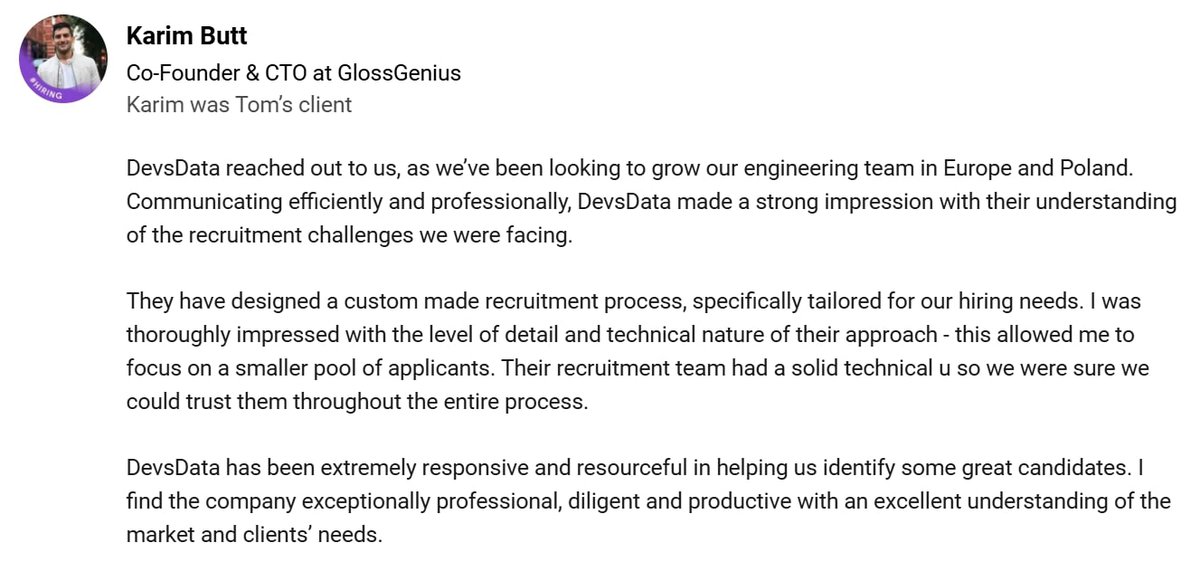
"DevsData reached out to us, as we've been looking to grow our engineering team in Europe and Poland. Communicating efficiently and professionally, DevsData made a strong impression with their understanding of the recruitment challenges we were facing. They designed a tailored recruitment process for our needs. I was impressed with the technical depth of their approach."

Karim Butt
Co-Founder & CTO at GlossGenius, Inc.
"Out of all the vendors we work with, DevsData clearly stands out. The quality of developers they deliver is beyond what we've received from any other vendor, and they've been able to send profile recommendations very quickly. I'm happy to be their reference for other companies from Israel and talk about their recruitment abilities and what they delivered for us."

Ran Eyal
Senior Manager at
ZIM Integrated
Shipping Services Ltd.
"DevsData demonstrated a strong degree of proactivity, taking time to thoroughly understand the problem and business perspective, and continuously suggesting performance and usability enhancements. Their app exceeded my expectations. I've worked with DevsData on numerous projects over the last 3 years and I'm very happy. Being both responsive and honest in communication."

Jonas Lee
Partner & Executive VP of Verus,
Financial LLC, Investor,
& Serial Entrepreneur
Acknowledgments