Thanks for subscribing.
Your gift is on the way.



Shopify has become a core platform for modern eCommerce, used by companies across retail, DTC brands, subscription businesses, and B2B commerce. As more businesses rely on Shopify to launch quickly, scale reliably, and manage growing operational complexity, the role of development has evolved beyond basic storefront setup. Today, Shopify Developers are expected to support complex business requirements, not just visual customization.
According to data from BuiltWith, Shopify powers over 6 million active online stores worldwide and is used by merchants in more than 175 countries. In 2025, Shopify merchants generated about $14.6 billion in global sales, placing the platform among the most influential players in global eCommerce, where Shopify holds a 26.2% market share and competes most directly with WooCommerce, which holds 20.1%.
This article explains what Shopify Developers do in practice, when companies need dedicated Shopify expertise, and how to evaluate candidates based on real production experience. It also covers common hiring models, Shopify Developer salary benchmarks for 2026, and the main challenges companies face when recruiting for these roles. In addition, the guide compares leading agencies and platforms for hiring Shopify Developers based on recruitment experience, candidate vetting processes, technical evaluation standards, placement success rates, and long-term client feedback.
As Shopify adoption has grown and stores have become more complex, hiring expectations have shifted accordingly. Based on DevsData LLC’s recruitment experience, Shopify Developers are no longer hired only for theme adjustments or short-term store setup tasks. Companies increasingly seek developers who can build custom storefronts, optimize performance and conversion flows, connect third-party systems, and support scalable commerce architectures as their business grows.
A Shopify Developer builds, customizes, and maintains eCommerce stores on the Shopify platform, with a focus on functionality, performance, and long-term scalability. Their work goes well beyond visual changes. In most production environments, they are responsible for shaping how a store behaves, integrates with other systems, and supports core sales processes such as checkout flows, subscriptions, promotions, and order fulfillment.
At the core of the role is theme and storefront development using Liquid, HTML, CSS, and JavaScript.
Shopify Developers create custom sections, templates, and reusable components that align with brand design while remaining flexible for ongoing updates. They also adapt themes to meet accessibility standards, mobile performance requirements, and SEO best practices.
Many Shopify Developers work on custom apps and integrations, connecting stores with payment providers, shipping services, inventory systems, CRMs, ERPs, analytics platforms, and marketing tools. This often involves working with Shopify’s REST and GraphQL APIs, webhooks, and third-party services to support automated workflows and data synchronization.
In more advanced setups, Shopify Developers support headless commerce architectures, where Shopify handles commerce logic while the frontend is built with frameworks such as React, Next.js, or Shopify Hydrogen. In these cases, developers manage API-driven storefronts, custom checkout logic, and performance optimization for high-traffic environments.
AI now shapes a growing share of Shopify development work. The platform has opened its commerce infrastructure to AI agents, so a shopping assistant is able to search a store’s catalog and build a cart on a customer’s behalf. Shopify Developers prepare stores for this channel by structuring product data and metafields in a form agents read accurately. Inside the admin, Sidekick and Shopify Magic assist merchants with routine tasks such as content generation and store analysis.
Across all project types, Shopify Developers collaborate closely with designers, product managers, marketers, and, at times, backend engineers to translate business goals, campaign requirements, and user feedback into stable, production-ready solutions. Their role is to transform business requirements into stable technical solutions while keeping the store fast, maintainable, and resilient during traffic spikes, promotions, and platform updates.
Typical responsibilities include:
Do you have software development needs?
Shopify Developers combine platform-specific knowledge with frontend development skills and practical eCommerce experience. Their effectiveness depends not only on technical ability but also on understanding how online stores operate under real traffic, sales cycles, and operational constraints.
When hiring Shopify Developers, it helps to look at their skills in relation to the responsibilities they enable. The areas below reflect what companies typically assess when building or scaling a Shopify-based store.
| Skill/knowledge area | What it means in practice |
|---|---|
| Shopify platform | Understanding Shopify core features, limitations, admin workflows, and extensibility options |
| Liquid templating | Building dynamic templates, sections, and reusable components that support content updates |
| Frontend development | HTML, CSS, and JavaScript for responsive, accessible, and conversion-focused UI |
| Shopify apps | Developing private or public apps to extend store functionality |
| APIs & webhooks | Integrating Shopify with payment systems, logistics, CRM, ERP, and marketing tools |
| Performance optimization | Improving load times, Core Web Vitals, and storefront responsiveness |
| Headless commerce | Working with Shopify Hydrogen or custom frontend frameworks when decoupling the UI |
| AI & agentic commerce | Preparing product data and storefront APIs so AI agents search catalogs and complete purchases |
| SEO & analytics | Implementing structured data, tracking, and search visibility improvements |
| Version control | Using Git-based workflows for safe deployment and collaboration |
| Maintenance & updates | Supporting platform changes, app updates, and long-term stability |
Strong Shopify Developers are able to balance clean frontend implementation with platform constraints and business requirements. They write maintainable code, document key decisions, and anticipate how store changes will affect performance, conversion, and operational workflows over time.
This skill set is especially important for companies running revenue-critical stores, where issues such as broken payment integrations, failed checkout scripts, inventory sync errors, or slow-loading pages can immediately affect sales, customer trust, and campaign performance.
Shopify Developers are hired by companies that rely on eCommerce as a primary or growing revenue channel. While Shopify is often associated with small online stores, most hiring demand comes from businesses operating at scale or planning to scale quickly.
Early-stage and growth-stage DTC brands hire Shopify Developers to build custom storefronts, implement brand-specific design systems, and support initiatives such as landing page testing, campaign launches, tracking setup, and checkout optimization. As these brands grow, developers also handle performance optimization, subscription logic, and integrations with fulfillment and analytics tools.
Mid-sized and enterprise retailers use Shopify Developers to manage complex product catalogs, multi-store setups, and international sales. These companies often require integrations with ERP systems, inventory management platforms, payment providers, and regional shipping services.
B2B companies increasingly adopt Shopify for online ordering portals, wholesale workflows, and custom pricing logic. In these cases, Shopify Developers adapt the platform to support account-based access, bulk ordering, and internal approval processes.
Agencies and marketing teams also hire Shopify Developers to support client stores, redesign projects, and conversion optimization initiatives. Developers in these environments work closely with designers and marketers to implement campaigns without disrupting live revenue flows.
Even teams with in-house frontend developers often bring in dedicated Shopify Developers to handle platform-specific logic, reduce risk during major updates, and prevent issues such as broken themes, app conflicts, or checkout errors after platform or plugin changes.
Evaluating Shopify Developers requires more than confirming familiarity with the platform. Strong candidates demonstrate practical experience working on live stores, understand how technical decisions affect revenue, and can operate within Shopify’s architectural constraints.
A structured evaluation process typically focuses on the areas below.
Review the stores the candidate has worked on in production. Pay attention to store scale, traffic levels, and the types of changes they owned. Experience with active revenue-generating stores is far more relevant than demo projects.
Assess how the candidate works with Liquid, theme structure, and frontend code. Well-organized templates, reusable sections, and clean JavaScript indicate long-term maintainability.
Discuss any custom apps or integrations the candidate has built. Look for experience with Shopify APIs, webhooks, and third-party services such as payments, shipping, analytics, or marketing tools.
Strong Shopify Developers understand the relationship between load time, user experience, and conversion. Ask how they approach speed optimization, mobile performance, and Core Web Vitals.
Shopify has clear technical boundaries. Evaluate how candidates work within those limits, handle edge cases, and choose trade-offs without breaking store stability.
Shopify Developers often work with designers, marketers, and product teams. Clear communication and the ability to translate business requirements into technical solutions are critical.
Ask how the candidate prepares a store for AI shopping agents. Useful answers cover product data structure and the way agent-driven carts interact with existing checkout logic. Hands-on work with Shopify’s MCP servers shows the candidate follows where the platform is heading.
Evaluation checklist:
| Evaluation area | What to assess |
|---|---|
| Production experience | Live stores, scale, and ownership of changes |
| Theme development | Liquid structure, frontend quality |
| Apps & integrations | APIs, webhooks, third-party tools |
| Performance | Speed, mobile behavior, UX impact |
| Problem solving | Handling platform constraints |
| Collaboration | Communication with non-technical teams |
| Code quality | Maintainability and documentation |
| AI readiness | Agent-facing data, MCP experience |
Hiring dedicated Shopify Developers provides clear advantages for companies that depend on eCommerce revenue. Their platform-specific experience reduces technical risk and supports steady store growth as business requirements evolve.
Experienced Shopify Developers know the platform’s constraints and best practices. This allows them to implement changes without disrupting live stores or the payment flows behind them. They test updates in a duplicate theme before publishing, so errors surface away from customers. Releases are scheduled around marketing campaigns, when an outage would cost the most revenue.
Developers who focus on Shopify know how to optimize themes and scripts to reduce load times and improve mobile performance. They audit installed apps, since each one adds code that slows page rendering. Image handling and lazy loading receive the same attention. Faster stores directly affect user experience and conversion rates.
Shopify Developers work closely with design and marketing teams to implement UX improvements and checkout optimizations. Small changes to product pages or cart behavior are measured against sales data before a wider rollout. Structured data added to templates supports SEO goals at the same time. The result is a store that is easier to use and converts a higher share of visitors.
As stores expand into new regions or add product lines, Shopify Developers help adapt the platform without full rebuilds. Multi-currency pricing and localized storefronts are configured through Shopify Markets instead of separate stores. Subscriptions and B2B features are introduced as extensions of the existing setup. Each addition is built on the same codebase, which keeps the store consistent as the business grows.
Well-structured themes and clean app integrations make ongoing updates easier, and documented code helps new team members pick up the work. Unused apps and leftover scripts are removed before they cause conflicts. This lowers long-term maintenance effort and reduces the risk of breaking changes during platform updates.
For companies running revenue-critical stores, these benefits often justify dedicated Shopify expertise rather than relying on general frontend resources or ad-hoc contractors.
While the demand for Shopify Developers is growing, finding skilled candidates can be challenging due to the platform’s specialized nature and the increasing complexity of modern eCommerce stores. Companies should be aware of several common hurdles:
Although Shopify is widely used, developers with deep experience in custom themes and complex integrations are less common. Many candidates have worked only with pre-built themes and app store installs. High-quality candidates are often in short supply, particularly outside major tech hubs in North America and Western Europe. Companies hiring for app development or headless builds face the narrowest selection.
Not all developers claiming Shopify expertise have worked on revenue-generating stores or handled high-traffic scenarios. Portfolios often show finished storefronts without clarifying which parts the candidate built. Assessing real-world projects means asking for specifics on custom functionality and performance work. Reference calls with previous clients help confirm ownership of those changes.
Shopify has specific architectural limitations, including API rate limits and app sandboxing. Liquid templating adds its own rules for how data reaches the storefront. Developers must balance creativity with these platform rules, which is difficult for candidates transitioning from general frontend or backend development. Workarounds that ignore the limits tend to break during platform updates.
Stores often need multiple third-party systems working together, from payment gateways and fulfillment services to marketing automation and analytics tools. Each connection introduces its own data format and failure points.
Mismanaged integrations lead to data errors or downtime. Developers need practical experience connecting Shopify reliably to external platforms, including monitoring that flags sync failures early.
High-demand Shopify Developers often move between projects. When a developer leaves, knowledge of custom code and integration logic leaves with them unless documentation exists. Companies need strategies to retain talent or rely on trusted agencies to maintain continuity. Handover procedures agreed at the start of an engagement reduce the impact of a departure.
Companies can engage Shopify Developers through several hiring models depending on project scope, timeline, and budget. Each model has distinct advantages:
Full-time Shopify Developers become part of your in-house or dedicated remote team. They take long-term ownership of the store, implement ongoing improvements, and support complex integrations. This model works best for businesses with continuous development needs, high traffic, or multiple stores.
Contract developers are ideal for short-term Shopify projects with a defined scope. Typical examples include migrating a store to an Online Store 2.0 theme or moving checkout customizations to Checkout Extensibility. Seasonal work fits this model too, such as preparing a storefront for Black Friday traffic. Companies gain specialized skills for the duration of the project without a permanent commitment.
Embedded developers work alongside existing teams, joining the same sprints as in-house design and marketing staff. A retailer building a Hydrogen storefront, for example, adds embedded Shopify Developers to handle the Storefront API layer while internal engineers own the backend systems. This approach suits projects that require deep technical support while maintaining internal control over workflows.
Outsourced Shopify Developers are provided by agencies for ongoing store management, custom development, or performance optimization. This model offers scalability, pre-vetted talent, and reduced recruitment overhead, making it suitable for businesses that want expertise without hiring directly.
Selecting the right hiring model depends on project complexity, business priorities, and whether the need is temporary or continuous. For example, large-scale merchants expanding internationally may benefit from full-time or embedded developers, while smaller brands experimenting with custom features may prefer contractors or agencies.
Salaries for Shopify Developers vary depending on experience, location, and the complexity of stores they manage. Developers with expertise in custom themes, app development, integrations, or headless commerce command higher rates due to the specialized nature of their work.
| Region | Mid-level salary (USD) | Senior salary (USD) | Freelance rate (USD/hr) |
|---|---|---|---|
| United States | 70000 – 95000 | 110000 – 140000 | 40 – 80 |
| United Kingdom | 50000 – 70000 | 85000 – 110000 | 35 – 65 |
| Germany | 45000 – 65000 | 80000 – 100000 | 30 – 60 |
| Eastern Europe | 30000 – 50000 | 55000 – 80000 | 20 – 45 |
| Latin America | 25000 – 40000 | 45000 – 65000 | 15 – 35 |
| India & SEA | 15000 – 30000 | 35000 – 50000 | 10 – 25 |
These benchmarks provide a guideline for companies planning to hire Shopify Developers, though rates should always be verified through local job market data and specialized platforms like Glassdoor, Levels.fyi, or Payscale.
Finding experienced Shopify Developers can be challenging due to the platform’s specialized nature. Partnering with trusted agencies or platforms helps reduce hiring risk and provides access to pre-vetted talent.
Here are our top picks:
Do you have software development needs?

Company size: ~60 employees
Founding year: 2016
Website: www.devsdata.com
Headquarters: Brooklyn, NY, and Warsaw, Poland
DevsData LLC takes the best overall position for the depth of its vetting and the low-risk terms offered to clients. With over ten years of experience in tech recruitment, the company connects organizations with Shopify Developers who match both technically and culturally. Placed candidates build custom storefronts and integrate third-party apps with marketing and operational workflows.
Speed and quality define the recruitment process. Holding a government-approved recruitment license, the company maintains a proprietary database of over 95000 pre-vetted professionals with a 6% acceptance rate. This selectivity narrows each search to Shopify Developers with expertise in Liquid, custom theme development, Shopify APIs, headless commerce, and app integrations.

Each candidate undergoes a 90-minute technical interview conducted by senior engineers and recruiters based in Europe and the US. These evaluations cover both technical problem-solving and collaboration skills, ensuring that candidates can handle live store challenges, integrate with cross-functional teams, and adapt to ongoing business needs.
DevsData LLC operates on a success-based pricing model with a guarantee period: clients pay only when a candidate is successfully hired. If a placement does not work out, the company provides a replacement or full refund at no extra cost.
DevsData LLC recruited three frontend engineers, including a Senior Shopify Developer, to enhance the company’s eCommerce platform. The recruitment emphasized timezone alignment with distributed teams, async collaboration, and strong communication, helping Talaera improve deployment speed and scalability.
DevsData LLC recruited 18 engineers and specialists for the company’s digital transformation. Several hires brought experience in building custom Shopify themes, app integrations, and high-traffic store optimization.
Do you have software development needs?
To learn how DevsData LLC can help you hire top-tier Shopify Developers or scale your eCommerce team, visit www.devsdata.com or reach out at general@devsdata.com.
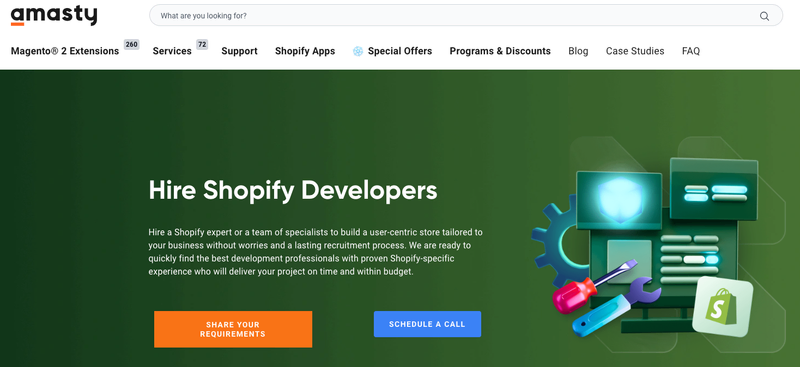
Website: https://amasty.com
Team size: ~70 employees
Founded: 2009
Headquarters: Nicosia, Cyprus
Amasty operates dedicated teams for multiple eCommerce platforms, including Shopify, alongside its long-standing work with Magento and Adobe Commerce. In addition to custom module development, the team often supports backend integrations, performance improvements, and platform extensions that require a deep understanding of PHP and related stack components. Clients working on complex storefronts or omni-channel eCommerce solutions use Amasty when they need engineers familiar with mature SaaS commerce ecosystems and extension development best practices.
Amasty’s contributions extend to security, scalability, and feature optimization for live commerce environments. Because their heritage is closely tied to eCommerce needs, they are a go-to resource for companies that must align backend functionality with evolving sales channels and conversion requirements.

Website: https://lemon.io
Team size: ~160 employees
Founded: 2015
Headquarters: New York, New York
Lemon.io connects companies with vetted freelance developers for full stack roles and for dedicated frontend or backend work. Matching is fast for a structural reason: developers pass vetting before any client request arrives, so each new search starts from an approved pool instead of an open job posting. Flexible freelance engagements shorten the process further, since contract terms are simpler to agree than permanent employment offers. Teams fill technical gaps without long recruitment cycles, and the same pool covers related roles, which makes Lemon.io practical when Shopify Developers are needed alongside integration or analytics specialists.
The platform’s vetting focuses on general readiness, meaning coding ability and work habits, instead of niche specializations. Collaboration readiness forms part of the same assessment. For businesses that prefer agile staffing with transparent pricing and quick ramp-up times, Lemon.io is often a practical choice.
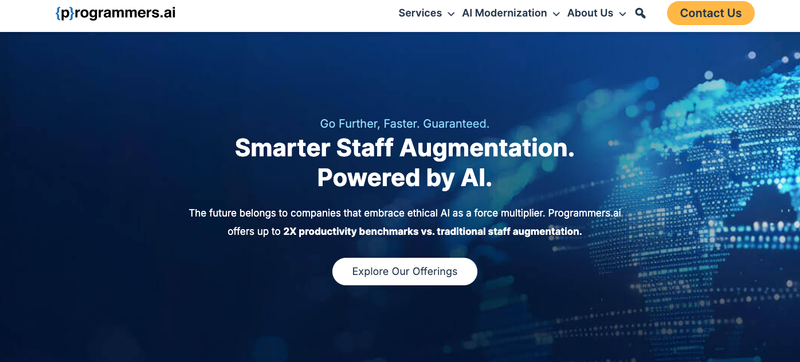
Website: https://programmers.ai
Team size: ~130 employees
Founded: 2024
Headquarters: Jaipur, India
Programmers.ai offers engineering resources with a focus on backend development, automation, and data-oriented solutions. While the platform serves a broad technology range, it frequently supports teams that need developers capable of handling API development, integration pipelines, backend-centric features, and system automation. Its model blends talent matching with technical project support, which can be valuable for medium and enterprise projects that demand structured delivery.
Programmers.ai emphasizes technical vetting and practical assignments during candidate evaluation, helping ensure developers can contribute effectively to backend tasks from day one.
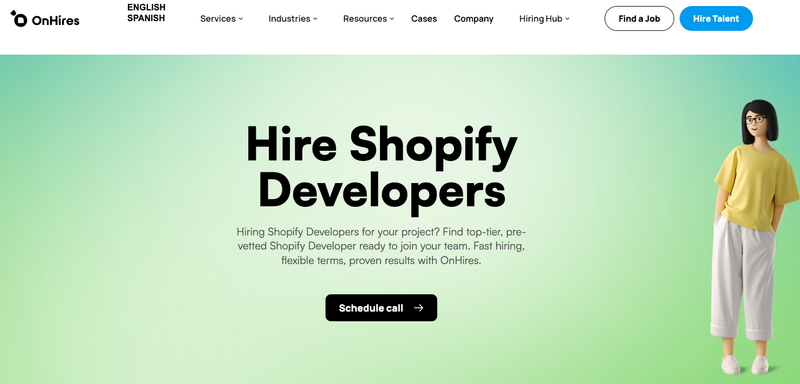
Website: https://onhires.com
Team size: ~40 employees
Founded: 2020
Headquarters: Sheridan, Wyoming
OnHires specializes in connecting companies with dedicated developers and engineering teams tailored to their technical roadmap. The platform supports a mix of backend, frontend, and full stack talent, but its strength is in building team-level capacity rather than only individual contributors. This makes OnHires suitable for businesses aiming to scale engineering output while maintaining cohesive coordination and delivery rhythm.
OnHires also supports onboarding, retention, and remote team management for Shopify-focused teams working on storefront development, app integrations, and ongoing platform optimization.
At Shopify’s current scale, even small technical issues can have immediate business impact. As stores grow, the need for custom themes, app integrations, headless commerce setups, and performance optimization goes beyond what general frontend or marketing teams can manage.
Shopify Developers bring expertise in Liquid, API integrations, performance tuning, and storefront architecture, enabling stable, high-converting, and scalable online stores. Whether a company chooses full-time, contract, embedded, or outsourced models, selecting the right candidate or agency reduces operational risk and supports sustained growth.
Partnering with experienced recruitment agencies such as DevsData LLC gives businesses access to pre-vetted, production-ready talent through structured evaluation, technical interviews, and success-based hiring models.
By understanding the skills, responsibilities, hiring models, and market benchmarks outlined in this guide, companies can make informed decisions when expanding their Shopify capabilities, minimizing downtime, and improving long-term store performance.
Discover how IT recruitment and staffing can address your talent needs. Explore trending regions
like Poland, Portugal, Mexico, Brazil and more.
 Frequently asked questions (FAQ)
DevsData – your premium technology partner
DevsData is a boutique tech recruitment and software agency. Develop your software project with veteran engineers or scale up an in-house tech team of developers with relevant industry experience.
Free consultation with a software expert
🎧 Schedule a meeting
FEATURED IN


DevsData LLC is truly exceptional – their backend developers are some of the best I’ve ever worked with.”

Nicholas Johnson
Mentor at YC, serial entrepreneur


 Build your project with our veteran developers.
Explore the benefits of technology recruitment and tailor-made software.
Learn how to source skilled and experienced software developers.

Rebecca Botvin

Commercial Director

Tom Potanski
Manager




Categories: Big data, data analytics | Software and technology | IT recruitment blog | IT in Poland | Content hub (blog)
















careers@devsdata.com





general@devsdata.com

"I interviewed about a dozen different firms. DevsData LLC is truly exceptional – their backend developers are some of the best I've ever worked with. I've worked with a lot of very well-qualified developers, locally in San Francisco, and remotely, so that is not a compliment I offer lightly. I appreciate their depth of knowledge and their ability to get things done quickly."

Nicholas Johnson
CEO of Orange Charger LLC,
Ex-Tesla Engineer,
Mentor at YCombinator
"DevsData reached out to us, as we've been looking to grow our engineering team in Europe and Poland. Communicating efficiently and professionally, DevsData made a strong impression with their understanding of the recruitment challenges we were facing. They designed a tailored recruitment process for our needs. I was impressed with the technical depth of their approach."

Karim Butt
Co-Founder & CTO at GlossGenius, Inc.
"Out of all the vendors we work with, DevsData clearly stands out. The quality of developers they deliver is beyond what we've received from any other vendor, and they've been able to send profile recommendations very quickly. I'm happy to be their reference for other companies from Israel and talk about their recruitment abilities and what they delivered for us."

Ran Eyal
Senior Manager at
ZIM Integrated
Shipping Services Ltd.
"DevsData demonstrated a strong degree of proactivity, taking time to thoroughly understand the problem and business perspective, and continuously suggesting performance and usability enhancements. Their app exceeded my expectations. I've worked with DevsData on numerous projects over the last 3 years and I'm very happy. Being both responsive and honest in communication."

Jonas Lee
Partner & Executive VP of Verus,
Financial LLC, Investor,
& Serial Entrepreneur
Acknowledgments