Thanks for subscribing.
Your gift is on the way.



Node.js has become one of the most influential technologies in modern web development. According to the 2024 Stack Overflow Developer Survey, Node.js was ranked as one of the most widely used web technologies by professional developers, with roughly 40.7% indicating usage in their development work, a sign of its widespread adoption in backend development.
Beyond developer preference, Node.js also powers a significant slice of the web itself. Over 6.3 million websites use Node.js in their technology stack, demonstrating scalability and performance across small projects through large enterprise systems.
Part of Node.js’s appeal lies in its event-driven, non-blocking I/O architecture that supports high concurrency and real-time capabilities, features that make it well-suited for APIs, streaming platforms, and microservice environments. Businesses increasingly adopt Node.js to build scalable backend systems that handle large volumes of simultaneous requests without sacrificing performance.
For companies looking to hire Senior Node.js Developers, the question rarely stops at runtime familiarity. Senior backend talent must combine architectural depth with security awareness, DevOps fluency, and the judgment to design systems that remain stable under growth. This article draws on DevsData LLC’s recruitment experience across the US, Europe, and Israel to outline what hiring senior Node.js talent looks like in practice.
Unlike traditional multi-threaded backends, Node.js uses an event-driven, non-blocking architecture that handles high volumes of concurrent requests efficiently.
While conventional stacks perform well under moderate workloads, Node.js excels in applications that must process thousands of simultaneous connections or operate within distributed systems.
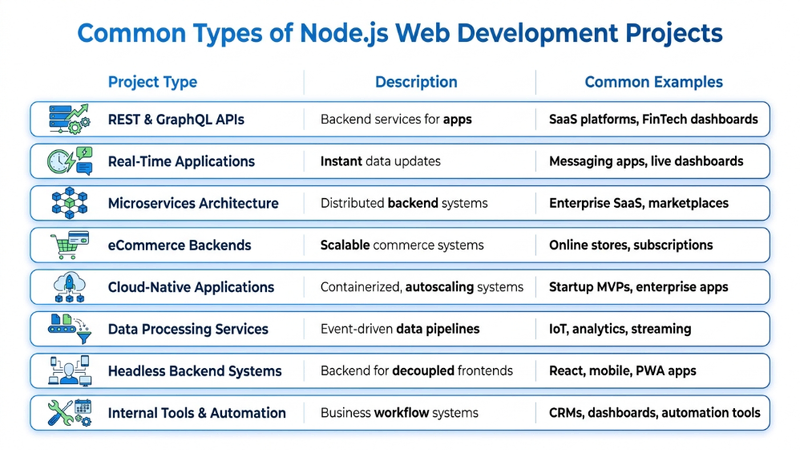
Node.js development typically focuses on building RESTful or GraphQL APIs, designing microservice architectures, managing authentication, and structuring databases for performance and reliability. Businesses use it to create backend layers that connect web and mobile frontends with databases, payment systems, CRMs, and other third-party services.
Real-time functionality is a common use case. Chat platforms, live dashboards, streaming services, and collaborative tools benefit from Node.js’s asynchronous model, which supports instant data exchange without blocking other operations.
Most projects follow a modular approach. Frameworks such as Express.js or NestJS provide structure, while custom code addresses specific business logic. Cloud deployment, containerization, CI/CD pipelines, monitoring, and horizontal scaling are often part of production-ready systems.
Security and maintainability are built into every layer. Authentication relies on OAuth 2.0 and OIDC flows, HTTP headers are hardened through Helmet and Content Security Policy configuration, and dependencies are pinned with automated auditing via npm audit and Snyk. Test coverage spans unit, integration, and end-to-end levels.
The visual below outlines the most common Node.js project categories and their typical real-world applications.
Senior Node.js Developers are sought after for reasons grounded in measurable engineering outcomes, not framework hype. The runtime offers structural advantages that translate into faster delivery cycles, lower infrastructure costs, and architectures that hold up as products scale.
Traditional thread-based backends allocate dedicated memory for each connection, which limits how many simultaneous users a single server supports. Node.js handles concurrent operations through a single-threaded event loop with asynchronous I/O, meaning thousands of connections share the same process without proportional memory overhead. Senior Engineers who understand this model design APIs that stay responsive during traffic spikes rather than requiring emergency infrastructure scaling.
Teams building with Node.js share a single language between client and server layers. Frontend Developers contribute to API logic when needed, Backend Engineers reason about data shapes the UI consumes, and onboarding new team members takes less time. This shared foundation reduces context switching and supports faster iteration cycles than polyglot architectures, where backend and frontend require separate skill sets.
Node.js services start quickly and consume modest resources, which makes splitting a system into many small services practical. Senior Developers use this property to design domain-bounded services that deploy independently, fail in isolation, and scale based on actual load patterns. The pattern works particularly well for products where different parts of the system grow at different rates, such as an authentication service handling steady traffic alongside a search service that spikes unpredictably.
WebSocket support and event-driven patterns are native to Node.js rather than retrofitted through external libraries. Engineers building chat platforms, collaborative editors, multiplayer games, or live dashboards rely on persistent connections that push updates instantly to connected clients. The same architecture handles transaction notifications in FinTech products and live status updates in logistics platforms.
Cloud platforms charge based on resource consumption, and Node.js applications generally require less memory than comparable systems built with thread-based runtimes. Serverless deployments start faster than functions built on heavier thread-based runtimes, keeping billable execution durations short in function-as-a-service environments.
Senior Developers experienced with AWS Lambda, Google Cloud Functions, or Azure Functions structure code to minimize cold-start overhead and avoid unnecessary dependencies that inflate package sizes.
The npm registry hosts millions of packages covering authentication, validation, queueing, caching, and most other backend concerns. Senior Engineers know how to evaluate package quality, audit transitive dependencies, and avoid the supply-chain risks that come with poorly maintained libraries. This judgment separates productive use of the ecosystem from accumulating technical debt through indiscriminate package installation.
Do you have IT recruitment needs?
Hiring Senior Node.js Developers calls for evaluation rooted in production experience rather than CV keywords. Many candidates list Node.js alongside other JavaScript technologies, though only a subset has architected systems that survived real traffic, integration complexity, and long maintenance cycles. The table below maps the structured approach DevsData LLC applies across backend recruitment engagements, with each stage tied to what it verifies.
Each row pairs a hiring stage with the signal it confirms about a candidate.
| Hiring stage | What it verifies |
|---|---|
| Define architectural scope before sourcing | Expected request volumes, real-time needs, integration depth, and database growth that set the seniority profile |
| Screen for asynchronous programming depth | Fluent reasoning about event loops, promise-chain error propagation, and memory management under concurrent load |
| Use practical assessments calibrated to seniority | Real engineering decisions such as designing an API gateway or diagnosing a memory leak, not generic algorithm puzzles |
| Validate production and DevOps experience | Hands-on work with containerization, CI/CD, observability, and incident response in past engagements |
| Test security-first thinking | Concrete handling of input validation, secrets, npm auditing, and authentication token lifecycles |
| Assess collaboration and communication | How candidates explain trade-offs, handle code-review disagreement, and translate requirements into engineering decisions |
| Confirm engagement model and long-term fit | Availability, code ownership expectations, documentation standards, and knowledge transfer practices |
Senior engineers tend to invest in maintainability, while contractors focused on short engagements often optimize for immediate output at the expense of system health.
Do you have IT recruitment needs?
Recruiting senior backend talent comes with obstacles that slow hiring, inflate costs, or introduce technical debt when overlooked. Each challenge below reflects patterns DevsData LLC has observed across recruitment engagements, along with the approach we apply to address it.
Node.js evolves quickly. TypeScript adoption has expanded across production codebases, NestJS and Fastify have replaced older Express-only patterns in many enterprise environments, and serverless deployments have shifted how teams architect backend services. Engineers who mastered Node.js five years ago without continued learning often lack current knowledge of these patterns.
We screen for evidence of active engagement with the ecosystem: contributions to open source projects, recent technical writing, conference talks, or production work with newer frameworks. Years of experience matter less than recent hands-on involvement with modern Node.js patterns, testing frameworks, and deployment practices.
Senior Node.js Developers who handle production incidents, mentor Junior Engineers, and reason architecturally remain in high demand across industries. Companies in finance, healthcare, retail, and technology compete for the same talent pool, which extends time-to-hire and inflates compensation expectations.
We prioritize signals of proven ownership, looking for shipped production systems, incident response history, and documented architectural decisions. Structured technical interviews separate theoretical knowledge from production readiness, while early engagement with passive candidates expands the pool beyond active job seekers.
Many candidates describe themselves as Full Stack Developers with Node.js experience, but their backend depth varies substantially. Some have built complete production systems with database optimization, caching strategies, observability, and incident response. Others have only created basic Express routes without exposure to deployment, monitoring, or performance profiling.
We align screening with target technical depth. For backend-focused senior roles, we validate that candidates reason confidently about query optimization, API rate limiting, caching layers, connection pooling, and production monitoring beyond surface-level route handling.
The event-driven model requires thinking that differs from synchronous programming backgrounds. Engineers who learned Node.js as a secondary skill sometimes struggle with promise chain error handling, race conditions, memory leaks in long-running processes, and event emitter patterns. Surface-level fluency with async/await syntax can mask gaps that surface during production incidents.
We evaluate candidates using real-world async scenarios that include error propagation in promise chains, race-condition prevention, memory-leak diagnosis, and event-emitter patterns. The goal is to confirm a deep understanding of how Node.js behaves under concurrent load.
Functional code is not the same as secure code. Many candidates write working backend logic without considering input validation, secrets management, dependency auditing, or token lifecycle security. These gaps surface in production through dependency vulnerabilities, injection attacks, and improper error exposure.
We assess security competence through scenario-based questions covering dependency auditing, environment variable management, rate limiting implementation, and secure API design patterns. Candidates who answer with concrete production decisions rather than generic best-practice phrases pass this stage.
Selecting a Node.js development partner shapes whether your backend becomes a scalable foundation or an operational bottleneck. Outside help tends to make sense once a system moves past predictable internal traffic toward high concurrency, deeper integrations, or stricter security exposure. Its long-term value then depends on architectural decisions and DevOps discipline that vary widely across vendors. The criteria below mark out what a capable partner looks like against teams focused on rapid feature delivery alone.
A capable partner demonstrates fluency in asynchronous programming, event loops, concurrency models, and memory management, not just familiarity with Express.js or NestJS. Conversations should explore how they structure modular applications, separate domain logic from transport layers, handle state in distributed environments, and weigh trade-offs between monoliths and microservices, REST and GraphQL, or different scaling strategies. Teams that think architecturally design systems that remain stable as user traffic and feature complexity grow.
Strong Node.js implementations begin long before coding starts. Examine how the partner approaches requirements analysis, system modeling, API contract definition, and performance forecasting. Do they assess expected request volumes, real-time requirements, database growth, and integration dependencies? During delivery, do they enforce sprint planning, code reviews, automated testing, CI/CD pipelines, and observability tooling? Disciplined process reduces technical debt and supports backend evolution without disruptive rewrites.
Case studies should reflect similar scalability or integration challenges, not just similar industries. Look for projects involving high-concurrency APIs, cloud-native deployments, containerized services, event-driven architectures, or large-scale data processing.
Teams that have repeatedly solved performance bottlenecks and stabilized production workloads develop judgment that surface-level Node.js familiarity cannot replicate.
Production-ready Node.js development extends beyond writing backend code. Containerization, orchestration, load balancing, monitoring, logging, and automated deployment all factor into reliable delivery. Ask how the partner handles horizontal scaling, rollback strategies, environment isolation, and runtime observability. Strong DevOps capabilities reduce downtime risk and support predictable performance under real-world conditions.
Node.js ecosystems shift quickly, so sustainable systems require disciplined dependency management, security audits, structured code reviews, documentation standards, and clear ownership boundaries. Ask how the partner prevents dependency bloat, manages version updates, and enforces coding standards. Clean architecture and well-defined interfaces protect long-term flexibility and reduce the total cost of ownership.

Website: www.devsdata.com
Team size: ~60 employees
Founded in: 2016
Headquarters: Brooklyn, NY, and Warsaw, Poland
At DevsData LLC, we have helped companies across the US, Europe, and Israel hire Senior Node.js Developers and build scalable backend systems for FinTech, healthcare, eCommerce, AI/ML, and enterprise SaaS environments. Our recruitment and vetting process is tailored specifically to Node.js-based development, evaluating asynchronous architecture, API design, microservices patterns, performance optimization, security practices, and long-term maintainability. We maintain a proprietary database of 95000+ vetted IT professionals worldwide, giving us access to experienced Node.js Developers beyond the general JavaScript talent pool.

Across 80+ satisfied clients and more than 100 successfully delivered technical engagements, we have helped organizations avoid common backend pitfalls, including poorly managed asynchronous flows, memory leaks, fragile integrations, performance regressions, and security oversights in Node.js applications. With consistent 5.0 ratings on Clutch and GoodFirms, our focus remains on predictable delivery paired with disciplined engineering and backend teams that support long-term product stability rather than short-term output.

Cense AG, a Swiss Web3-focused company, required Senior Node.js Engineers with blockchain expertise to support its automated compliance and due diligence platform. The challenge combined traditional backend architecture with Solana smart contract integration in a security-sensitive environment, while the role scope evolved during the search, and the interview funnel spanned more than five stages per candidate. DevsData LLC assembled Node.js Engineers experienced in event-driven systems and secure backend design, sourcing over 120 candidates and delivering the first curated shortlist within six business days. Four Senior Backend Engineers were placed within four weeks, each with hands-on Solana experience and strong cultural alignment.
Key learning: in blockchain and compliance-focused platforms, Senior Node.js Developers must balance real-time event processing with strict security controls, architectural clarity, and the patience to navigate multi-stage interview funnels without losing engagement.

SZIC.pl, an automotive marketplace platform, engaged DevsData LLC to build and optimize a scalable Node.js backend capable of handling dynamic vehicle listings, search filtering, and real-time inventory updates. The challenge was maintaining performance under growing traffic volumes while preserving data consistency across multiple integrations. We implemented a Node.js architecture supported by PostgreSQL, optimized API response times, and structured asynchronous workflows for inventory synchronization. Performance tuning and database query optimization reduced bottlenecks and improved system responsiveness during peak usage periods.
Key learning: at SZIC.pl, moving inventory synchronization out of the request path and into asynchronous background jobs produced the largest performance gains. Decoupling the workflows held response times steady as listing volumes and integration traffic grew.

Bright Carbon Ltd., a marketing technology company, required experienced Node.js Engineers to support backend infrastructure development and integration with Microsoft Azure services. The primary challenge was scaling backend systems to support complex enterprise integrations while preserving reliability and clean architectural structure. DevsData LLC recruited Senior Node.js Developers with expertise spanning API design, authentication flows, and cloud integration. The reworked backend reduced deployment failures and held up under heavier enterprise integration loads.
Key learning: in integration-heavy environments, Node.js scalability depends as much on architectural discipline and senior engineering oversight as on the runtime itself.
Do you have IT recruitment needs?
Hiring Senior Node.js Developers succeeds when sourcing depth, architectural vetting, and disciplined evaluation align with the actual technical complexity of the system being built.
Hiring Senior Node.js Developers gives companies the backend expertise to handle heavy concurrency without failures and to design for future traffic peaks. As products grow in complexity and traffic, experienced Node.js specialists support clean asynchronous architecture, predictable performance, and long-term stability, provided hiring is grounded in structured evaluation rather than surface-level framework familiarity.
As security expectations rise and real-time features grow more common, leaning on generalist or ad-hoc backend resources often introduces unnecessary risk. Success requires a systematic approach that combines Node.js-specific technical vetting, architectural oversight, and disciplined engineering standards. With this foundation, a Node.js development partner moves beyond short-term delivery, reducing technical debt while supporting sustainable product growth.
At DevsData LLC, we help organizations worldwide strengthen their backend teams through structured assessments, architecture-focused evaluations, and access to a vetted global network of 95000+ IT professionals. With 100+ successful projects and a decade of delivering complex engineering engagements across the US, Europe, Israel, and beyond, we bring the rigor and communication standards required to build and maintain high-performing Node.js-based systems with long-term reliability. Learn more at www.devsdata.com or contact general@devsdata.com.
Discover how IT recruitment and staffing can address your talent needs. Explore trending regions
like Poland, Portugal, Mexico, Brazil and more.
 Frequently asked questions (FAQ)
DevsData – your premium technology partner
DevsData is a boutique tech recruitment and software agency. Develop your software project with veteran engineers or scale up an in-house tech team of developers with relevant industry experience.
Free consultation with a software expert
🎧 Schedule a meeting
FEATURED IN


DevsData LLC is truly exceptional – their backend developers are some of the best I’ve ever worked with.”

Nicholas Johnson
Mentor at YC, serial entrepreneur


 Build your project with our veteran developers.
Explore the benefits of technology recruitment and tailor-made software.
Learn how to source skilled and experienced software developers.
Build your project with our veteran developers.
Explore the benefits of technology recruitment and tailor-made software.
Learn how to source skilled and experienced software developers.

Rebecca Botvin

Commercial Director

Tom Potanski
Manager




Categories: Big data, data analytics | Software and technology | IT recruitment blog | IT in Poland | Content hub (blog)
















careers@devsdata.com









general@devsdata.com

"I interviewed about a dozen different firms. DevsData LLC is truly exceptional – their backend developers are some of the best I've ever worked with. I've worked with a lot of very well-qualified developers, locally in San Francisco, and remotely, so that is not a compliment I offer lightly. I appreciate their depth of knowledge and their ability to get things done quickly."

Nicholas Johnson
CEO of Orange Charger LLC,
Ex-Tesla Engineer,
Mentor at YCombinator
"DevsData reached out to us, as we've been looking to grow our engineering team in Europe and Poland. Communicating efficiently and professionally, DevsData made a strong impression with their understanding of the recruitment challenges we were facing. They designed a tailored recruitment process for our needs. I was impressed with the technical depth of their approach."

Karim Butt
Co-Founder & CTO at GlossGenius, Inc.
"Out of all the vendors we work with, DevsData clearly stands out. The quality of developers they deliver is beyond what we've received from any other vendor, and they've been able to send profile recommendations very quickly. I'm happy to be their reference for other companies from Israel and talk about their recruitment abilities and what they delivered for us."

Ran Eyal
Senior Manager at
ZIM Integrated
Shipping Services Ltd.
"DevsData demonstrated a strong degree of proactivity, taking time to thoroughly understand the problem and business perspective, and continuously suggesting performance and usability enhancements. Their app exceeded my expectations. I've worked with DevsData on numerous projects over the last 3 years and I'm very happy. Being both responsive and honest in communication."

Jonas Lee
Partner & Executive VP of Verus,
Financial LLC, Investor,
& Serial Entrepreneur
Acknowledgments