Thanks for subscribing.
Your gift is on the way.



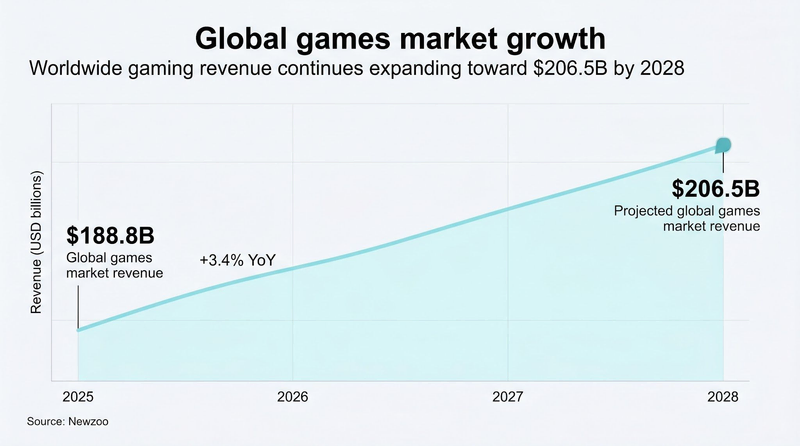
Global gaming revenue reached USD 188.8 billion in 2025, and is projected to grow toward USD 206.5 billion by 2028, with a 3.4% year-over-year increase. However, that growth is not evenly distributed. Console revenue is expanding at 5.5% year-over-year, faster than both PC and mobile, which tells studio leaders something useful before a single role is posted: the technical center of gravity is moving back toward high-fidelity, performance-intensive production.
The player base sits underneath that revenue and explains why the demand persists. Across 2025, the global audience reaches 3.578 billion people, roughly 61.5% of the world’s online population, split across mobile, PC, and console in very different proportions. A studio building for 2.985 billion mobile players faces an entirely different engineering problem than one building for 645 million console players, and that divergence is the first reason gaming hiring resists generic software recruitment.
The complexity has compounded as well. A modern title is rarely a single discipline. It combines real-time rendering, physics, gameplay logic, networked state synchronization, platform-specific optimization, and increasingly a live-service operational layer that keeps the product running for years after launch. Each of those layers maps to a distinct engineering specialization, and most of them cannot be substituted for one another. A gifted gameplay programmer does not automatically become a competent graphics engineer, and a backend developer from a FinTech background rarely arrives understanding authoritative server models or lag compensation.
That specialization is what makes gaming recruitment genuinely difficult. The pool looks large in aggregate, yet narrows sharply once a studio needs proven seniority in a specific engine, on a specific platform, against a specific performance budget. Hiring teams that treat all Game Developers as interchangeable tend to discover the gap late, usually after a mis-hire has already cost a milestone.
This article works through that problem in order. It explains what gaming developers actually build, separates the major specializations and what they command in compensation, reviews the market forces shaping demand, and then turns to the practical mechanics of hiring: where studios get stuck, how to evaluate a recruitment partner, and when an outsourced model outperforms an in-house build.
Game development requires coordination of several engineering disciplines that each solve a different real-time problem, and understanding what they do is the precondition for hiring them well. The unifying constraint is the frame budget. A game running at 60 frames per second has roughly 16 milliseconds to simulate the world, resolve player input, synchronize networked state, and render a coherent image, every frame, without interruption. That single constraint shapes how every specialization below approaches its work, and it is why game engineering diverges so far from conventional application development.
Each discipline above owns a separate layer of the same runtime, which is what determines how a studio divides its engineering team. The roles are interdependent but not interchangeable, and the cost of a weak link is visible immediately because it manifests as a dropped frame, a desynchronized match, or a crash on one platform but not another. When a studio sets out to hire, it is rarely looking for a general Game Developer. It is looking for a specific competency that closes a specific gap in this stack, evaluated against the performance constraints the product has already committed to. That framing is what the rest of this article builds on.
Game development became specialized as the technical demands of each layer outgrew what any single engineer could master. Rendering a physically based lighting model, architecting an authoritative multiplayer server, and optimizing a build for a handheld are no longer variations on one skill set. They are separate engineering tracks with their own tooling, their own performance vocabulary, and their own talent pools. The table below maps the major specializations a studio hires against, drawing every salary figure from Glassdoor, so the compensation comparison rests on a single consistent source. Figures are United States national averages unless a sample is small enough to warrant caution, which the interpretation addresses afterward.
| Developer type | Main engines/tools | Primary platforms | Technical focus | Typical projects | Average salary |
|---|---|---|---|---|---|
| Gameplay developers | Unity (C#), Unreal (C++/Blueprints) | PC, console, mobile | Combat, AI, physics, input, mission logic | Feature-driven titles across genres | USD 87177 |
| Graphics programmers | HLSL/GLSL, DirectX 12, Vulkan, Metal | PC, console, high-end mobile | Shaders, rendering pipelines, lighting, GPU profiling | Visually intensive AAA and showcase titles | USD 101321 |
| Engine developers | C++, proprietary engines, Unreal source | PC, console, mobile | Memory, threading, asset pipeline, tooling | Engine and platform foundation work | USD 101097 |
| Unity developers | Unity (C#), URP/HDRP, DOTS | PC, mobile, XR | C# scripting, asset workflow, runtime tuning | Mobile, indie, and cross-platform titles | USD 79960 |
| Unreal Engine developers | Unreal 5.x, C++, Blueprints, Nanite, Lumen | PC, console, XR | C++ extension, gameplay frameworks, rendering | High-fidelity AAA and console titles | USD 111894 |
| Multiplayer/network engineers | C++, dedicated servers, replication frameworks | PC, console, mobile | Authoritative servers, lag compensation, anti-cheat | Competitive and live-service multiplayer | USD 109212 |
| Mobile game developers | Unity, Unreal Mobile, Swift/Metal, Kotlin | iOS, Android | Device fragmentation, memory budgets, SDK integration | Free-to-play and mobile-first titles | USD 112921 |
| AR/VR developers | Unity XR Toolkit, Unreal VR, OpenXR, Meta SDK | Quest, PS VR2, visionOS, SteamVR | Stereoscopic rendering, motion-to-photon latency | Immersive and spatial-computing titles | USD 113682 |
Note: All salary figures above are United States national averages reported by Glassdoor.
The spread across these rows is not random, and reading why the numbers fall where they do is more useful than the numbers themselves. Three forces explain most of the variation: how close the work sits to the hardware, how scarce the proven talent is, and how directly the role gates a product’s technical ambition.
Engine specialization is the clearest driver. Unity and Unreal each serve as the primary engine for 32% of developers, an even split that masks a sharp difference in what each pool commands. Unreal developers average USD 111894 against USD 79960 for Unity developers, a gap that reflects where each engine concentrates. Unreal anchors high-fidelity console and PC production where C++ fluency and rendering knowledge are expected, while Unity dominates mobile and cross-platform work where the entry bar sits lower, and the supply is deeper. The engines are not interchangeable on a resume, so a studio standardizing on one cannot freely recruit from the other’s pool.
Ecosystem differences widen the gap further. Mobile engineers contend with device fragmentation and tight memory budgets, yet the discipline draws from a large global pool, which keeps averages moderate despite real difficulty. Console and PC work, by contrast, reward proximity to the hardware. Graphics programmers average USD 101321 precisely because shader authoring and GPU profiling are unforgiving, and the talent is thin. The same logic explains why multiplayer and network engineers are among the hardest hires in the market. Authoritative server design and lag compensation are specialized, the consequences of getting them wrong are visible to every player at once, and the proven pool is small. Real-time performance requirements sit underneath all of it. When a role directly determines whether a build holds its frame budget, studios pay to remove the risk, and that premium is what the senior end of this market reflects.
The third force works differently from the other two. Hardware proximity and scarcity both describe the supply side, while technical ambition describes what a studio has already promised its own product. A title that commits to a rendering standard or to a concurrent player count has fixed its engineering requirements before the first sprint, and a small number of roles carry the weight of meeting them. An Engine Developer or a Graphics Programmer who cannot hold that target does not simply slow a feature down. That gap forces the target itself to move. Studios price those roles against the cost of that outcome rather than against a general salary band, which is why the upper rows of the table cluster around the competencies that decide what a product is allowed to attempt.
Do you have IT recruitment needs?
The hiring market for gaming developers is shaped less by headcount growth than by where production is concentrating and how technically demanding that production has become. The subsections below isolate the trends that matter most to a staffing plan, and each one carries a different implication for which specializations a studio should prioritize and how hard those roles will be to fill.
The revenue picture sets the frame for everything else. Global games revenue is moving toward USD 188.8 billion in 2025 and onward to USD 206.5 billion by 2028, but the more instructive figure for a hiring plan is the segment mix. Console is the fastest-growing segment at 5.5 percent year-over-year, ahead of PC and mobile, which signals renewed investment in the high-fidelity production where engine and graphics specialists matter most. A studio reading that trend would weight its near-term hiring toward the performance-intensive roles that high-fidelity production depends on, rather than assuming demand is spread evenly across disciplines.
Underneath the revenue is a concentration of production around real-time engines. Unity and Unreal each serve as the primary engine for roughly a third of projects, with proprietary engines accounting for a further share, so the market rewards engineers who can work inside a real-time runtime and extend it. The Steam ecosystem shows how steep the competitive bar has become. Valve reported that 5863 titles earned more than USD 100000 on Steam in 2025, up from roughly 3000 in 2020. Against more than 20000 titles released on Steam in 2025, that is a minority of releases clearing even a modest commercial threshold, which raises the premium on engineering quality from the first line of code and on the engine specialists who safeguard it.
Live-service production is the structural force most likely to reshape a studio’s hiring, and it is concentrated at the top of the market. Sixteen percent of all developers are currently building live-service games, but among AAA developers that figure rises to 33%. Live-service is an operational commitment as much as a technical one. It requires engineers who can sustain a product for years, instrument it for engagement, and keep its backend stable under load, which is why studios moving into the model find themselves competing for the same scarce multiplayer and backend talent rather than for generalists.
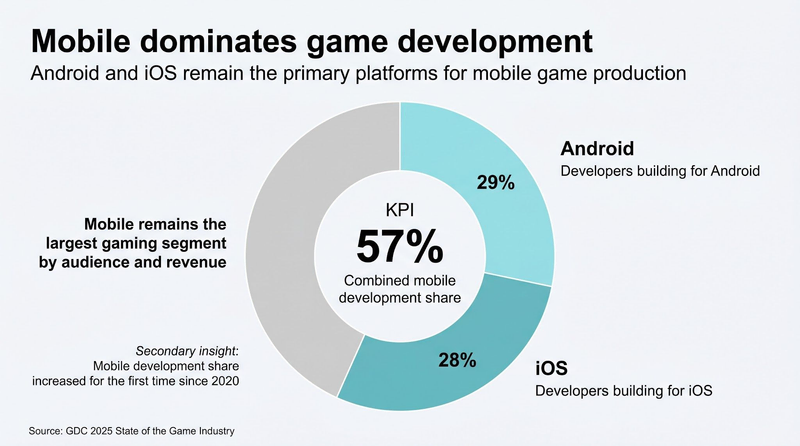
Mobile remains the largest segment by audience and revenue, and its development share rose for the first time since 2020, with 29% of developers building for Android and 28% for iOS. The operational implication is scale rather than fidelity. Mobile teams optimize against fragmentation and battery and thermal limits across thousands of device configurations, a discipline distinct from the frame-budget work that defines console production, and one that draws from a deeper global talent pool. A studio expanding into mobile is solving a different engineering problem and recruiting from a different supply than one staffing a console title.
Spatial computing is the most volatile part of the market and the easiest to misread when hiring. IDC reported that the XR market expanded 44.4% in 2025, which sounds like a clear signal to staff up on VR talent. The composition tells a more careful story. The growth is led by display-less smart glasses rather than the headsets that gaming targets, and the gaming-relevant headset segment is contracting even as the overall category grows. A studio hiring AR and VR developers should weight OpenXR and current spatial platforms over legacy headset experience, because the demand inside gaming is narrower than the headline suggests.
AI tooling is changing parts of the development stack faster than the org chart around it. Procedural generation and AI-assisted animation are absorbing work that once filled junior content pipelines: 54% of engineering leaders expect hiring of junior engineers to decrease, while AI coding assistants speed routine implementation without touching the hard problems of real-time performance or netcode. The hiring implication is a shift in what studios screen for. Demand is moving toward engineers who can direct and integrate these tools rather than perform the tasks the tools now cover, which raises the premium on senior judgment and lowers it on routine production headcount.
Eighty percent of developers now work on PC titles, the highest share recorded in over a decade, which makes distributed PC and cross-platform work more viable than ever. For studios willing to hire across borders, that distribution is a route to proven engine and systems talent outside the most expensive domestic markets, provided the recruitment process can evaluate specialization rigorously at a distance.
The hardest part of staffing a modern game is finding engineers who can hold a real-time system inside its performance budget while it scales to millions of concurrent players, because that competence is specialized, scarce, and visible to every player the moment it fails.
The difficulty in gaming recruitment is rarely a shortage of candidates in the abstract. It is the mismatch between what a resume claims and what a specialized role actually requires, evaluated under performance constraints that generic screening never surfaces. The challenges below recur across studio sizes and genres, and each one is a place where a hire that looked correct on paper turns out to be wrong once production pressure arrives. Understanding them is what separates a recruitment process that closes roles from one that simply fills seats. Each challenge below is paired with the way DevsData LLC handles it. DevsData LLC is a technology recruitment firm operating from Brooklyn and Warsaw, and its practice centers on specialized engineering searches where the competency matters more than the job title.
A Game Developer’s portfolio is harder to read than it looks. A shipped-title credit signals participation, not contribution, and certainly not commercial competence. The Steam data makes the point bluntly, since only a small minority of the titles released in a year clear even a modest commercial threshold. A candidate who lists three shipped games may have worked on three that never found an audience, or may have owned a peripheral system on a successful one. The signal a hiring team needs is technical, not promotional. It lives in code samples, in the specific systems the candidate architected, in profiler captures that show they understand performance, and in their ability to explain why a particular approach held its frame budget. Without that depth of inspection, portfolio review rewards the developers who present well rather than the ones who build well, and the gap only becomes visible after the hire is embedded in a milestone.
DevsData LLC screens for contribution rather than credits. Its technical evaluation includes a 90-minute problem-solving challenge that surfaces how a candidate reasons about real engineering problems, not how they narrate past projects. That process separates developers who owned meaningful systems from those who were merely present for a launch, which is exactly the distinction portfolio review alone cannot make.
The even 32 percent split between Unity and Unreal hides a recruitment trap. The two engines are not interchangeable on a resume, and a studio standardizing on one cannot freely recruit from the other’s pool. Unreal production expects C++ fluency and rendering knowledge. The gap is not seniority alone. It reflects where each engine concentrates: Unreal in high-fidelity console and PC work, Unity in mobile and cross-platform titles. A studio that has committed to Unreal 5 and its Nanite and Lumen systems needs engineers who have shipped against those systems under load, and that pool is materially smaller than the count of people who list Unreal on a profile. Hiring teams that underestimate this difference tend to extend timelines mid-search or compromise on the depth of engine experience, both of which carry a production cost.
DevsData LLC validates engine expertise against the specific systems a role depends on, rather than the engine name on a resume. With more than 95000 candidates in its database, it can filter for proven Unreal or Unity production experience at the seniority a studio actually requires, then confirm that depth through structured technical screening before a candidate reaches the client’s pipeline.
Multiplayer and network engineering are consistently among the hardest competencies to hire, and the reasons are structural. Authoritative server design, lag compensation, anti-cheat, and matchmaking are specialized subjects that few engineers have implemented at scale, and the consequences of getting them wrong are not subtle. A flawed netcode decision is visible to every player in a match simultaneously, which makes the cost of a mis-hire unusually public. The talent pool reflects the difficulty. Studios moving into competitive multiplayer or live-service often discover that the same narrow group of engineers is being pursued by every other studio with the same ambition, which extends search cycles well beyond what they budgeted for generalist roles.
DevsData LLC treats network and multiplayer roles as the specialized searches they are. Rather than screening for general backend experience, it sources engineers with demonstrable authoritative-server and live-service track records and verifies that experience through targeted technical assessment, shortening a search that studios routinely underestimate.
Performance engineering is the competency that most directly gates a product’s ambition, and it is the hardest to fake. Holding a build inside a 16-millisecond frame budget while it ships across PC, console, and increasingly handheld hardware requires engineers fluent in low-level graphics APIs and disciplined about profiling. The market reflects that scarcity. Cross-platform scalability compounds the problem. A feature that runs comfortably on console may exceed the thermal and memory limits of a handheld, so the same system often needs platform-specific implementations and an engineer who understands each target’s constraints. Studios that hire for one platform and assume the skills transfer to others tend to find the gap during certification, which is the most expensive possible moment to discover it.
DevsData LLC screens performance-critical roles against the platforms and budgets a project actually targets. Its technical process probes how candidates profile, optimize, and reason about hardware constraints, so studios can confirm cross-platform competence before a hire rather than during a certification crunch.
Taken together, these challenges share a root cause. Gaming roles are specialized in ways that generic recruitment cannot see, and the cost of misjudging a specialization surfaces late, inside a milestone or a certification window, where it is most disruptive to fix. A recruitment process built for general software hiring will reliably mistake presence for contribution and engine familiarity for engine depth. Across every one of these challenges, the DevsData LLC answer is one instrument applied to different competencies, a structured technical evaluation that measures what a candidate built rather than what shipped around them, supported by a database of over 95000 candidates deep enough to make specialization searchable in the first place. Closing gaming roles well requires screening matched to the specific competency and the performance budget the role protects, which is the discipline the following sections turn into a selection framework.
Specialization is the whole game in technical recruitment. A studio does not need a developer who has touched everything. It needs the one engineer whose proven depth in a single demanding system closes the exact gap the product cannot ship without, and finding that person is an engineering evaluation, not a keyword match.
Do you have IT recruitment needs?
A recruitment partner for gaming roles has to do something most technical recruiters cannot: Evaluate specialized engineering competence against real performance constraints, not just match titles to job descriptions. Technical judgment is where most agencies fail first, though it is not the only thing a studio is buying. How a partner charges and how it runs a search determine whether that judgment ever reaches a shortlist, as does the sourcing infrastructure sitting behind it. The six steps below are the questions a studio should put to any agency before trusting it with a search.
The first test is whether the partner can read a portfolio the way an engineer would. Shipped-title credits and engine names on a resume are weak signals, since participation is not contribution, and only a minority of released titles ever clear a meaningful commercial threshold. A capable partner inspects code samples, identifies which systems a candidate actually architected, and asks for evidence of performance discipline rather than accepting a list of credits. If an agency cannot explain how it distinguishes a developer who owned a system from one who was merely present at launch, it is screening for presentation rather than capability.
Because Unity and Unreal are not interchangeable and each anchors a different production world, a partner must validate engine depth against the specific systems a role depends on. Listing Unreal on a profile is not the same as having shipped against Nanite, Lumen, or its replication framework under load. The right partner confirms that a candidate’s engine experience matches the seniority and the subsystems the studio actually needs, and can articulate the difference between surface familiarity and production depth. An agency that treats engine experience as a binary checkbox will reliably surface candidates who interview well and underperform once the work begins.
Network and multiplayer roles are the searches most often mishandled, so a partner’s approach here is revealing. Authoritative server design, lag compensation, and anti-cheat are specialized competencies that few engineers have implemented at scale, and the premium the market pays for them reflects genuine scarcity. A reliable partner sources for demonstrable live-service and authoritative-server track records and verifies them through targeted assessment, rather than equating general backend experience with multiplayer competence. If an agency cannot distinguish a developer who has built netcode from one who has merely worked near it, it is not equipped for the hardest gaming searches.
With PC now the dominant development target and console close behind, a partner must understand how platform constraints shape a role. Building for Windows, PlayStation, Xbox, mobile, and handheld hardware each carries distinct certification requirements, input models, and performance ceilings, and competence on one does not transfer automatically to another. A capable partner screens for the specific platforms a project ships to and confirms that a candidate has worked within those constraints, rather than assuming platform skills are fungible. This matters most for studios shipping cross-platform, where a gap surfaces during certification at the worst possible time.
The penultimate test is whether a partner can evaluate the performance engineering that gates a product’s ambition. Holding a frame budget across platforms while scaling to large concurrent audiences is a discipline that lives in profiling, optimization, and low-level fluency, and it is the competency hardest to assess from a resume. A reliable partner probes how candidates reason about hardware constraints and performance trade-offs through a structured technical evaluation, so a studio can confirm depth before hiring. An agency that cannot test for this is, in effect, asking the studio to discover it in production.
The final test is commercial rather than technical. A success-fee arrangement leaves the risk of an unsuccessful search with the partner, and a guarantee period extends that alignment past the start date, while retained and hourly models ask the studio to fund activity regardless of outcome. Process discipline carries similar weight. A partner should be able to describe how a search is managed week to week and who owns communication with the hiring manager. Its sourcing infrastructure deserves the same scrutiny, since a candidate database that cannot be filtered by engine subsystem or target platform will not produce specialized shortlists at any useful speed. An agency that answers the technical questions well but cannot answer these is offering assessment without delivery.
The table below condenses these steps into the specific questions a studio should ask any prospective recruitment partner, so the evaluation stays grounded in capability rather than reputation.
| Evaluation step | Questions to ask the agency |
|---|---|
| Technical portfolio evaluation | ● How do you distinguish a candidate who architected a system from one who was present at launch? ● Do you inspect code samples and evidence of performance discipline? |
| Engine expertise validation | ● How do you confirm that Unreal or Unity experience matches the specific subsystems and seniority we need, rather than surface familiarity? |
| Multiplayer experience verification | ● How do you verify authoritative-server, lag-compensation, and anti-cheat experience, and how do you avoid equating general backend work with netcode competence? |
| Platform specialization assessment | ● How do you screen for the specific platforms we ship to, and how do you confirm a candidate has worked within their certification and performance constraints? |
| Scalability and performance expertise | ● How does your technical evaluation test profiling, optimization, and reasoning about hardware constraints before a candidate reaches our pipeline? |
| Engagement model and search process | ● How do you charge, and what covers us if a placement does not work out? ● How is the search managed week to week, and who owns contact with our hiring manager? |
The same six tests define how DevsData LLC approaches a gaming search, screening each candidate against the specialization and the performance budget a role actually protects. The next section explains how that works in practice.
Everything above concerns how a role is evaluated. What remains is where the person filling it sits. A studio that has identified the exact specialization it needs still has to decide between carrying that competency as permanent headcount and engaging it for the period the project requires, and the decision reshapes the search itself, because the two routes draw on different pools and move at very different speeds.
The choice between building an in-house gaming team and engaging an outsourced one is not a binary preference. It is a trade-off that shifts depending on a studio’s stage, its production timeline, and which specializations it needs and for how long. The distinctions below matter most where gaming diverges from general software, namely in how specialized the required expertise is and how unevenly demand for it falls across a development cycle.
Production control is the clearest advantage of an in-house team. When engineers sit inside the studio, the studio owns their priorities, their context, and their institutional knowledge, which matters for long-running live-service titles where the same people maintain a product for years. An outsourced team trades some of that direct control for flexibility, which is the right trade when the need is bounded, specialized, or urgent rather than permanent.
Scalability and access to specialized expertise are where outsourcing often wins outright. A studio rarely needs a senior graphics programmer or a netcode specialist for the full duration of a project, yet when it needs them, it needs proven depth immediately. Building that depth in-house is slow and expensive, and the scarcity of senior engine and network talent means a domestic search can stall for months. An outsourced partner with a deep candidate pool can supply the specialization for the window it is required and scale it back down afterward, which is difficult to replicate with permanent headcount.
Operational flexibility, cost efficiency, and development velocity follow from the same logic. The table below sets the factors side by side, after which the interpretation explains how to weigh them.
| Factor | In-house team | Outsourced team |
|---|---|---|
| Production control | Direct ownership of priorities, context, and institutional knowledge | Shared control, with coordination handled through the partner |
| Scalability | Slow to scale; bound by hiring speed and permanent headcount | Rapid to scale up and down as project phases demand |
| Specialized expertise access | Limited to who the studio can recruit and retain directly | Immediate access to scarce engine, graphics, and network specialists |
| Operational flexibility | Lower; fixed roles persist beyond the need for them | Higher; expertise engaged for the window it is required |
| Cost efficiency | Full salary, benefits, and overhead regardless of utilization | Cost aligned to the duration and depth of the actual need |
| Development velocity | Strong once assembled, but slow to assemble | Fast to mobilize proven specialists against a deadline |
The operational reading is that the two models solve different problems. An in-house team is the right structure for the durable core of a studio, the engineers who hold the product’s long-term context and maintain a live-service title across years. Outsourcing is the right structure for the specialized peaks, the graphics, engine, and multiplayer competencies that a project needs intensely but temporarily and that are slow and costly to recruit permanently. Most studios are best served by a hybrid: a stable in-house core for continuity, augmented by outsourced specialists for the scarce, high-premium roles where speed of access matters more than permanence. The decision is less about cost in the abstract than about matching the employment model to how long and how deeply a given specialization is actually needed.

Company size: ~60 employees
Founding year: 2016
Website: www.devsdata.com
Headquarters: Brooklyn, NY, and Warsaw, Poland
DevsData LLC specializes in recruiting gaming and complex engineering talent, and the firm is built around the kind of technical evaluation that specialized game roles demand. With more than 10 years of experience in the market, it has developed a screening process suited to distinguishing genuine engineering depth from surface familiarity, which is the central difficulty in gaming recruitment.
The firm has specialists from the United States on its team with experience serving global corporate clients and high-growth startups across several countries, including the United States and Israel. That range matters in gaming, where studios span established publishers and fast-moving independent teams with very different hiring rhythms. DevsData LLC draws on a database of over 95000 candidates and operates under an official, government-approved license for recruitment services, and it has completed more than 100 recruitment projects for over 100 clients.
Its commercial model is designed to align incentives with outcomes. DevsData LLC works on a success-fee basis and backs placements with a guarantee period, so a studio carries the cost when a hire succeeds rather than for activity alone. The screening itself is rigorous, anchored by a 90-minute problem-solving challenge that tests reasoning rather than rehearsed narration, and the firm places weight on candidates who communicate clearly, which is decisive on distributed gaming teams where coordination across disciplines is constant. That track record is reflected in a 5 out of 5 rating on both Clutch and GoodFirms.
A studio operating in the gaming industry needed to expand its engineering team within Poland’s competitive technical market, where strong Game Developers are actively pursued by both local studios and international employers.

The studio needed engineers with proven specialization rather than general developers, and it needed them without the extended search cycles that scarce gaming talent usually imposes. Distinguishing genuine depth from resume familiarity was central, since a mis-hire in a specialized role would have cost production time the studio could not spare.
DevsData LLC built the pipeline around the studio’s actual technical needs, screening for hands-on experience with Unity (C#) and URP/HDRP, rather than for engineers who simply listed the engine on a profile.
Candidates moved through the firm’s structured technical evaluation, anchored by its problem-solving challenge, which tested how engineers reasoned about real problems rather than how they described past work. That step is what separated developers with genuine ownership of complex systems from those whose experience was more peripheral than their resumes suggested.
The process delivered specialists matched to the studio’s requirements, allowing the team to expand with proven talent rather than compromising on depth or extending its timeline. The team added seven specialized engineers in time for the milestone they were staffing, avoiding both the search delay and the mis-hire risk that usually accompany scarce gaming roles.
Do you have IT recruitment needs?
For studio leaders, the central point is that the gaming talent pool only looks large until a role gets specific. Proven depth in the right engine at the right performance budget is what narrows it, and that is the difficulty no amount of general screening resolves. The work is specialized in ways that generic software recruitment cannot see, and the cost of misjudging a specialization surfaces late, inside a milestone or a certification window, where it is most disruptive to fix. The strategic takeaway for studio leaders is that the gaming talent pool only looks large in aggregate. It narrows sharply the moment a role requires proven seniority in a specific engine, on a specific platform, against a specific performance budget.
The technical hiring implications follow directly. Engine specialization is not transferable on a resume, so a studio’s stack decision constrains its talent pool from the first day of a search. Multiplayer and performance engineering carry real premiums because the proven talent is scarce and the consequences of a weak hire are immediate and public. Cross-platform competence has shifted from an advantage to a baseline, a change visible in the GDC survey‘s record share of developers now working on PC and in console’s position as the fastest-growing segment. Each of these realities argues for screening matched to the exact competency a role protects, rather than for keyword matching against job titles.
The specialization trend is unlikely to reverse. As production reconcentrates toward high-fidelity console and PC titles and as live-service models extend the operational lifespan of games, demand will keep favoring engineers who can hold a real-time system inside its budget while it scales. The studios that hire well will be the ones that treat each gaming role as a distinct engineering evaluation and build their teams as a stable core augmented by specialized depth where speed of access matters most.
That is the discipline DevsData LLC is built to provide. By pairing a deep candidate database with technical screening designed to surface genuine engineering depth, DevsData LLC helps studios close the specialized roles that generic recruitment leaves open, matching proven specialists to the exact gaps a product cannot ship without. For a studio weighing how to scale its engineering team without absorbing the cost of a mis-hire, that combination of specialization focus and rigorous evaluation is what makes the difference between filling a seat and closing a role.
Any questions or comments? Let me know on
Twitter/X.
Discover how IT recruitment and staffing can address your talent needs. Explore trending regions
like Poland, Portugal, Mexico, Brazil and more.
 Frequently asked questions (FAQ)
DevsData – your premium technology partner
DevsData is a boutique tech recruitment and software agency. Develop your software project with veteran engineers or scale up an in-house tech team of developers with relevant industry experience.
Free consultation with a software expert
🎧 Schedule a meeting
FEATURED IN


DevsData LLC is truly exceptional – their backend developers are some of the best I’ve ever worked with.”

Nicholas Johnson
Mentor at YC, serial entrepreneur


 Build your project with our veteran developers.
Explore the benefits of technology recruitment and tailor-made software.
Learn how to source skilled and experienced software developers.
Build your project with our veteran developers.
Explore the benefits of technology recruitment and tailor-made software.
Learn how to source skilled and experienced software developers.

Rebecca Botvin

Commercial Director

Tom Potanski
Manager




Categories: Big data, data analytics | Software and technology | IT recruitment blog | IT in Poland | Content hub (blog)















careers@devsdata.com









general@devsdata.com

"I interviewed about a dozen different firms. DevsData LLC is truly exceptional – their backend developers are some of the best I've ever worked with. I've worked with a lot of very well-qualified developers, locally in San Francisco, and remotely, so that is not a compliment I offer lightly. I appreciate their depth of knowledge and their ability to get things done quickly."

Nicholas Johnson
CEO of Orange Charger LLC,
Ex-Tesla Engineer,
Mentor at YCombinator
"DevsData reached out to us, as we've been looking to grow our engineering team in Europe and Poland. Communicating efficiently and professionally, DevsData made a strong impression with their understanding of the recruitment challenges we were facing. They designed a tailored recruitment process for our needs. I was impressed with the technical depth of their approach."

Karim Butt
Co-Founder & CTO at GlossGenius, Inc.
"Out of all the vendors we work with, DevsData clearly stands out. The quality of developers they deliver is beyond what we've received from any other vendor, and they've been able to send profile recommendations very quickly. I'm happy to be their reference for other companies from Israel and talk about their recruitment abilities and what they delivered for us."

Ran Eyal
Senior Manager at
ZIM Integrated
Shipping Services Ltd.
"DevsData demonstrated a strong degree of proactivity, taking time to thoroughly understand the problem and business perspective, and continuously suggesting performance and usability enhancements. Their app exceeded my expectations. I've worked with DevsData on numerous projects over the last 3 years and I'm very happy. Being both responsive and honest in communication."

Jonas Lee
Partner & Executive VP of Verus,
Financial LLC, Investor,
& Serial Entrepreneur
Acknowledgments