Thanks for subscribing.
Your gift is on the way.



Most eCommerce platforms handle single-catalog stores with straightforward checkout and a fixed set of products. The trouble starts when a business outgrows that range. A retailer expanding into new markets or adding wholesale accounts to an existing consumer operation faces constraints that basic storefronts weren’t designed to handle. Magento (Adobe Commerce) gives these businesses room to grow without abandoning existing infrastructure.
With the global eCommerce market projected to reach 4.0 billion users by 2030, the gap between platforms built for small operations and those built for scale becomes more consequential each year.
Where does Magento fit compared to alternatives? Shopify draws merchants who prioritize a fast, managed setup, while WooCommerce appeals to those already running WordPress. Magento sits third among eCommerce platforms, used on 1.5% of all eCommerce systems tracked by W3Techs as of April 2026, behind the two larger platforms yet concentrated in a different segment. That share understates its reach, since Adobe Commerce runs a disproportionate number of high-volume enterprise storefronts rather than small shops. The wider market keeps expanding around all three: eMarketer put global retail eCommerce at $6.419 trillion in 2025, or 20.5% of total retail sales, up from 19.9% a year earlier. In the US, online sales reached 16.6% of total retail spending in the fourth quarter of 2025, according to the US Census Bureau. Magento serves operations that have outgrown simpler tools: retailers managing large catalogs across multiple storefronts, running B2B accounts with customer-specific pricing, or building checkout flows that off-the-shelf platforms cannot replicate without heavy plugin stacking.
Qualified Magento Developers stay in demand because the platform rewards people who understand both its architecture and the business side of online retail, a combination that stays in short supply. By the end of this guide, Hiring Managers will have the information to choose the right Magento edition for their operations, run a structured candidate screen using a defined skills checklist, and set compensation offers based on current US salary benchmarks.

Magento provides retailers with the infrastructure to build online stores and offers extensive customization options. Varien released the platform on March 31, 2008, creating an open source alternative to the proprietary eCommerce solutions available at the time. Merchants who needed more flexibility than turnkey options provided gravitated toward Magento early on.
Adobe acquired the platform in 2018 for $1.68 billion. The acquisition added scalability for larger operations and tighter connections between storefronts and Adobe’s analytics tools.
Today, the platform operates under two names: Adobe Commerce, the commercial version with full Adobe integration, and Magento Open Source, which remains freely available for businesses that prefer independent hosting.
Adobe Commerce connects the storefront to personalization capabilities, allowing merchants to tailor shopping experiences to customer behavior. Businesses using Magento Open Source retain the flexibility that attracted the original developer community, while managing integrations independently.
Magento powers stores ranging from small independent retailers to enterprise operations. Nike and Samsung represent the enterprise end of the spectrum. Smaller retailers use the same core platform, scaled to fit their catalog size and transaction volume. This range sets Magento apart from platforms such as Shopify and WooCommerce, which attract merchants at different stages of growth.
Magento 2 replaced the original version with a structure built for modern eCommerce demands. Adobe rebuilt the codebase around full-page caching, Varnish integration, and improved database indexing, which cut page generation times against Magento 1 under comparable conditions, though the real-world gain depends heavily on hosting and caching setup rather than the platform alone. The checkout process received a complete redesign with fewer steps and stronger payment security measures, reducing the friction that leads to abandoned carts.
Administrative tasks became simpler, with maintenance routines and version upgrades requiring less time from store operations teams. These changes addressed the performance and usability complaints that accompanied Magento 1 without sacrificing the customization depth that defined the platform from launch.
Do you have IT recruitment needs?
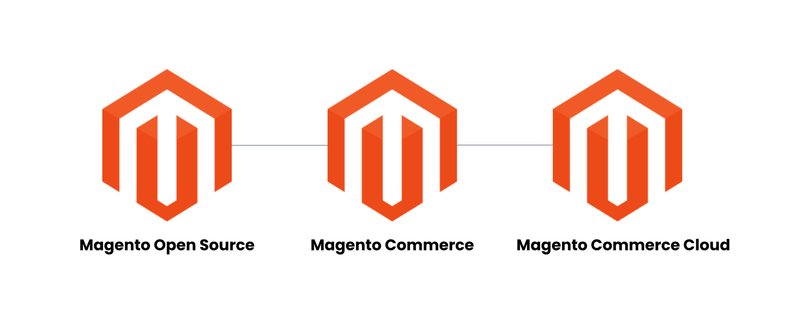
Magento is available in multiple editions, each designed for different operational requirements. Businesses evaluating the platform need to match their technical resources and growth plans against what each edition offers.
Magento Open Source carries no licensing fees. Retailers download the platform and install it on the hosting infrastructure they select and manage. This edition, formerly known as Magento Community, appeals to businesses with in-house development teams that can handle customization independently.
The open source model allows modifications to any part of the codebase, giving Developers full access to shape the storefront around specific business logic. Small and medium-sized retailers with strong technical capabilities often start here, accepting responsibility for security patches and version updates in exchange for zero subscription costs.
Adobe Commerce represents the commercial tier, formerly marketed as Magento Enterprise. The subscription includes dedicated account management from Adobe and access to features not available in the open source edition. Elasticsearch powers product discovery, delivering faster results across large catalogs.
Content staging allows marketing teams to schedule promotional changes in advance and preview them before going live. B2B functionality ships out of the box starting with version 2.2 and supports company accounts, approval workflows, and customer-specific pricing. Retailers without dedicated development staff benefit from the support structure, and enterprise operations gain tools that reduce reliance on custom code for common B2B scenarios.
Commerce Cloud packages Adobe Commerce with managed hosting on Amazon Web Services infrastructure. Adobe handles server provisioning, security monitoring, and performance optimization as part of the subscription.
Businesses paying for Commerce Cloud trade direct control over infrastructure for operational simplicity, freeing internal teams to focus on merchandising rather than server administration. That trade-off also reshapes the hiring brief: teams on Commerce Cloud spend less on infrastructure-focused DevOps skills and more on Developers who extend catalog logic and storefront features, while Open Source operations need people who can own patching, hosting, and security in-house.
Choosing an edition represents only the first decision. The platform itself needs to justify the investment in development resources and ongoing maintenance.
Online retail spending continues to climb, with Adobe reporting that consumers spent $88.7 billion online in October 2025 alone, an 8.2% increase year-over-year.
Merchants competing for a share of that spending need infrastructure that performs under pressure and adapts as their operations mature.
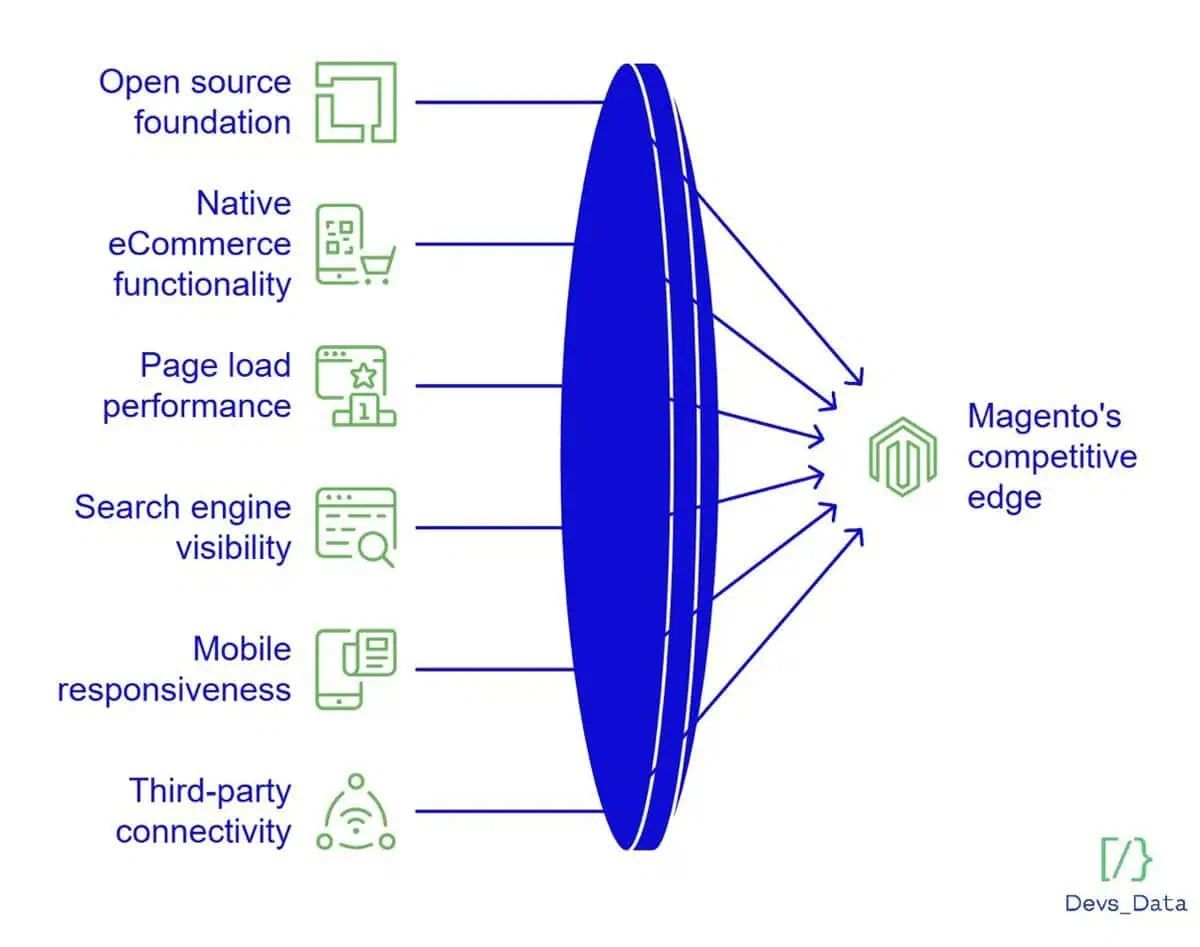
The open source model behind Magento invites contributions from Developers worldwide. This global community identifies vulnerabilities, submits patches, and builds extensions that expand platform capabilities. Amasty’s Improved Layered Navigation, for instance, is a widely adopted community-built extension that replaces Magento’s default filtering with faceted search, giving shoppers faster access to relevant products across large catalogs. Merchants benefit from this kind of contribution without having to commission custom development for a well-solved problem, which keeps the cost of adding capability lower than it would be on a closed platform where every gap means paid custom work or a monthly app subscription.
The extension marketplace offers ready-made solutions for common business requirements, reducing dependence on custom code. Store owners retain full authority over which features run on their sites, adjusting functionality to match operational realities rather than accepting a fixed feature set. For a business with an unusual pricing model, a niche fulfillment process, or a workflow no packaged platform anticipated, that authority is the difference between shaping the software around the business and reshaping the business around the software.
Magento ships with commerce-specific tools that other platforms add through plugins. Product catalog management, inventory tracking, promotional pricing, and checkout configuration are included in the core installation. Store administrators set up operations from a single dashboard without assembling separate systems for each function. This integrated approach reduces compatibility issues that surface when third-party extensions interact poorly with one another, and it lowers the ongoing maintenance overhead of a stack held together by a dozen separately updated plugins, a cost that grows with catalog size and order volume.
The platform processes database queries efficiently, returning product information without the delays that frustrate customers mid-browse. Merchants who need additional speed gains have options: custom optimization through code adjustments or third-party caching tools like Varnish and Redis to further push performance. Faster pages lead to longer browsing sessions, higher conversion rates, and a stronger return on advertising spend, which is why performance headroom matters most to high-traffic retailers whose revenue is sensitive to even small shifts in conversion.
Organic search traffic reduces customer acquisition costs over time, which is why the retailers who choose Magento tend to treat SEO as infrastructure rather than an afterthought. Magento provides the SEO infrastructure required for on-page optimization, but the default configuration does not guarantee good results on its own. The platform generates XML sitemaps automatically and exposes metadata fields for every product and category page, giving Marketing teams direct access to the admin panel for title tags and descriptions.
Getting these elements to work well in search requires additional attention: canonical tags need proper configuration to prevent duplicate content issues on faceted navigation pages, and URL structures benefit from a review of how layered filtering generates parameter strings that crawlers penalize when left unmanaged. That gap between built-in capability and results in the wild is exactly where a Developer who understands both Magento and search earns their keep.
Mobile devices generate the majority of eCommerce traffic, so a storefront that falters on a phone loses sales where most customers now shop. Magento storefronts render correctly across screen sizes, preserving functionality that desktop users expect. Product filtering, cart management, and checkout steps work on smartphones without degradation. The Progressive Web Application (PWA) Studio extends mobile capabilities for merchants running Magento 2.3 and above, delivering an app-like experience in the browser and giving larger retailers a route to app-level speed without building and maintaining a separate native app.
Business operations rarely exist in isolation. Magento connects with external systems via APIs that integrate storefronts with payment processors, shipping carriers, accounting software, and customer relationship management platforms. Google Analytics integration tracks visitor behavior. ERP connections synchronize inventory across sales channels. The admin dashboard centralizes configuration for these integrations, giving store managers visibility into connected services from a single interface. For a business running the storefront as one node in a larger operation rather than a standalone shop, that connective depth is often the deciding factor, since the platform has to fit the systems already in place rather than replace them.
These capabilities explain why Magento remains an established eCommerce platform. The combination of flexibility and built-in commerce tools appeals to retailers who have outgrown simpler solutions. What remains is finding Developers who understand how to put these capabilities to work.
Do you have IT recruitment needs?
The Magento Developer label covers a wide range of actual experience. Candidates who have handled theme customization often list the same skills as those who have built custom B2B modules from scratch. Retailers recruiting for complex requirements need Developers with documented project histories in the platform’s modular architecture and PHP layer, not just familiarity with the admin panel or surface-level frontend work.
eCommerce user penetration will reach 54.5% in 2026 and climb to 56.4% by 2030, expanding the customer base that online stores must serve reliably.
This growth intensifies demand for Developers who can build storefronts capable of handling increased traffic and transaction volume. Project scope shapes whether contract or permanent hiring makes sense. Implementation projects with defined endpoints fit well into fixed-term engagements. Ongoing feature development benefits from staff who build expertise in the specific codebase over time.
Hiring Managers sometimes assume Magento Developers possess uniform capabilities. Actual competencies vary widely between candidates. Some excel at frontend theme customization and responsive design. Others bring stronger experience in backend module development and performance optimization with Varnish and Redis. Distinguishing baseline requirements from preferred qualifications creates a practical screening filter.
The table below separates skills every Magento Developer candidate must demonstrate from those that strengthen a hire but remain optional.
| Required skills | Preferred skills |
|---|---|
| Proficiency in PHP with demonstrated Magento project experience | Adobe Commerce (Magento 2) certification |
| Understanding of MySQL database structure and query optimization | Experience with Varnish or Redis caching configuration |
| Experience with Magento’s modular architecture and extension framework | Familiarity with B2B module setup and customer group pricing |
| Working knowledge of version control systems, particularly Git | Understanding of CI/CD pipelines for Magento deployment workflows |
| Ability to work with REST and GraphQL APIs for third-party integrations | Knowledge of PWA Studio for headless commerce implementations |
| Familiarity with Magento admin panel configuration and store management | Experience migrating stores from Magento 1 to Magento 2 |
Matching candidates against these criteria calls for more than time. Internal HR teams rarely carry the technical fluency to tell a Developer who has built custom modules from one who has only configured the admin panel, and the strongest Magento talent tends to be employed rather than scanning job boards. Add the cost of a mishire on a build that revenue depends on, and the calculation shifts. Organizations turn to specialist technical recruiters less for the hours saved than for the platform knowledge, the reach into passive talent, and the screening depth to make the call with confidence.
Hiring budgets for Magento roles require accurate compensation data before recruitment begins. Candidates with production experience expect salaries that reflect their skill level. Companies competing for this talent often find themselves bidding against agencies and retailers seeking the same profiles.
Experience level drives the largest variation in compensation. Entry-level Developers command different rates than mid-career professionals who have built complex B2B configurations or migrated stores from Magento 1 to Magento 2. Geographic location adds another variable. Salaries in major tech hubs exceed those in regions with a lower cost of living. Remote work arrangements have compressed some of these differences, though location-based pay adjustments remain common across the industry.
The table below provides an overview of typical earnings in the US market. For current salary data, sources such as Glassdoor remain useful.
| Experience | Salary range (USD) |
|---|---|
| 0-1 years | $61000-$113000 yearly |
| 1-3 years | $65000-$119000 yearly |
| 4-6 years | $75000-$134000 yearly |
These figures reflect base compensation and additional pay components reported across the US market. Actual salaries vary based on factors such as company size, project scope, and regional cost of living. Developers with Adobe Commerce certification or specialized performance-optimization experience often command rates at the higher end of their respective ranges. Pinning an offer to the right point in these ranges is easier with a specialist recruiter who tracks live benchmark data across markets, since they can flag when a candidate’s expectations sit above or below the going rate and keep an offer competitive without overpaying.
Recruiting Magento Developers with production-level experience requires evaluation methods that most internal HR teams lack the time to develop. Agencies specializing in technical placements maintain processes designed for this purpose. Pre-screened candidates arrive with verified backgrounds, reducing delays caused by independent sourcing and interviewing. The points below describe how agency partnerships address common hiring obstacles.
Qualified agency networks distinguish themselves by the thoroughness with which they document candidates before they reach the client’s interview stage. That documentation covers verified employment history, reference checks, and repository-level review of past Magento work, combined with a technical screen assessing PHP proficiency and experience with the platform’s modular architecture. Workflows built on this foundation shorten the gap between opening a role and extending an offer, keeping store launches on track.
Recruiters assess proficiency in PHP and MySQL fundamentals through practical evaluations tailored to Magento’s architecture. Candidates complete module development exercises that test their ability to extend core functionality without breaking upgrade paths. Code review sessions using sample Magento extensions reveal how candidates approach the platform’s EAV database structure and dependency injection patterns. This validation confirms that candidates perform at production-grade levels before being introduced to Hiring Managers.
Salary expectations for Magento Developer roles vary by region and experience level. Junior candidates command different rates than seniors with Adobe Commerce certification or Magento 1 migration expertise. Agencies monitor benchmark data across markets, helping employers set offers that attract qualified candidates while staying within budget.
To assess retention risk, recruiters present candidates with ambiguous project requirements and observe whether they ask clarifying questions or proceed on assumptions. That response pattern predicts collaboration quality more reliably than technical assessment alone. Candidates who surface missing requirements before estimating work tend to integrate better with existing teams, a distinction that affects sprint cadence and code review dynamics from the first weeks of an engagement.
International hiring introduces contract variations and tax obligations that differ by jurisdiction. Agencies manage cross-border documentation and compliance requirements, enabling companies to expand talent searches beyond local markets where Magento expertise runs thin.
Partnering with a specialized recruitment firm builds consistency into technical hiring cycles. Organizations scaling their Magento capabilities gain access to vetted professionals while reducing administrative burden on internal staff. The distinction between a firm that delivers this and one that adds another layer of process comes down to method: verified screening, reach into passive talent, and accountability on each placement. DevsData LLC builds its Magento recruitment around exactly those points, which is where the following section turns.

Website: www.devsdata.com
Team size: ~60 employees
Founded: 2016
Headquarters: Brooklyn, NY, and Warsaw, Poland
DevsData LLC specializes in recruiting Magento Developers for organizations operating eCommerce platforms that demand backend customization and storefront optimization. The firm also delivers software projects requiring Magento implementation alongside React Native mobile development for retail clients.
More than 60 professionals work across the recruitment and technical consulting divisions, with operations spanning more than ten years. A database of 95000 verified candidates provides rapid access to qualified Magento specialists. Clients across the US, Israel, and Europe rely on DevsData LLC for consistent placement outcomes, with 100% satisfaction, as evidenced by verified 5/5 reviews on Clutch and GoodFirms.
Each recruitment project receives end-to-end management. Services begin with candidate sourcing and technical evaluation, then continue through structured interviews and onboarding coordination. Clients receive HR advisory support alongside legal guidance to maintain compliance throughout the hiring cycle. These systems serve eCommerce retailers and large-scale enterprise operations alike.
DevsData LLC refined its hiring model through years of technical recruitment work. Magento Developers complete practical assessments measuring proficiency in PHP, MySQL, and the platform’s modular architecture. Recruiters evaluate collaboration style alongside communication clarity to confirm candidates integrate well with existing teams. In-house staff lead reference verification during English-language interviews and coordinate final negotiations. Work is performed on a success-fee basis, with payment due only upon placement.
Key Features:
The agency serves established enterprises as well as high-growth startups. Past clients include BCG and venture-backed companies across multiple sectors. Academic partnerships extend sourcing reach alongside connections to engineering communities worldwide. DevsData LLC recruits specialists for Adobe Commerce implementations and Magento Open Source customizations. The team handles ERP integration assignments and Magento 1-to-Magento 2 migration projects. Dedicated Recruiters replace public job boards, adding precision to each search.
Completed engagements demonstrate how DevsData LLC addresses eCommerce hiring requirements across different organizational contexts.
Caraway needed a Lead Software Engineer to scale its digital platform and strengthen backend operations. DevsData LLC placed a Full Stack Engineer with PHP, WooCommerce, and Laravel expertise in three weeks. The hire improved site performance, reduced cart abandonment rates, and introduced peer-led development workflows that strengthened team collaboration.
SZIC.pl, a leading European Kia distributor, partnered with DevsData LLC to redesign and rebuild its eCommerce platform over a two-year collaboration. The project covered full-cycle development from UX/UI design through backend architecture and payment integrations. Organic traffic increased by 40-60% following launch, and the platform now attracts approximately 5000 monthly visitors.
Beyond recruitment, DevsData LLC delivers technical consulting for Magento-integrated projects. Teams assist with mobile application development and performance optimization for eCommerce systems running on the platform. The company supports React Native builds that connect to Magento backends, addressing the mobile commerce requirements that retailers increasingly prioritize. Combining hiring expertise with software consulting gives clients access to both skilled Developers and dependable project delivery under a unified service model.
Project delivery work reinforces the recruitment practice by keeping technical knowledge current across the Magento ecosystem.
DevsData LLC modernized the mobile application for a Chicago-based health food chain operating under the Now Foods brand. The project delivered a React Native rebuild with WCAG 2.2 accessibility compliance, Magento integration to synchronize product data, and geolocation-based push notifications that linked online browsing to in-store visits.
A Pennsylvania retailer faced checkout errors and sync failures between its mobile app and Magento backend. DevsData LLC rebuilt the application using React Native while preserving the existing codebase, delivering improved navigation, geolocation-based store discovery, and stable performance under daily traffic within a nine-week timeline.
Businesses seeking Magento Developers who match their technical requirements can reach DevsData LLC at general@devsdata.com or visit www.devsdata.com to connect with a Recruiter experienced in eCommerce platform roles.
Do you have IT recruitment needs?
Magento remains a platform for retailers who have outgrown the constraints of simpler eCommerce solutions. The architecture supports large catalogs, multi-store configurations, and B2B workflows that competing platforms address only through extensive plugin installations. This flexibility comes with corresponding complexity.
Storefronts running on Magento Open Source or Adobe Commerce require ongoing attention from Developers who understand the platform’s PHP foundation, its modular extension system, and the database structures that power product management. Hiring decisions in this space carry weight because missteps delay store launches, introduce technical debt, and frustrate internal teams who depend on reliable digital infrastructure. Retailers expanding into new markets or adding wholesale channels face particular pressure, since these growth moves demand backend modifications that generalist Developers struggle to execute without platform-specific experience.
The salary benchmarks documented earlier in this guide reflect the premium that qualified Magento talent commands, justified by the revenue impact of skilled implementation. Organizations competing for a share of the 4.0 billion eCommerce users projected by 2030 need development teams capable of building storefronts that perform under load, convert visitors into customers, and adapt as business requirements shift.
DevsData LLC supports this hiring process through recruitment services designed for eCommerce platforms. The firm maintains a database of 95000 verified candidates, including Magento specialists with documented project histories across Adobe Commerce implementations and Open Source customizations. Technical assessments evaluate PHP proficiency, MySQL optimization skills, and familiarity with the platform’s extension architecture before candidates reach client interviews.
Completed engagements with retailers such as Fruitful Yield and ShopGarden demonstrate how DevsData LLC combines recruitment expertise with hands-on Magento project delivery, keeping technical knowledge current across the Magento ecosystem.
A three-month replacement-or-refund guarantee protects each placement, and Employer of Record services simplify international hiring for companies expanding their search beyond local markets.
Businesses seeking Magento Developers who match their technical requirements can reach DevsData LLC at general@devsdata.com
Discover how IT recruitment and staffing can address your talent needs. Explore trending regions
like Poland, Portugal, Mexico, Brazil and more.

 Frequently asked questions (FAQ)
DevsData – your premium technology partner
DevsData is a boutique tech recruitment and software agency. Develop your software project with veteran engineers or scale up an in-house tech team of developers with relevant industry experience.
Free consultation with a software expert
🎧 Schedule a meeting
FEATURED IN


DevsData LLC is truly exceptional – their backend developers are some of the best I’ve ever worked with.”

Nicholas Johnson
Mentor at YC, serial entrepreneur


 Build your project with our veteran developers.
Explore the benefits of technology recruitment and tailor-made software.
Learn how to source skilled and experienced software developers.

Rebecca Botvin

Commercial Director

Tom Potanski
Manager




Categories: Big data, data analytics | Software and technology | IT recruitment blog | IT in Poland | Content hub (blog)
















careers@devsdata.com





general@devsdata.com

"I interviewed about a dozen different firms. DevsData LLC is truly exceptional – their backend developers are some of the best I've ever worked with. I've worked with a lot of very well-qualified developers, locally in San Francisco, and remotely, so that is not a compliment I offer lightly. I appreciate their depth of knowledge and their ability to get things done quickly."

Nicholas Johnson
CEO of Orange Charger LLC,
Ex-Tesla Engineer,
Mentor at YCombinator
"DevsData reached out to us, as we've been looking to grow our engineering team in Europe and Poland. Communicating efficiently and professionally, DevsData made a strong impression with their understanding of the recruitment challenges we were facing. They designed a tailored recruitment process for our needs. I was impressed with the technical depth of their approach."

Karim Butt
Co-Founder & CTO at GlossGenius, Inc.
"Out of all the vendors we work with, DevsData clearly stands out. The quality of developers they deliver is beyond what we've received from any other vendor, and they've been able to send profile recommendations very quickly. I'm happy to be their reference for other companies from Israel and talk about their recruitment abilities and what they delivered for us."

Ran Eyal
Senior Manager at
ZIM Integrated
Shipping Services Ltd.
"DevsData demonstrated a strong degree of proactivity, taking time to thoroughly understand the problem and business perspective, and continuously suggesting performance and usability enhancements. Their app exceeded my expectations. I've worked with DevsData on numerous projects over the last 3 years and I'm very happy. Being both responsive and honest in communication."

Jonas Lee
Partner & Executive VP of Verus,
Financial LLC, Investor,
& Serial Entrepreneur
Acknowledgments