Thanks for subscribing.
Your gift is on the way.



Storing customer data in spreadsheets works until the client list grows beyond a few dozen contacts. Sales teams then spend more time searching for information than closing deals. Customer relationship management software fixes that retrieval problem by centralizing contact records and communication histories, though storage accounts for a small share of what these platforms actually do. The system scores incoming leads and triggers follow-up sequences without manual input. Revenue forecasts pull directly from pipeline data rather than from a manager’s estimate. Service teams work from the same records sales uses, so a support agent sees the full purchase history before responding to a ticket. That operational reach explains why configuring a CRM has become a specialist Developer role rather than an administrative task.
The global CRM market reached USD 73.40 billion in 2024, with projections pointing to USD 163.16 billion by 2030 at a 14.6% compound annual growth rate.
That growth trajectory reflects sustained investment in platforms that automate repetitive tasks and provide deeper visibility into sales pipelines.
Demand for professionals who build and customize these platforms continues to climb. A Forrester survey found that 57% of organizations in the United States plan to increase CRM spending over the next 12 months. This investment pattern creates hiring pressure across industries that depend on customer data for sales and service operations. Finding Developers with verified platform expertise requires evaluation methods beyond standard resume screening. The sections ahead define CRM systems, compare platform varieties, weigh benefits against drawbacks, outline recruitment considerations, and detail DevsData LLC’s experience placing CRM specialists.
Customer relationship management (CRM) refers to integrated technologies that document and track an organization’s interactions with current and prospective buyers. These platforms support the sales process and connect with enterprise resource planning (ERP) systems. Teams gain control over lead generation activities and deal progression through a customizable dashboard that consolidates data from multiple sources.
CRM software handles lead management and sales forecasting, giving mobile teams access to contact data through a unified interface. Within call center operations, systems track the frequency and outcomes of follow-up communications with prospects. This analysis improves retention rates and strengthens support processes over time. The collected data informs workflow adjustments and relationship assessments.
CRM platforms vary by deployment size and industry vertical. Full suites include online chat and document-sharing applications alongside the core contact database. These systems integrate with marketing tools such as Mailchimp and support eCommerce operations. Order tracking and revenue monitoring extend the functionality into back-office processes.
Do you have IT recruitment needs?
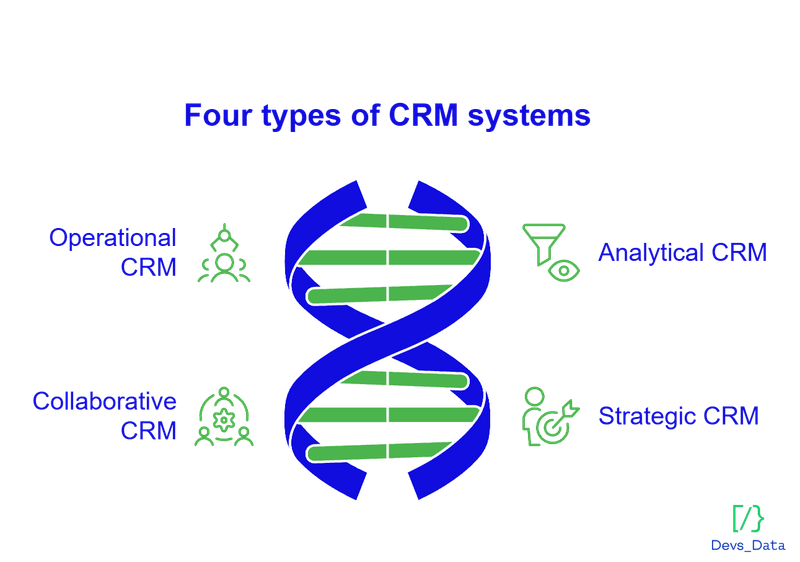
Four primary CRM system types serve different organizational needs: operational, analytical, collaborative, and strategic.
Selecting the appropriate category directly affects bottom-line performance, with most businesses reporting sales revenue increases of 21-30% after CRM implementation.
Many organizations run multiple systems or build custom solutions that combine elements from several categories.
Operational CRM platforms handle sales functions and marketing execution. Salesforce and HubSpot are two widely adopted platforms in this category, each offering configurable pipelines suited to different team sizes. Microsoft Dynamics 365 covers similar ground for organizations already standardized on Microsoft tooling, while Zoho CRM and Pipedrive serve smaller sales teams at lower per-seat cost. Customer service workflows run through the same interface. These systems govern how a company interacts with buyers at each stage of the relationship.
The primary goal centers on acquisition and retention. New leads enter through various channels and receive targeted nurturing content before converting into paying customers. Post-purchase communication maintains the relationship over time. Businesses of all sizes adopt operational CRM to automate repetitive outreach across these workflows.
The following automation types are available on operational platforms.
Operational CRM fills the sales funnel. Analytical CRM reveals how prospects move through it.
These systems capture and analyze customer data to show how buyers interact with a business. Teams assess campaign effectiveness and adjust strategy based on evidence rather than assumptions. A company might compare six recent marketing campaigns against performance benchmarks and model future efforts on the two strongest results.
Analytical capability usually arrives as a layer attached to an operational platform rather than as a separate purchase. Salesforce sells CRM Analytics, previously named Einstein Analytics and Tableau CRM, as the native analytics experience inside its CRM, with Einstein Discovery absorbed as the predictive engine and Data Cloud integration extending the queryable dataset. Microsoft positions Dynamics 365 Customer Insights for teams whose bottleneck is the time between collecting customer data and acting on it. Zoho CRM bundles analytics alongside pipeline management and marketing automation in a single product, which suits companies that would rather not license a second tool.
That distinction matters for hiring. A Developer configuring analytical CRM works with datasets, data models, and query logic instead of the workflow builders used on the operational side, and the naming history alone creates friction: Salesforce’s analytics product has carried four names, with Trailhead modules and help articles still referencing the older ones.
Performance reports cover sales history and satisfaction scores. Managers spot top performers and pinpoint development areas for other team members. VC firms tracking outreach conversion by sector or measuring how quickly deals progress from first meeting to term sheet rely on this category to surface patterns that spreadsheet analysis misses.
Large organizations often have multiple departments working on the same client accounts. Sales and marketing personnel handle acquisition. Support Agents manage post-purchase needs. A collaborative CRM connects these groups through shared records and communication logs.
Platforms in this category differ mainly in where the conversation happens. Bitrix24 keeps chat, video calls, tasks, workgroups, and document sharing inside the CRM, so a Sales Representative discusses a lead, assigns follow-up, and uploads a proposal without leaving the platform. Copper takes the opposite approach and runs natively in a Gmail and Google Calendar sidebar, removing the context switch for teams whose customer communication already lives in Google Workspace. SugarCRM splits its offering into separate sales, marketing, and service products, with Sugar Serve carrying case management, SLA tracking, and a self-service portal. Zoho CRM handles cross-team visibility through a Feeds function for discussing deals and record updates, plus chat integration with Cliq, Teams, and Slack. At enterprise scale, Salesforce Sales Cloud and Microsoft Dynamics 365 both serve this pattern, the latter appealing to organizations already inside the Microsoft stack.
The customer lifecycle demonstrates how cross-department visibility works in practice. A Sales Representative gathers lead information at an event and uploads the record to the database. Marketing adds that contact to an automated campaign. When Sales Representatives follow up by phone, they see the full interaction history from the first touch through recent email engagements. After purchase, customer service receives a notification to send a thank-you message. If the buyer later submits a support request, the agent can access complete records and resolve the issue faster.
Strategic CRM overlaps with collaborative CRM in feature sets. The distinction lies in the time horizon. Collaborative systems target immediate process improvements. Strategic platforms focus on long-term engagement by mapping relationship health over years rather than quarters. Predictive scoring models, for instance, flag accounts at risk of disengagement based on declining interaction frequency over a defined period.
Enterprise suites dominate this category, since multi-year relationship data has to sit alongside finance and supply chain records to be worth much. SAP rebuilt its customer strategy around the Customer Experience suite, previously called C/4HANA, which spans Sales Cloud, Service Cloud, Marketing Cloud, Commerce Cloud, and Customer Data Cloud for identity and consent management. Oracle markets its CX suite as reaching past traditional CRM toward sustained relationship management across marketing, sales, and service, and the fit is strongest for large enterprises already running Oracle ERP or HCM products. Salesforce Data Cloud plays the equivalent role in its ecosystem, unifying customer data so teams act on segments rather than raw records.
These systems collect data on customer preferences and communication channel choices over extended periods. An IT services company providing ongoing infrastructure support would benefit from strategic CRM. The platform tracks evolving client needs across years of relationship history, surfacing patterns that inform retention efforts. Developers working here spend less time on interface configuration and more on integration with ERP and data warehouse systems, which is the skill split the recruitment section returns to.
Do you have IT recruitment needs?
Organizations evaluating CRM investment need a clear view of what these platforms deliver and where limitations surface. Implementation requires careful consideration of existing workflows and team readiness. Hiring managers benefit from understanding these tradeoffs when scoping Developer roles and assessing candidate skill sets. The comparison below outlines primary advantages and drawbacks.
| Pros | Cons |
|---|---|
| Data entry automation reduces the hours spent on manual input for sales teams. | Field-level customization required to fit non-standard sales processes can take significant developer hours up front |
| An efficient dashboard streamlines sales activities and pipeline visibility. | System effectiveness depends on proper initial setup and configuration. |
| Revenue potential increases through better lead tracking and conversion optimization. | Some platforms prioritize manager reporting over sales representative needs. |
| Centralized records allow easier collaboration between departments. | Subscription costs add up, particularly for larger teams requiring multiple seats. |
| Repetitive task automation frees staff to focus on higher-value work. | Incorrect usage turns the platform into a time drain rather than a productivity tool. |
Every advantage listed comes from the software itself, while every drawback comes from a decision made around the software. Configuration effort, poor initial setup, reporting that serves managers over Sales Representatives, seat licensing, and low adoption are all choices, not defects in the product. That distinction changes how the tradeoffs should be weighed during procurement, since the risk sits with the buying organization rather than the vendor.
Sequencing addresses most of the cost problems. Companies that document their sales process before configuration start from standard objects and customize only where their workflow genuinely diverges from the platform default, which keeps Developer hours concentrated on the parts that carry business value. Reversing that order produces the expensive version: Heavy customization built on an undefined process, then rebuilt once the process settles.
Adoption determines whether the automation benefits ever appear. A platform configured around manager reporting collects data but returns little to the people entering it, and Sales Representatives respond by logging the minimum. Building views that answer a Representative’s daily questions, then treating record completeness as a management metric rather than a technical one, closes that gap. Seat costs deserve the same scrutiny, since read-only or limited licenses often cover departments that need visibility without full editing rights.
The performance gap is measurable: businesses using a CRM are 86% more likely to exceed sales goals than those operating without one.
Teams lacking clear workflows or training programs experience friction rather than efficiency gains. The platform’s complexity means Developer expertise remains concentrated among professionals who understand both the technical configuration and the business logic behind customer data management, a factor the recruitment section addresses directly.
Organizations scaling their sales operations often reach a point where off-the-shelf CRM configurations no longer meet business requirements. Custom workflows, third-party integrations, and data migration projects require developers who understand platform architecture in depth. Finding professionals with this expertise is difficult. Most candidates specialize in a single platform, such as Salesforce or HubSpot, while hiring companies often require cross-platform experience or migration capabilities.
Project scope shapes whether contract or permanent hiring makes sense. Implementation projects with defined endpoints are well-suited to fixed-term engagements. Ongoing customization and maintenance benefit from staff who build expertise in the system’s integration points over time.
Hiring managers sometimes assume CRM Developers possess uniform capabilities. Actual competencies vary widely between candidates. Some excel at backend automation and API connections. Others bring experience with reporting dashboards or data migration. Distinguishing baseline requirements from preferred qualifications creates a practical screening filter.
The table below separates skills every candidate must demonstrate from those that strengthen a hire but remain optional.
| Required skills | Preferred skills |
|---|---|
| Proficiency in at least one major CRM platform such as Salesforce, HubSpot, or Microsoft Dynamics 365. | Experience with multiple CRM platforms or cross-platform migration projects. |
| Understanding of sales pipeline and customer lifecycle concepts. | Background in marketing automation configuration and campaign management. |
| Experience with data migration and system integration. | Knowledge of platform-specific languages such as Apex or HubL for advanced customization. |
| Working knowledge of SQL or similar database query languages. | Familiarity with ERP system integration patterns. |
| Ability to configure workflows and automation rules within CRM interfaces. | Experience building custom reporting dashboards and analytics views. |
| Strong problem-solving abilities. | Understanding of API design principles for third-party connections. |
| Working familiarity with the platform’s native AI layer, including lead scoring and record summarization. | Hands-on agent configuration in builders such as Agentforce Builder or Zia Agent Studio. |
Matching candidates to these criteria takes time that internal HR departments rarely have, which explains why many organizations turn to recruitment agencies specializing in technical roles.
Recruiting CRM Developers with production-level experience requires evaluation methods that most internal HR teams lack the time to develop. Agencies specializing in technical placements maintain processes designed for this purpose. Pre-screened candidates arrive with verified backgrounds, reducing delays caused by companies sourcing and interviewing independently. The points below describe how agency partnerships address common hiring obstacles.
Faster placement
Agencies maintain active databases of CRM professionals with documented project histories. Established screening workflows shorten the gap between opening a role and extending an offer. Product timelines stay on track when recruitment cycles compress from months to weeks.
Verified skills
Recruiters assess platform proficiency and CRM architecture knowledge through practical tests. Portfolio reviews confirm experience with workflow automation and system integration. This validation ensures candidates perform at production-grade levels before introductions to hiring managers.
Compensation accuracy
Salary expectations for CRM roles vary by region and platform specialization. Salesforce Developers command different rates than HubSpot or Dynamics specialists. Agencies monitor benchmark data across markets, helping employers set offers that attract qualified candidates while staying within budget.
Long-term fit
Technical ability alone does not predict retention. Recruiters evaluate communication patterns and working preferences to identify candidates who integrate smoothly into existing teams. This assessment reduces turnover risk stemming from cultural misalignment rather than skill gaps.
Global coordination
International hiring introduces contract variations and tax obligations that differ by jurisdiction. Agencies offering Employer of Record (EoR) services handle payroll, documentation, and compliance requirements across borders, allowing companies to expand talent searches beyond local markets where CRM specialists are concentrated.
Partnering with a specialized recruitment firm builds consistency into technical hiring cycles. Organizations scaling their CRM capabilities gain access to vetted professionals while reducing administrative burden on internal staff. What separates a useful partnership from a scheduling layer is technical assessment capacity, since the four platform categories described earlier translate into different Developer profiles and a firm that screens for platform names on a resume passes the real filtering work back to the hiring manager. The section below outlines how DevsData LLC structures its evaluation process, along with client engagements that show the screening depth in practice.
Team size: ~60 employees
Founded: 2016
Headquarters: Brooklyn, NY, and Warsaw, Poland
DevsData LLC specializes in recruiting CRM Developers for organizations building customer management platforms and sales automation systems. The firm also delivers software projects requiring CRM implementation and customization. More than 60 professionals work across recruitment and technical consulting divisions. Operations span over nine years. A database of 95000 verified candidates provides rapid access to qualified CRM specialists. Clients across the US, Israel, and Europe rely on DevsData LLC for consistent placement outcomes. Satisfaction remains at 100%, supported by verified 5/5 reviews on Clutch and GoodFirms.
Each recruitment project receives end-to-end management. Services begin with candidate sourcing and technical evaluation, then continue through structured interviews and onboarding coordination. Clients receive HR advisory support alongside legal guidance to maintain compliance throughout the hiring cycle. These systems serve software engineering firms and large-scale enterprise operations alike.
DevsData LLC refined its hiring model through years of technical recruitment work. CRM Developers complete practical assessments measuring platform proficiency and workflow automation knowledge. Recruiters evaluate collaboration style alongside communication clarity to confirm candidates integrate well with existing teams. In-house staff leads reference verification during English-language interviews while coordinating final negotiations. Work is performed on a success-fee basis, with payment due only upon placement.
The agency serves established enterprises as well as high-growth startups. Past clients include BCG and venture-backed companies across multiple sectors. Academic partnerships extend sourcing reach alongside connections to engineering communities worldwide. DevsData LLC recruits specialists for Salesforce customization projects and HubSpot implementation work. The team handles Dynamics 365 configuration and cross-platform migration assignments. Searches extend to mid-market platforms where the candidate pool thins out considerably, covering Zoho CRM and Pipedrive alongside SugarCRM and its open source counterpart SuiteCRM for teams running self-hosted deployments. Enterprise mandates reach into Oracle CX and the SAP Customer Experience suite, where candidates need ERP integration experience layered on top of CRM configuration skills. Requests for Bitrix24 or Copper specialists usually come from companies whose CRM sits inside an existing collaboration stack rather than operating as a standalone system. Dedicated recruiters replace public job boards, adding precision to each search.
Beyond recruitment, DevsData LLC delivers technical consulting for CRM projects. Teams assist with platform migration and performance optimization for sales automation systems. The company supports scalability planning and configuration audits that strengthen long-term maintainability. Combining hiring expertise with software consulting gives clients access to both skilled Developers and dependable project delivery under a unified service model.
Businesses seeking CRM Developers who match their technical requirements can reach DevsData LLC at general@devsdata.com or visit www.devsdata.com to connect with a recruiter experienced in customer relationship management platform roles.
Do you have IT recruitment needs?
DevsData LLC’s recruitment history shows assignments in which both delivery speed and candidate caliber mattered. The firm has placed CRM specialists across enterprise sales platforms and SaaS operations. Targeted sourcing paired with structured technical assessments compressed hiring timelines while securing Developers who met rigorous role specifications.
EasyShip, Inc., a Hong Kong-headquartered eCommerce SaaS provider with over 100 employees across eight global offices, needed three Ruby Tech Leads to strengthen backend leadership on its logistics platform. Internal hiring had stalled for nearly 100 days due to fragmented workflows and inconsistent screening across regions. DevsData LLC reset the search to target Central and Eastern European candidates whose time zones aligned with those of the US and Asian teams. The firm screened 270 profiles and delivered a curated shortlist within five business days. The first placement was signed in 31 days, with the new hire contributing production code by the second sprint.
The table below summarizes the engagement details.
| Category | Detail |
|---|---|
| Client | EasyShip, Inc. |
| Role hired | Ruby Tech Lead (three positions) |
| Recruitment timeline | 31 days to first placement |
| Key criteria | Ruby on Rails proficiency, high-traffic API design, CI/CD experience, remote collaboration across time zones |
| Result | 270 profiles screened, 31-day hiring cycle (vs. 100 days internal), production contributions within first sprint |

Caraway, Inc., a New York-based eCommerce brand with $30.4 million in annual revenue, sells eco-conscious cookware and needed a Lead Software Engineer to scale its digital platform during rapid growth. The role required full stack expertise across JavaScript, React, PHP, WooCommerce, and Node.js, alongside leadership capabilities to mentor a junior development team. DevsData LLC completed the placement in three weeks, sourcing candidates through CodersRank, LinkedIn, and Codeable while evaluating over 20 profiles. The placed engineer reduced page load times by 25% through backend optimization and introduced structured code reviews, thereby shortening release cycles.
The table below summarizes the engagement details.
| Category | Detail |
|---|---|
| Client | Caraway, Inc. |
| Role hired | Lead Software Engineer |
| Recruitment timeline | 3 weeks |
| Key criteria | Full stack expertise (JavaScript, React, PHP, Node.js, WooCommerce), eCommerce platform experience, and team leadership capability |
| Result | 25% page load improvement, reduced cart abandonment, structured code review processes, shorter release cycles |
CRM platforms power sales operations across industries, making qualified Developers a recurring hiring priority for organizations that depend on customer data management. Market investment continues to climb as companies recognize the operational advantages these systems deliver. The technical complexity of modern CRM implementations requires professionals who grasp platform architecture alongside business process logic.
Internal HR teams often lack the specialized screening capacity to evaluate candidates’ proficiency in workflow automation or cross-platform migration. This gap extends hiring timelines and increases the risk of mismatched placements. Selecting the right recruitment partner determines whether open positions are filled with capable specialists or stall through prolonged evaluation cycles that delay project delivery.
DevsData LLC brings more than nine years of technical recruitment experience to CRM Developer searches. The firm employs US specialists and serves clients worldwide, including organizations in the US and Israel. A database of 95000 verified candidates supports rapid sourcing for platform-specific roles. The company holds an official, government-approved license for recruitment services, providing compliant hiring processes across international markets.
For further details on DevsData LLC’s services, contact them at general@devsdata.com or visit www.devsdata.com.
Any questions or comments? Let me know on
Twitter/X.
Discover how IT recruitment and staffing can address your talent needs. Explore trending regions
like Poland, Portugal, Mexico, Brazil and more.
 Frequently asked questions (FAQ)
DevsData – your premium technology partner
DevsData is a boutique tech recruitment and software agency. Develop your software project with veteran engineers or scale up an in-house tech team of developers with relevant industry experience.
Free consultation with a software expert
🎧 Schedule a meeting
FEATURED IN


DevsData LLC is truly exceptional – their backend developers are some of the best I’ve ever worked with.”

Nicholas Johnson
Mentor at YC, serial entrepreneur


 Build your project with our veteran developers.
Explore the benefits of technology recruitment and tailor-made software.
Learn how to source skilled and experienced software developers.

Rebecca Botvin

Commercial Director

Tom Potanski
Manager




Categories: Big data, data analytics | Software and technology | IT recruitment blog | IT in Poland | Content hub (blog)














careers@devsdata.com





general@devsdata.com

"I interviewed about a dozen different firms. DevsData LLC is truly exceptional – their backend developers are some of the best I've ever worked with. I've worked with a lot of very well-qualified developers, locally in San Francisco, and remotely, so that is not a compliment I offer lightly. I appreciate their depth of knowledge and their ability to get things done quickly."

Nicholas Johnson
CEO of Orange Charger LLC,
Ex-Tesla Engineer,
Mentor at YCombinator
"DevsData reached out to us, as we've been looking to grow our engineering team in Europe and Poland. Communicating efficiently and professionally, DevsData made a strong impression with their understanding of the recruitment challenges we were facing. They designed a tailored recruitment process for our needs. I was impressed with the technical depth of their approach."

Karim Butt
Co-Founder & CTO at GlossGenius, Inc.
"Out of all the vendors we work with, DevsData clearly stands out. The quality of developers they deliver is beyond what we've received from any other vendor, and they've been able to send profile recommendations very quickly. I'm happy to be their reference for other companies from Israel and talk about their recruitment abilities and what they delivered for us."

Ran Eyal
Senior Manager at
ZIM Integrated
Shipping Services Ltd.
"DevsData demonstrated a strong degree of proactivity, taking time to thoroughly understand the problem and business perspective, and continuously suggesting performance and usability enhancements. Their app exceeded my expectations. I've worked with DevsData on numerous projects over the last 3 years and I'm very happy. Being both responsive and honest in communication."

Jonas Lee
Partner & Executive VP of Verus,
Financial LLC, Investor,
& Serial Entrepreneur
Acknowledgments