Thanks for subscribing.
Your gift is on the way.



ChatGPT went from a public launch to a workplace fixture in under three years. 28% of employed adults now use the tool at work, up from eight percent two years ago. Day-to-day tasks range from writing sales outreach and debugging code to condensing research findings and formatting client deliverables.
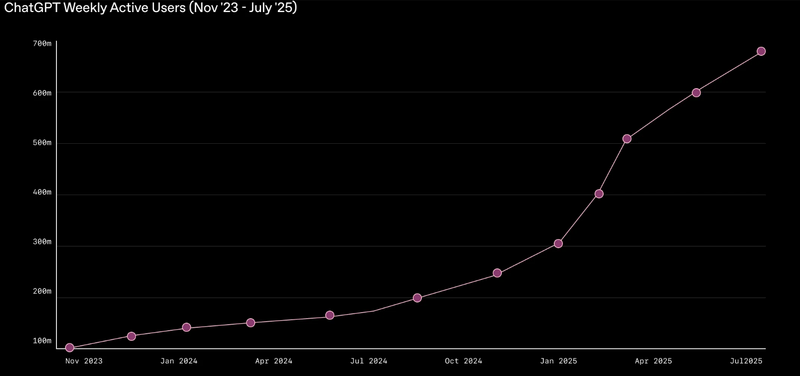
OpenAI trained the models on large-scale text data and human feedback using a process called reinforcement learning from human feedback (RLHF), producing a system that interprets conversational context and generates responses that span text and code. Weekly active users grew from roughly 80 million in November 2023 to nearly 700 million by mid-2025, as the chart below illustrates.
Enterprise adoption followed a similar curve. 92% of Fortune 500 companies have integrated ChatGPT into their operations, creating sustained demand for Developers who build the applications behind this adoption.
These range from customer-facing chatbots and automated support systems to internal tools that process documents, generate reports, or connect AI capabilities to existing CRMs and data pipelines. The majority of these implementations require a Developer who understands OpenAI’s API well enough to turn a general-purpose model into one that reliably serves a specific business function.
Hiring Managers screening for these roles often find a gap between their own technical knowledge and the specialized skills candidates must demonstrate. This article examines ChatGPT’s technical foundations, weighs platform advantages against limitations, explores business applications, defines the Developer role, presents criteria for selecting a recruitment partner, and reviews staffing agencies serving this market.
ChatGPT is an artificial intelligence chatbot developed by OpenAI. Users interact with the system by typing prompts and receiving responses that mirror natural conversation. The tool has gained traction for research queries and quick informational lookups, where users prefer a direct conversational answer over scanning through search results, though it remains less suited for tasks requiring real-time data or source verification.
In the US, 53% of adults who use AI report choosing ChatGPT over other options, positioning it as the leading consumer AI application.
“GPT” stands for “generative pre-trained transformer.” AI training is the process of teaching a computer system to identify patterns and make decisions based on input data.
A transformer is a type of neural network that analyzes context across input sequences and assigns a weight to each component based on relevance. These models excel at natural language processing (NLP) tasks by learning contextual relationships between words. A model, in AI terminology, refers to the set of mathematical equations and algorithms a computer applies when analyzing data.
Older chatbots produced detailed answers to standalone questions. ChatGPT introduced a dialog format that retains conversation history. This structure supports follow-up questions.
Do you have software development needs?
Natural language processing enables ChatGPT to interpret and generate human-like text. OpenAI trained the large language model on two primary input types:
Human feedback throughout this process helps refine model safety and output reliability.
Beyond the consumer-facing chat interface, OpenAI makes its models accessible through an API designed for software integration. Developers interact with this API by sending prompts programmatically and processing the returned outputs within their own applications. This programmatic access layer is what separates casual ChatGPT usage from the development work that organizations hire specialists to perform.
ChatGPT extends beyond individual productivity to operational workflows spanning entire departments. Companies deploy the model across functions ranging from front-line support to internal training programs. Each application requires a different integration approach and carries its own implementation considerations. The seven use cases below outline how teams apply ChatGPT to specific business challenges.
Businesses deploy ChatGPT as a virtual assistant on company websites to address routine customer queries. The model delivers immediate responses, which reduces ticket volume for human support teams.
Integration begins by connecting the model to your website or messaging platform. Employees simulate customer interactions during initial training, posing common questions and troubleshooting scenarios.
This internal testing phase refines response accuracy before external rollout. Once outputs meet quality standards, a controlled pilot with a small customer segment validates real-world performance. Fallback routing to live agents remains active at all times, so customers with complex or sensitive requests reach a human rather than receiving an inadequate automated response.
ChatGPT helps teams gather competitive intelligence and synthesize industry data. The model scans publicly available sources and condenses findings into summaries that inform campaign planning.
Companies integrate ChatGPT into their market analysis workflow by supplying research queries tied to specific verticals. Training the model on industry terminology and consumer behavior patterns improves relevance. ChatGPT then aggregates data from market reports and online discussions, surfacing trends and competitor movements.
ChatGPT engages website visitors through conversational prompts, qualifies prospects, and collects demographic data. This automated interaction directs high-intent visitors toward appropriate sales channels.
Implementation starts with embedding the model on landing pages or product pages. The virtual assistant gathers information aligned with your qualification criteria. Training the model on ideal customer profiles sharpens targeting. Prompts tailored to your sales process increase the probability of conversion by filtering out low-fit prospects early.
ChatGPT generates draft material for blog posts, email newsletters, social media updates, and product descriptions. The model accelerates production timelines by handling first-draft work.
Access ChatGPT through an API or hosted platform. Define content goals and input prompts that specify topic, tone, and format. The model generates draft text, which your team edits to align with the brand voice. Human review remains necessary to maintain originality and accuracy before publication.
ChatGPT drafts and maintains project documentation by processing inputs from team discussions and collaboration platforms. The model converts meeting recordings into written summaries and compiles progress updates into formatted reports that distributed teams reference between syncs.
Integration starts with connecting ChatGPT to the platforms where project communication happens. The model draws on existing documentation to maintain consistency across outputs. Training it on prior project records sharpens the relevance of generated content during planning phases.
ChatGPT processes large datasets and generates summary reports. This capability benefits organizations that lack dedicated Data Analysts.
Integration involves connecting the model to analytics tools or data pipelines. Training on relevant datasets enables ChatGPT to identify patterns and generate written insights. The model identifies trends and anomalies, then formats findings into structured summaries with labeled sections, plain-language explanations, and flagged outliers that non-technical stakeholders can act on without additional interpretation.
One constraint here is that ChatGPT lacks confidentiality safeguards. Avoid uploading sensitive or proprietary data, as the model cannot guarantee privacy protections equivalent to those provided by an NDA.
ChatGPT delivers company policies and procedural guidance to new hires. The model answers questions about workplace norms and directs employees to relevant resources.
Training the model on internal documentation, best practices, and compliance materials prepares it for onboarding tasks. ChatGPT generates interactive quizzes and learning modules tailored to each role. Scheduled delivery keeps development on track, while real-time feedback addresses knowledge gaps as they surface.
These applications share a common requirement: Human oversight at every stage. Automated outputs streamline operations, while review cycles catch errors and preserve quality standards across functions.
Operational improvements depend on how well organizations implement and maintain their ChatGPT systems. This work falls to ChatGPT Developers, specialists who build, customize, and optimize AI applications on top of OpenAI’s infrastructure.
According to 2025 data, teams using AI report 77% faster task completion and a 45% boost in overall productivity.
Capturing these gains requires technical expertise that most internal teams lack. The responsibilities below outline what ChatGPT Developers are responsible for throughout the project lifecycle.
ChatGPT Developers advise organizations on implementation strategy before any code is written. They assess existing workflows and recommend where AI integration delivers the highest return.
This guidance covers model selection and NLP capabilities in relation to business objectives. Developers map current operational bottlenecks against potential AI solutions, identifying where automation reduces costs and where it improves throughput. This business analysis phase sets the direction for the technical work that follows.
Developers connect ChatGPT to existing software systems through API configuration. They ensure the model communicates with databases, CRMs, and customer-facing platforms without disrupting current operations. Proper integration improves response times and extends functionality across departments.
Every organization operates differently, so off-the-shelf ChatGPT configurations rarely fit without adjustments. Developers modify conversation flows, build custom API endpoints, and align chatbot responses with brand voice. This tailoring process turns a general-purpose model into a tool that reflects company-specific requirements.
ChatGPT Developers build new applications that automate internal processes and customer interactions. They write code that connects OpenAI’s models to proprietary systems, creating solutions tailored to each client’s operational goals. This work ranges from standalone chatbots to integrated AI features within larger software products.
Developers run comprehensive tests to identify errors before deployment. They monitor model outputs for accuracy, flag inconsistencies, and correct faulty responses. Ongoing debugging maintains stable performance as usage scales and new edge cases surface.
These responsibilities require a combination of software engineering skills and applied AI knowledge. Organizations that lack this expertise in-house turn to external Developers or recruitment partners to fill the gap.
Do you have software development needs?

The agency an organization selects for a ChatGPT Developer search controls much of the hiring outcome. Recruiters shape how the employer’s brand reaches candidates and set the communication cadence that determines whether top Developers engage with the opportunity or pass on it. Evaluating agencies before contracts are signed prevents misaligned partnerships from consuming budget without producing results.
That evaluation starts with role definition. The job specification should separate skills the role demands on day one from qualifications that develop after hire. For most ChatGPT searches, Python proficiency and direct experience with OpenAI’s API sit on the non-negotiable side. A preference for a specific project management tool sits on the trainable side. Budget ceilings and timeline targets belong in the same brief, since they stop agencies from surfacing candidates outside approved salary ranges and help Recruiters prioritize across concurrent searches.
Domain expertise separates productive agency relationships from expensive ones. Recruiters who specialize in AI and machine learning placements understand model fine-tuning requirements that generalist Recruiters miss. Ask for placement examples from the past 12 months involving ChatGPT or LLM-related roles. An agency without a documented record in NLP applications or API development rarely maintains the sourcing networks these positions require.
Account Managers sign the contract, but Sourcers run the actual search. A short conversation with the people doing candidate work reveals whether the agency understands technical requirements at a level deeper than keyword matching. Ask how they evaluate code samples. Ask whether their technical screens test tool calling schemas and guardrail implementation alongside latency tuning and error handling. These competencies separate a Developer who prototypes from one who ships production-grade AI systems. Response time commitments matter here: qualified ChatGPT Developers receive competing offers within days, and agencies that lag lose candidates.
Performance data tells more than a sales pitch. Time-to-hire figures show execution speed across past searches. Interview-to-offer ratios indicate screening quality, with lower numbers suggesting the agency sends well-matched candidates rather than flooding the pipeline. Retention rates at 90 days reveal whether placements last beyond probation. Offer acceptance percentages show how well the agency reads candidate intent before extending an offer.
Fee structures deserve the same scrutiny. Written rate cards specifying hourly bill rates prevent invoice surprises. Temp-to-hire conversion terms should state whether the employer pays a flat amount or a percentage of annual salary. Direct-hire placements for ChatGPT Developers typically fall between 15% and 25% of first-year compensation, and agencies pricing below that range often cut screening depth to protect margins.
Technology matters on the administrative side. Agencies that provide digital platforms for managing candidate profiles and processing invoices reduce friction for internal HR teams. Hiring Managers should have direct access to candidate information without having to route requests through intermediaries. Integration with the organization’s applicant tracking system reduces duplicate data entry, which can add up when multiple positions remain open.
Strong agency relationships compound over time. Recruiters who learn the organization’s culture and technical stack produce better candidate matches with each successive search. Guarantee periods should define what happens when a placement leaves before completing probation, including replacement timelines and refund terms.
ChatGPT Developers operate across freelance platforms and AI-focused professional communities. Each channel attracts different candidate profiles, from junior Developers learning prompt engineering to senior engineers with production-scale deployments. This distributed talent pool means organizations often search multiple sources before identifying suitable matches. The list below covers IT recruitment agencies that connect companies with qualified ChatGPT professionals.
Here are our top five picks:
Website: www.devsdata.com
Team size: ~60 employees
Founded: 2016
Headquarters: Brooklyn, NY, and Warsaw, Poland
DevsData LLC recruits ChatGPT Developers for organizations that need AI-powered applications built by professionals who understand both OpenAI’s API architecture and underlying business requirements. The firm also delivers software projects that require ChatGPT development, enabling clients to address hiring and implementation needs through a single partner.
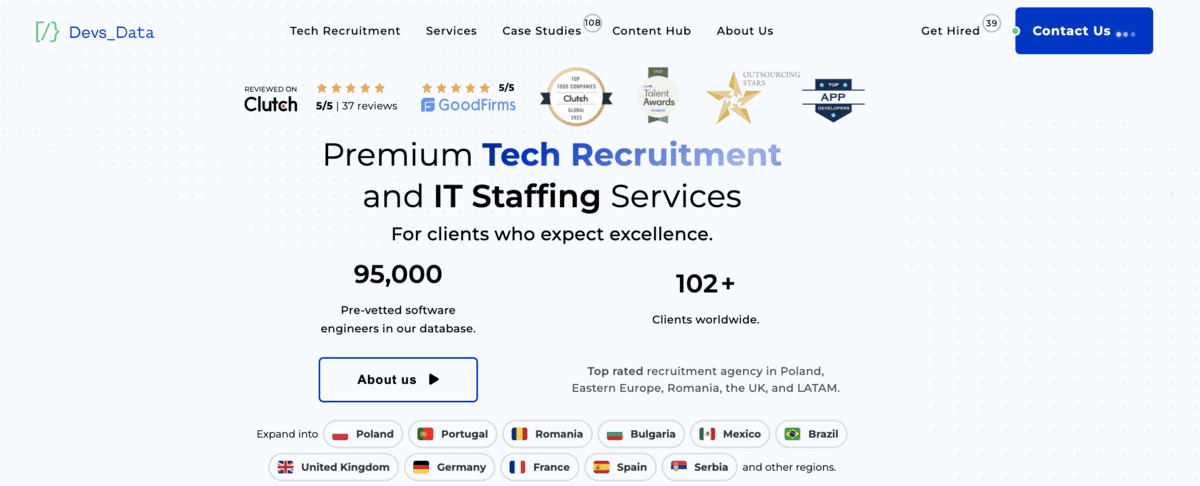
More than 60 professionals operate across these recruitment and technical consulting divisions, a team size shaped by ten years of continuous operations in the technical staffing market. Sourcing speed depends on database depth, and DevsData LLC maintains a database of 95000 verified candidates ready for specialized placements. Clients throughout the US, Israel, and Europe return for additional hires because placement outcomes remain consistent across engagements, a pattern reflected in verified 5/5 ratings on Clutch and GoodFirms.
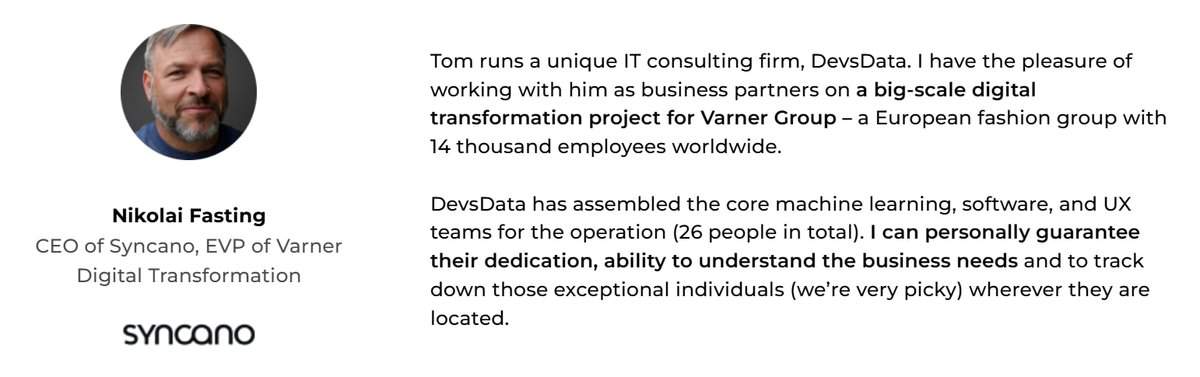
Recruitment projects run from initial sourcing through onboarding coordination under a unified management structure. Candidate identification leads to technical evaluation, which in turn informs structured interviews designed to assess both skill proficiency and team compatibility.
HR advisory and legal guidance accompany these stages, ensuring compliance with local employment requirements throughout each hiring cycle. Enterprise AI teams and startup product groups alike use these systems because the process scales without losing screening rigor.
Hands-on delivery of AI projects across the firm’s consulting division informs the design of these assessments, as teams that have built ChatGPT applications firsthand recognize the difference between theoretical knowledge and production-ready skills. ChatGPT Developers complete practical exercises to test their command of API integration and prompt engineering before advancing to the next round.
The client roster spans established enterprises and high-growth startups, including BCG and venture-backed companies operating across multiple sectors. Academic partnerships and connections with AI developer communities extend sourcing reach beyond conventional channels, proving valuable for NLP and LLM integration roles, where passive candidates often outperform active job seekers. Dedicated Recruiters assigned to each search replace public job boards, adding precision that broad postings cannot achieve.
Two recent engagements illustrate this approach in practice. PlantingSpace, a Swiss artificial intelligence startup building a knowledge representation system, needed Engineers with expertise in Julia programming and doctoral-level backgrounds in mathematics. After conventional channels failed, DevsData LLC’s targeted methods secured qualified specialists and kept the project aligned with investor milestones.
Nearmap Inc., an American InsurTech company that uses machine learning to analyze aerial imagery, struggled through a 60-day internal search that yielded few viable profiles. DevsData LLC delivered a shortlist within six business days and closed four hires in 28, including a Head of Artificial Intelligence and a Senior Machine Learning Engineer.
Businesses seeking ChatGPT Developers who match specific technical requirements can reach DevsData LLC at general@devsdata.com or visit www.devsdata.com to connect with a Recruiter experienced in AI development roles.
Do you have software development needs?
Website: https://binary-studio.com
Team size: 160+ employees
Founded: 2005
Headquarters: Lviv, Ukraine
Binary Studio provides ChatGPT application development services, including the creation of custom AI assistants and conversational interface design. The team integrates large language models into client systems, customizing each deployment to specific business workflows. Their internal engineering academy trains Developers in emerging AI technologies, maintaining a pipeline of graduates familiar with production AI workflows that the company draws from when staffing new projects.
The agency serves clients in healthcare, FinTech, and wellness verticals. Project types include chatbots for customer support, generative AI tools for content creation, and NLP-powered analytics platforms.
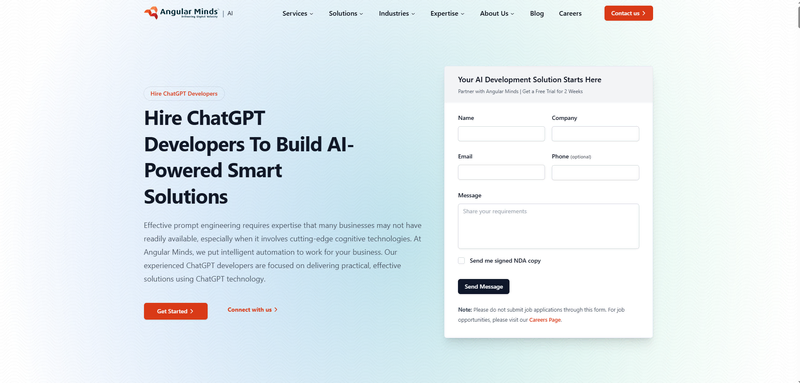
Website: https://angularminds.com
Team size: 100+ employees
Founded: 2011
Headquarters: San Diego, California
Angular Minds offers ChatGPT Developer hiring alongside direct development services. Their team holds experience with GPT-5, and Azure OpenAI Service integration. Services cover intelligent chatbot creation, virtual assistant development, and NLP-powered automation tools. The agency positions itself as an OpenAI-certified integration partner with expertise in fine-tuning models for domain-specific applications.
Client industries include healthcare, eCommerce, finance, and real estate. The company uses an agile delivery model focused on measurable business outcomes. Developers are onboarded within 48 hours of selection, and the agency offers both staff augmentation and full project outsourcing.
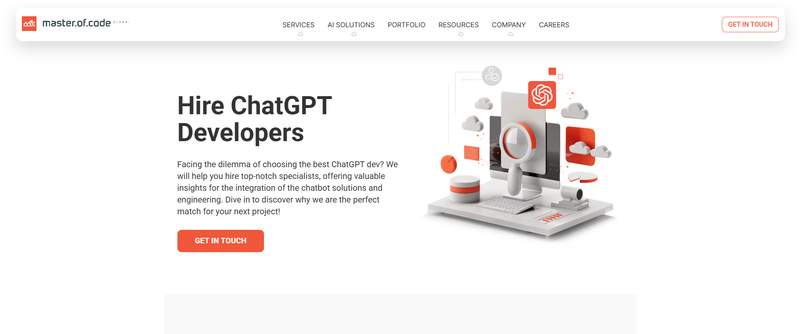
Website: https://masterofcode.com
Team size: 250+ employees
Founded: 2004
Headquarters: Redwood City, California
Master of Code Global staffs ChatGPT Developers from its conversational AI practice, a team that built LOFT, an open source LLM orchestrator framework credited with reducing initial project setup effort by 43%. Developers placed through the agency bring experience in chatbot systems and voice AI. Their skill sets extend to generative AI integration and agentic AI architectures that operate autonomously across business workflows. The agency holds ISO 27001 certification and supports HIPAA-compliant staffing for healthcare clients.
Past clients include T-Mobile, Estée Lauder, Burberry, and Tom Ford, with Golden State Warriors and LivePerson on the roster. Master of Code Global reports a 9.2 customer satisfaction score and structures enterprise rollouts within six to 12 weeks. One documented engagement generated $500000 in revenue within the first few months of chatbot deployment, with conversion rates 3x higher than the client’s website. Projects delivered through the agency have reached more than one billion users worldwide.
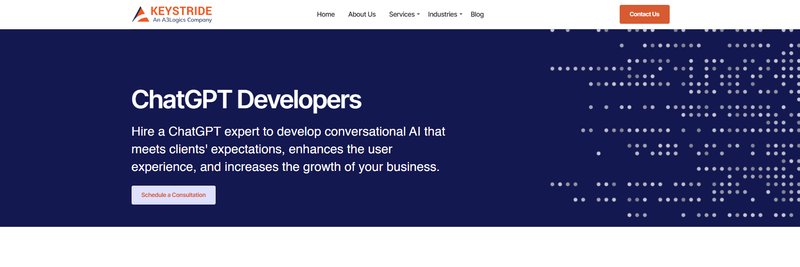
Website: https://keystride.com
Team size: 800+ employees
Founded: 2013
Headquarters: Bengaluru, India
Keystride supplies ChatGPT Developers, as well as broader AI and machine learning talent. Developers placed through the agency work on conversational AI and intelligent chatbot projects, with additional experience in voice-activated systems built on OpenAI’s models. Staffing extends to generative AI integration and NLP roles, including custom LLM development tailored to specific industry requirements. A3Logics acquired Keystride in February 2024, adding Keystride’s deep-tech capabilities to its existing product engineering portfolio.
Keystride targets clients in BFSI and healthcare, with additional reach into pharma and retail, as well as IoT. The agency offers AI as a Service (AIaaS) options that allow businesses to deploy AI applications without building in-house teams. Engagement models include dedicated teams and project outsourcing, with consulting arrangements available under transparent pay-per-use pricing structures.
Companies across sectors now treat ChatGPT development as a core operational function rather than a side experiment. The demand reflects how deeply AI tools have been embedded in customer service, content workflows, and internal automation.
Internal recruitment teams face a difficult task when screening for prompt engineering skills or API integration experience without firsthand technical knowledge. Missteps during candidate evaluation lead to poor placements, extended vacancies, and budget overruns. The recruitment partner an organization selects determines how quickly qualified Developers join the team and how well those placements perform over time.
DevsData LLC operates as a licensed recruitment agency with over ten years of market experience. The firm maintains a database of 95000 verified candidates and employs US-based specialists alongside international team members. Clients worldwide, including organizations in the US and Israel, rely on the agency for AI and software recruitment. This global reach, combined with a government-approved license, positions DevsData LLC as a qualified partner for ChatGPT Developer searches.
To learn more about DevsData LLC’s recruitment services, reach out at general@devsdata.com or visit www.devsdata.com.
Any questions or comments? Let me know on
Twitter/X.
Discover how IT recruitment and staffing can address your talent needs. Explore trending regions
like Poland, Portugal, Mexico, Brazil and more.
 Frequently asked questions (FAQ)
DevsData – your premium technology partner
DevsData is a boutique tech recruitment and software agency. Develop your software project with veteran engineers or scale up an in-house tech team of developers with relevant industry experience.
Free consultation with a software expert
🎧 Schedule a meeting
FEATURED IN

DevsData LLC is truly exceptional – their backend developers are some of the best I’ve ever worked with.”

Nicholas Johnson
Mentor at YC, serial entrepreneur


 Build your project with our veteran developers.
Explore the benefits of technology recruitment and tailor-made software.
Learn how to source skilled and experienced software developers.
Build your project with our veteran developers.
Explore the benefits of technology recruitment and tailor-made software.
Learn how to source skilled and experienced software developers.

Rebecca Botvin

Commercial Director

Tom Potanski
Manager




Categories: Big data, data analytics | Software and technology | IT recruitment blog | IT in Poland | Content hub (blog)














careers@devsdata.com









general@devsdata.com

"I interviewed about a dozen different firms. DevsData LLC is truly exceptional – their backend developers are some of the best I've ever worked with. I've worked with a lot of very well-qualified developers, locally in San Francisco, and remotely, so that is not a compliment I offer lightly. I appreciate their depth of knowledge and their ability to get things done quickly."

Nicholas Johnson
CEO of Orange Charger LLC,
Ex-Tesla Engineer,
Mentor at YCombinator
"DevsData reached out to us, as we've been looking to grow our engineering team in Europe and Poland. Communicating efficiently and professionally, DevsData made a strong impression with their understanding of the recruitment challenges we were facing. They designed a tailored recruitment process for our needs. I was impressed with the technical depth of their approach."

Karim Butt
Co-Founder & CTO at GlossGenius, Inc.
"Out of all the vendors we work with, DevsData clearly stands out. The quality of developers they deliver is beyond what we've received from any other vendor, and they've been able to send profile recommendations very quickly. I'm happy to be their reference for other companies from Israel and talk about their recruitment abilities and what they delivered for us."

Ran Eyal
Senior Manager at
ZIM Integrated
Shipping Services Ltd.
"DevsData demonstrated a strong degree of proactivity, taking time to thoroughly understand the problem and business perspective, and continuously suggesting performance and usability enhancements. Their app exceeded my expectations. I've worked with DevsData on numerous projects over the last 3 years and I'm very happy. Being both responsive and honest in communication."

Jonas Lee
Partner & Executive VP of Verus,
Financial LLC, Investor,
& Serial Entrepreneur
Acknowledgments