Thanks for subscribing.
Your gift is on the way.



Face recognition moved from research labs into real-world use after advances in deep learning and mobile sensors. When applied responsibly, it strengthens secure access at airports and speeds account onboarding for banks. Conversely, misapplied systems lead to intrusive surveillance and biased outcomes when training data lacks diversity. This technology uses advanced algorithms and machine learning to detect unique facial patterns, enabling secure and accurate recognition. Over the past decade, there have been significant improvements in the accuracy of the software.
A 2020 study by the National Institute of Standards and Technology (NIST) found that the best-performing facial recognition algorithms have error rates below 0.1%, making them highly reliable for identity verification.
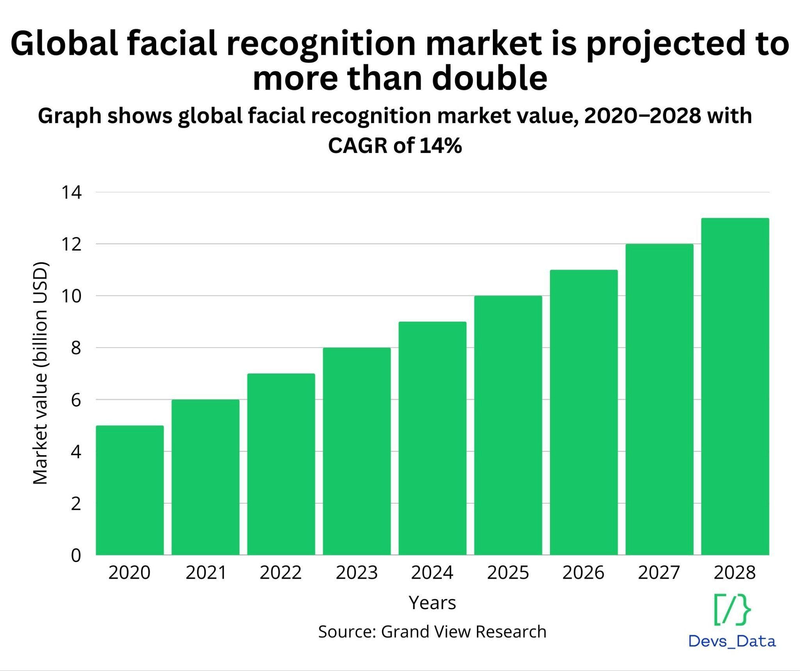
Businesses use face recognition software for several reasons: it enhances security by controlling access to sensitive areas or data, streamlines customer interactions through seamless identity verification, and offers fraud prevention in financial transactions. The global facial recognition market was valued at approximately $5 billion in 2020 and is projected to reach $13 billion by 2028, growing at a compound annual growth rate of 14% during this period. This growth is driven by increasing demand for security and surveillance applications in various industries.
Most importantly, it provides personalized services, data-driven marketing, and insights into customer engagement. Studies show that businesses using facial recognition can reduce customer wait times by up to 40%, particularly in the hospitality, retail, and travel sectors. Before exploring the companies that deliver face recognition software development services, let’s briefly discuss the technical background of facial recognition technology.
Recent advances in deep learning and on-device sensors pushed facial recognition into mass-market use. A significant milestone arrived in 2017 when Apple introduced Face ID on the iPhone X. That system used a TrueDepth module that combined an infrared camera and a dot projector to produce a depth map. On-device neural networks processed that map to authenticate users, improving accuracy and anti-spoofing compared with earlier 2D camera approaches. Biometric templates remained inside a secure enclave on the device, reducing exposure of personal data. This shift made biometric authentication available to millions and set a new standard for consumer-grade face recognition.
China has the most extensive implementation of facial recognition, with over 700 million surveillance cameras deployed across major cities, creating one of the world’s largest monitoring networks. These AI-powered systems integrate with the social credit system, tracking citizens’ behavior and compliance with social norms. While controversial, this implementation showcases the powerful combination of AI and facial recognition at an unprecedented scale.
The technical foundation of facial recognition relies on specialized neural networks within Deep Learning, utilizing architectures like YOLO (You Only Look Once) and Faster-RCNN.
Today, these technologies have become integral to Know Your Customer (KYC) solutions, where facial recognition serves as a cornerstone for identity verification in banking, finance, and various digital services, streamlining customer onboarding while enhancing security measures.
Modern facial recognition applications continue to expand, with Amazon Go stores using computer vision for cashierless shopping across the US. Customers log in through the Amazon app, scan a QR code to enter, and are tracked by cameras that combine facial recognition with figure-tracking to match them to items removed from shelves.
Face recognition development blends engineering trade-offs with legal and social constraints. Design choices determine operational limits and the kinds of errors a system will produce. Misjudging those limits raises costs and weakens stakeholder trust. The following challenges highlight critical technical and governance risks to address.
Where systems record identifiable images or stream video, public expectation and law diverge sharply. Passive capture in public spaces often triggers stricter notice and consent requirements. Left unchecked, capture pipelines also accumulate metadata that broadens compliance obligations and harms public trust.
Solution: Design products to minimize data capture and move matching to the device where feasible. Implement clear, auditable consent flows and short retention policies, and publish plain-language summaries of data practices.
Training sets that lack diverse representation cause uneven accuracy across user groups. Such disparities appear only after deployment and can produce false matches or missed matches that damage credibility. Legal and procurement teams then face difficult trade-offs when performance is not uniform.
Solution: Run targeted validation across defined demographic cohorts and operational scenarios. Maintain a versioned dataset registry, update models from measured gaps, and apply conservative thresholds where disparities exist.
Biometric templates act like permanent credentials once created, which raises stakes for breaches. Centralized storage increases the blast radius of an incident and invites secondary uses beyond the original scope. Remediation after compromise is complex and costly.
Solution: Store non-invertible templates and encrypt them both in transit and at rest. Limit retention to the minimum needed, log every access with tamper-evident records, and require contractual limits on downstream processing.
Models trained on controlled images often break when exposed to real capture conditions such as low light and heavy occlusion. Differences in camera hardware and framing change input statistics and reduce match rates in production. Over time, changing population characteristics or camera upgrades cause gradual performance drift.
Solution: Validate with datasets that mirror operational capture conditions and a range of device types. Deploy monitoring that tracks accuracy and triggers targeted retraining or safe rollback when drift exceeds defined thresholds.
Edge targets impose strict caps on model size, runtime latency, and power consumption. Fragmented device ecosystems complicate consistent behavior across platforms and increase regression risk during updates. Integration failures can interrupt downstream services and escalate support costs.
Solution: Apply hardware-aware model compression and profile inference on representative devices. Use automated contract tests, staged rollouts, and clear versioning with rollback paths to reduce the risk of deployment failures.
After outlining these development challenges and practical mitigations, let us explore the top agencies that provide face recognition software development services, highlighting companies with proven delivery records, documented case evidence, and strong privacy controls.
Here are the top picks for you to consider:

Website: www.devsdata.com
Team size: ~60 employees
Founded: 2016
Headquarters: Brooklyn, NY, and Warsaw, Poland
DevsData LLC specializes in face recognition software development, leveraging 8+ years of market expertise to deliver advanced solutions for businesses worldwide. Their team of US specialists combines deep technical knowledge with extensive experience in Big Data and Machine Learning, ensuring robust and scalable facial recognition implementations. Their team includes senior Computer Vision specialists and PhDs with extensive experience in the field, ready to discuss and explore potential ideas. With a perfect 5/5 rating on both Clutch and GoodFirms, DevsData LLC has established itself as a trusted partner for global corporate clients and high-growth startups from the US and Israel.

What sets DevsData LLC apart is its expertise in face recognition software development with a strong focus on biometric solutions and AI implementation. With developers having 10+ years of experience in facial recognition technology, they deliver secure, scalable recognition systems and customized biometric solutions that optimize security protocols. Their Google-level in-house engineers specialize in implementing advanced facial recognition algorithms, making complex technology accessible and effective for businesses of all sizes.
This expertise was notably demonstrated in a recent partnership with a defense contractor seeking sophisticated human recognition technology. The project required DevsData LLC to engineer a streamlined system for real-time human position analysis in video feeds. Despite the constraints of Nvidia Jetson hardware, their development team successfully integrated OpenCV technology with custom algorithms, creating an innovative solution that overcame the platform’s deep learning limitations.
By strategically combining C++ and Python programming for direct CUDA algorithm access, they developed a proprietary library that significantly enhanced processing efficiency. This demonstrates DevsData LLC’s expertise in face recognition software. The company provides liveness detection and on-device matching while optimizing performance for limited hardware. Follow this link to learn more about the company’s expertise and other successful projects.
Do you have IT recruitment needs?
To discover how DevsData LLC can elevate your business with customized face recognition software solutions, contact them at general@devsdata.com or visit their website at www.devsdata.com.
Website: https://www.prioxis.com/
Team size: ~250 employees
Founded: 2019
Headquarters: Ahmedabad, India
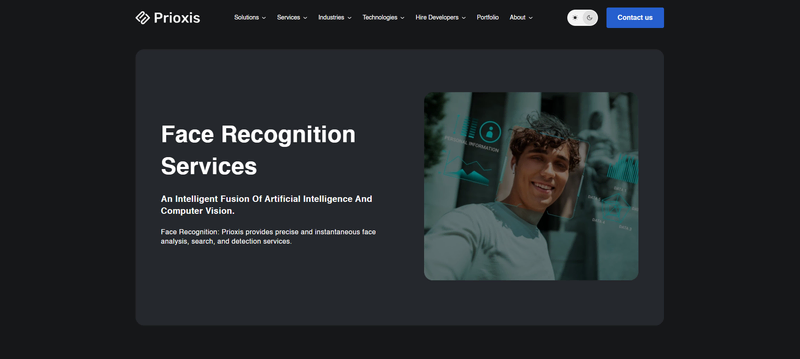
Prioxis Technologies specializes in biometric authentication systems with advanced facial recognition integration. Their engineering approach combines computer vision algorithms with artificial intelligence, delivering custom authentication solutions that process biometric data for security and access control applications.
Utilizing state-of-the-art technology, the company’s facial emotion recognition systems operate in real-time, enabling sophisticated sentiment tracking alongside user authentication. Built with proprietary anti-spoofing mechanisms and custom biometric verification protocols, the platform seamlessly integrates facial recognition capabilities with existing security infrastructure while maintaining strict compliance requirements.
Website: https://itrexgroup.com/
Team size: ~1000 employees
Founded: 2009
Headquarters: Aliso Viejo, CA
ITRex Group delivers sophisticated facial recognition solutions with an emphasis on security analytics. Leveraging a team of 300+ specialists, they combine computer vision with advanced behavior analytics to create enterprise-grade authentication systems, specializing in multi-environment facial geometry analysis and real-time detection frameworks.
Advanced multi-point facial geometry analysis systems maintain accuracy despite partial obstructions and varying lighting conditions, while customized industry-specific solutions incorporate behavioral analytics capabilities that integrate seamlessly with existing security infrastructure.
Website: https://devoxsoftware.com/
Team size: ~250 employees
Founded: 2017
Headquarters: Kyiv, Ukraine
Devox Software has developed custom facial recognition solutions, integrating AI-driven security systems since 2017. Their development process encompasses real-time identification systems, mobile applications, and cloud-based solutions, serving clients across 16 countries with a specialized focus on biometric authentication and surveillance systems.
Featuring advanced anti-spoofing technologies and customizable matching thresholds, the platform delivers consistent facial recognition accuracy across varying environmental conditions. Enhanced with mobile-first applications, the system offers multi-factor authentication capabilities and remote monitoring functions, supported by scalable solutions with integrated analytics for user behavior tracking and large-scale monitoring capabilities.

Website: https://www.opencv.ai/
Team size: ~250 employees
Founded: 2017
Headquarters: Palo Alto, CA
OpenCV.ai represents the professional consulting division of OpenCV.org, specializing in multi-face detection systems and custom computer vision solutions. Their approach leverages the world’s largest open-source Computer Vision library to deliver enterprise-grade facial recognition implementations.
Equipped with advanced multi-face detection algorithms, OpenCV.ai’s solutions can process multiple subjects simultaneously, even in challenging environments. The facial authentication systems include irreversible blurring features to ensure GDPR compliance and meet data protection standards, while the emotion detection frameworks assess facial expressions to provide valuable insights into customer engagement and behavior.
Having analyzed frontrunners in facial recognition systems, our research reveals additional specialized agencies shaping the biometric identification landscape.
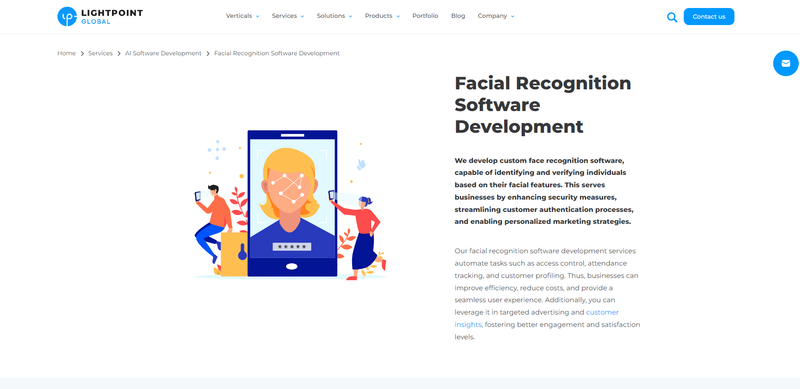
Website: https://lightpointglobal.com/
Team size: ~250 employees
Founded: 2011
Headquarters: Warsaw, Poland
Lightpoint Global operates as a software development company with 100+ specialists, delivering facial recognition solutions alongside their broader technology services, including cloud-native enterprise applications and IoT systems integration. Comprehensive in scope, the company’s facial recognition development encompasses both 2D and 3D recognition systems, successfully deployed across ePublishing, MarTech, FinTech, and healthcare sectors.
Website: https://chisw.com/
Team size: ~1000 employees
Founded: 2006
Headquarters: Limassol, Cyprus
CHI Software is a facial recognition software development company with experience in AI solutions and virtual assistant development. Built with precision, the platform’s facial recognition solutions integrate emotional detection, age/gender analysis, and skin anomaly detection capabilities. Their team of AI engineers delivers end-to-end development, from initial research and consulting to deploying complex AI software solutions, ensuring tailored facial recognition systems for diverse industry needs.
Website: https://www.cognitec.com/
Team size: ~200 employees
Founded: 2002
Headquarters: Dresden, Germany
Cognitec Systems emerges as a premier provider of biometric solutions for the transportation sector, leveraging its FaceVACS technology to enhance security and operational efficiency. Since 2002, this German-based innovator has revolutionized facial recognition implementations worldwide across airports and train stations, delivering real-time monitoring capabilities that excel in high-traffic environments. Their customizable solutions, backed by independently verified performance metrics, ensure seamless integration with existing security infrastructure.
Website: https://www.nec.com/
Team size: ~10000 employees
Founded: 1899
Headquarters: Tokyo, Japan
NEC Corporation is a pioneering force in banking security solutions, leveraging over half a century of biometric expertise to revolutionize financial authentication systems. Their facial recognition technology, consistently ranking highest in NIST evaluations with 99% accuracy, transforms banking security through AI-powered verification systems. With implementations across 70 countries, NEC’s NeoFace technology has become the cornerstone of modern banking fraud prevention, enabling secure transactions and identity verification for financial institutions worldwide.
Website: https://www.clearview.ai/
Team size: ~50 employees
Founded: 2017
Headquarters: New York City, NY
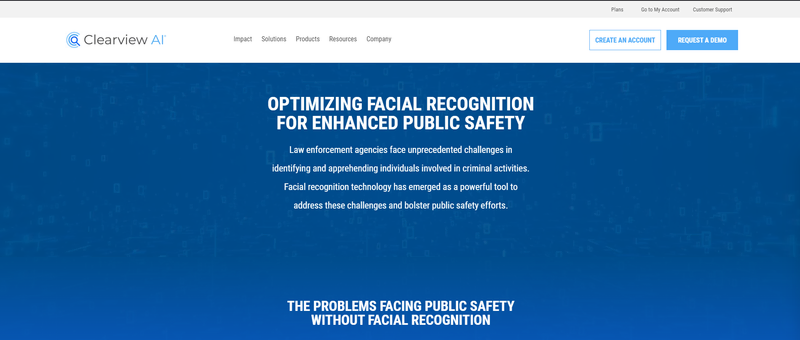
Clearview AI is an American tech company that has revolutionized criminal investigations through its expansive over 50 billion facial images. By integrating sophisticated biometric algorithms with comprehensive public data analysis, their platform empowers law enforcement agencies to process and identify suspects rapidly. This technological breakthrough has transformed traditional investigative methodologies, enabling agencies across jurisdictions to accelerate case resolution and enhance public safety measures.
Website: https://www.facefirst.com/
Team size: ~200 employees
Founded: 2012
Headquarters: Austin, TX
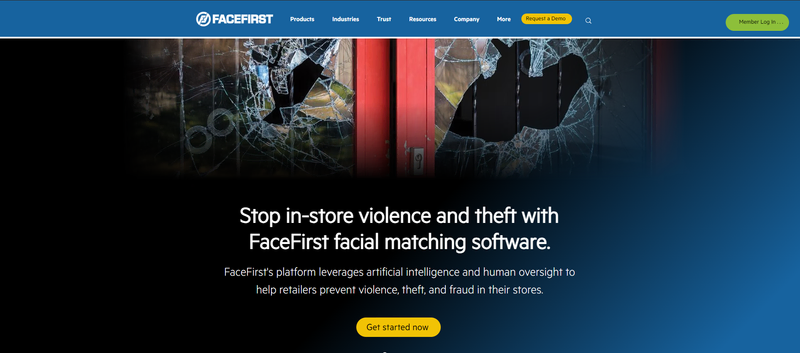
FaceFirst, headquartered in Austin, combines advanced AI algorithms with human oversight to deliver comprehensive facial matching solutions for diverse security environments. Their patented video analytics platform streamlines loss prevention and safety protocols across retail, healthcare, and entertainment sectors. Through seamless integration with existing surveillance systems, FaceFirst transforms security operations while maintaining stringent privacy standards and ethical compliance.
Website: https://www.innovatrics.com/
Team size: ~200 employees
Founded: 2004
Headquarters: Bratislava, Slovakia
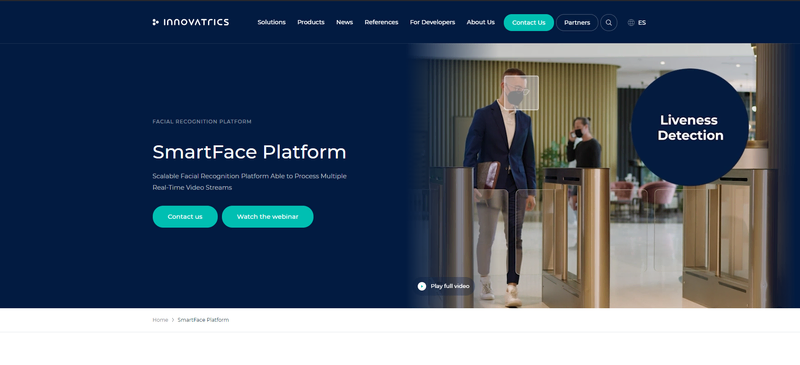
Innovatrics, an independent EU-based biometric solutions provider, has established its dominance through high-speed, large-scale identity verification systems deployed across 80 countries. Their proprietary algorithms, consistently ranking among the fastest in NIST tests, have processed over a billion identities worldwide. Since 2004, this technological powerhouse has revolutionized trust-building in government and enterprise sectors through advanced biometric innovations.
Do you have IT recruitment needs?
Face recognition software development offers businesses a significant competitive advantage in today’s tech-driven world by enabling fast, accurate, and secure identity verification systems. Companies across industries can seamlessly integrate facial recognition into their operations, improving both security and user experience without the complexities associated with traditional authentication methods. Outsourcing the development of face recognition software allows businesses to access specialized expertise in biometric technology, ensuring the creation of robust and scalable solutions. By optimizing security protocols and streamlining customer interactions, outsourcing facial recognition development helps organizations stay competitive in an evolving market and achieve their long-term goals.
For businesses seeking specialized face recognition software development services, DevsData LLC is a premier partner. With over 8 years of experience in software development and IT talent acquisition, DevsData LLC is renowned for delivering custom face recognition solutions tailored to meet the specific needs of each client.
DevsData LLC‘s success fee model makes their face recognition development services risk-free and fully aligned with client goals, providing peace of mind and ensuring businesses derive maximum value from their investment. As a strategic partner with a team of US specialists, DevsData LLC is committed to helping companies navigate the complexities of face recognition software development efficiently and effectively.
To learn more about how DevsData LLC can enhance your business with expert face recognition software development services, contact them at general@devsdata.com or visit their website at www.devsdata.com.
Any questions or comments? Let me know on Twitter/X.
Discover how IT recruitment and staffing can address your talent needs. Explore trending regions like Poland, Portugal, Mexico, Brazil and more.
 Frequently asked questions (FAQ)
DevsData – your premium technology partner
DevsData is a boutique tech recruitment and software agency. Develop your software project with veteran engineers or scale up an in-house tech team of developers with relevant industry experience.
Free consultation with a software expert
🎧 Schedule a meeting
FEATURED IN


DevsData LLC is truly exceptional – their backend developers are some of the best I’ve ever worked with.”

Nicholas Johnson
Mentor at YC, serial entrepreneur


 Build your project with our veteran developers.
Explore the benefits of technology recruitment and tailor-made software.
Learn how to source skilled and experienced software developers.
Build your project with our veteran developers.
Explore the benefits of technology recruitment and tailor-made software.
Learn how to source skilled and experienced software developers.

Rebecca Botvin

Commercial Director

Tom Potanski
Manager




Categories: Big data, data analytics | Software and technology | IT recruitment blog | IT in Poland | Content hub (blog)
















careers@devsdata.com









general@devsdata.com

"I interviewed about a dozen different firms. DevsData LLC is truly exceptional – their backend developers are some of the best I've ever worked with. I've worked with a lot of very well-qualified developers, locally in San Francisco, and remotely, so that is not a compliment I offer lightly. I appreciate their depth of knowledge and their ability to get things done quickly."

Nicholas Johnson
CEO of Orange Charger LLC,
Ex-Tesla Engineer,
Mentor at YCombinator
"DevsData reached out to us, as we've been looking to grow our engineering team in Europe and Poland. Communicating efficiently and professionally, DevsData made a strong impression with their understanding of the recruitment challenges we were facing. They designed a tailored recruitment process for our needs. I was impressed with the technical depth of their approach."

Karim Butt
Co-Founder & CTO at GlossGenius, Inc.
"Out of all the vendors we work with, DevsData clearly stands out. The quality of developers they deliver is beyond what we've received from any other vendor, and they've been able to send profile recommendations very quickly. I'm happy to be their reference for other companies from Israel and talk about their recruitment abilities and what they delivered for us."

Ran Eyal
Senior Manager at
ZIM Integrated
Shipping Services Ltd.
"DevsData demonstrated a strong degree of proactivity, taking time to thoroughly understand the problem and business perspective, and continuously suggesting performance and usability enhancements. Their app exceeded my expectations. I've worked with DevsData on numerous projects over the last 3 years and I'm very happy. Being both responsive and honest in communication."

Jonas Lee
Partner & Executive VP of Verus,
Financial LLC, Investor,
& Serial Entrepreneur
Acknowledgments