Thanks for subscribing.
Your gift is on the way.



The global recruitment landscape is undergoing a significant transformation, with the staffing and recruitment market projected to grow to $2031.34 billion by 2031, reflecting a compound annual growth rate (CAGR) of 13.1%. This trend highlights the shifting dynamics of workforce demands across various industries.
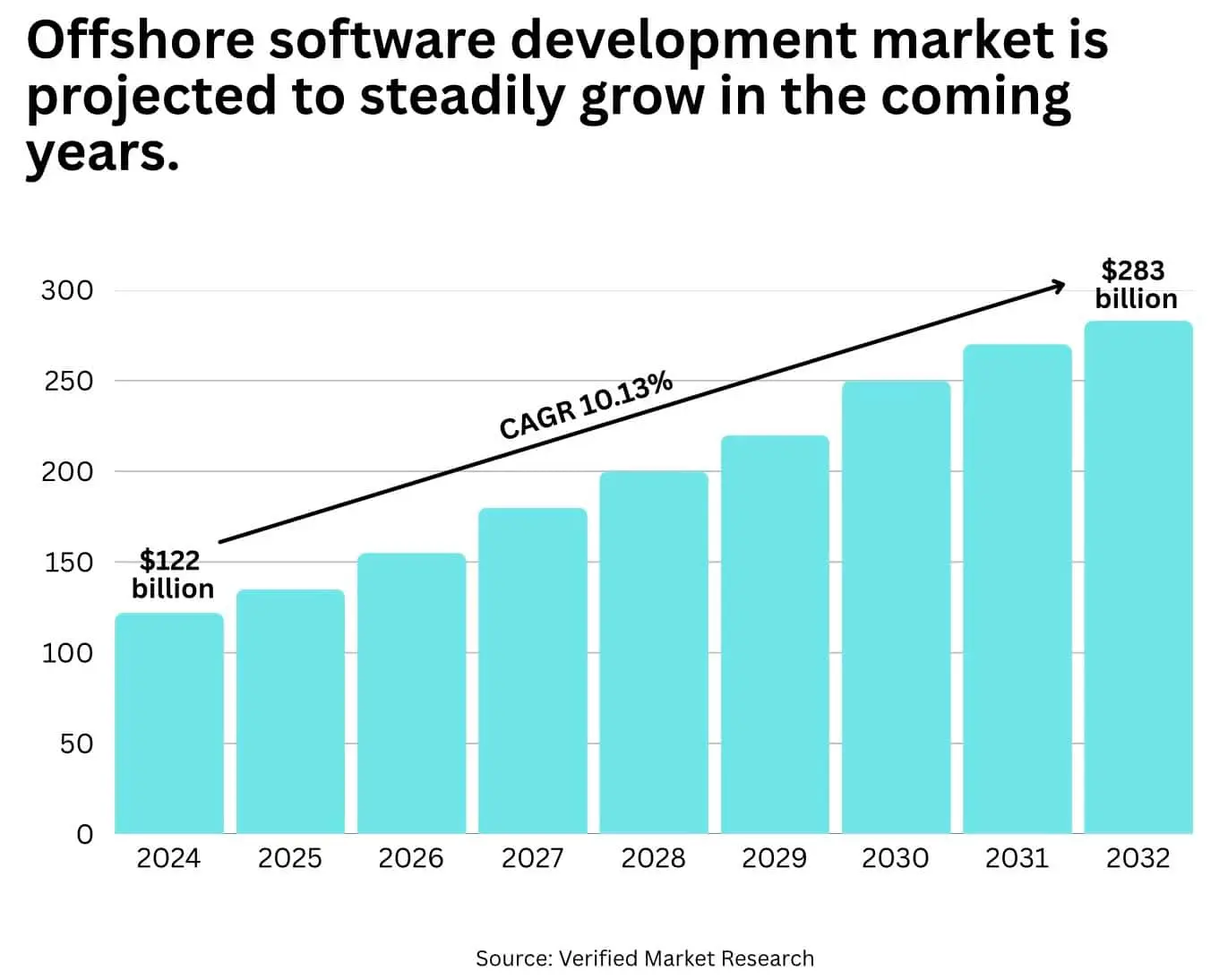
In response to this demand, many companies have turned to offshore software development. The offshore software development market was valued at $122 billion in 2024 and is projected to reach $283 billion by 2032. While offshoring offers cost advantages and access to a global talent pool, it also presents challenges such as time zone differences, cultural disparities, and communication barriers.
As businesses strive to remain competitive, it’s imperative to explore innovative recruitment strategies that not only address the growing demand for talent but also mitigate the challenges associated with traditional offshoring. One such strategy is the establishment of a Dedicated Development Center (DDC). A DDC serves as an extension of a company’s in-house team, providing dedicated resources and infrastructure tailored to the organization’s specific needs.
In this article, we will provide an overview of the concept of Dedicated Development Centers, examining their structure, functions, and the potential benefits they offer to businesses seeking to enhance their development capabilities.
A Dedicated Development Center (DDC) is a strategic model where a company establishes a specialized team of software engineers in a different region or country. This team operates exclusively for the company, aligning with its objectives and integrating seamlessly with its in-house operations. Unlike traditional outsourcing or outstaffing, a DDC functions as an extension of the company’s internal team, maintaining the organization’s standards, culture, and brand identity. This extends to technical parity: DDC teams adopt the client’s CI/CD pipelines, definition of done (DoD), and coding standards to ensure consistent output across locations.
The primary advantage of a DDC lies in its ability to provide access to a diverse talent pool, often in regions with a high concentration of skilled professionals. Teams can be structured with a deliberate seniority mix, combining senior architects with mid-level and junior engineers to balance cost efficiency and technical leadership. This approach not only addresses the challenges of local talent shortages but also offers cost efficiencies due to varying economic conditions across countries. By having a dedicated team, companies can ensure that the development process is tailored to their specific needs, with direct oversight and control over project timelines, quality, and outcomes.
Establishing a DDC involves setting up a physical office space equipped with the necessary infrastructure and resources to support the development team’s activities. In practice, many DDCs now operate on a hybrid basis, with team members splitting time between the office and remote work depending on project phase and collaboration needs. This setup fosters a cohesive working environment, promoting collaboration and effective communication between the remote team and the company’s headquarters. Additionally, the team’s focused commitment fosters a deep understanding of the company’s products, services, and goals, leading to more innovative and customized solutions.
Many industry leaders have successfully implemented the DDC model to enhance their development capabilities. For instance, Microsoft has established dedicated software centers in various regions, such as India, Serbia, and the UAE, to leverage local expertise and drive innovation. This approach allows the company to tap into specialized talent pools, accelerate product development, and tailor solutions to regional market needs, strengthening its global presence and technological leadership.
A Dedicated Development Center is built upon a carefully designed framework that supports its operations and ensures its efficiency. Below is an overview of its key structural elements and how they drive development success.
The foundation of any DDC lies in its physical and operational setup, along with the development team. Each element plays a distinct role in maintaining productivity and ensuring smooth project execution.
The physical office serves as the central hub of a Dedicated Development Center. This is where software engineers collaborate, brainstorm, and execute tasks. The setup typically involves leasing office space, creating workstations, and providing the necessary hardware and software to support efficient operations. Many DDCs also provision virtual desktop infrastructure (VDI) and cloud development environments such as GitHub Codespaces or AWS Cloud9, which strengthen security controls while enabling remote access to standardized toolchains. This environment fosters team collaboration, ensures progress tracking, and addresses technical challenges, all essential for smooth product development.
A robust engineering team is fundamental to the DDC model. The team’s composition can be customized to fit specific project needs and may include frontend and backend developers, full stack engineers, QA engineers, UI/UX designers, and tech leads. With complete control, companies decide on team size and specialization to align with their objectives.
A DDC’s success relies heavily on back-office operations, including IT recruitment, HR management, legal compliance, payroll, and accounting. These functions ensure the seamless management of the center. Many businesses choose to delegate these tasks to local service providers, allowing them to focus entirely on product development while leaving operational complexities to experienced professionals.
Do you have IT recruitment needs?
The functions of a DDC are what set it apart from other operational models. These aspects demonstrate how it contributes to business goals and enhances development processes.
DDCs enable businesses to allocate resources efficiently, ensuring that specialized teams handle specific projects while the on-site team focuses on strategic initiatives. This structure prevents resource dilution and allows companies to maintain a clear focus on core objectives. Research from the Carnegie Mellon Software Engineering Institute shows that a developer assigned to five projects simultaneously operates at roughly 20% productive capacity, with the remaining 80% lost to context switching. McKinsey’s Developer Velocity Index found that companies in the top quartile for developer focus and tooling achieved 4 to 5 times faster revenue growth than bottom-quartile companies. At the same time, a DDC offers flexibility by enabling businesses to scale teams, adjust skill sets, and shift project priorities as needed. This adaptability ensures a responsive workforce that can quickly align with evolving business demands, making the development process both efficient and scalable.
By directly managing internal processes, DDCs eliminate the high markups often associated with outsourcing providers. Companies can hire skilled developers at competitive rates, particularly in regions like Eastern Europe and Latin America, where salaries are significantly lower than in the US or Western Europe.
A DDC gives companies full control over development processes, enabling them to oversee operations, make real-time decisions, and seamlessly integrate their corporate culture. Unlike traditional outsourcing, a DDC operates under the employer’s brand, fostering a sense of ownership and cohesion among team members. This alignment not only enhances productivity and morale but also ensures higher-quality outcomes by creating a work environment that reflects the company’s values and long-term vision.
A DDC provides a secure environment where intellectual property and sensitive data remain fully under the company’s control, minimizing risks associated with third-party involvement. Adopting a Zero Trust Architecture, where every access request is verified regardless of network location, further strengthens this control for distributed DDC teams. Unlike traditional outsourcing, where external vendors may handle confidential information, a DDC ensures that all data, infrastructure, and development processes are managed internally, reducing exposure to security breaches and unauthorized access. This model also simplifies compliance with industry regulations and data protection laws, as businesses can implement their own security protocols, access controls, and monitoring systems. By maintaining full ownership of development assets and safeguarding critical information, a DDC helps companies mitigate cybersecurity threats and maintain long-term operational integrity.
Determining whether your business would benefit from establishing a Dedicated Development Center (DDC) involves assessing specific indicators that suggest this model aligns with your operational needs and strategic goals. Here are key factors to consider:
If your projects require expertise that your current team lacks, or if you’re venturing into new technological domains, a DDC can provide access to professionals with niche skills. From software engineers to UI/UX designers and data scientists, a dedicated team is tailored to your requirements. This ensures you have the right talent to innovate, enhance product quality, and maintain a competitive edge in your industry.
Hiring developers and running operations in regions like Eastern Europe or Latin America can result in significant cost savings. For example, a senior full stack engineer in Poland earns about $73000 annually, compared to $153000 in the US. Beyond salaries, companies save on operational expenses, including office leases, equipment, and facilities. This allows businesses to allocate resources to strategic priorities such as innovation and employee retention programs.
For businesses focused on long-term projects, a DDC provides continuity with a dedicated team that integrates with your company’s processes and culture. Over time, this team gains in-depth knowledge of your products and goals, enabling greater efficiency and alignment. This consistency is crucial for maintaining momentum, reducing onboarding times, and ensuring that your strategic objectives are met without disruptions or delays.
When local hiring falls short of meeting technical or volume demands, a Dedicated Development Center (DDC) can bridge the gap. Establishing a presence in regions with strong IT talent pools enables businesses to access skilled professionals quickly and cost-effectively, minimizing hiring delays and keeping projects on track.
Beyond talent acquisition, a DDC offers the flexibility to scale teams as project requirements evolve. Whether expanding with specialized developers or downsizing post-project, this model allows seamless adjustments without the burdens of full-time hiring or layoffs. This adaptability helps businesses stay competitive, optimize resources, and respond efficiently to market changes.
Managing a DDC allows your in-house team to focus on strategic priorities while delegating routine development tasks. This model ensures you aren’t bogged down by operational challenges, such as recruitment or administrative issues. By freeing up internal resources, companies can enhance their decision-making processes, improve operational efficiency, and dedicate more time to growth, innovation, and customer engagement.
If you’re entering a new market, a DDC can help overcome local operational challenges, such as navigating legal requirements, tax systems, and cultural nuances. Collaborating with a reliable local partner ensures compliance and operational efficiency, allowing you to adapt quickly and save time. Additionally, establishing a presence in a strategic location helps businesses tap into new customer bases and expand their market reach effectively. A DDC in a complementary time zone also enables a “follow the sun” workflow, where development or support tasks continue across shifts without downtime.
One of the defining differences between a Dedicated Development Center (DDC) and traditional outsourcing is how talent is employed and retained. In a DDC, developers and other specialists are hired to work exclusively for one company rather than being assigned to multiple clients. Depending on the setup, they may be contracted directly by the parent company or through a local service provider that manages legal and administrative aspects, but in practice, they operate as long-term employees of the client organization.
This employment model fosters stronger loyalty and lower turnover. ISG reported that IT outsourcing vendor attrition exceeded 21% during market tightness, running 500 to 1000 basis points above historical norms, and identified this churn as a primary driver pushing enterprises toward captive center models. Deloitte’s 2024 Global Outsourcing Survey confirmed the shift: 70% of executives had selectively insourced scope previously handled by third parties over the preceding five years, citing turnover at service providers as a key concern. McKinsey’s Developer Velocity Index found that organizations with top-quartile developer focus and retention practices achieved 47% higher developer satisfaction compared to bottom-quartile companies.
Because DDCs are built for ongoing collaboration and continuity, employees often stay longer than in project-based outsourcing setups. They benefit from career stability, the opportunity to work on complex, long-term projects, and closer alignment with the company’s vision. This combination of stability and ownership drives commitment, improves productivity, and reduces the costs associated with frequent turnover.
Dedicated Development Centers (DDCs) operate under several models, each designed to address specific business needs and strategic goals. Choosing the right model depends on factors like your level of control, operational preferences, and long-term objectives. Below are the key DDC models:
The BOT model involves partnering with a local vendor to establish a Dedicated Development Center in a foreign location. The vendor manages recruitment, legal compliance, payroll, and daily operations during the setup and initial operational phases. Once the center is fully operational, it transitions to the client. While the model is cost-efficient and provides access to local expertise, the transfer phase can cause disruptions in team dynamics, knowledge sharing, and productivity due to potential miscoordination. Conducting a transfer readiness audit before the handover, covering documentation completeness, team retention commitments, and infrastructure ownership, can reduce these risks.
A hybrid DDC combines on-site teams located in the business’s country with remote teams operating from other regions. This model allows the enterprise to balance proximity for critical operations with cost savings and access to global talent. The hybrid approach is ideal for organizations seeking flexibility and operational synergy across multiple locations.
In the partnered DDC model, the company establishes its own office abroad with a dedicated team of full-time developers. Unlike the BOT model, the business retains full control of the office, personnel, documentation, and intellectual property from the outset. A development office services provider typically handles back-office tasks like recruitment, payroll, legal compliance, and office maintenance. Meanwhile, core operations, such as team management and product development, remain the client’s responsibility, ensuring greater oversight and seamless integration with business objectives.
Do you have IT recruitment needs?
When considering strategies for expanding development capabilities, businesses often face the decision between outsourcing and establishing a DDC. While both approaches provide access to global talent and cost advantages, they differ significantly in terms of control, team integration, and long-term alignment with company goals. The following comparison highlights the main differences between outsourcing and DDC, helping businesses choose the model best suited to their needs and objectives.
| Aspect | Outsourcing | Dedicated Development Center (DDC) |
|---|---|---|
| Control | Limited control over the team and processes. | Full control over team, processes, and development activities. |
| Team integration | External vendors may not fully align with the company culture. | The team works as an extension of the company, integrating seamlessly with the culture. |
| Data security | Potential risks with third-party data handling. | Full control over intellectual property and sensitive data, minimizing external risks. |
| Customization | Limited ability to customize the team or process. | High customization based on specific project needs and company goals. |
| Scalability | Scalability depends on vendor capabilities. | Flexible scalability, allowing businesses to adjust team size and skills as needed. |
| Cost efficiency | It can be cost-effective but may include hidden costs and less control. | Cost-effective, especially in regions with lower labor costs, with better cost predictability and control. |
| Team ownership | The team is typically managed by the outsourcing vendor. | The team is fully dedicated to the company, fostering ownership and commitment. The DDC team develops fluency in the product’s business logic, not only its codebase. |
| Communication | Challenges in communication due to time zone differences and cultural gaps. | Direct communication and collaboration are closely aligned with the company’s core team. |
| Flexibility | Less flexible in terms of scaling or shifting focus. | Highly flexible, adapting to project changes, skill requirements, and team scaling. |
| Long-term alignment | Short-term focus with less alignment to long-term goals. | Long-term focus with alignment to the company’s ongoing objectives and vision. |
The delivery performance gap is measurable. According to the 2024 DORA Accelerate State of DevOps Report by Google Cloud, elite-performing teams, which share the autonomous, stable structure of a DDC, deploy on demand (multiple times per day) and recover from failures in under one hour. Low performers deploy monthly to every six months and require one week to one month for recovery.
A Dedicated Development Center is not external support: it operates as an integrated extension of the company, preserving control, culture, and long-term strategic alignment.
Building a Dedicated Development Center (DDC) is a complex process that requires careful planning and execution. However, businesses often encounter challenges that can compromise the success of their efforts. Below are common mistakes and how to avoid them.
Hiring several service providers to handle different aspects of your offshore delivery center might seem practical, but it often leads to miscoordination and delays. Each provider operates independently, making it challenging to maintain a cohesive workflow. This fragmentation increases costs and reduces efficiency. A better alternative is partnering with a single, reliable business process outsourcing service provider capable of managing all back-office operations, an arrangement often referred to as the Master Services Integrator (MSI) approach. This approach ensures seamless processes, reduces administrative burdens, and keeps your DDC running smoothly.
Employer branding is often overlooked during market entry, but it plays a vital role in attracting top talent. A lack of visibility and clarity about your company’s values, culture, and career opportunities may deter potential candidates, leading to rejected offers. To address this, implement a robust employer branding strategy that includes a compelling employee value proposition (EVP), active participation in local developer communities, and targeted PR and social media campaigns. This will position your company as an attractive employer, increasing your chances of securing high-quality hires.
Securing suitable office space can be a significant hurdle when setting up a DDC in a foreign country. Overlooking essential factors like ventilation, electrical systems, soundproofing, and utilities can lead to operational inefficiencies. Additionally, landlords may demand higher rents, further complicating the process. Conducting thorough research on local rental markets and understanding lease structures is critical. Collaborating with a local service provider can simplify these challenges, as they offer expertise in negotiating leases and ensuring compliance with local regulations.
A less visible but more damaging mistake is excluding DDC engineers from the parent company’s code review workflow. When DDC-produced code bypasses the main review pipeline, technical debt accumulates without oversight. McKinsey estimates that technical debt amounts to 20 n 40% of the value of a company’s entire technology estate, and that 10 n 20% of the budget for new products is diverted to resolving debt-related issues. Research found that structured code reviews at rates below 200 lines of code per hour catch over 50% of defects before they reach production. To prevent this, DDC teams should participate in the same pull request reviews, CI/CD checks, and definition of done (DoD) standards as the headquarters team from day one.
Protecting intellectual property is crucial when establishing a DDC, especially in countries with varying legal systems. Neglecting this aspect exposes your business to risks, even if you hire your own developers. To safeguard your assets, it’s essential to draft comprehensive non-disclosure agreements (NDAs) tailored to the region’s legal framework. Partnering with local legal experts ensures that these agreements address all necessary nuances, providing maximum protection for your company’s IP and ensuring compliance with local laws.
Website: www.devsdata.com
Company size: ~60 employees
Founding year: 2016
Headquarters: Brooklyn, NY, and Warsaw, Poland
DevsData LLC offers expert support for businesses looking to establish a Dedicated Development Center, with extensive experience in collaborating with both global corporate clients and high-growth startups. The company has worked across multiple countries, including the US and Israel, and has built a proven track record of scaling teams and delivering high-quality development solutions.
One of the key advantages of working with DevsData LLC is its access to a vast talent pool. With a database of over 95000 candidates, the company can source top-tier developers and technical professionals from across a wide range of regions. This network is bolstered by their government-approved recruitment license, which enhances the company’s ability to find suitable candidates in various countries while maintaining full legal compliance.
DevsData LLC operates on a success-fee model, ensuring a risk-free hiring process for businesses looking to expand their teams through a DDC. This approach means clients pay only for successful hires, and the company offers a guarantee period to ensure satisfaction. The risk-free structure helps alleviate concerns about recruitment and provides peace of mind as businesses scale their teams.
The recruitment process at DevsData LLC is rigorous and designed to identify the most qualified candidates. One of the key steps is a 90-minute problem-solving challenge that assesses technical proficiency, communication skills, and the ability to handle complex tasks. This ensures that only the most skilled developers with exceptional problem-solving capabilities are selected. The focus on communication skills further ensures that hired professionals can collaborate effectively with teams across borders, a crucial aspect when building a DDC.
Beyond recruitment, DevsData LLC also supports clients with the operational aspects of establishing a DDC, including HR management, legal compliance, payroll, and office infrastructure. This end-to-end approach ensures that businesses not only secure top talent but also maintain a fully functional and compliant development center capable of scaling smoothly. The company has earned a perfect 5/5 rating on platforms like Clutch and GoodFirms, underscoring its commitment to delivering top-quality services.
A prime example of their work is a recruitment case for a demanding financial institution, where DevsData LLC played a pivotal role in establishing an entire engineering branch for the client. This project required sourcing highly specialized technical talent and streamlining the recruitment process to meet strict requirements. DevsData LLC leveraged its robust recruitment process to build a skilled team, helping establish a dedicated engineering unit aligned with the development center’s goals.
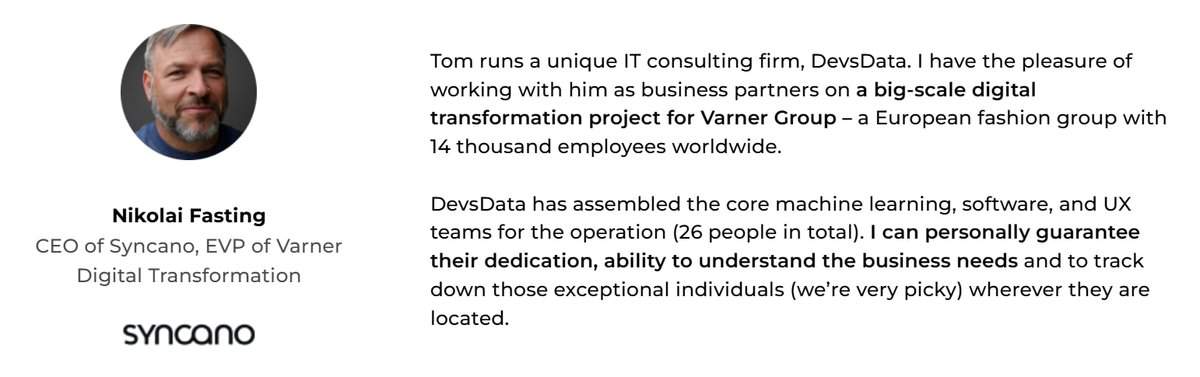
DevsData LLC’s proven success is reflected in their track record, having completed over 100 projects for more than 80 businesses. Their experience spans multiple industries and project types, enabling them to tailor their solutions to your specific needs. Whether you are setting up a DDC to cut costs, expand into new markets, or scale your team, DevsData LLC provides the expertise, talent, and support required to build and manage a successful Dedicated Development Center.
Do you have IT recruitment needs?
Contact DevsData LLC at general@devsdata.com or explore their services at www.devsdata.com.
Establishing a Dedicated Development Center (DDC) enables companies to expand development capacity while keeping control over operations and team dynamics. Unlike outsourcing, a DDC functions as part of the organization itself, aligning with its culture, workflows, and long-term vision. This approach reduces dependency on third parties and provides stability for scaling initiatives.
A DDC enables companies to scale development capacity while retaining ownership of processes, talent, and intellectual property.
Another advantage lies in security and customization. Sensitive data and intellectual property remain under the company’s direct oversight, while the structure of the DDC, whether build-operate-transfer (BOT), hybrid, or partnered, can be tailored to specific goals. With a model designed for ownership and continuity, businesses can strengthen their global presence, optimize resources, and support sustainable growth.
Common mistakes to avoid when building a DDC include engaging multiple service providers, neglecting employer branding, overlooking office details, and failing to secure proper IP rights protection. These pitfalls can lead to delays, increased costs, and complications in managing a DDC. Therefore, businesses must be meticulous in their planning and execution, collaborating with trusted partners who understand local markets and legal frameworks.
DevsData LLC stands out as a trusted partner for businesses looking to set up and scale their Dedicated Development Centers. With a proven track record of over 100 successful projects and a database of 95000 candidates, they provide tailored hiring solutions for clients across countries like the US and Israel. DevsData LLC operates on a success-fee model, offering risk-free hiring with a guarantee period. With a perfect 5/5 rating on Clutch and GoodFirms, DevsData LLC is the go-to partner for companies seeking to scale their development operations seamlessly.
Ready to build your own Dedicated Development Center? Partner with DevsData LLC to access top global talent, streamline operations, and establish a long-term foundation for growth. Contact the firm today at general@devsdata.com or explore more at www.devsdata.com.
Any questions or comments? Let me know on
Twitter/X.
Discover how IT recruitment and staffing can address your talent needs. Explore trending regions
like Poland, Portugal, Mexico, Brazil and more.
 Frequently asked questions (FAQ)
DevsData – your premium technology partner
DevsData is a boutique tech recruitment and software agency. Develop your software project with veteran engineers or scale up an in-house tech team of developers with relevant industry experience.
Free consultation with a software expert
🎧 Schedule a meeting
FEATURED IN

DevsData LLC is truly exceptional – their backend developers are some of the best I’ve ever worked with.”

Nicholas Johnson
Mentor at YC, serial entrepreneur


 Build your project with our veteran developers.
Explore the benefits of technology recruitment and tailor-made software.
Learn how to source skilled and experienced software developers.
Build your project with our veteran developers.
Explore the benefits of technology recruitment and tailor-made software.
Learn how to source skilled and experienced software developers.

Rebecca Botvin

Commercial Director

Tom Potanski
Manager




Categories: Big data, data analytics | Software and technology | IT recruitment blog | IT in Poland | Content hub (blog)














careers@devsdata.com









general@devsdata.com

"I interviewed about a dozen different firms. DevsData LLC is truly exceptional – their backend developers are some of the best I've ever worked with. I've worked with a lot of very well-qualified developers, locally in San Francisco, and remotely, so that is not a compliment I offer lightly. I appreciate their depth of knowledge and their ability to get things done quickly."

Nicholas Johnson
CEO of Orange Charger LLC,
Ex-Tesla Engineer,
Mentor at YCombinator
"DevsData reached out to us, as we've been looking to grow our engineering team in Europe and Poland. Communicating efficiently and professionally, DevsData made a strong impression with their understanding of the recruitment challenges we were facing. They designed a tailored recruitment process for our needs. I was impressed with the technical depth of their approach."

Karim Butt
Co-Founder & CTO at GlossGenius, Inc.
"Out of all the vendors we work with, DevsData clearly stands out. The quality of developers they deliver is beyond what we've received from any other vendor, and they've been able to send profile recommendations very quickly. I'm happy to be their reference for other companies from Israel and talk about their recruitment abilities and what they delivered for us."

Ran Eyal
Senior Manager at
ZIM Integrated
Shipping Services Ltd.
"DevsData demonstrated a strong degree of proactivity, taking time to thoroughly understand the problem and business perspective, and continuously suggesting performance and usability enhancements. Their app exceeded my expectations. I've worked with DevsData on numerous projects over the last 3 years and I'm very happy. Being both responsive and honest in communication."

Jonas Lee
Partner & Executive VP of Verus,
Financial LLC, Investor,
& Serial Entrepreneur
Acknowledgments