Thanks for subscribing.
Your gift is on the way.



As businesses seek cost-effective solutions for their IT needs, nearshore outsourcing has become a strategic approach. In Latin America, Colombia and Uruguay have emerged as attractive destinations for technology outsourcing, each offering unique advantages.
Colombia boasts a rapidly growing IT sector, with projections of Statista indicating a compound annual growth rate (CAGR) of 9.43% from 2025 to 2029. Uruguay, though smaller in scale, is also experiencing significant growth, with its CAGR of 8.03% over the same period.
These figures reflect a broader regional trend: Latin America’s digital services sector is expanding steadily, supported by increasing government investment, improved connectivity, and a strategic focus on exporting technology services.
This article explores the comparative strengths of Colombia and Uruguay in the nearshore IT outsourcing landscape. By exploring critical factors such as market potential, talent availability, salary rates, and time zone compatibility, we aim to provide a clear picture of what each country offers. Whether you’re a startup looking to scale efficiently or a corporation seeking to optimize in IT operations, understanding these two dynamic markets is essential for making an informed decision.
Both Colombia and Uruguay present promising landscapes for nearshore IT outsourcing, each demonstrating significant market potential and growth trajectories.
Colombia’s Information Technology (IT) market is experiencing significant expansion. A Verified Market Research reports that in 2024, the market was valued at approximately $8.2 billion and is projected to reach $15.7 billion by 2031.
This growth is fueled by several key factors, including government initiatives promoting digital transformation, rising internet penetration, and increasing adoption of cloud computing. Below, we will briefly outline how these elements contribute to Colombia’s expanding IT sector.
Colombia has seen a significant rise in internet penetration from just 38% in 2014 to around 63% in 2023, driven by growing urban connectivity and increased mobile access. Building on this momentum, the Colombian government launched the Connect ICT 360 plan, focused on expanding affordable mobile internet and digital infrastructure to reach 85% of the population by 2026. These efforts not only demonstrate a strong commitment to digital transformation but also create fertile ground for IT service expansion.
Additionally, initiatives supporting digital literacy and tech education are helping to cultivate a more skilled workforce, further strengthening Colombia’s position as a rising tech outsourcing destination.
The demand for cloud services is surging due to their scalability and cost-effectiveness, with many sectors adopting cloud solutions for data management and operational efficiency. Industry analysts expect the cloud managed services market to exceed $1.2 billion by 2029, reflecting strong demand across diverse sectors. A hybrid-cloud report further highlights that the Colombian government and financial services are key adopters of cloud solutions, emphasizing improved scalability, security, and cost savings .
Uruguay’s IT sector, though smaller in scale, is also experiencing significant growth. The IT services market is projected to reach $1.05 billion by 2029.
The key drivers of this growth include the following:
Approximately 300 companies in Uruguay are engaged in software production and export, with 76% of their income derived from exports. The United States is the largest partner, accounting for 80% of IT services exports.
Employees in Uruguay’s IT sector enjoy an average monthly salary of $2300, which is double the national workforce average, indicating a highly skilled and valued talent pool.
The Uruguayan government facilitates collaboration between companies and the tech industry through various chambers and the Cámara Uruguaya de Tecnologías de la Información (CUTI), fostering a conducive environment for IT growth.
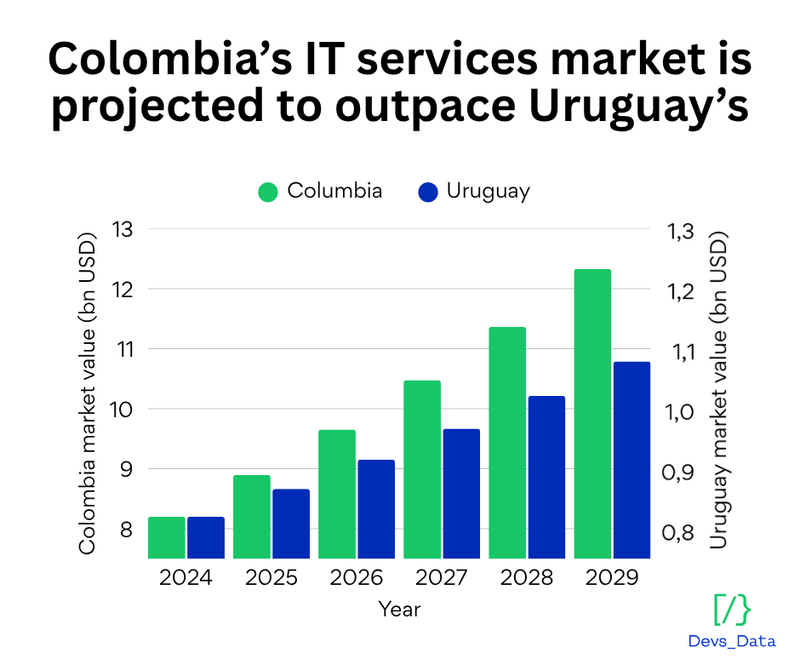
While Colombia’s IT market is larger and growing at a slightly faster pace, Uruguay’s focus on exports and a highly skilled workforce make it a competitive player in the nearshore IT outsourcing landscape. Both countries offer favorable conditions for businesses seeking to leverage nearshore IT services, supported by government initiatives and a commitment to technological advancement.
Do you have IT outsourcing needs?
Both Colombia and Uruguay have established themselves as significant players in exporting Information and Communication Technology (ICT) services, each leveraging unique strengths to contribute to their economic landscapes.
Colombia’s ICT service exports have demonstrated consistent growth over the years. In 2023, the country reported ICT service exports amounting to approximately $1.63 billion, highlighting its expanding role in the global technology market. This sector encompasses a range of services, including telecommunications, computer, and information services.
The US stands as a significant partner in Colombia’s ICT services trade. Trade.gov states that in 2021, US exports of telecommunications, computer, and information services to Colombia totaled $956 million, reflecting a growing demand for such services.
To put that in perspective, Colombia’s total ICT service exports stood at approximately $1.63 billion in 2023, meaning US exports to Colombia alone represented about 59% of that volume.
Uruguay has positioned itself as a notable exporter of software and technology services. Nearshore Americas reports that in 2023, the country’s IT services exports surpassed $1 billion, marking a significant milestone. This achievement underscores Uruguay’s strong export profile in the ICT sector. The US remains the dominant market for Uruguayan software, accounting for 87% of total exports. This strong export orientation highlights Uruguay’s integration into the global IT services market.
While both countries have demonstrated significant capabilities in exporting IT services, Uruguay’s per capita export figures are particularly noteworthy, given its smaller population. Colombia’s larger economy and population contribute to its substantial export volumes. Both nations continue strengthening their positions in the global IT services market through strategic partnerships and a focus on quality service delivery.
Both Colombia and Uruguay have developed dynamic technology sectors, each with distinct areas of expertise and growth. While both countries offer strong capabilities in IT services, their key strengths and specializations differ, making them suitable for various business needs.

Colombia’s technology landscape is diverse, with several key sectors driving innovation and economic growth:
Reuters revealed that the FinTech industry in Colombia has seen substantial growth, with the number of financial technology startups increasing from 703 in 2017 to 3069 in 2023. This expansion is supported by regulatory advancements and a focus on serving the unbanked population.
The health technology sector is evolving, with initiatives aimed at improving healthcare delivery through digital solutions. The government’s focus on e-health services is fostering growth in this area.
Agricultural technology is gaining traction as Colombia seeks to enhance productivity and sustainability in farming practices. Innovations in this sector are crucial for the country’s economic diversification efforts.
The eCommerce sector is expanding, driven by increasing internet penetration and consumer adoption of online shopping. This growth presents opportunities for tech companies specializing in digital retail solutions.

Uruguay has positioned itself as a regional technology hub, with strengths in several key sectors:
Uruguay is the largest software exporter per capita in Latin America, with the IT sector accounting for 4.4% of the country’s GDP in 2023. The sector’s revenue reached $3.3 billion, reflecting its significant economic impact.
The FinTech industry is growing, supported by a stable financial system and a tech-savvy population. Government policies encourage innovation in financial services, contributing to the sector’s development
Uruguay’s eCommerce sector processed millions of transactions in 2023, accounting for about 1.5% of the country’s GDP. Online sales increased by 22% compared to 2022, reaching revenue figures in the hundreds of millions of dollars, rather than just one million.
The video game industry is emerging, with a growing number of startups contributing to the tech ecosystem. This sector benefits from the country’s strong IT infrastructure and creative talent pool.
Both nations continue to foster environments conducive to tech growth through supportive policies and investment in digital infrastructure.
While both countries have vibrant tech sectors, Colombia’s strengths lie in FinTech, HealthTech, AgriTech, and eCommerce, driven by a larger domestic market and diverse economic activities. Uruguay stands out as a regional hub for technology innovation, with particular strengths in software development, FinTech, eCommerce, and the emerging video game industry, all supported by a stable economy, strong digital infrastructure, and government-backed innovation policies.
Do you have IT outsourcing needs?
The business climates in Colombia and Uruguay are pivotal in shaping their respective IT sectors, influencing foreign investment, operational efficiency, and overall industry growth.
Colombia has made concerted efforts to enhance its business environment, particularly in the Information and Communication Technology (ICT) sector. The enactment of the ICT Sector Modernization Law (Law 1978 of 2019) aims to bridge the digital divide and stimulate sector growth by encouraging innovative projects and improving service accessibility. Despite these advancements, challenges persist. The introduction of a 3% digital services tax in January 2024 has raised concerns about potential biases against third-country entities, potentially affecting foreign digital service providers.
Additionally, Colombia ranked 67th out of 190 countries in the World Bank’s 2020 “Ease of Doing Business” index, indicating room for improvement in bureaucratic processes and regulatory frameworks.
Uruguay offers a stable and transparent business environment, making it an attractive destination for foreign investors. The country’s commitment to the rule of law, low political risk, and macroeconomic stability contribute to its favorable business climate.
According to the World Bank’s 2020 “Ease of Doing Business” index, Uruguay ranked 101st out of 190 countries, indicating a relatively favorable business environment.
Notably, according to a survey conducted by Uruguay XXI and Equipos Consultores in 2024 revealed that 84% of foreign companies expressed satisfaction with the investment climate, and 40% planned to reinvest within the next five years. The government actively promotes the IT sector as a national priority, offering various incentives for software development and positioning Uruguay as a regional technology hub.
Additionally, Uruguay’s strategic location and transparent business practices enhance its appeal to tech companies and investors.
| Factor | Colombia | Uruguay |
|---|---|---|
| Ease of Doing Business | Ranked 67ᵗʰ out of 190 (World Bank, 2020) | Ranked 95ᵗʰ out of 190 economies ( World Bank 2019) |
| Foreign Direct Investment (FDI) Overview | FDI Inflow 2023 USD: $17.14 billion. % of GDP (2023): 4.72 % |
FDI Inflow 2023 USD: $ -5.48 billion. % of GDP (2023): -0.56 % |
| Political and Economic Stability | Moderate stability with ongoing improvements; some regulatory unpredictability | High political and macroeconomic stability with low risk |
| ICT Sector Support | Government-driven digital expansion and tech ecosystem development | National priority status for the IT sector; positioned as a regional tech hub |
| Overall Outlook | Promising but with regulatory hurdles | Highly favorable and trusted by international tech firms |
While both countries have made strides in improving their business climates, Uruguay’s stability and proactive government policies provide a more conducive environment for IT sector growth. Colombia’s larger market offers significant opportunities but is tempered by regulatory challenges that may impact foreign investment decisions.
The availability and quality of tech talent are crucial factors for companies considering nearshore IT outsourcing. Both Colombia and Uruguay offer distinct advantages in this regard.
Colombia boasts a substantial and continually expanding tech talent pool. The KPMG 2023 -2024 report indicates that the country has over 85000 software developers, including developers and engineers, with initiatives in place to significantly increase this number. Notably, Colombia has one of the highest rates of science and engineering graduates in Latin America, with 23.10% of all tertiary degrees related to manufacturing, engineering, and construction.
Key cities such as Bogotá, Medellín, and Cali serve as major tech hubs, each offering unique strengths and specializations. The government’s commitment to fostering a thriving tech ecosystem is evident in its support for education and innovation, contributing to a dynamic and skilled workforce.
Uruguay, though smaller in population, has developed a highly skilled and specialized tech workforce. According to PanamericanWorld, the country has implemented educational initiatives like the “One Laptop Per Child” program, ensuring that every child in public schools has access to a personal laptop and internet connection. This initiative has been instrumental in cultivating a tech-savvy younger generation.
Additionally, Russell Bedford highlights that Uruguay’s education system is free and delivers excellent academic results, contributing to a talent pool that is not only technically proficient but also multilingual.
While Colombia offers a larger talent pool with a high output of engineering graduates, Uruguay provides a highly specialized and multilingual workforce. Companies seeking a broad base of tech professionals may find Colombia advantageous, whereas those prioritizing language skills and specialized expertise might consider Uruguay more suitable. Both countries demonstrate a strong commitment to education and technological development, making them attractive destinations for nearshore IT outsourcing.
When evaluating nearshore IT outsourcing options, understanding the salary structures in potential markets is essential. Both Colombia and Uruguay offer competitive compensation for software developers, which can lead to significant cost savings compared to hiring in countries like the United States.
Glassdoor shows that in Colombia, software developer salaries vary based on experience and specialization:
These figures indicate that Colombian software engineers earn approximately 30-50% less than their US counterparts, making Colombia an attractive option for cost-effective outsourcing without compromising quality.
Based on Salary Expert, In Uruguay, software developer salaries vary based on experience and specialization:
This data suggests that Uruguayan developers generally earn higher salaries than their Colombian counterparts. Junior and mid-level developers in Uruguay make approximately 10-30% more than those in Colombia, reflecting the country’s more mature IT industry and higher cost of living. However, these rates remain significantly lower than in the US, offering cost advantages for companies seeking highly skilled talent in a stable and business-friendly environment.
| Experience Level | Colombia (USD) | Uruguay (USD) |
|---|---|---|
| Junior | $10000 to $16500 | $25432 to $35768 |
| Mid-Level | $16200 to $24000 | $35768 to $45204 |
| Senior | $25650 to $33600 | $45204 to $54640 |
Sources: Uruguay (Salary Expert); Colombia (Glassdoor).
Both Colombia and Uruguay provide cost-effective alternatives for hiring software developers, with salaries generally lower than those in the US. Colombia offers a broader range of salary options, accommodating various budget constraints, while Uruguay presents slightly higher salary ranges, reflecting its specialized and highly skilled talent pool. Companies should consider these factors alongside other elements such as talent availability, language proficiency, and business climate when making outsourcing decisions.
| Location | Time Zone | UTC Offset (Standard Time) | Difference from Colombia (COT) | Difference from Uruguay (UYT) |
|---|---|---|---|---|
| Colombia (Bogotá) | Colombia Time (COT) | UTC−05:00 | Reference | −2 hours |
| Uruguay (Montevideo) | Uruguay Time (UYT) | UTC−03:00 | +2 hours | Reference |
| New York (Eastern) | Eastern Standard Time (EST) | UTC−05:00 | Same | −2 hours |
| Chicago (Central) | Central Standard Time (CST) | UTC−06:00 | −1 hour | −3 hours |
| Denver (Mountain) | Mountain Standard Time (MST) | UTC−07:00 | −2 hours | −4 hours |
| Los Angeles (Pacific) | Pacific Standard Time (PST) | UTC−08:00 | −3 hours | −5 hours |
| London (GMT) | Greenwich Mean Time (GMT) | UTC±00:00 | +5 hours | +3 hours |
Language proficiency, particularly in English, is a critical factor when considering nearshore IT outsourcing, as it directly impacts communication efficiency and project success. Below is an analysis of English proficiency levels in Colombia and Uruguay, based on the latest data from the EF English Proficiency Index (EF EPI).
Colombia has demonstrated a gradual improvement in English proficiency over recent years. EF EPI 2024 report indicates that Colombia achieved a score of 485, ranking 74th out of 116 countries globally. This positions Colombia in the “low proficiency” band. Notably, this is the first time Colombia has exceeded the global average score of 477, reflecting a positive trend in English language skills.
Regionally, LingoFluency ranks Colombia 17th among 21 Latin American countries assessed. Departments such as Quindío and Bogotá exhibit higher levels of bilingual individuals, categorized within the moderate proficiency range.
Conversely, regions like Caquetá and Chocó are classified under the very low proficiency category. In urban centers, cities like Armenia and Bogotá lead in English proficiency, while Valledupar and Tuluá lag behind.
Uruguay has made notable strides in English language proficiency. The EF EPI 2024 report assigns Uruguay a score of 538, placing it 36th globally and within the “moderate proficiency” band. This ranking highlights Uruguay’s commitment to enhancing English language education and its relative advantage in English proficiency within the region.
The table below summarizes the English proficiency scores and global rankings of Colombia and Uruguay:
| Country | EF EPI Score | Global Ranking | Proficiency Band |
|---|---|---|---|
| Uruguay | 538 | 36th | Moderate |
| Colombia | 485 | 74th | Low |
Source: EF English Proficiency Index 2024
These findings indicate that Uruguay has a higher level of English proficiency compared to Colombia, which can be a significant consideration for companies seeking nearshore IT outsourcing partners. A workforce with higher English proficiency facilitates clearer communication, reduces the likelihood of misunderstandings, and enhances overall collaboration efficiency.
While Colombia is showing progress in improving English language skills, Uruguay currently offers a more proficient English-speaking talent pool, potentially providing an advantage in international business engagements.
Choosing between Colombia and Uruguay as your nearshore IT outsourcing destination can be challenging, given the unique strengths both countries offer. However, the key to a successful outsourcing experience lies not just in selecting the right location, but in having an expert partner to guide you through the process.
Traditional outsourcing models come with risks, from hiring the wrong talent to navigating unfamiliar local business practices. At this stage, working with a partner such as DevsData LLC can help ensure the solution is both technically sound and aligned with business goals.
Website: www.devsdata.com
Company size: ~60 employees
Founding year: 2016
Headquarters: Brooklyn, NY, Medellin, Colombia, Montevideo, Uruguay, and Warsaw, Poland
DevsData LLC is a leading provider of tailored IT solutions, leveraging the dynamic tech ecosystems of Colombia, Uruguay, and the broader Latin American region. The company’s service portfolio includes backend and frontend development, mobile applications, Big Data solutions, DevOps and cloud infrastructure, enterprise systems, and tailored technology consulting. By combining technical depth with business understanding, DevsData supports startups and global enterprises alike in building scalable, secure, and high-performing digital products.
DevsData LLC stands out for outsourcing tailored software development and IT solutions through dedicated teams aligned to each client’s specific needs. Blending in-house expertise with a vetted global network, the company offers high-quality services across web, mobile, backend, cloud, and data systems at competitive rates.
With delivery centers in Eastern Europe and a growing presence in Latin America, DevsData supports startups and enterprises across FinTech, healthcare, and eCommerce. Its strong project management, technical excellence, and focus on clear communication ensure reliable delivery for both short-term and long-term initiatives.
Client public testimonials showcase the company’s exceptional performance, backed by perfect 5.0 ratings on both Clutch and GoodFirms, a testament to an unwavering commitment to excellence.

A standout example of DevsData LLC’s expertise lies in its collaboration with an international fashion corporation seeking to revolutionize its digital infrastructure. Facing competition from giants like Zalando and disruptive startups, the company sought to modernize operations, marketing, and logistics by building an innovation lab. DevsData LLC assembled a global team of specialists in machine learning, software development, UX/UI design, and operations, recruiting top talent from the US, Canada, Europe, and beyond. Notably, the company boasts a strong presence of highly skilled specialists from the US, ensuring expertise in cutting-edge technologies and industry best practices.
This diverse team developed advanced IT systems that unified online operations, optimized logistics, and enhanced customer engagement, enabling the company to stay competitive. DevsData LLC’s ability to provide tailored, high-quality tech solutions highlights its expertise in supporting businesses through transformative challenges.
For more information about DevsData LLC, contact their team at general@devsdata.com or visit their website at www.devsdata.com.
Do you have IT outsourcing needs?
Colombia and Uruguay have emerged as top nearshore IT outsourcing destinations in Latin America. Colombia offers a rapidly growing tech market, robust digital initiatives, and a large talent pool in cities like Bogotá and Medellín. Its strengths span FinTech, HealthTech, AgriTech, and eCommerce, making it ideal for companies seeking scale and sectoral diversity. Time zone alignment with EST and improving English proficiency in urban hubs further enhance its appeal.
Uruguay, while smaller, stands out for its political and economic stability, strong government support, and export-driven IT sector; 76% of software revenue comes from exports, primarily to the US. It boasts a skilled, multilingual workforce and excels in software development, FinTech, and emerging fields like video game development. Salaries are lower than in the US in both countries, though Uruguay’s rates are slightly higher, reflecting its maturity.
Ultimately, Colombia is a strong choice for companies needing scale and versatility, while Uruguay suits those prioritizing communication fluency, specialization, and a low-risk business environment.
As the nearshore IT outsourcing market in Latin America continues to grow, now is the ideal time for businesses to explore the benefits of partnering with trusted providers like DevsData LLC. By tapping into the region’s thriving tech ecosystem, companies can stay ahead in an increasingly competitive global landscape.
Discover how IT recruitment and staffing can address your talent needs. Explore trending regions
like Poland, Portugal, Mexico, Brazil and more.
 Frequently asked questions (FAQ)
DevsData – your premium technology partner
DevsData is a boutique tech recruitment and software agency. Develop your software project with veteran engineers or scale up an in-house tech team of developers with relevant industry experience.
Free consultation with a software expert
🎧 Schedule a meeting
FEATURED IN


DevsData LLC is truly exceptional – their backend developers are some of the best I’ve ever worked with.”

Nicholas Johnson
Mentor at YC, serial entrepreneur


 Build your project with our veteran developers.
Explore the benefits of technology recruitment and tailor-made software.
Learn how to source skilled and experienced software developers.
Build your project with our veteran developers.
Explore the benefits of technology recruitment and tailor-made software.
Learn how to source skilled and experienced software developers.

Rebecca Botvin

Commercial Director

Tom Potanski
Manager




Categories: Big data, data analytics | Software and technology | IT recruitment blog | IT in Poland | Content hub (blog)
















careers@devsdata.com









general@devsdata.com

"I interviewed about a dozen different firms. DevsData LLC is truly exceptional – their backend developers are some of the best I've ever worked with. I've worked with a lot of very well-qualified developers, locally in San Francisco, and remotely, so that is not a compliment I offer lightly. I appreciate their depth of knowledge and their ability to get things done quickly."

Nicholas Johnson
CEO of Orange Charger LLC,
Ex-Tesla Engineer,
Mentor at YCombinator
"DevsData reached out to us, as we've been looking to grow our engineering team in Europe and Poland. Communicating efficiently and professionally, DevsData made a strong impression with their understanding of the recruitment challenges we were facing. They designed a tailored recruitment process for our needs. I was impressed with the technical depth of their approach."

Karim Butt
Co-Founder & CTO at GlossGenius, Inc.
"Out of all the vendors we work with, DevsData clearly stands out. The quality of developers they deliver is beyond what we've received from any other vendor, and they've been able to send profile recommendations very quickly. I'm happy to be their reference for other companies from Israel and talk about their recruitment abilities and what they delivered for us."

Ran Eyal
Senior Manager at
ZIM Integrated
Shipping Services Ltd.
"DevsData demonstrated a strong degree of proactivity, taking time to thoroughly understand the problem and business perspective, and continuously suggesting performance and usability enhancements. Their app exceeded my expectations. I've worked with DevsData on numerous projects over the last 3 years and I'm very happy. Being both responsive and honest in communication."

Jonas Lee
Partner & Executive VP of Verus,
Financial LLC, Investor,
& Serial Entrepreneur
Acknowledgments