Thanks for subscribing.
Your gift is on the way.



The global Business Process Outsourcing market was valued at $302.62 billion in 2024 and is projected to reach $525.23 billion by 2030, growing at a compound annual growth rate of 9.8%.
That scale reflects a structural reorganization of how companies operate. Organizations across manufacturing, healthcare, FinTech, eCommerce, and SaaS have moved entire functions to external providers so internal teams can work on what differentiates them.
58% of organizations using BPO services report gaining access to innovations such as robotic process automation and AI that they could not have deployed internally at an equivalent speed or cost. The same IBM analysis put the 2025 global average cost of a data breach at $4.4M and found that ungoverned AI systems raised breach likelihood, which is why the choice of provider carries direct financial weight rather than reputational risk alone. A company hands operational and customer data to whichever vendor it selects, so the screening done before signing shapes that exposure more than the contracted rate does.
This article breaks down the BPO business model from the ground up. It covers what BPO is, which seven types exist, how delivery models and billing structures work, what the benefits and risks look like in practice, and how a well-run outsourcing engagement is structured from initial scoping through ongoing management.
Business Process Outsourcing (BPO) is the practice of contracting an external provider to manage specific business functions that a company would otherwise handle in-house. These functions range from payroll and accounting to customer support, IT services, and data entry.
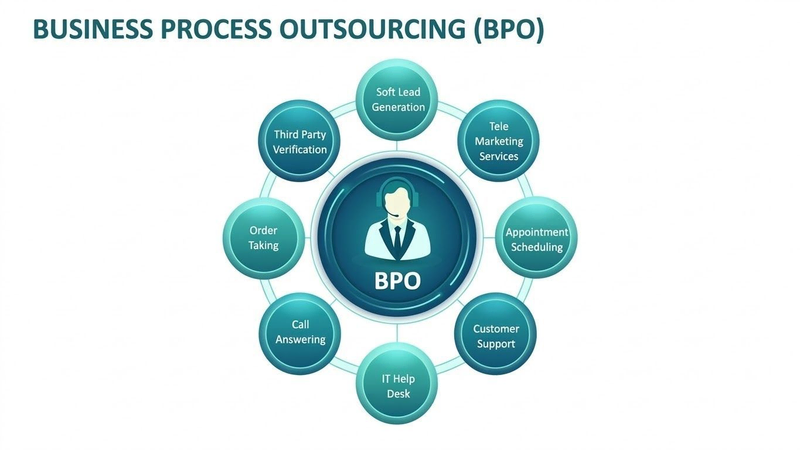
BPO originated in manufacturing, where companies outsourced supply chain tasks to reduce overhead. The model has since expanded across healthcare, asset management, eCommerce, pharmaceuticals, energy, and financial services.
Most organizations carry a set of functions that are operationally required but do not drive competitive outcomes. BPO addresses that gap by providing an external structure for managing them.
The field is divided into two broad operational categories. Back-office BPO covers internal functions that do not involve direct customer contact, such as finance, HR administration, compliance, quality assurance, and IT infrastructure. Front-office BPO handles customer-facing activity, including technical support, sales, marketing, and multilingual customer service. Many organizations outsource from both categories simultaneously, depending on where their internal capacity gaps are largest.
Do you have BPO needs?
Understanding the types of BPO is the first step toward identifying which model fits a given organization. The categories below differ by the nature of the work being outsourced, the location of the provider, or the depth of expertise involved.
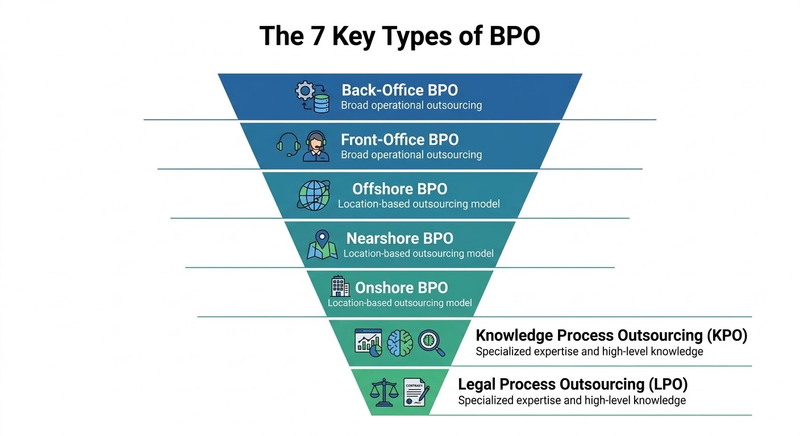
Back-office BPO encompasses the internal administrative and operational functions that keep a business running but do not directly touch the customer. Common examples include payroll processing, financial reporting, HR administration, data entry, regulatory compliance, and IT infrastructure management.
Example: A retail chain outsources payroll to a specialized provider that handles salary calculations, tax deductions, and compliance across thousands of employees. The retailer avoids building a full internal payroll team while gaining access to a provider whose entire operation is built around that function.
Providers have absorbed automation into their standard service offering, with robotic process automation (RPA) handling the repetitive steps of payroll and finance work, such as data transfer between systems and form population. Machine learning runs alongside it, flagging duplicate entries or expense anomalies before they reach a human reviewer.
Front-office BPO covers the customer-facing side of operations. This includes inbound and outbound customer support, technical helpdesk services, lead generation, sales, social media management, and marketing campaign execution. The defining characteristic is direct interaction with end customers or prospects.
Example: An eCommerce company partners with a customer service provider to manage inquiries, returns, and complaints across phone, email, and live chat. The provider brings trained agents, established workflows, and the ability to scale staffing during peak periods, none of which the eCommerce company would build cost-effectively on its own.
Front-office BPO has shifted from traditional phone-based support toward omnichannel cloud contact centers that consolidate voice, email, chat, and social interactions in a single platform. Many providers now deploy AI-powered chatbots alongside human agents, using automation to handle high-volume, low-complexity queries while reserving agent time for situations that require judgment.
Offshore BPO means contracting with a provider located in a different country, typically one where labor costs are significantly lower. India, the Philippines, and Eastern Europe are the most established offshore destinations. India’s BPO market was valued at $49.87 billion in 2024 and is expected to reach $139.35 billion by 2033, driven by a large English-speaking workforce and deep technical expertise. The Philippines generated $38 billion in BPO revenue in 2024, with particular strength in customer service functions.
Example: A US financial services firm contracts a provider in the Philippines to handle customer service operations. The time zone difference allows for near-round-the-clock coverage, and labor cost savings of 50 to 70% compared to domestic staffing make the model financially attractive.
The main tradeoffs in offshore BPO are practical: time zone gaps can delay response cycles, and communication friction tends to increase when teams work across different languages and cultural norms. Addressing those gaps in practice means setting fixed overlapping hours, establishing daily check-ins, and maintaining written documentation detailed enough that work does not stall when teams are offline.
Nearshore BPO involves outsourcing to a provider in a geographically adjacent or culturally proximate country. For US companies, this typically means Mexico, Central America, or Canada. European firms frequently nearshore to Eastern European countries such as Poland, Romania, or North Macedonia.
Example: A California-based company partners with a customer service provider in Mexico City to handle Spanish and English support. Overlapping time zones simplify real-time collaboration, and the cost difference relative to domestic staffing remains meaningful.
Nearshoring has gained momentum as companies look to reduce the operational risks that distance introduces. A provider four hours away by plane is easier to oversee than one 14 time zones away, which lowers the chance of slow issue resolution, communication gaps, and supply disruption when a single far-off region runs the work. For functions requiring frequent interaction, that proximity shortens response cycles.
Onshore BPO keeps the outsourced function within the same country, even if the provider operates in a different city or region. The model trades some of the labor cost advantages of offshore arrangements for regulatory alignment, the ability to conduct on-site audits without significant travel, and the shared legal framework that domestic labor law provides.
Example: A New York financial services company contracts a document processing provider in North Carolina. The domestic arrangement simplifies compliance with data residency requirements and makes site visits for auditing and training straightforward.
Onshore BPO is particularly favored in industries handling sensitive data, such as healthcare and legal services, where domestic jurisdiction requirements or client expectations make offshore arrangements impractical.
KPO represents a more advanced tier of outsourcing, covering processes that require analytical thinking, specialized domain expertise, or advanced technical skills. While standard BPO handles high-volume, rule-based tasks, KPO engages providers capable of independent judgment and research.
KPO services span a broad range: financial analysis and investment research, market intelligence, actuarial services, clinical data analysis, content development, and product design. The distinguishing factor is that the value delivered depends on expertise, not execution volume.
Example: A pharmaceutical company outsources clinical trial data analysis to a KPO firm staffed with biostatisticians and regulatory specialists. Hiring that expertise in-house would require significant recruitment investment and long onboarding timelines; the KPO model provides immediate access to a formed team.
LPO vendors staff teams of paralegals and legal researchers, and most operate with licensed attorneys, since the work they take on spans contract review and drafting, litigation support, patent research, and regulatory compliance documentation.
Example: A corporate legal department outsources contract review for a major procurement cycle to an LPO provider. The provider processes hundreds of agreements against a defined risk framework, flagging exceptions for in-house counsel. The arrangement lets the legal team maintain oversight without being consumed by volume.
LPO has grown in parallel with the broader legal technology sector. Many providers now combine human expertise with contract analysis software, reducing review times and increasing consistency across large document sets.
Do you have BPO needs?
Beyond the type of service being outsourced, the terms under which a BPO engagement operates vary considerably. The delivery model determines how costs are calculated, how performance is evaluated, and how the relationship scales over time.
Time-based billing is the practical default when the scope cannot be defined upfront, such as ongoing IT support where ticket volume varies week to week, and any fixed-cost estimate would either overprice the service or leave the provider absorbing unplanned work.
Fixed-time/fixed-cost agreements set both the timeline and the total cost in advance, based on a clearly defined scope. This model provides predictability on budget and deliverables and is most appropriate for discrete, well-scoped projects where requirements are unlikely to shift mid-engagement.
Hybrid arrangements combine fixed fees for predictable core tasks with time-based billing for ad hoc or variable work. The structure gives clients a predictable base cost for recurring work while leaving room in the contract for ad hoc requests that do not fit a fixed scope.
Transaction-based pricing charges per unit of output: per call handled, invoice processed, record entered, or email sent. This model aligns costs directly with activity volume and scales naturally as business demand fluctuates. Customer support and back-office processing operations use it most frequently.
Companies adopt BPO for several distinct reasons, and the weight of each benefit varies depending on the function being outsourced and the model chosen. The table below maps primary benefits to the conditions under which each is most pronounced.
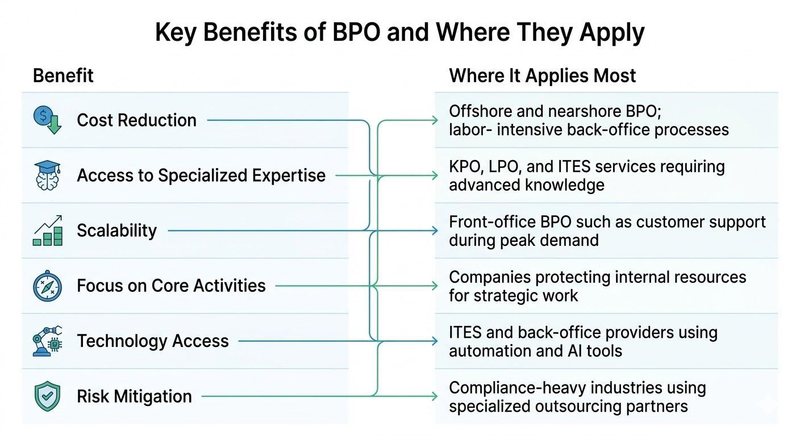
The benefits above do not operate in isolation. A company that outsources payroll to reduce costs often gains access to compliance automation it would not have built independently. A startup that outsources customer support to scale during growth frequently ends up with a better-staffed operation than it could have maintained in-house. The pattern across all six benefits is the same: the returns compound when the right function meets the right model.
78% of businesses plan to increase investment in AI-powered BPO automation, a signal that the industry’s value proposition has shifted well beyond labor cost arbitrage.
A realistic assessment of BPO includes the operational risks alongside the benefits.
Loss of direct control is the most consistent friction point. Delegating a function to an external party requires accepting reduced visibility into day-to-day execution. Without clearly defined performance standards, service-level agreements (SLAs), and regular review cycles, quality and consistency can drift in ways that are difficult to detect early. The solution is not to avoid outsourcing but to invest in governance from the start.
Data security risks are inherent to any arrangement involving shared access to operational or customer data. According to IBM’s Cost of a Data Breach 2025 report, the global average cost of a data breach is USD 4.44 million. Evaluating a provider’s security certifications, such as GDPR or ISO 27001 compliance, and conducting thorough due diligence on their data handling practices is a precondition for any engagement involving sensitive information, not an afterthought.
Communication barriers are particularly relevant in offshore arrangements, where time zone gaps, language differences, and cultural misalignment can introduce friction. These issues are manageable but require deliberate investment in communication protocols, clear escalation paths, and, in some cases, dedicated coordination roles on both sides of the relationship.
Governance and onboarding determine more about BPO outcomes than model selection does. A well-structured transition, clearly defined SLAs, and a functioning escalation process matter far more than whether the provider is offshore or domestic.
Organizations that execute BPO well tend to follow a structured sequence. The steps below reflect patterns observed across successful implementations.
Analyze operations for functions that are high-volume, well-defined, not core to competitive differentiation, and currently resource-intensive.
Define the scope of work, research vendors with relevant industry experience, evaluate technology infrastructure and security certifications, and request references from comparable clients.
Establish detailed service definitions, performance metrics, data security requirements, pricing structure, SLAs, and termination and transition clauses before work begins.
Conduct knowledge transfer sessions, integrate systems, run pilot programs before full go-live, and communicate clearly with internal teams affected by the change.
Hold regular performance reviews against SLAs, maintain open escalation channels, and schedule periodic contract assessments to adjust scope as business needs evolve.
Running that sequence well takes experience that most organizations are building for the first time, which is where a placement partner earns its place. DevsData LLC handles the early steps of the process, matching the function to a vetted provider before the contract is drafted.
Website: www.devsdata.com
Team size: ~60 employees
Founded in: 2016
Headquarters: Brooklyn, NY, and Warsaw, Poland
DevsData LLC is a government-licensed BPO placement agency headquartered in Brooklyn, with operations in Warsaw and clients across the US, Europe, Israel, and beyond. Founded in 2016, the company has completed over 100 projects for more than 80 clients globally, building a track record across both IT and non-IT outsourcing functions.
The core service is BPO placement, meaning DevsData LLC connects a client with an outsourcing provider rather than running the outsourced function itself. The company maps the client’s organizational needs, screens providers against those requirements, and facilitates the partnership once a match holds up to scrutiny. The scope of functions covered includes HR, finance, payroll, and customer support. The company operates on a success fee model, meaning clients pay for successful placements rather than for the search process itself. A guarantee period is included with each placement. DevsData LLC holds a 5/5 rating on Clutch and GoodFirms.
Beyond placement, the company offers direct outsourcing solutions, including HR advisory, payroll management, and Employer of Record (EoR) services. These are particularly relevant for organizations managing cross-border employment, where local compliance, payroll legislation, and administrative complexity would otherwise require significant in-house expertise to navigate.
DevsData LLC also provides IT recruitment and custom software development as complementary services. The recruitment practice draws on a vetted network of over 95000 professionals, applying a rigorous evaluation process with an acceptance rate below 6%. That network spans Software Developers, Data Scientists, Machine Learning Engineers, UX/UI Designers, and Operations specialists. The software development practice covers mobile app development, backend solutions, and full stack platforms, built to client specifications.
The company’s project history spans industries. In one engagement, DevsData LLC assisted an international fashion brand undergoing digital transformation by building a core technology team covering Machine Learning, UX/UI, and operations, directly revitalizing key departments that had lacked technical leadership. In a separate project, DevsData LLC recruited a specialized tech professional for a pharmaceutical client, improving platform functionality and user engagement across global markets. Additional case studies are available at www.devsdata.com. Direct inquiries can be directed to general@devsdata.com.
Do you have BPO needs?
The market data reflects this: a sector projected to exceed $525 billion by 2030 is not being driven by companies trimming payroll expenses alone. Organizations are outsourcing to close expertise gaps, access automation infrastructure, scale operations across borders, and free internal teams to work on problems that actually differentiate them in their markets.
The model is not without risk. Provider selection, contract structure, and ongoing governance determine whether a BPO partnership delivers the operational gains it promises or introduces the data security, quality, and communication problems that poorly managed outsourcing is known for. Execution quality depends on what happens before the contract is signed. Scope definition, SLA design, and a transition plan with real ownership are the inputs that separate a productive outsourcing relationship from one that underdelivers.
For organizations at the evaluation stage, the practical starting point is not choosing between offshore and nearshore, or between fixed-cost and transaction-based billing. It is an honest internal assessment of which functions are genuinely non-core, where external expertise would outperform internal capacity, and what governance the organization is prepared to commit to sustaining the relationship. The right model follows from those answers.
DevsData LLC works with organizations at exactly that stage, evaluating outsourcing needs, identifying providers suited to specific requirements, and supporting the placement process through to a successful partnership. For companies that need direct outsourcing solutions alongside placement, the HR advisory, payroll management, and EoR services cover the operational layer that placement alone does not. Reach out at general@devsdata.com or visit www.devsdata.com to start the conversation.
Discover how IT recruitment and staffing can address your talent needs. Explore trending regions
like Poland, Portugal, Mexico, Brazil and more.
 Frequently asked questions (FAQ)
DevsData – your premium technology partner
DevsData is a boutique tech recruitment and software agency. Develop your software project with veteran engineers or scale up an in-house tech team of developers with relevant industry experience.
Free consultation with a software expert
🎧 Schedule a meeting
FEATURED IN

DevsData LLC is truly exceptional – their backend developers are some of the best I’ve ever worked with.”

Nicholas Johnson
Mentor at YC, serial entrepreneur


 Build your project with our veteran developers.
Explore the benefits of technology recruitment and tailor-made software.
Learn how to source skilled and experienced software developers.
Build your project with our veteran developers.
Explore the benefits of technology recruitment and tailor-made software.
Learn how to source skilled and experienced software developers.

Rebecca Botvin

Commercial Director

Tom Potanski
Manager




Categories: Big data, data analytics | Software and technology | IT recruitment blog | IT in Poland | Content hub (blog)















careers@devsdata.com









general@devsdata.com

"I interviewed about a dozen different firms. DevsData LLC is truly exceptional – their backend developers are some of the best I've ever worked with. I've worked with a lot of very well-qualified developers, locally in San Francisco, and remotely, so that is not a compliment I offer lightly. I appreciate their depth of knowledge and their ability to get things done quickly."

Nicholas Johnson
CEO of Orange Charger LLC,
Ex-Tesla Engineer,
Mentor at YCombinator
"DevsData reached out to us, as we've been looking to grow our engineering team in Europe and Poland. Communicating efficiently and professionally, DevsData made a strong impression with their understanding of the recruitment challenges we were facing. They designed a tailored recruitment process for our needs. I was impressed with the technical depth of their approach."

Karim Butt
Co-Founder & CTO at GlossGenius, Inc.
"Out of all the vendors we work with, DevsData clearly stands out. The quality of developers they deliver is beyond what we've received from any other vendor, and they've been able to send profile recommendations very quickly. I'm happy to be their reference for other companies from Israel and talk about their recruitment abilities and what they delivered for us."

Ran Eyal
Senior Manager at
ZIM Integrated
Shipping Services Ltd.
"DevsData demonstrated a strong degree of proactivity, taking time to thoroughly understand the problem and business perspective, and continuously suggesting performance and usability enhancements. Their app exceeded my expectations. I've worked with DevsData on numerous projects over the last 3 years and I'm very happy. Being both responsive and honest in communication."

Jonas Lee
Partner & Executive VP of Verus,
Financial LLC, Investor,
& Serial Entrepreneur
Acknowledgments