Thanks for subscribing.
Your gift is on the way.



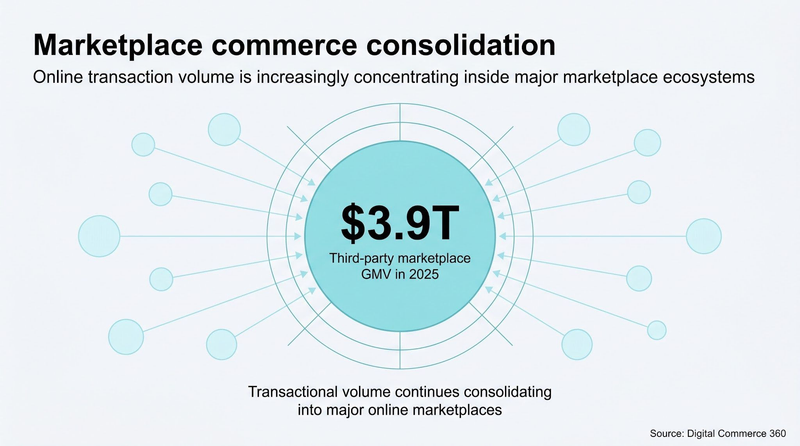
Online marketplaces have moved from a convenient sales channel to a core layer of how commerce runs. The shift is visible in the volume now flowing through third-party platforms rather than single-seller storefronts. Third-party gross merchandise value (GMV) across the largest online marketplaces is projected to reach $3.9 trillion in 2025, according to Digital Commerce 360. A number that size reframes the question for any operator entering the space, because it marks where transactional volume is consolidating.
Bidding-based commerce moves with that same current rather than against it. eBay reported a full-year 2025 GMV of $74.7 billion, a reminder that bidding-based transactions still anchor one of the largest consumer marketplaces in operation.
Behind those numbers sits a harder engineering reality, and the businesses running on it stretch well past the consumer marketplace most people picture. Copart alone sold more than 4 million vehicles through online auctions last year to roughly a million registered members in over 185 countries. Enthusiast and collectibles platforms such as Bring a Trailer and Catawiki operate on the same ascending model, while Whatnot runs auctions live inside a video stream and Sotheby’s takes online bids on lots clearing seven figures. Public sector surplus, industrial equipment, and enterprise sourcing events all move through their own auction platforms. An auction is not a catalog with a checkout button. It is a live, contested, time-bound transaction where many participants act against the same item at the same moment, and where the system must resolve who wins, when, and at what price without ambiguity.
As marketplace volume grows, the transactional layer underneath it grows more complex in step. Concurrency stops being an edge case and becomes the normal operating condition. Payment flows have to clear reliably across borders and methods. Fraud controls have to run inline without slowing the bid path. Each of these pressures compounds the others, which is why building an auction platform looks less like web development and more like distributed systems engineering applied to money in motion.
This article works through that territory in order. It defines what auction website development actually involves at the system level, separates the major auction models by their distinct engineering demands, reviews the market forces driving demand for these platforms, and examines the operational challenges that surface once a platform carries real load.
Auction website development is the construction of a transactional system that accepts competing bids, holds authoritative state about price and ownership, and settles the outcome with no room for dispute. It draws on marketplace engineering, real-time systems design, and payment infrastructure rather than on page layout and content management. The components below each carry weight that a static storefront never has to bear, because every one of them sits directly in the path of a live transaction.
The bidding engine accepts concurrent bids, validates each against the current state, and broadcasts the new high bid to every watcher within a tight window. It must enforce a single authoritative ordering of events so two bids placed in the same instant resolve deterministically rather than by accident of network timing.
Bid interfaces carry unusual pressure because a user commits money in seconds under competitive stress. Current price, increment, remaining time, and outbid status have to be legible at a glance, and a confirmation step has to prevent accidental commitment without slowing a deliberate one. Ambiguity here produces disputes and abandoned bids rather than mere annoyance.
Settlement has to clear across cards, wallets, and increasingly buy-now-pay-later methods, often across currencies and jurisdictions. The platform holds the obligation between bid acceptance and capture, which means authorization, holds, and reconciliation all have to behave predictably under load.
Load on an auction platform is spiky by nature. A popular lot draws a burst of activity in its closing minutes, so the backend has to absorb sudden concurrency without degrading the bid path for anyone. This favors in-memory state, horizontal scaling, and clean separation between hot transactional services and slower analytical ones.
Bidders commit to real financial obligations, so identity has to be established before a bid counts. Strong authentication, step-up verification for high-value activity, and session integrity protect both the seller and the auction result from manipulation.
Shill bidding, account takeover, and payment fraud all attack the integrity of the outcome. Detection has to run inline against live behavior, scoring activity as it happens rather than flagging it after settlement, when the damage is already booked.
Outbid alerts, closing reminders, and win confirmations drive the engagement that makes an auction work. These have to fan out reliably across channels in near real time, because a late outbid notice is a lost re-bid and a lost increment of GMV.
A large share of marketplace activity now happens on phones, so the bidding experience has to perform on mobile as a first concern rather than a scaled-down afterthought. Latency, layout, and one-tap authentication all matter more on a small screen during a closing auction.
Read together, these components describe a system defined by transactional reliability and operational scalability, not by visual design or content volume. The defining question is not whether a page renders cleanly but whether the platform can accept a thousand near-simultaneous bids on a closing lot, settle the winner correctly, move the money, and notify everyone involved without a single inconsistent state along the way. That is why serious auction development belongs closer to distributed systems work than to conventional website building, and why the choices made in the bidding engine and data layer end up governing what the whole business can support.
Auction models look similar from the outside, yet they impose very different demands on the systems that run them. The variable that drives engineering effort is how and when price is determined, because that dictates where contention concentrates and how fast the system has to resolve it. An ascending consumer auction stresses broadcast and concurrency, a private sealed process stresses confidentiality and settlement, and a procurement event stresses integration and scoring. Treating them as one category is the most common way a build goes wrong.
The open ascending model is the familiar one, where price climbs through public competing bids until a fixed close. The transaction logic is simple, but concurrency is severe: every watcher needs the current high almost instantly, and closing-minute bursts concentrate contention on a single lot. The engineering centers on broadcast fan-out, typically over WebSocket or a pub-sub channel, paired with fast validation against an in-memory leader held in a structure like a sorted set. Anti-sniping logic extends the timer when late bids land and must stay fair under load. Trust rests on an unforgeable bid history, and payment exposure is bounded but real once the hammer falls. eBay built the consumer version of this model, and Copart, Bring a Trailer, and Catawiki run it at scale across vehicles and collectibles.
Here, the price starts high and descends automatically until the first bidder claims the item, which inverts the engineering problem. There is no bidding war to broadcast; instead, the system runs an authoritative price clock and resolves a single first-claim event with absolute fairness. The hard part is server-side ordering, often a single-writer claim path guarded by a lock or an atomic compare-and-set, so a latency edge never becomes an unfair one. Infrastructure pairs that central write authority with regional read replicas streaming the descending price. Trust depends entirely on deterministic, tamper-proof claim resolution. Royal FloraHolland has run descending clock auctions for Dutch flowers for decades, and the format also appears in token sales and in the modified Dutch auction Google used for its 2004 share offering.
In a sealed process, bids are submitted privately within a window and revealed only at close, where the highest, or in a second-price variant the next-highest, wins. Live load is light because there is no public price discovery, but cryptographic work rises sharply: a commit-reveal scheme hashes each sealed bid on submission and verifies it against the plaintext at reveal, backed by an append-only audit trail. The workload concentrates at settlement rather than streaming across the event, so the architecture is batch-oriented. Confidentiality and tamper-evidence dominate, and payment settles in a single decisive step at the reveal. US Treasury securities are sold through sealed competitive bidding, and the same structure governs most public construction tenders and confidential real estate sales.
A reverse auction flips the direction, with a buyer publishing a requirement and qualified suppliers competing by lowering their bids. Complexity comes from multi-attribute scoring rather than bid speed, since awards weigh price against a set of weighted criteria such as quality and delivery, run through a configurable scoring engine. Concurrency is modest, tens to low hundreds of suppliers, but each event needs qualification gates, decrement rules, and audit-grade event logging. Infrastructure leans on identity verification and back-office integration over APIs. Trust rests on transparent, defensible award logic, and settlement connects to contracting rather than instant capture. SAP Ariba and Coupa run supplier bidding events of this type for corporate buyers, commonly in logistics and indirect categories.
Enterprise procurement auctions are the most demanding category, spanning forward, reverse, sealed, and combinatorial formats inside a source-to-pay suite. The engineering challenge is integration depth: these systems connect to ERP, contract lifecycle management, supplier networks, and e-invoicing through APIs and EDI, often under data-residency rules. Real-time needs are moderate, since strategic sourcing events run over hours or days, but the surrounding workflow and approval chains are heavy. Scalability is measured in event and contract volume rather than concurrent bidders. Trust and compliance dominate, and payment integration extends into approval chains and regulated financial controls rather than a single checkout. SAP Ariba, Jaggaer, and GEP sit inside source-to-pay suites where the auction is one step in a longer contracting workflow.
On-chain auctions settle through smart contracts, which moves trust into code and changes the failure modes entirely. English or Dutch formats run with reserve prices and royalty enforcement encoded directly in the contract, while bids are often signed off-chain and submitted on settlement to save gas. Block time sets a floor on confirmation speed, so layer-two networks are used where it matters. Infrastructure spans node access, wallet connection, and decentralized metadata storage. Scalability is bounded by chain throughput rather than server capacity, and trust depends on contract security, where a flaw is a loss to absorb rather than a bug to patch. OpenSea and Foundation host on-chain bidding, and Christie’s and Sotheby’s have run digital art sales settled the same way.
The table below condenses these distinctions into the dimensions that most affect a build decision, so the contrast between consumer-facing speed and enterprise-grade integration is visible at a glance.
| Auction model | Real-time complexity | Infrastructure requirements | Scalability difficulty | Technical focus | Typical business use | Example platforms |
|---|---|---|---|---|---|---|
| English | High | Broadcast fan-out, in-memory bid state | High | Concurrency and bid ordering | Collectibles, vehicles, recommerce | eBay, Copart, Bring a Trailer, Catawiki |
| Dutch | High | Central write authority, price clock | Medium | Deterministic first-claim | Perishables, commodity, token sales | Royal FloraHolland flower clock, token sale platforms |
| Sealed-bid | Low to medium | Encryption, commit-reveal, audit log | Low | Confidentiality and settlement | Real estate, sensitive procurement | US Treasury auctions, public tender portals |
| Reverse | Medium | Supplier KYC, ERP and CRM integration | Medium | Multi-attribute scoring | Indirect procurement, logistics | SAP Ariba, Coupa sourcing events |
| B2B procurement | Medium | ERP, CLM, supplier network, e-invoicing | Medium to high | Integration depth and compliance | Direct and indirect sourcing | SAP Ariba, Jaggaer, GEP, Coupa |
| NFT / digital asset | Variable | Node access, wallets, smart contracts | Chain-bound | Contract security | Digital art, tokenized assets | OpenSea, Foundation, Christie’s digital sales |
The pattern is that real-time complexity and integration complexity rarely peak in the same model, and that should steer both architecture and hiring. Consumer ascending auctions live or die on concurrency, where a closing-minute surge has to be validated and broadcast while one consistent leader is held, and any lag suppresses the final increments. Enterprise procurement faces the opposite balance: light concurrency but deep integration into financial and contractual systems and an audit trail that must hold up. Building one as though it were the other wastes effort in the wrong layer.
Do you have software development needs?
The case for investing in serious auction infrastructure rests on where commerce volume is moving and how buyer expectations are hardening. The market points in one direction: more transactions are flowing through marketplace platforms, more of them happen on mobile, and more of them are expected to clear instantly and reliably. Each of these trends translates into a specific engineering obligation, which is the lens this section uses to read the numbers.
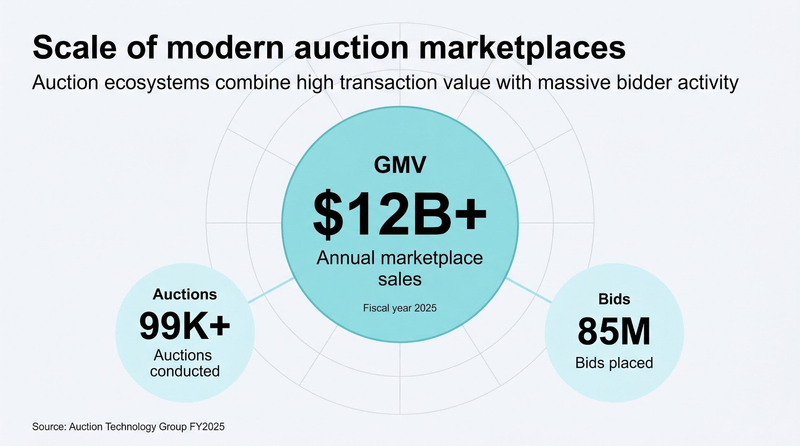
The volume concentrating in marketplaces is the starting point. Auction Technology Group facilitated more than $12 billion in annual marketplace sales in its 2025 fiscal year, across more than 99000 auctions, up 13% year over year, that together generated 85 million bids. That last figure matters most for engineering: 85 million discrete contested events is the realistic load profile a mid-market auction platform should design toward, not a theoretical ceiling.
Peer-to-peer and re-commerce activity is widening the base of marketplace transactions. Liquidity Services crossed $1.57 billion in annual GMV in its 2025 fiscal year, up from $1.37 billion a year earlier, with record auction participation in its surplus and public-sector segments. Growth at this layer multiplies the number of distinct buyers and sellers a platform must authenticate, score for fraud, and settle between, which raises the identity and trust burden faster than it raises raw transaction count.
Where transactions happen has shifted decisively toward mobile, and that changes the performance bar. Mobile is also where friction costs the most: Dynamic Yield benchmarks mobile cart abandonment at 80.02%, well above desktop. For an auction, abandonment in the closing moments is not a deferred sale but a permanently lost bid increment, so mobile latency and one-tap authentication move from polish to revenue protection.
Buyers now expect settlement to be immediate and payment options to be flexible. Adobe reported that buy-now-pay-later contributed $20 billion in online spend over the 2025 holiday season, evidence that flexible payment is now a default expectation rather than a niche feature. For auction platforms, that means the payment layer has to support deferred and split methods inline with bid settlement, adding states that the system must track between winning and capture.
Settlement itself is starting to move on-chain, which matters for auctions because the bid and the payment can resolve in the same operation. Adjusted stablecoin volume, the measure that strips out bot and trading activity, reached roughly $28 trillion in 2025 on Chainalysis figures, with the firm projecting continued growth toward payment-network scale over the next decade. For an auction platform, that introduces a settlement rail with no chargeback mechanism and near-instant finality, which shifts fraud control earlier in the flow rather than removing it.
The tooling that makes real-time marketplaces possible has consolidated around a recognizable stack. The 2025 Stack Overflow Developer Survey records Docker at 71% usage among developers, its largest single-year rise, alongside continued growth for Redis and PostgreSQL as the most-wanted database. The signal for auction engineering is clear: containerized, horizontally scalable services backed by in-memory caching are the assumed baseline for handling spiky bid load, not an advanced option.
As volume and expectations rise, the transactional surface that has to stay reliable expands with them. High-value digital transactions illustrate the point. McKinsey finds that 39% of B2B buyers now place orders above $500000 through self-service or remote digital channels, a level of trust in online transactions that was rare only a few years ago. Carrying transactions of that size demands step-up authentication, audit trails, and settlement reliability that a lightweight marketplace was never built to provide.
Marketplace volume is consolidating into platforms faster than most operators have rebuilt their transactional layer to match, and the gap between the two is where reliability problems surface first.
Once an auction platform carries real traffic, the difficult problems are operational rather than conceptual. They appear at the moment of contention, when many users act on the same item, money has to move, and fraud controls have to run without slowing anyone down. The challenges below are the ones that most often separate a platform that scales cleanly from one that buckles under its own success. Each is paired with the engineering approach used by DevsData LLC, a software development company with over 10 years of experience.
The hardest moment in any auction is its last, when a popular lot draws a surge of near-simultaneous bids. The system has to validate each against the current high, fix a single authoritative ordering, and broadcast the new leader inside a window short enough to still feel live. Route every bid through one relational write, and it serializes under load, dropping or delaying bids and suppressing the closing increments that form the final price. The design that holds separates the hot bid path from persistence, keeps live state in memory, and fans updates out through pub-sub. Concurrency control stays fast yet strict enough that two bids in the same millisecond never both win.
DevsData LLC engineers the bid path as a dedicated low-latency service, holding the live leader in memory with a write-through queue to durable storage so persistence never blocks acceptance. Updates fan out over a publish-subscribe layer, and optimistic concurrency control with deterministic tie-breaking resolves simultaneous bids to one winner, validated against closing-minute surge profiles before production.
An auction result is a financial commitment, so the platform cannot tolerate the inconsistent states a content site shrugs off. When the hammer falls, one bidder wins at a fixed price, and that outcome has to survive a restart, a partition, or a payment retry without ever showing two winners or a drifting price. The difficulty is that the tools built for speed, in-memory caches and async messaging, are the ones that make consistency hard. Reconciling them needs a clear boundary between the fast path and the authoritative ledger, idempotent operations so a retried message never double-counts, and settlement bound so a win and its charge commit or roll back together.
DevsData LLC treats the outcome ledger as the single source of truth, with the fast bid path reconciling into it through idempotent, replayable operations. Winning a lot and placing its payment hold commit as one transactional step, so partial failures roll back cleanly. Partition and restart tests confirm the authoritative result is identical after a failure.
Payment is where an auction platform meets the mess of real money. Settlement has to clear across cards, wallets, and deferred methods, often across currencies and regulatory regimes, each with its own authorization, hold, and reconciliation behavior. The platform sits between bid acceptance and capture, holding an obligation it must track even when an authorization stalls or a method fails. Buy-now-pay-later adds further states, since the platform coordinates with an external provider while keeping its own record straight. The real burden is ongoing reconciliation, because settlement timing, chargebacks, and refunds flow back asynchronously and have to match the original outcome. A weak layer surfaces as failed captures and mismatched ledgers.
DevsData LLC abstracts payment behind a provider-agnostic layer that normalizes authorization, capture, and refund across cards, wallets, and deferred methods, so adding a provider never destabilizes the core. Each obligation between acceptance and capture is tracked as explicit state, and asynchronous settlements and chargebacks reconcile automatically against the originating auction record.
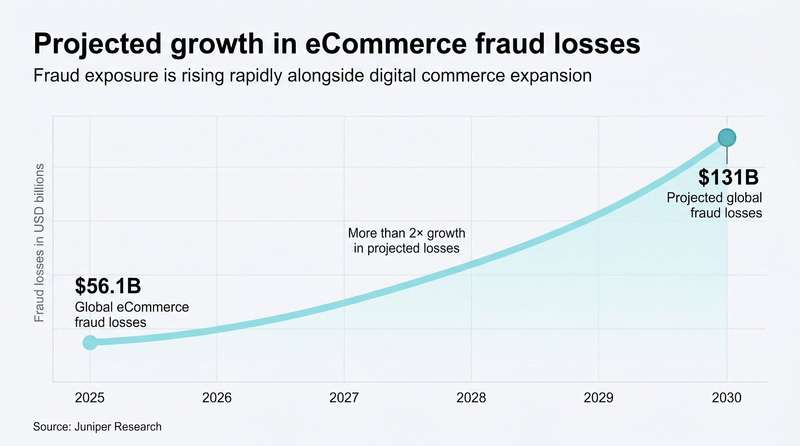
Fraud attacks an auction at its most sensitive point, the integrity of the outcome. Shill bidding inflates prices, account takeover hijacks trust, and payment fraud books a loss after settlement. Effective detection has to run inline, scoring behavior as bids are placed, because once an auction closes on a fraudulent bid, the damage is already recorded. That puts fraud logic in the latency-sensitive path, competing with the speed that makes the auction feel live, and static rules age fast against adaptive attackers. The stakes are quantified: Juniper Research projects eCommerce fraud losses rising from $56.1 billion in 2025 to $131 billion by 2030, which makes inline, adaptive prevention a cost of entry.
DevsData LLC builds fraud scoring as a first-class service in the bid path, evaluating behavioral signals in real time so suspicious activity is caught before close. Machine-learning models adapt to new attack patterns alongside configurable rules, with the engine tuned to return a decision fast enough to never bottleneck acceptance, and human review on high-value edge cases.
Every other challenge runs through latency, because an auction is a real-time contest where delay changes outcomes. Slow acceptance suppresses competition, a lagging broadcast leaves watchers acting on stale prices, and a delayed fraud check forces a choice between speed and safety. The hard part is holding latency down not in calm conditions but during the closing-minute surge, the opposite of how most systems behave. That takes in-memory state to avoid disk round-trips on the hot path, geographically distributed read capacity, efficient serialization, and care to avoid any shared resource that becomes a contention point. Assembling those into a system that stays fast under unpredictable surge is the real work.
DevsData LLC designs the latency-critical path explicitly, keeping live state in memory, distributing read capacity to cut round-trip distance, and removing shared contention points that degrade under surge. Performance is validated against realistic closing-minute load, and the same path carries fraud scoring and broadcast inside the budget rather than trading them off.
Taken together, these challenges show why auction platform development resists shortcuts. Concurrency, consistency, payments, fraud, and latency are not independent problems to solve in sequence; they intersect at the same instant, the close of a contested lot, where load peaks, money moves, and fraud strikes at once. A platform that handles each in isolation but not their intersection will still fail under real conditions. The engineering value lies in designing the system so these pressures are resolved together, which is the difference between a platform that demos well and one that carries volume reliably for years.
The test of an auction platform is not how it behaves on an average afternoon but how it holds its latency, its consistency, and its fraud controls in the final sixty seconds of a contested lot, when all of them are stressed at once.
Do you have software development needs?
Selecting a development partner for an auction platform is mostly a question of verifying the right kind of experience. General web shops can build a presentable marketplace front end, but the transactional core is where projects succeed or fail, and that core demands a specific track record. The steps below focus the evaluation on the capabilities that actually determine whether a platform will hold up under load and money.
Start by confirming the partner has built genuine multi-party marketplaces rather than single-seller stores with a marketplace label. Ask how they separated the hot transactional path from slower services, how they modeled buyers, sellers, and contested items, and where they placed authoritative state. A partner who reaches immediately for in-memory bid state, clear service boundaries, and event-driven updates is describing lived experience. One who frames the build around a content management system and a payment plugin has not done this work before, and an auction platform is the wrong place to let them learn it on your budget.
Auction load is spiky and unforgiving, so the partner needs demonstrated experience with concurrency under surge, not just steady traffic. Ask for specifics: how they load-tested closing-minute bursts, what concurrency they sustained, and how the system degraded when pushed past its limit. The answers reveal whether scalability was designed in or hoped for. A credible partner will talk about horizontal scaling, contention points they identified and removed, and the difference between average and peak load. Vague reassurance that the platform scales is a warning sign, because real scalability work leaves concrete evidence behind.
Probe how the partner guarantees that an auction resolves to exactly one winner at one price, and that the result survives failures. Look for fluency in idempotency, transactional boundaries, and reconciliation between fast and authoritative layers. This is the knowledge that prevents the disputes and inconsistent states that quietly destroy marketplace trust. A partner who can explain how they keep the bid record and the payment hold consistent under partial failure understands the domain. One who treats transactions as a database default has not confronted the consistency problems that auctions create at scale.
Payment is an ongoing reconciliation problem, not a one-time connection, so assess how the partner abstracts providers and handles asynchronous settlement events. Ask how they would add a new payment method or a buy-now-pay-later option without destabilizing the core, and how refunds and chargebacks reconcile against the original auction outcome. A partner with real payment experience will describe a provider-agnostic layer and explicit obligation tracking. One who names a single gateway and stops there is exposing you to the friction and ledger mismatches that surface only after launch, when they are expensive to fix.
The platform you launch is the platform you maintain for years, so weigh how the partner structures code, documents architecture, and plans for handover. Ask about testing coverage on the transactional core, how new auction models would be added, and what operating the system requires day to day. A partner who builds for maintainability leaves clean service boundaries, meaningful tests, and documentation that lets your team operate and extend the platform. One who optimizes only for a fast initial launch leaves technical debt that compounds, turning every later change into a risk against the live transactional system.
The questions below distill these steps into a practical checklist for partner conversations, each aimed at surfacing evidence rather than reassurance.
| Evaluation area | Questions to ask the development company |
|---|---|
| Marketplace architecture expertise | Which multi-party marketplaces have you built, and how did you separate the transactional path from supporting services? |
| Scalability experience | How did you load-test closing-minute bid surges, and what concurrency did the system sustain before degrading? |
| Transactional infrastructure knowledge | How do you guarantee exactly one winner at one price, and how does that result survive a partition or restart? |
| Payment integration capabilities | How would you add a new payment or buy-now-pay-later method, and how do refunds and chargebacks reconcile to the auction record? |
| Long-term maintainability | What does testing coverage on the transactional core look like, and how would a new auction model be added after launch? |
One of the earliest and most consequential decisions an operator faces is whether to build a custom auction platform or adopt a marketplace SaaS solution. The choice is often framed as cost versus speed, but the more important distinction is control versus convenience, and that distinction plays out across the entire operational life of the platform. SaaS gets a marketplace running quickly on proven infrastructure, while a custom build trades initial speed for ownership of the parts that differentiate the business. Reading the trade-off correctly requires looking past the launch and toward how the platform has to behave once it carries real volume.
The differences all trace to one line: whether the operator can shape the system or must work within what the vendor built. A SaaS platform bounds scalability and flexibility to its product, keeps the data and infrastructure in its own environment, patches on its own schedule, and routes payments through its arrangements. A custom build inverts every one of those, handing the operator control over the concurrency profile, the auction logic, the settlement flow, and the data behind them, along with the duty to maintain it all. The table below sets the six factors side by side.
| Factor | Custom auction platform | Marketplace SaaS solution |
|---|---|---|
| Scalability | Scales by operator’s own design, ceiling is self-determined | Scales within vendor-defined boundaries |
| Operational flexibility | Auction logic shaped fully to the business | Configuration within preset options |
| Infrastructure ownership | Operator controls infrastructure and data | Vendor owns infrastructure and data environment |
| Customization | Transactional core fully customizable | Front end themeable, core fixed |
| Long-term maintenance | Operator maintains, controls own schedule | Vendor maintains and patches on its schedule |
| Payment ecosystem control | Operator owns provider relationships and terms | Payments routed through vendor arrangements |
That trade-off has a cost shape worth making explicit before an operator commits. On the SaaS side, dedicated auction platforms are usually fixed-fee rather than commission-based, with hosted products such as BidJS running from a few hundred to a couple of thousand dollars a month and one-time licenses such as AuctionWorx starting near $3000, neither of which takes a percentage of sales. Commission-based marketplace SaaS is the exception that changes the math, since a platform like Mirakl layers a variable fee of roughly 2% of gross merchandise value on top of its subscription, so its cost climbs directly with volume. A custom auction build sits at the other end, starting around $50000 for a basic version and reaching $225000 to $500000 or more for an enterprise-grade real-time system, with the bidding engine as the single largest cost. Ownership then carries an annual load that is easy to underestimate, since maintenance alone runs about 15 to 20% of the build cost each year before hosting and engineering.
The decision reduces to a break-even point an operator can calculate directly. Set the annual SaaS cost, meaning its subscription plus any percentage-of-GMV and per-transaction fees, against the annualized cost of owning a platform, meaning the build spread across its useful life plus that maintenance rate and the infrastructure and staff to run it. Building pays off once the first figure overtakes the second, which for a commission-based platform charging around 2% tends to arrive only in the multi-million-dollar GMV range. Where the SaaS takes no cut of sales, that crossover rarely comes at all, and the reason to build shifts from cost savings to control over how the auctions run and who owns the data behind them.
Where the business creates value decides the choice. An operator whose auctions are conventional and whose edge is inventory or audience is usually well served by SaaS, since the transactional core is not where they compete, and vendor-managed reliability genuinely helps. An operator whose differentiation lives in the auction mechanics themselves will eventually hit the limits of a fixed core. A development partner earns its fee at this point rather than after it, by modeling the concurrency the platform will actually face, testing whether a candidate SaaS product can carry that load, and putting a defensible number against the custom option before anyone commits. The consequence of skipping that work is a decision made on vendor demos, followed a year later by a migration off a platform that was chosen correctly for the wrong assumptions. The real question is whether the business intends to compete on the transactional layer, because that is the layer SaaS holds and a custom build hands back.

Company size: ~60 employees
Founding year: 2016
Website: www.devsdata.com
Headquarters: Brooklyn, NY, and Warsaw, Poland
DevsData LLC is a software development company built for exactly the kind of transactional, scalability-driven work that auction platforms demand. The firm approaches marketplace engineering as a distributed systems problem rather than a website project, which is the orientation this domain requires. Its credentials line up with the capabilities that the earlier evaluation criteria call for, and that alignment is what makes it a credible partner for operators who intend to carry real volume and real money through their platforms.
DevsData LLC is headquartered in Brooklyn, NY, and Warsaw, Poland, giving it a presence across the US and European markets and time zones. The company specializes in auction website development and brings developers with over 10 years of experience in auction and marketplace platform engineering to the work. With a decade of experience in the market, the firm has accumulated the kind of pattern knowledge that only comes from building transactional systems repeatedly and seeing how they behave under sustained load.
The team includes US-based specialists and Google-level in-house engineers, which matters for a domain where the difference between a platform that scales and one that fails often comes down to the depth of the engineering behind it. DevsData LLC has experience working with global corporate clients as well as high-growth startups from various countries, including the US and Israel, so it understands both the compliance and reliability expectations of large enterprises and the speed and flexibility that emerging companies need. That range is useful in auction work, where an enterprise procurement platform and a consumer marketplace impose very different demands on the same core competencies.
Across its history, DevsData LLC has completed 140+ software projects for over 100 clients, a volume that reflects sustained delivery rather than a handful of showcase builds. The firm also specializes in Big Data and Machine Learning, capabilities that map directly onto the fraud-detection and behavioral-scoring requirements that modern auction platforms cannot do without. Machine learning is no longer adjacent to marketplace engineering; it is embedded in the fraud and trust layer, and a partner fluent in it builds that layer as a strength rather than an afterthought.
DevsData LLC holds a rating of 5/5 on Clutch and GoodFirms, independent confirmation of the engineering quality, operational reliability, and product delivery processes that the firm brings to client work. For an operator weighing a partner for a platform where reliability is the entire value proposition, that combination of deep engineering talent, marketplace scalability experience, and verified delivery record is the substantive basis for the decision.
Molten Materials Inc., an American company based in California, needed a transactional commerce platform that could represent its business credibly and handle online sales reliably.

The challenge centered on combining reliable transactional handling with a design that matched the client’s market positioning. For a materials business selling into a demanding customer base, that reliability had to come through in both the engineering and the look, which meant the two advanced together rather than as separate phases.
DevsData LLC took on both the web development and the design, building on Shopify as the commerce foundation so the client gained proven, hosted transactional reliability without operating a custom stack. The work centered on a brand-aligned custom theme, a dependable hosted checkout, and the catalog and payment integrations the business needed, while keeping the managed base that lowered cost and risk. The judgment reflects the custom-versus-managed reasoning laid out earlier in this article.
The result was a launched commerce platform that gave Molten Materials Inc. a reliable transactional presence aligned with its brand. The business impact was a credible, functioning storefront that supported the company’s sales without the operational fragility that a hastily assembled platform would have introduced. The engagement demonstrates the firm’s pattern of matching the technical approach to the business situation rather than defaulting to the most complex build available.
If you are planning an auction or marketplace platform and want a partner who treats the transactional core as the priority it deserves, DevsData LLC can scope the architecture, scalability, and fraud-prevention work your build requires. Reach out to start the conversation by emailing general@devsdata.com or visit www.devsdata.com.
Do you have software development needs?
Auction platform development is best understood as distributed systems engineering applied to contested transactions, and that framing carries through every decision an operator makes. The market case is settled: transaction volume is consolidating into marketplaces, more of it runs on mobile, and buyers expect instant, flexible, reliable settlement. Those forces translate into engineering obligations that a conventional web build was never designed to meet, which is why the auction model an operator chooses should drive the architecture rather than the reverse.
The recurring lesson is that the hard problems converge at a single moment. Concurrency, consistency, payment settlement, fraud detection, and latency all peak together at the close of a contested lot, and a platform that handles them in isolation but not in combination will still fail when it matters. Marketplace scalability is therefore not a feature to add later but a property to design in from the bid path outward, because the closing-minute surge is predictable in timing and punishing in size. Operational reliability follows the same logic: exactly one winner, at one price, with the money moving correctly, surviving any failure, is the standard the entire business rests on, and it is built into the transactional core, or it is not present at all.
Looking ahead, the demands on auction platforms are intensifying rather than easing. Fraud is growing in scale and sophistication, payment ecosystems are adding methods and states, and machine intermediation is beginning to reshape how B2B transactions are placed. Platforms built on a sound transactional foundation can absorb these shifts; those built for a fast launch will find each new pressure exposes a layer that was never engineered to carry it. The strategic choice an operator makes early, about where to own the core and how seriously to treat scalability, determines which of those two futures they inherit.
This is the work DevsData LLC is built for. With a decade in the market, Google-level in-house engineers, deep Big Data and Machine Learning capability, and a verified delivery record across enterprises and high-growth startups, DevsData LLC approaches auction platform development as the transactional engineering challenge it genuinely is. For operators who intend to compete on the reliability and scalability of their marketplace, that orientation is the difference between a platform that demos well and one that carries the business for years.
Any questions or comments? Let me know on
Twitter/X.
Discover how IT recruitment and staffing can address your talent needs. Explore trending regions
like Poland, Portugal, Mexico, Brazil and more.
 Frequently asked questions (FAQ)
DevsData – your premium technology partner
DevsData is a boutique tech recruitment and software agency. Develop your software project with veteran engineers or scale up an in-house tech team of developers with relevant industry experience.
Free consultation with a software expert
🎧 Schedule a meeting
FEATURED IN


DevsData LLC is truly exceptional – their backend developers are some of the best I’ve ever worked with.”

Nicholas Johnson
Mentor at YC, serial entrepreneur


 Build your project with our veteran developers.
Explore the benefits of technology recruitment and tailor-made software.
Learn how to source skilled and experienced software developers.

Rebecca Botvin

Commercial Director

Tom Potanski
Manager




Categories: Big data, data analytics | Software and technology | IT recruitment blog | IT in Poland | Content hub (blog)















careers@devsdata.com





general@devsdata.com

"I interviewed about a dozen different firms. DevsData LLC is truly exceptional – their backend developers are some of the best I've ever worked with. I've worked with a lot of very well-qualified developers, locally in San Francisco, and remotely, so that is not a compliment I offer lightly. I appreciate their depth of knowledge and their ability to get things done quickly."

Nicholas Johnson
CEO of Orange Charger LLC,
Ex-Tesla Engineer,
Mentor at YCombinator
"DevsData reached out to us, as we've been looking to grow our engineering team in Europe and Poland. Communicating efficiently and professionally, DevsData made a strong impression with their understanding of the recruitment challenges we were facing. They designed a tailored recruitment process for our needs. I was impressed with the technical depth of their approach."

Karim Butt
Co-Founder & CTO at GlossGenius, Inc.
"Out of all the vendors we work with, DevsData clearly stands out. The quality of developers they deliver is beyond what we've received from any other vendor, and they've been able to send profile recommendations very quickly. I'm happy to be their reference for other companies from Israel and talk about their recruitment abilities and what they delivered for us."

Ran Eyal
Senior Manager at
ZIM Integrated
Shipping Services Ltd.
"DevsData demonstrated a strong degree of proactivity, taking time to thoroughly understand the problem and business perspective, and continuously suggesting performance and usability enhancements. Their app exceeded my expectations. I've worked with DevsData on numerous projects over the last 3 years and I'm very happy. Being both responsive and honest in communication."

Jonas Lee
Partner & Executive VP of Verus,
Financial LLC, Investor,
& Serial Entrepreneur
Acknowledgments