Thanks for subscribing.
Your gift is on the way.



Hiring a developer you will never share an office with used to be the exception. It has become the default. The pool of work that can be done from anywhere keeps widening, and software engineering sits close to the center of it. The World Economic Forum projects that the number of global digital jobs capable of being performed remotely will rise by roughly 25% to around 92 million by 2030, a structural shift rather than a temporary post-pandemic adjustment. When the talent pool turns global, the screening process has to carry far more weight than it did when a hiring manager could simply walk past someone’s desk.
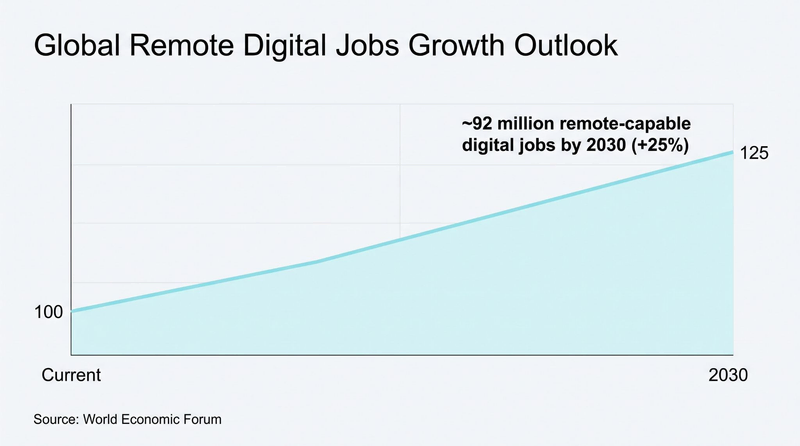
That weight is easy to underestimate. The developer community has already moved: in 2025, 32.4% of developers reported working fully remote, with a large additional share splitting time between home and office. Demand, meanwhile, keeps outrunning local supply. Korn Ferry has estimated a global technology talent shortfall of 4.3 million workers by 2030, which pushes companies to look across borders whether or not they feel ready to. Screening is the mechanism that decides whether that wider reach produces stronger teams or simply more noise.
The cost of getting it wrong is not abstract. The average cost of a bad hire is estimated at USD 17000, and that figure sits at the conservative end. In a distributed team, the detection takes longer because the everyday signals a manager reads in an office are absent. Nobody sees the developer stuck on the same ticket for three days, and a question that never gets asked leaves no trace anywhere. The first hard evidence usually arrives at sprint review, several weeks after the point where a colleague sitting nearby would have noticed something was wrong.
This article lays out why remote screening differs from traditional hiring, weighs the trade-offs between distributed and in-office engineering, and then walks through a seven-step framework built for evaluating remote developers. It closes with the mistakes that derail remote hiring, the methods that sharpen it, and a checklist you can apply to your own process. The goal is not a list of clever interview questions. It is a way of reasoning about screening that holds up when the work happens out of sight.
Remote work does not simply relocate the same job to a different room. It changes which competencies determine success, and therefore which competencies a screening process has to measure. An office can quietly compensate for a developer who communicates poorly in writing or struggles to organize their own day. A distributed team cannot. The traits that office environments treat as nice-to-have become the traits that decide whether remote work functions at all.
In a co-located team, a manager reads progress through presence: who is at their desk, who is whiteboarding, who looks stuck. Remove the shared space and that signal disappears, replaced almost entirely by written communication. IDC research found that knowledge workers lose 30% of the workweek searching for information they cannot find, a cost that lands hardest where documentation is weak. A remote developer who writes clearly is not just pleasant to work with. They are actively reducing the single largest source of friction in distributed engineering.
Without anyone nearby to redirect them, remote developers make dozens of small judgment calls a day with no immediate oversight. Autonomy stops being a personality note and becomes a job requirement. It is also tied to retention: in the 2025 developer community data, autonomy and trust rank among the strongest drivers of job satisfaction. A screening process that never tests for self-direction is leaving one of the most predictive remote competencies entirely unmeasured.
When a team spans several time zones, real-time conversation becomes a scarce resource. Work shifts toward asynchronous handoffs, where one developer finishes a task, documents it thoroughly, and leaves it for a colleague who picks it up hours later. That rhythm rewards people who write down their reasoning, anticipate questions, and structure their work so others can continue it without a meeting. Screening for remote roles therefore has to value documentation habits and asynchronous clarity as much as raw coding speed, because the fastest coder on the team adds little if their work cannot be handed off cleanly.
It is tempting to treat communication, adaptability, and collaboration as secondary to technical ability. Remote work inverts that hierarchy. Structured behavioral interviewing, which probes exactly these traits, sits at the top of the methods reviewed in the selection research, with a validity estimate of 0.42. A validity estimate is a correlation between how a candidate scores in a screening method and how well that person later performs on the job, on a scale where 0 means the method tells you nothing and 1 would mean perfect prediction. At 0.42, structured interviews outrank cognitive ability tests at 0.31 in the same review, which reverses the ordering the field worked with for two decades. The lesson for remote hiring is direct: the so-called soft skills are not soft at all. They are the load-bearing competencies of a distributed team, and they belong at the center of the screening process rather than the margins. The lesson for remote hiring is direct: the so-called soft skills are not soft at all. They are the load-bearing competencies of a distributed team, and they belong at the center of the screening process rather than the margins.
Working remotely is easy. The challenge is working asynchronously. That is the real skill a distributed engineering team has to hire for.
Do you have IT recruitment needs?
The numbers above settle the question of whether distributed engineering is here to stay. They do not describe what it costs to run. Remote hiring widens the pool and simultaneously removes the informal correction an office provides, and a screening process can only compensate for a weakness once someone has named it. The comparison that follows exists for that purpose. Reading where in-office arrangements still hold an advantage is how a hiring team works out which competencies its own process now has to prove rather than assume.
The one consistent rule is that remote teams demand a more structured screening process. When day-to-day supervision is limited, the hiring decision has to do more work upfront, because there is less opportunity to course-correct later. The table below compares the two models across the factors that most affect engineering outcomes.
| Factor | Remote teams | In-office teams | What model to choose |
|---|---|---|---|
| Talent availability | Global pool, limited only by time zones | Restricted to commuting distance | Remote when needed skills are scarce locally |
| Hiring speed | Wider funnel, but needs structured remote screening | Smaller, slower local funnel | Remote for niche or hard-to-find roles |
| Access to specialized expertise | Reaches deep-tech talent anywhere | Constrained by local market depth | Remote for rare, specialized skill sets |
| Salary competitiveness | Can balance cost across regions | Tied to one local cost base | Remote for budget flexibility |
| Communication | Written and documentation-heavy | Verbal and in-person | Remote rewards strong writers |
| Collaboration | Asynchronous, tooling-dependent | Spontaneous and real-time | In-office for ambiguous, fast-moving work |
| Innovation and brainstorming | Workable with the right operating model | Easier ad-hoc whiteboarding | In-office for rapid divergent ideation |
| Team culture | Built deliberately and intentionally | Forms organically | Hybrid for connection plus reach |
| Employee retention | Strengthened by autonomy and flexibility | Supported by in-person belonging | Either, when management is mature |
| Operational costs | Lower real estate and overhead | Higher fixed facility costs | Remote for cost control |
| Scalability | Scales across geographies quickly | Limited by physical space | Remote for rapid headcount growth |
The clearest advantage of remote hiring is reach. A co-located team competes for whoever is willing to commute to one building; a remote team competes globally. That difference matters most precisely where it is hardest to hire. With a projected shortfall of millions of technology workers concentrated in senior and specialized roles, the companies that can credibly evaluate candidates anywhere hold a structural edge. The constraint simply moves from geography to screening quality: a global pool only helps if the process can tell strong candidates from the rest at a distance.
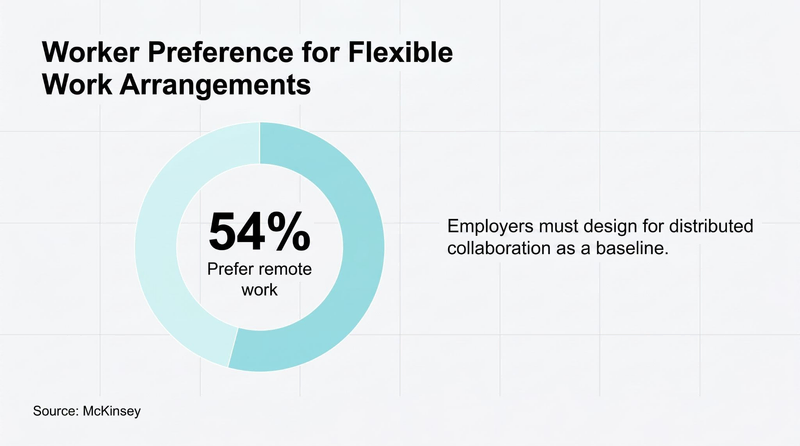
This is where in-office teams retain a real edge and remote teams carry a real cost. Spontaneous problem-solving is harder to replicate over video, and McKinsey’s work on flexible arrangements found that 54% of workers nonetheless prefer remote options, forcing employers to make distributed collaboration work rather than wish it away. The implication for screening is that remote candidates must be evaluated on how they collaborate in writing and across time zones, not just on whether they are personable in a single live conversation.
The fear that remote developers are less productive does not hold up well under scrutiny. The more durable finding is that productivity depends on operating model and management maturity rather than on location itself. What changes is how ownership is observed. In an office, effort is partly visible; remotely, it shows up almost entirely through delivered results and the quality of handoffs. That shift is why ownership has to be screened for directly. A developer who waits to be told what to do next can coast unnoticed in an office far longer than on a distributed team, where their silence quickly becomes a bottleneck.
Remote models lower fixed costs by reducing real estate and overhead, and they let companies balance compensation across regions rather than anchoring every salary to one expensive market. Those savings are real, but they are not free. They are unlocked only when the screening process reliably identifies people who can work well without supervision. A cheaper hire who needs constant hand-holding erases the cost advantage and then some, which is why cost efficiency in remote teams is downstream of screening rigor rather than independent of it.
Every distinction above resolves into a single practical point. Wherever the scarce skill sits outside commuting distance, and the opening section showed how often that is now the case, the hiring decision has to stand on its own without the informal correction an office supplies afterward. Ambiguous early-stage work still benefits from a shared room, yet even those teams reach outside their city the moment a specialized role opens. Most scaling organizations end up running a blend, which means the screening process is the one component that has to work under either arrangement. The seven-step framework that follows is built for that reality.
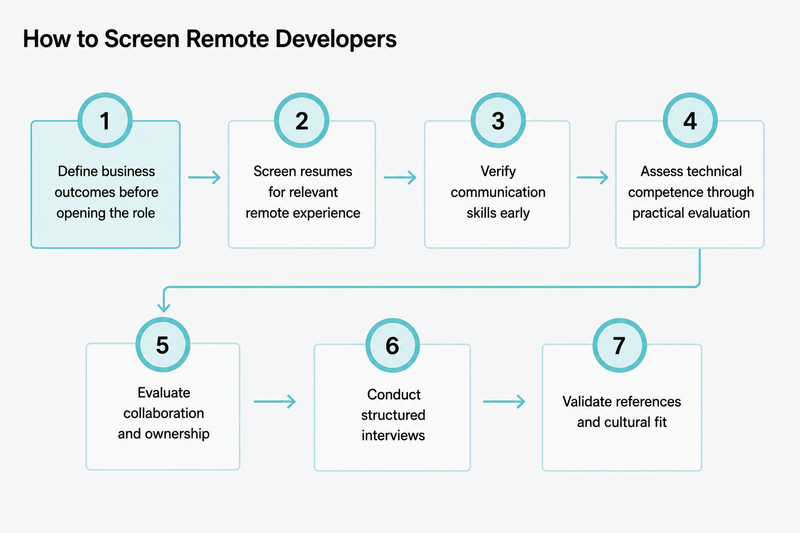
The framework below moves from definition to decision. Each step exists to measure something the next step depends on, and skipping any one of them tends to push its cost downstream, where it is more expensive to fix. The sequence is deliberate: cheap, high-signal filters come first, and the most time-intensive evaluation comes only once a candidate has earned it.
Screening cannot be consistent if no one has agreed on what good looks like. Before sourcing begins, the hiring team should write down the business outcomes the role is meant to produce and the competencies that map to them. This becomes the scorecard every later step refers back to.
Common mistake: opening a role with a vague title and a generic list of technologies, then letting each interviewer invent their own definition of a strong candidate on the spot.
Recommendation: define three to five weighted competencies tied to outcomes, and require that interviewers agree on them before the first conversation. If they cannot agree on what strong performance looks like, the process is not ready to start.
Business implication: a clear scorecard is what makes every downstream score comparable. Without it, the pipeline produces opinions rather than evidence, and the final decision defaults to whoever argues most confidently.
The resume screen is a cheap filter, and its job is narrow: remove obvious mismatches without over-reading. For remote roles, it should look for evidence of distributed work, asynchronous collaboration, and the specific competencies defined in Step 1, not simply a list of impressive logos.
Common mistake: treating the resume as a strong predictor of performance. On its own it is a weak signal, and filtering on pedigree alone discards capable people while admitting well-branded ones who may not fit a remote setting.
Recommendation: apply a consistent rubric that scores relevant remote and asynchronous experience, then move quickly to steps that produce stronger signal rather than lingering on the resume.
Business implication: a disciplined resume screen protects interviewer time for candidates who deserve it, but over-weighting it quietly narrows the funnel in ways that rarely correlate with remote success.
Because written communication carries so much of a distributed team’s work, it should be tested early, before expensive technical rounds. The exercise that works is not a generic writing sample but the artifact the job actually produces: a handoff note. Give the candidate a short scenario in which they finish half a task before logging off, then ask for the 200 words they would leave a colleague picking it up eight hours later. The output shows whether they surface open decisions, flag what they were unsure about, and give the next person enough to continue without a call. AI assistance does not weaken this test, because AI tools are already part of daily engineering work, with 84% of developers using them or planning to. What the exercise measures is judgment about what a colleague needs to know, which no model can supply on the candidate’s behalf. A live call tests synchronous fluency instead, which is the mode a distributed team relies on least.
Common mistake: deferring any communication assessment until a late-stage conversation, by which point significant interviewer time has already been spent.
Recommendation: use a brief written prompt early in the funnel and score it against a rubric for clarity and structure, treating it as a genuine gate rather than a formality.
Business implication: catching weak written communication early prevents the most common and expensive remote failure mode, where a technically capable hire cannot hand off work cleanly across time zones.
Technical screening should resemble the work, not a puzzle from a textbook. Practical work samples carry meaningful predictive validity, with a corrected estimate of 0.33 for work sample tests, and they are also what developers themselves consider fair. Realistic, scenario-based tasks beat abstract algorithm trivia for telling you whether someone can do the job.
Common mistake: handing candidates a take-home that asks for a working application built from scratch over a weekend, or a live task in a framework the team does not even run. Both filter for spare time and recall instead of the judgment the job requires.
Recommendation: use a realistic task drawn from the actual stack, and pair it with a live discussion of the candidate’s own solution so that authorship and reasoning are clear in an era of AI-assisted answers.
Business implication: a job-shaped assessment predicts on-the-job performance far better than a trivia round, and it protects the candidate experience that senior engineers weigh when deciding whether to accept an offer.
This step asks how a candidate works, not just whether they can code. Pair programming and scenario-based discussion reveal how someone reasons aloud, responds to feedback, and takes responsibility for a problem end to end. For remote roles, ownership is the trait that determines whether a developer moves work forward without being chased.
Common mistake: measuring responsiveness and calling it collaboration. Fast replies during a live call show that a candidate can hold a conversation, not that they can leave a colleague in another time zone enough context to continue without asking.
Recommendation: use a short collaborative exercise and watch for whether the candidate clarifies ambiguity, narrates their thinking, and treats the problem as theirs to solve.
Business implication: ownership and collaboration are precisely the competencies that go untested in office hiring and most damage distributed teams when missing, so observing them directly is worth the time it costs.
Structure is the single highest-leverage choice in the entire process, and the evidence behind it was set out earlier. What matters at this stage is what structure looks like in practice. Every candidate answers the same questions in the same order, each answer is rated against a scale with written anchors describing what a weak and a strong response contain, and interviewers commit their scores before anyone speaks to a colleague. That last rule does most of the work, because a panel that debates first converges on whoever speaks with the most conviction.
Common mistake: running free-form conversations that drift differently with every candidate, which lowers validity and lets bias fill the gaps.
Recommendation: standardize the questions, use past-behavior and scenario prompts, and have each interviewer score against the Step 1 scorecard before discussing the candidate with others.
Business implication: structure converts interviews from a collection of impressions into evidence, which is the difference between a defensible hiring decision and a confident guess.
The final step confirms the track record and closes the loop. Structured reference checks, tied to the same competencies as the rest of the process, verify reliability and remote-readiness rather than collecting vague praise. Cultural fit here means alignment with how a distributed team actually operates, not similarity of background.
Common mistake: skipping references under time pressure, or asking only soft questions that invite generic, positive answers.
Recommendation: ask reference questions mapped to the defined competencies, and require a consensus scorecard across interviewers before extending an offer.
Business implication: a structured close prevents a strong technical candidate with poor reliability from slipping through, and it forces the hiring group to commit to evidence rather than to the loudest opinion in the room.
The failures below are not errors of principle. They occur inside pipelines that already have a scorecard and a structured interview, which is why they go unnoticed for so long.
A staff title earned inside a heavily managed organization says little about how someone operates when nobody assigns their week. The candidate may have shipped ambitious work while a manager set priorities, ran the planning, and escalated blockers on their behalf. Strip those supports away and the same engineer can stall on a decision they were never asked to make alone. Screening has to ask what the candidate decided without permission, not what they delivered.
The same rating scale produces different scores in different countries. Interviewers reward candidates who claim credit directly and mark down those who describe achievements as team outcomes, and that preference tracks cultural convention rather than capability. On a panel spread across several markets, the effect compounds quietly, because each interviewer believes they are applying the shared rubric faithfully.
A screening process can identify an engineer who documents thoroughly and works well without supervision, then place them into a team that has never written a handoff note. Nothing in the funnel examines whether the receiving side can support asynchronous work, so the hire absorbs the blame for friction the organization created before they arrived.
Each obstacle below is paired with the cost it carries and the practice that removes it.
The table below pairs each mistake with the risk it creates and the better alternative that a structured process puts in its place.
| Obstacle | Business risk | Better practice |
|---|---|---|
| Seniority mistaken for autonomy | Hire stalls once nobody sets their priorities | Ask what the candidate decided without approval |
| Rubric read through local norms | Scores track presentation convention, not capability | Calibrate interviewers on scored sample answers |
| Receiving team never assessed | Strong remote hire fails inside a team without async practice | Audit documentation and handoff habits before hiring |
No single screening method is sufficient on its own. Each measures something specific, works best at a particular stage, and carries a limitation that another method has to cover. The strongest processes combine several deliberately, because composites of structured methods predict performance far better than any one technique used in isolation. What follows is how to read each method rather than simply how to run it.
Technical assessments measure applied skill, and their value depends almost entirely on realism. A job-shaped work sample, with its 0.33 corrected validity, tells you whether a candidate can do the work; an abstract puzzle tells you whether they have practiced puzzles. The limitation is rising AI-assisted plagiarism on unsupervised take-homes, which is why the assessment should connect to a later live discussion rather than stand alone.
Live coding measures reasoning under mild pressure and, used well, confirms authorship of earlier work. Watching a developer think aloud reveals how they decompose a problem and respond to new information. Its limitation is artificial pressure, which can disadvantage strong engineers who work more deliberately, so it should be framed as a discussion rather than a performance and weighted accordingly.
A portfolio or open-source history shows real, demonstrated work in a way no exercise can fully replicate. It is especially useful early, as corroboration of what a resume claims. The limitation is verification: it can be hard to confirm exactly what a candidate contributed and in what context, which means a portfolio should inform later conversations rather than substitute for direct assessment.
Behavioral interviews assess the competencies that remote work depends on most, ownership and autonomy above all. Their predictive strength is covered earlier in this article, so what matters here is the question format. Past-behavior prompts ask what a candidate actually did in a specific situation rather than what they would do in a hypothetical one, and the difference in signal is substantial. The limitation is that they require structure to work. Without a rubric they collapse into impressions and invite bias.
Reference checks verify track record and reliability, and they belong at the end of the process as a final confirmation. Their limitation is well known: references are rarely neutral, and unstructured calls tend to produce uniformly positive, low-information answers. Tying the questions to specific competencies turns a courtesy call into a genuine validation step.
Read together, the methods form a sequence rather than a menu. The table below summarizes what each one measures, where it fits, and the limitation that the rest of the process must compensate for.
| Screening method | Measures | Best stage | Main limitation |
|---|---|---|---|
| Resume review | Background and relevant remote experience | Initial filter | Weak standalone predictor; embellishment risk |
| Technical assessment | Applied, job-shaped skill | Early to mid | AI-assisted plagiarism on unsupervised tasks |
| Live coding | Reasoning and authorship under pressure | Mid | Artificial pressure can mislead |
| Portfolio review | Demonstrated real-world work | Early to mid | Hard to verify authorship and context |
| Behavioral interview | Ownership, autonomy, adaptability | Mid to late | Needs structure or bias creeps in |
| Structured interview | Job knowledge and reasoning, scored | Mid to late | Requires trained interviewers and rubrics |
| Reference check | Track record and reliability | Final | Positivity bias; low signal if unstructured |
Website: www.devsdata.com
Company size: ~60 employees
Founding year: 2016
Headquarters: Warsaw, Poland, and Brooklyn, New York
Everything above describes what a disciplined remote screening process should look like. DevsData LLC was built to run that process at a level most internal teams cannot sustain on their own. With more than ten years of experience in technology recruitment and a roster of US recruitment specialists, the firm screens remote engineers for clients across the United States and Israel, combining global reach with the structure that distributed hiring demands. The point of difference is not access to candidates alone. It is the rigor applied to evaluating them before a client ever spends time on an interview.
That rigor starts with scale and selectivity working together. A talent database of roughly 95000 candidates gives DevsData LLC a wide enough pool to find rare, specialized profiles, while a government-approved recruitment license and more than 140 completed recruitment projects across over 100 clients provide the operational discipline to filter that pool down to genuine fits. Breadth without selectivity produces noise; selectivity without breadth produces empty pipelines. Holding both is what lets the firm surface candidates who match not just a tech stack but the way a distributed team actually works.
The evaluation itself mirrors the framework, resulting in a 6% acceptance rate. At its center is a proprietary 90-minute technical interview led by senior engineers, deep enough to test real problem-solving rather than rehearsed answers. Around that technical core sit a structured communication assessment and a soft-skill evaluation, because DevsData LLC treats written clarity, ownership, and collaboration as load-bearing competencies for remote roles rather than as afterthoughts. A dedicated remote-work readiness assessment then checks whether a candidate can operate with autonomy across time zones, the trait that most often separates a strong office developer from a strong distributed one.
The commercial model reinforces the screening discipline rather than working against it. A success-fee structure means the firm is paid for outcomes, not activity, which aligns its incentives with finding candidates who actually last. A guarantee period extends that alignment past the offer, giving clients protection if a placement does not work out and giving DevsData LLC a direct stake in long-term fit rather than a quick close. Independent verification backs this up: the firm holds a 5 out of 5 rating on Clutch and GoodFirms, signals that the rigor described here shows up in client outcomes rather than only in process documents.
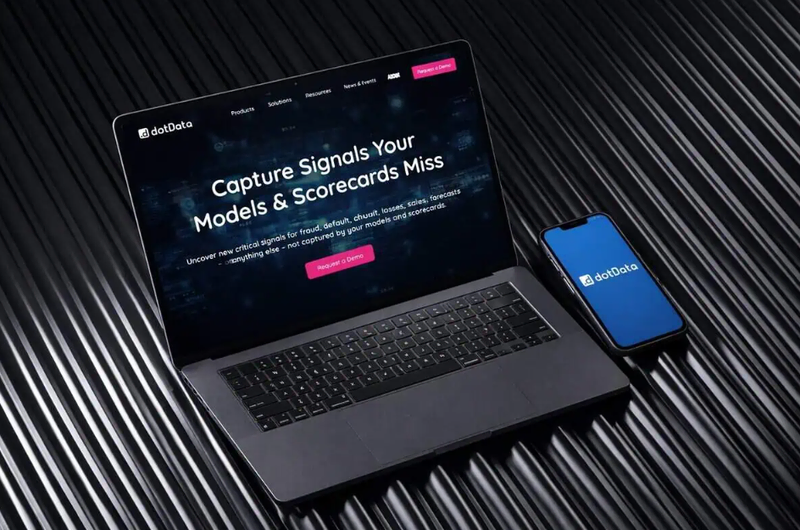
DotData, Inc., a Silicon Valley enterprise software company specializing in automated data science and AI-driven analytics, set out in 2022 to expand its engineering capacity beyond the United States and Japan. The company serves Fortune 500 clients across finance, telecom, and retail, and it turned to DevsData LLC to build a distributed engineering team across Poland, Europe, and Japan. The roles spanned Scala engineering, Python development, DevOps, data science, and technical writing, supporting both the American and Japanese teams.
This was a remote-screening problem in its purest form. DotData needed deep-tech specialists who were not only technically exceptional but also able to operate across Japanese, American, and European teams, each with different expectations around documentation, decision-making, and pace. Candidates had to manage asynchronous workflows across several time zones, leaving thorough documentation for colleagues who would continue the work hours later. Generic hiring platforms had already failed to surface engineers with the required hybrid skill sets, such as DevOps engineers who also understood machine-learning infrastructure.
DevsData LLC assembled a cross-functional recruitment team and ran geo-distributed, parallel hiring tracks tailored to each location. The technical vetting went well beyond checking language proficiency: candidates worked through task-based exercises that mirrored scalable, cloud-native architecture challenges, including ETL workflows, fault tolerance, and latency optimization, followed by in-depth conversations on system design. For technical writer roles, documentation samples were reviewed for clarity and the ability to explain advanced workflows. Behavioral interviews then assessed adaptability within cross-cultural teams, the competency that most determines whether a remote hire integrates cleanly.
The engagement delivered 16 senior professionals, primarily for the Polish team with select hires in Japan, spanning DevOps engineers, data scientists, senior Scala developers, Python developers, and technical writers. The deep-tech vetting produced an interview-to-hire ratio of approximately 70%, an average time-to-offer of six to nine days, and high candidate retention, with most hires integrated into their teams within the first month.
The engineers hired through DevsData LLC took full ownership of complex, data-intensive components, including distributed data pipelines and infrastructure automation. Their contributions helped reduce deployment cycles by over 25%, increased platform stability, and supported faster feature delivery, allowing DotData to maintain its edge in a competitive AI-driven market. Beyond the immediate hires, DevsData LLC left behind a repeatable, culturally aligned hiring framework that reduced dependency on external contractors and strengthened the company’s long-term engineering capacity.
Screening remote developers at a distance?
Like DotData, you can build a distributed engineering team without lowering the bar. DevsData LLC runs the full seven-step screening process for you, from a senior-led technical interview to structured communication and remote-readiness assessment. Talk to our recruitment team about your open remote roles by emailing at general@devsdata.com or visiting www.devsdata.com.
Do you have IT recruitment needs?
A framework only helps if it survives contact with a live hiring pipeline. The checklist below condenses the seven steps into a sequence of decisions a hiring team can work through for any remote engineering role. It is a practical implementation summary rather than a new set of ideas: each stage maps directly to a step already discussed, and each asks a question that should be answerable with evidence before the process moves forward. Used consistently, it turns the framework from a concept into a routine, which is what makes screening outcomes repeatable instead of dependent on who happened to run the interview.
| Screening stage | Questions to answer |
|---|---|
| Define outcomes | Have we written a weighted scorecard and agreed on what strong performance looks like? |
| Resume screen | Does the candidate show relevant remote and asynchronous experience against our rubric? |
| Communication check | Has written clarity been tested early with a scored asynchronous exercise? |
| Technical assessment | Did we use a realistic, job-shaped task rather than an abstract puzzle? |
| Collaboration and ownership | Have we observed how the candidate works through a problem, not just discussed it? |
| Structured interview | Did every interviewer ask consistent questions and score against the scorecard? |
| References and decision | Are reference answers mapped to competencies, and is there a consensus scorecard? |
Treat the final column as a gate rather than a formality. If any stage cannot be marked complete with evidence, that is a signal to pause rather than to push forward on momentum. The discipline of refusing to advance a candidate past an unanswered question is precisely what separates a structured process from an optimistic one. Over a full pipeline, that discipline compounds: it keeps interviewer time focused on candidates who have earned it, it makes decisions defensible when stakeholders disagree, and it steadily raises the quality of the people who make it through to an offer.
Remote developer screening is not traditional hiring conducted over video. The conditions that let an office paper over a weak hire do not exist on a distributed team. When supervision is limited and most coordination happens in writing, the hiring decision carries more weight, and structure is the only reliable way to carry it. Consistent questions, shared rubrics, realistic assessments, and multiple methods used in sequence convert screening from a series of impressions into a body of evidence.
The case for that rigor is not procedural. Structured methods have the strongest record of predicting who will perform, and skipping them shows up later as missed handoffs, slipped timelines, and the expense of replacing someone who never fit. Those costs accrue quietly and for longer on a distributed team, which is why upfront discipline pays for itself. The seven-step framework is one way to make that discipline routine.
The direction of travel makes this more pressing. With remotely performable digital jobs projected to climb toward 92 million by the end of the decade and demand for senior engineering talent outpacing local supply, companies that build a credible remote screening capability hold a durable advantage. They hire from a genuinely global pool with confidence, while competitors treating remote hiring as lightly modified office hiring keep absorbing the cost of mismatches.
Screening is no longer a gate at the end of sourcing. It is the competency that decides whether a global talent pool becomes a stronger team or just a larger one. Building it, in-house or with a specialist partner, is the most reliable investment an engineering leader can make in the quality of everything the team ships afterward.
Any questions or comments? Let me know on
Twitter/X.
Discover how IT recruitment and staffing can address your talent needs. Explore trending regions
like Poland, Portugal, Mexico, Brazil and more.

 Frequently asked questions (FAQ)
DevsData – your premium technology partner
DevsData is a boutique tech recruitment and software agency. Develop your software project with veteran engineers or scale up an in-house tech team of developers with relevant industry experience.
Free consultation with a software expert
🎧 Schedule a meeting
FEATURED IN


DevsData LLC is truly exceptional – their backend developers are some of the best I’ve ever worked with.”

Nicholas Johnson
Mentor at YC, serial entrepreneur


 Build your project with our veteran developers.
Explore the benefits of technology recruitment and tailor-made software.
Learn how to source skilled and experienced software developers.

Rebecca Botvin

Commercial Director

Tom Potanski
Manager




Categories: Big data, data analytics | Software and technology | IT recruitment blog | IT in Poland | Content hub (blog)















careers@devsdata.com







general@devsdata.com

"I interviewed about a dozen different firms. DevsData LLC is truly exceptional – their backend developers are some of the best I've ever worked with. I've worked with a lot of very well-qualified developers, locally in San Francisco, and remotely, so that is not a compliment I offer lightly. I appreciate their depth of knowledge and their ability to get things done quickly."

Nicholas Johnson
CEO of Orange Charger LLC,
Ex-Tesla Engineer,
Mentor at YCombinator
"DevsData reached out to us, as we've been looking to grow our engineering team in Europe and Poland. Communicating efficiently and professionally, DevsData made a strong impression with their understanding of the recruitment challenges we were facing. They designed a tailored recruitment process for our needs. I was impressed with the technical depth of their approach."

Karim Butt
Co-Founder & CTO at GlossGenius, Inc.
"Out of all the vendors we work with, DevsData clearly stands out. The quality of developers they deliver is beyond what we've received from any other vendor, and they've been able to send profile recommendations very quickly. I'm happy to be their reference for other companies from Israel and talk about their recruitment abilities and what they delivered for us."

Ran Eyal
Senior Manager at
ZIM Integrated
Shipping Services Ltd.
"DevsData demonstrated a strong degree of proactivity, taking time to thoroughly understand the problem and business perspective, and continuously suggesting performance and usability enhancements. Their app exceeded my expectations. I've worked with DevsData on numerous projects over the last 3 years and I'm very happy. Being both responsive and honest in communication."

Jonas Lee
Partner & Executive VP of Verus,
Financial LLC, Investor,
& Serial Entrepreneur
Acknowledgments