Thanks for subscribing.
Your gift is on the way.



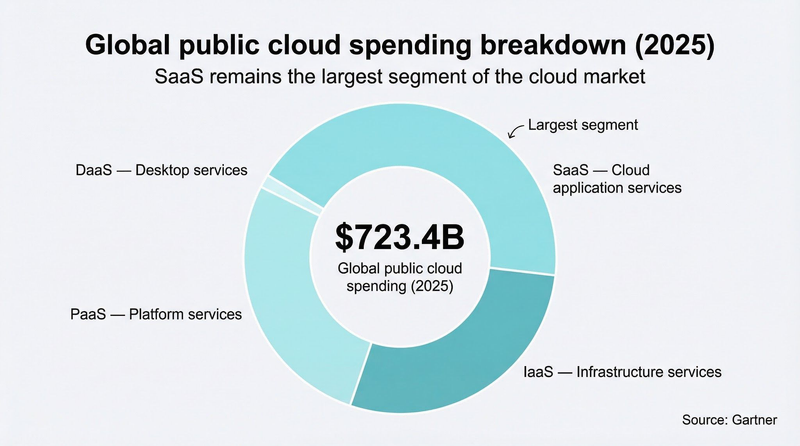
Software-as-a-Service has become the default delivery model for enterprise applications. Buyers prefer it because the subscription model replaces a large upfront hardware and licensing purchase with a predictable operating cost, and rollout shrinks from months to days. Engineering teams gain a single production environment that simplifies upgrades and monitoring rather than shipping installable software to thousands of customer servers. Gartner forecasted worldwide public cloud end-user spending at $723.4 billion in 2025, with SaaS remaining the largest segment of that market. The shift from licensed, on-premises software toward subscription-based, cloud-hosted platforms has restructured how technology companies generate revenue, retain customers, and scale operations.
According to IDC, over 70% of new enterprise application spending will be cloud-based by 2028. SaaS is no longer a new category, and the products that win at this stage are the ones built on solid architecture. Customers expect uptime, fast performance, and clean integrations as a baseline, so weaker engineering choices show up in churn rather than in differentiation. Companies launching SaaS products face decisions about multi-tenancy, API design, data isolation, deployment pipelines, and cost optimization that carry long-term consequences for product viability.
SaaS development consulting exists because these decisions require specialized expertise that most organizations do not maintain in-house. The difference between a SaaS product that scales efficiently and one that accumulates technical debt within 18 months often traces back to architecture choices made in the first quarter of development. This article examines the SaaS consulting landscape through institutional data from Gartner, McKinsey, IDC, CNCF, the World Economic Forum, and the U.S. Bureau of Labor Statistics. It covers what SaaS development consulting entails, when organizations need it, what the current market looks like, and how to evaluate consulting partners – concluding with DevsData LLC’s approach to SaaS development and talent acquisition.
SaaS development consulting is a professional engagement where external specialists advise on and execute the design, architecture, and build of software-as-a-service platforms. The term “consulting” signals a different scope of work from straight implementation engagements. Consultants are accountable for the architectural and product decisions themselves, not only for executing against a specification someone else has already written. The strategic dimension is what separates this discipline from staff augmentation or outsourced development – a SaaS Consultant evaluates multi-tenancy models, API contract design, microservices decomposition, and infrastructure selection before the first line of production code is committed.
The table below maps the core dimensions of SaaS development consulting and how each differs from conventional software development:
| Consulting dimension | What it covers | How it differs from standard development |
|---|---|---|
| Architecture strategy | Multi-tenancy design, data isolation patterns, service decomposition, database partitioning | Focuses on decisions that compound over years, not sprint-level feature delivery |
| Cloud infrastructure | Provider selection, container orchestration (Kubernetes), region strategy, hybrid deployment | Requires cross-provider fluency and cost modeling that product engineers rarely maintain |
| API and integration design | API contracts for human and AI consumers, event-driven communication, third-party integration governance | Treats APIs as strategic infrastructure, not implementation details |
| Platform engineering | CI/CD pipelines, developer experience, internal tooling, observability (OpenTelemetry) | Builds the engineering platform that accelerates all subsequent product development |
| Security and compliance | Tenant data isolation, encryption, access control, regulatory compliance architecture | Embeds security into architecture rather than applying it as an afterthought |
| FinOps and cost optimization | Resource allocation, autoscaling strategy, usage-based billing alignment, cloud cost governance | Connects architecture choices directly to unit economics and margin structure |
Read together, these dimensions share one trait: each governs a decision whose consequences outlast any single sprint. The value of consulting lies less in any individual choice than in keeping architecture, cost, and compliance coherent as the platform scales.
The consulting model works because SaaS architecture requires cross-functional depth that is difficult to assemble permanently. Building an internal team with simultaneous expertise in cloud-native development, distributed systems, FinOps, and compliance takes months. Engaging consultants with proven patterns compresses that timeline from quarters to weeks, reducing time-to-market while avoiding architecture mistakes that compound with every new tenant and feature release. Gartner projects that by 2028, AI agents will consume the majority of enterprise APIs – a shift that makes API architecture decisions made today even more consequential. Effective SaaS consulting treats product roadmaps and technical architecture as inseparable, because every architecture choice is a business decision that determines unit economics, customer onboarding speed, and the feasibility of future product directions.
Not every software project requires external consulting. The decision to engage SaaS consultants usually correlates with specific inflection points where the cost of wrong architectural decisions outweighs the investment in expert guidance. The following scenarios represent the most common triggers.
Greenfield SaaS products face foundational decisions in their first 90 days that shape the next five years of development. Multi-tenancy model, authentication architecture, billing integration, and deployment strategy all require resolution before meaningful feature work begins. Organizations without prior SaaS experience routinely underestimate the complexity of these decisions. Consulting ensures that the initial architecture supports the product’s target scale, compliance requirements, and commercial model from the outset rather than requiring costly re-architecture later.
Growth often exposes architectural weaknesses that were invisible at lower volumes. Database query patterns that worked for 500 users collapse at 50000. Single-region deployments create unacceptable latency for international customers. Monolithic codebases make feature releases slow and risky. Scaling consulting focuses on identifying bottlenecks before they become outages, designing horizontal scaling strategies, and implementing performance engineering practices that maintain reliability under increasing load.
Companies converting on-premises software to SaaS face one of the most complex transitions in enterprise technology. McKinsey reports that only 10% of cloud transformations achieve their full value, while large companies run just 15-20% of their applications in the cloud despite years of migration programs. The gap between migration intent and execution success makes consulting critical for migration planning, workload assessment, and re-architecture strategies that capture actual business value rather than simply relocating infrastructure.
Performance issues in SaaS products rarely have single causes. Slow API response times may stem from inefficient database queries, missing caching layers, suboptimal network configurations, or poorly designed service communication patterns. Diagnosing root causes requires experience across the full stack. SaaS performance consultants bring observability tooling expertise and established diagnostic methodologies that accelerate resolution from months to weeks.
Technical debt consumes engineering capacity without producing customer value. CISQ estimates accumulated US software technical debt at approximately $1.52 trillion. At the organizational level, this translates to engineers spending significant portions of their time maintaining legacy code rather than building new features. Consulting engagements focused on technical debt remediation prioritize high-impact refactoring, establish code quality gates, and create migration paths from legacy components to modern, maintainable architectures.
SaaS products that have not yet found stable product-market fit need architectures that support rapid iteration without accumulating structural problems. The tension between speed and quality is acute in early-stage SaaS companies. Consulting helps establish architectural boundaries that allow teams to experiment quickly within defined modules while protecting core system stability. This approach prevents the common failure mode where early speed creates later paralysis.
As AI workloads become embedded in SaaS platforms, organizations face new architecture challenges around model serving, inference infrastructure, and cost management. Gartner predicted that 30% of GenAI projects would be abandoned after proof of concept by the end of 2025 – a failure rate that reflects, in part, insufficient architectural planning for production AI workloads. Consulting brings experience in AI infrastructure patterns that prevent costly abandoned implementations.
Not every project starts with development. Clients frequently bring in consultants to determine what kind of SaaS product they should adopt in the first place. The work compares candidate tools against the organization’s workflows and budget, then identifies the option whose architecture and pricing model best match where the business is heading.
Do you have IT recruitment needs?
The SaaS development consulting market exists within a broader cloud and enterprise software ecosystem that has grown consistently for over a decade. Understanding the scale and direction of this market clarifies why consulting demand is structural rather than cyclical. Enterprise investment in SaaS platforms continues to accelerate, creating corresponding demand for the specialized architecture, engineering, and operational expertise that consulting firms provide. The data below maps the key dimensions of this market.
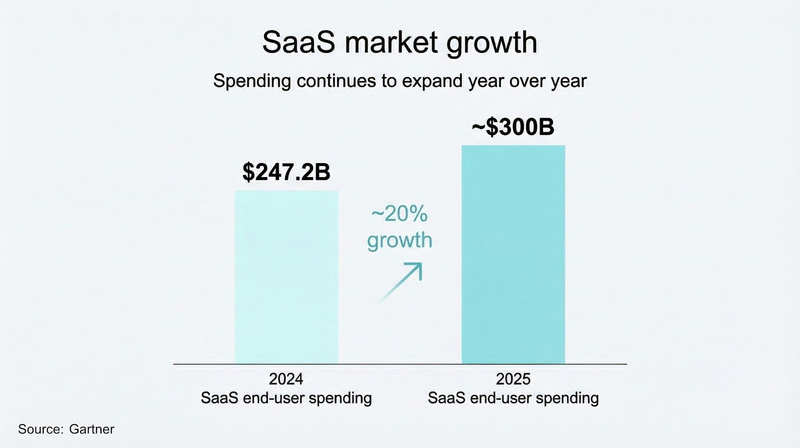
SaaS end-user spending reached $247.2 billion in 2024, growing at approximately 20% year over year. That figure approached $300 billion in 2025. The enterprise application segment alone – CRM, ERP, HR platforms – generated $218.5 billion in SaaS revenue in 2024, with CRM accounting for over half of that total. These figures indicate that SaaS is not an emerging category but a mature, dominant delivery model for enterprise software. For consulting, the implication is sustained demand: every dollar of new SaaS spending requires architecture decisions, platform engineering, and operational expertise.
The CNCF 2025 Annual Cloud Native Survey reports that 98% of surveyed organizations have adopted cloud-native techniques, with Kubernetes production usage reaching 82%. Container orchestration is no longer a differentiator – it is a baseline. The consulting opportunity has shifted accordingly. Rather than advising organizations on whether to adopt cloud-native architectures, consultants now focus on optimization: how to reduce Kubernetes operational overhead, implement effective observability with tools like OpenTelemetry, and design platform engineering functions that improve developer productivity.
The industry is recalibrating its approach to service decomposition. The CNCF 2024 Annual Survey found that cultural changes (not technology) are now the top challenge in cloud-native adoption, cited by 47% of respondents in the 2025 survey. This signals a maturation beyond pure technical implementation toward organizational design and team topology questions. For SaaS consultants, the implication is that architecture recommendations must account for organizational capacity, not just technical capability. Recommending microservices to a team that lacks the operational maturity to manage distributed systems creates more problems than it solves.
APIs are transitioning from developer tools to autonomous-agent interfaces. Gartner predicts that by 2028, 80% of organizations will report that AI agents consume the majority of their APIs, rather than human developers. This shift fundamentally changes API design requirements. SaaS products must be built with machine-readable specifications, robust error handling for autonomous consumers, and real-time governance capabilities. Consulting that addresses API strategy at the architecture level – rather than treating APIs as an afterthought – creates measurable competitive advantage.
SaaS platforms are growing more complex at a rate that exceeds available talent supply. The BLS projects 15% growth in Software Developer employment through 2034, with approximately 129200 annual openings – growth five times faster than the national average. Yet the Linux Foundation’s 2025 State of Tech Talent Report shows that 59% of organizations report understaffing in cloud computing and 56% in platform engineering. The shortage is not going to ease in the next hiring cycle, and SaaS companies that cannot recruit senior architects fast enough end up bringing in external ones to keep projects moving.
AI has shifted from an optional add-on to a structural force in how SaaS platforms are built. Gartner projects that 40% of enterprise applications will feature task-specific AI agents by the end of 2026, up from less than 5% a year earlier. That pace pushes model serving and inference cost into core architecture decisions, and platforms designed without provisioning for AI workloads face expensive rework once usage scales.
In a market where 98% of organizations have adopted cloud-native techniques, the consulting question is no longer whether to move to the cloud – it is whether your architecture can absorb the next five years of complexity without a rewrite.
SaaS development carries structural risks that differ from traditional software projects. The combination of multi-tenant architecture, continuous delivery requirements, distributed infrastructure, and evolving compliance obligations creates failure modes that are specific to the SaaS model. As a SaaS development consulting partner, DevsData LLC diagnoses these structural risks and then implements the fixes alongside client teams rather than handing over a report. The patterns below appear most often in its engagements, each followed by the resolution the firm puts in place.
SaaS products that perform adequately at launch frequently degrade as usage grows. Database schemas designed for hundreds of tenants create contention at thousands. Synchronous service communication patterns that work at low traffic volumes create cascading failures under load. Autoscaling configurations that were never load-tested produce unexpected cost spikes during usage peaks. These problems compound because the architecture decisions that caused them are embedded throughout the codebase, making incremental fixes insufficient.
DevsData LLC conducts architecture assessments that identify scalability constraints before they cause production incidents. The team designs horizontal scaling strategies, implements database sharding and read-replica patterns, and establishes load-testing practices that validate performance under projected growth scenarios. This preventive approach reduces the cost and disruption of scaling compared to reactive crisis response.
Architecture mistakes in SaaS products are disproportionately expensive because they affect every tenant, every deployment, and every integration. McKinsey reports that tech debt accounts for approximately 40% of IT balance sheets, with companies paying an additional 10-20% on top of project costs to address accumulated debt. Choosing the wrong database, authentication pattern, or service communication model in the first quarter of development can add years of remediation work later.
DevsData LLC applies architecture review processes at project inception, evaluating technology selection, data modeling, security patterns, and deployment strategy against the product’s growth trajectory. The team’s engineers, with over ten years of experience in SaaS development, bring pattern recognition from prior engagements that prevents the most common and most costly architectural errors.
Modern SaaS products do not operate in isolation. They integrate with payment processors, identity providers, analytics platforms, CRM systems, and increasingly with AI services. Each integration introduces authentication requirements, data format negotiations, rate-limiting constraints, and failure handling patterns. The total integration surface area of a mid-scale SaaS product often exceeds the complexity of the core product itself. PwC’s 2025 Global Digital Trust Insights survey found that 67% of respondents noted GenAI has increased their attack surface over the past year, adding a security dimension to integration complexity.
DevsData LLC designs integration architectures that use API gateways, event-driven communication patterns, and standardized contract testing to manage complexity at scale. The team implements circuit-breaker patterns and graceful degradation strategies that prevent third-party failures from cascading into core product outages.
Technical debt in SaaS products is uniquely dangerous because it affects the entire customer base simultaneously. McKinsey found that 70% of software used by Fortune 500 companies was developed over 20 years ago, and companies scoring in the 80th percentile on tech debt management grow revenue 20% faster than the bottom quintile. The direct link between technical debt and revenue performance makes debt remediation a business priority, not merely an engineering preference.
DevsData LLC conducts tech debt audits that quantify the business impact of accumulated debt and prioritize remediation by ROI. The team implements incremental modernization strategies – strangler fig patterns, module extraction, and API wrapping of legacy components – that allow continued feature development alongside debt reduction. This dual-track approach prevents the false choice between product progress and platform health.
The cost of a wrong architecture decision in SaaS is not the rework itself – it is the compound interest on that rework, charged against every tenant, every deployment, and every integration for the lifetime of the product.
These failure modes rarely appear in isolation, and the cost of misreading them falls on every tenant at once. That is why the choice of consulting partner matters as much as the work itself. The criteria below set out how to judge whether a prospective partner can handle SaaS problems at this level.
Do you have IT recruitment needs?
Selecting a SaaS consulting partner is a consequential decision because architecture mistakes are expensive to reverse and consulting relationships shape product direction. The following five-step evaluation framework addresses the dimensions that distinguish effective partners from vendors who deliver generic output.
General software development experience does not transfer directly to SaaS. Multi-tenancy, usage-based billing, zero-downtime deployments, and tenant data isolation are SaaS-specific concerns that require dedicated expertise. Evaluate whether the consulting partner has delivered production SaaS platforms – not just cloud applications or web services – and whether their team understands the operational differences between SaaS and traditional software delivery.
The DORA research program demonstrates that high-performing teams deliver faster, more reliably, and at lower cost. Evaluate whether the consulting partner measures software delivery performance using DORA metrics, implements platform engineering practices, and maintains CI/CD pipelines that support continuous deployment. Partners who cannot articulate their deployment frequency, change failure rate, and recovery time are unlikely to deliver the engineering discipline that SaaS platforms require.
SaaS architecture decisions carry long-term consequences, so the people making them matter disproportionately. McKinsey finds that an expert Developer is more than 10x more productive than a novice. Ask for the specific experience profiles of the engineers who will work on your project, not the firm’s general credentials. For SaaS engagements, request prior multi-tenant architecture work, evidence of having scaled a system past its first usage cliff, and hands-on familiarity with the cloud provider and managed services your platform will run on. Evaluate whether the firm retains senior talent or rotates junior staff through projects after the sales phase.
Cloud costs are a significant component of SaaS unit economics. Deloitte predicts that FinOps tools and practices could save enterprises $21 billion in 2025, with companies potentially cutting cloud costs by as much as 40%. A consulting partner that builds SaaS products without embedded FinOps practices is creating long-term cost liabilities. Evaluate whether cost optimization is integral to their architecture approach or an afterthought.
Effective SaaS consulting produces measurable outcomes: reduced deployment cycle times, improved system reliability, lower cloud costs per user, faster time-to-market for new features. Ask for case studies with quantified results. Partners who can only describe technical deliverables without connecting them to business outcomes may lack the strategic perspective that SaaS consulting requires.
The following table summarizes the evaluation framework:
| Evaluation step | Questions to ask |
|---|---|
| SaaS-specific experience | Have they delivered production multi-tenant SaaS platforms? Do they understand tenant isolation, usage-based billing, and zero-downtime deployment? |
| Cloud-native and DevOps maturity | Do they measure DORA metrics? Do they implement platform engineering, CI/CD, and infrastructure-as-code? |
| Team seniority and retention | Who specifically will work on the project? What is the average experience level? Do they retain senior engineers post-sale? |
| Cost optimization approach | Is FinOps embedded in their architecture methodology? Can they demonstrate cloud cost reduction from prior engagements? |
| Evidence of business impact | Can they provide case studies with quantified outcomes – reduced cycle times, lower costs, improved reliability? |
Applied honestly, this framework filters out partners who can describe SaaS work but have not delivered it under production load. A firm that answers each question with evidence rather than assertion is the one worth shortlisting. DevsData LLC was built to meet exactly these criteria, which the next section sets out in detail.
Website: www.devsdata.com
Company size: ~60 employees
Founding year: 2016
Headquarters: Warsaw, Poland, and Brooklyn, New York
DevsData LLC operates as a dual-capability firm – combining SaaS development consulting with specialized IT recruitment. This structure is a differentiator because effective SaaS projects require both architectural expertise and access to senior engineering talent. DevsData LLC delivers both from a single engagement, reducing coordination overhead and ensuring that recruited professionals align with the technical standards established during the consulting phase.
Headquartered in New York, NY, and Warsaw, Poland, DevsData LLC has over ten years of experience in the market. The firm maintains US-based specialists on the team and has completed more than 140 software projects for over 140 clients. These clients range from global corporate organizations to high-growth startups from the US, Israel, and other countries. The engineering team includes developers with over ten years of experience in SaaS development, alongside google-level in-house engineers who apply rigorous engineering standards to every engagement.
On the recruitment side, DevsData LLC maintains a database of over 95000 candidates and holds an official, government-approved license for recruitment services. The firm uses a success fee model with a guarantee period, eliminating upfront financial risk for clients. Candidate evaluation follows a rigorous interview process that includes a 90-minute problem-solving challenge, ensuring technical capability matches project requirements. DevsData LLC specializes in Big Data and Machine Learning recruitment alongside SaaS development, and holds a rating of 5/5 on both Clutch and GoodFirms.
Panzura, an American hybrid cloud storage and data management company headquartered in San Jose, California, needed to expand its India-based engineering hub with Senior Software Developers. The company’s products – CloudFS and Symphony – required hands-on expertise in Java, AWS, Google Cloud, Kubernetes, and Docker. Months of internal recruiting and local agency engagement had produced too few qualified candidates, straining delivery timelines and leaving security initiatives understaffed.
Technical scope: The engagement focused on sourcing Senior Java Developers capable of working across distributed cloud systems, supporting features for Panzura’s hybrid cloud file services platform, and contributing to security tasks, including access control reviews and encryption configuration. Candidates needed proven capability with test-driven development frameworks and experience collaborating in distributed, cross-border teams.
Solution and implementation: DevsData LLC introduced CTO-led technical interviews and custom coding assessments calibrated to Panzura’s stack. The team took full control of sourcing, scheduling, and candidate communication, freeing Panzura’s internal staff to focus on evaluating only the final shortlisted candidates. Role descriptions were recalibrated with hiring managers to tighten qualification criteria and reduce late-stage drop-off.
Outcome: The engagement delivered Senior Java Developers who integrated quickly into Panzura’s India hub and restored development velocity. The structured approach improved the interview-to-hire ratio, reduced dependency on local agencies, and established a repeatable recruitment process for continued engineering expansion.
The Panzura engagement illustrates a pattern that recurs across DevsData LLC’s SaaS consulting and recruitment work: technical hiring for cloud-native platforms fails when recruitment operates independently of architecture understanding. Sourcing Senior Developers for Kubernetes-orchestrated, distributed systems requires evaluating candidates against the specific infrastructure, security model, and collaboration patterns of the target environment – not against generic job descriptions. DevsData LLC’s dual capability in SaaS development and talent acquisition ensures that every hire is evaluated through the lens of the product’s actual technical requirements.
Do you have IT recruitment needs?
SaaS development consulting has evolved from a discretionary engagement into a structural requirement for organizations building cloud-native software products. The data is unambiguous: Gartner’s forecast of $6.15 trillion in global IT spending for 2026, with software growing at 14.7%, confirms that enterprise technology investment is accelerating. The World Economic Forum’s Future of Jobs Report 2025 identifies Software and Application Developers as the fourth fastest-growing occupation globally, yet 63% of employers cite skills gaps as their primary barrier to business transformation.
This combination of expanding demand and constrained talent supply defines the SaaS consulting market for the foreseeable future. Organizations that attempt to build SaaS products without specialized architecture expertise face the documented consequences: McKinsey’s finding that only 10% of cloud transformations achieve full value, and CISQ’s measurement of $2.41 trillion in annual costs from poor software quality. The gap between aspiration and execution is where consulting creates measurable value.
DevsData LLC addresses this gap through a dual-capability model that combines SaaS architecture consulting with access to a vetted talent pipeline of over 95000 candidates. With over ten years of experience, 140+ completed projects, and a team of senior engineers with deep SaaS expertise, DevsData LLC provides the strategic guidance and execution capability that SaaS organizations need to build products that scale, perform, and compete in a market that does not reward architectural shortcuts.
To explore how DevsData LLC can support your SaaS development or engineering recruitment needs, visit www.devsdata.com or contact the team directly at general@devsdata.com.
Any questions or comments? Let me know on
Twitter/X.
Discover how IT recruitment and staffing can address your talent needs. Explore trending regions
like Poland, Portugal, Mexico, Brazil and more.

 Frequently asked questions (FAQ)
DevsData – your premium technology partner
DevsData is a boutique tech recruitment and software agency. Develop your software project with veteran engineers or scale up an in-house tech team of developers with relevant industry experience.
Free consultation with a software expert
🎧 Schedule a meeting
FEATURED IN


DevsData LLC is truly exceptional – their backend developers are some of the best I’ve ever worked with.”

Nicholas Johnson
Mentor at YC, serial entrepreneur


 Build your project with our veteran developers.
Explore the benefits of technology recruitment and tailor-made software.
Learn how to source skilled and experienced software developers.

Rebecca Botvin

Commercial Director

Tom Potanski
Manager




Categories: Big data, data analytics | Software and technology | IT recruitment blog | IT in Poland | Content hub (blog)











careers@devsdata.com







general@devsdata.com

"I interviewed about a dozen different firms. DevsData LLC is truly exceptional – their backend developers are some of the best I've ever worked with. I've worked with a lot of very well-qualified developers, locally in San Francisco, and remotely, so that is not a compliment I offer lightly. I appreciate their depth of knowledge and their ability to get things done quickly."

Nicholas Johnson
CEO of Orange Charger LLC,
Ex-Tesla Engineer,
Mentor at YCombinator
"DevsData reached out to us, as we've been looking to grow our engineering team in Europe and Poland. Communicating efficiently and professionally, DevsData made a strong impression with their understanding of the recruitment challenges we were facing. They designed a tailored recruitment process for our needs. I was impressed with the technical depth of their approach."

Karim Butt
Co-Founder & CTO at GlossGenius, Inc.
"Out of all the vendors we work with, DevsData clearly stands out. The quality of developers they deliver is beyond what we've received from any other vendor, and they've been able to send profile recommendations very quickly. I'm happy to be their reference for other companies from Israel and talk about their recruitment abilities and what they delivered for us."

Ran Eyal
Senior Manager at
ZIM Integrated
Shipping Services Ltd.
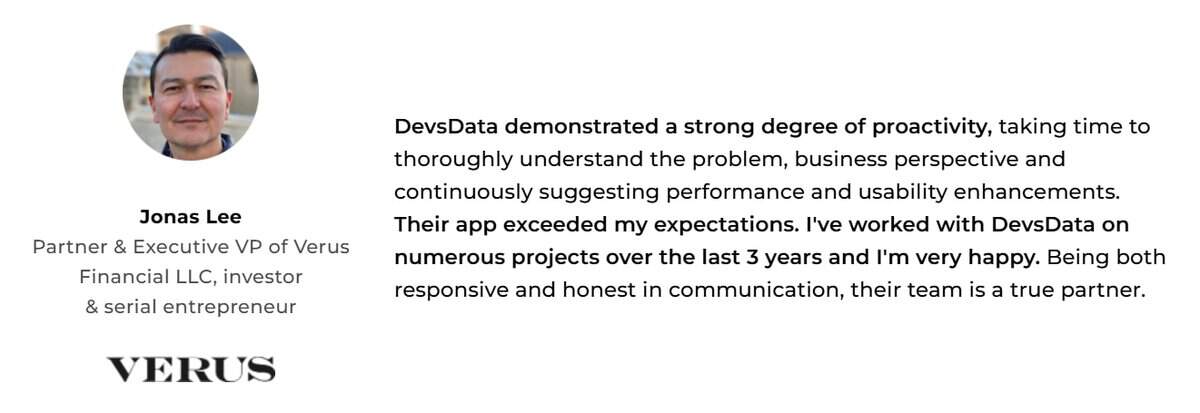
"DevsData demonstrated a strong degree of proactivity, taking time to thoroughly understand the problem and business perspective, and continuously suggesting performance and usability enhancements. Their app exceeded my expectations. I've worked with DevsData on numerous projects over the last 3 years and I'm very happy. Being both responsive and honest in communication."

Jonas Lee
Partner & Executive VP of Verus,
Financial LLC, Investor,
& Serial Entrepreneur
Acknowledgments