Thanks for subscribing.
Your gift is on the way.



Hungary’s information and communication technology sector accounts for roughly 6-7% of gross domestic product, while the wider digital economy reaches close to a fifth of national gross value added.
Engineering offices from global names give the market much of its reputation. Wise built sizable Budapest operations, and Cloudera runs engineering work from the capital, drawn by a steady supply of mathematics and computer science graduates. The city hosts well-known industry gatherings too, with Craft Conference and Startup Safari Budapest pulling international developers into Hungary each year.
For companies outside the country, reaching this talent depends on a recruitment partner who reads the local market accurately and matches senior engineers to the right roles. Premium in this context describes a search that opens with a review of the technical stack and closes with an interview run by a senior engineer, rather than a batch of CVs forwarded on volume. This article sets out how the Hungarian technology sector reached its current position and what that standard looks like in practice, drawing on placements DevsData LLC has delivered for clients hiring into and around the region.
Hungary’s strength in software did not appear by accident. The country invested in mathematics and engineering education for decades, treating these subjects as core disciplines long before short-track developer programs became common across Europe. That groundwork now feeds a workforce that international employers source directly.
Direct IT employment near 80100 professionals understates the full picture, since wider sector counts run higher once embedded developers join the total.
Multinational investment reinforced this base. Wise runs sizable Budapest operations and Cloudera keeps engineering work in the capital, part of a wider shift that turned the city into a hub for engineering rather than back-office support alone. Their presence raised local salary benchmarks and brought more senior roles and complex projects into the market, which kept graduates from Hungary’s universities working at home.
Higher education anchors the supply. Eötvös Loránd University, founded in 1635, runs research-led programs in mathematics and informatics. Budapest University of Technology and Economics produces a steady cohort of engineering graduates, while the University of Debrecen adds depth from Hungary’s second-largest city. English-taught programs at these institutions draw international students and keep the talent pool open to employers who operate in English.
EU and NATO membership rounds out the appeal. Companies hiring in Hungary operate within a familiar regulatory framework, with data protection and employment rules aligned with wider European standards. That alignment lowers the compliance burden for firms expanding from Western Europe or North America.
Do you have IT recruitment needs?
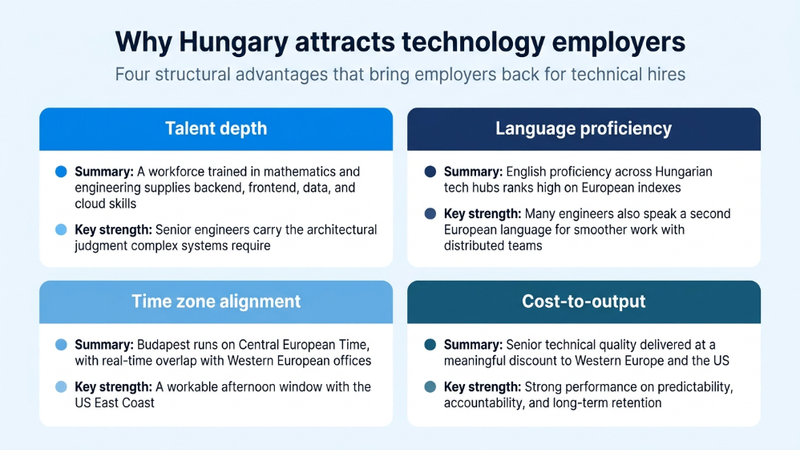
Several structural advantages explain why employers keep returning to Hungary for technical hires. Talent depth comes first. A workforce trained in mathematics and engineering supplies the backend, frontend, data, and cloud skills that modern products demand, and senior engineers carry the architectural judgment that complex systems require.
Language rarely blocks collaboration. English proficiency across Hungarian technology hubs ranks high on global indexes, and many engineers speak a second European language, which smooths day-to-day work with distributed teams. Time zone alignment helps as much as language. Budapest runs on Central European Time, giving real-time overlap with Western European offices and a workable afternoon window with the US East Coast.
Cost-to-output is the quieter advantage. Hungarian engineers no longer come at bargain rates, yet the country still delivers senior technical quality at a meaningful discount to Western Europe and the US. Employers who once picked the region on price alone now look for steadier signals, such as teams that hold together across a project and delivery dates that land when promised, and Hungary scores well on both.
Hungary rarely competes in isolation. Buyers weigh it against larger neighbors such as Poland, Ukraine, Bulgaria, and Romania, alongside the Czech Republic, each market carrying a distinct profile. Reading those differences shapes where a given project lands.
Poland runs the largest and most diversified pool in the region, with a developer base counted in the hundreds of thousands and strength in AI and cloud work, supported by a deep FinTech base. Cultural alignment with Western Europe and predictable delivery draw US firms looking to nearshore outside North America, where senior contractors typically bill near $28 to $38 an hour rather than work on the annual salaries quoted later in this article.
Ukraine offers cost efficiency and a strong STEM culture, with depth in software and blockchain work, though buyers weigh ongoing geopolitical risk against the lower rates. Romania built notable expertise in enterprise software and cybersecurity, helped by EU membership and multilingual talent, with rates that sit among the lower bands in the region.
The Czech Republic leans on productivity and strong IP protection, which suits security-sensitive and high-complexity work even at higher rates. Bulgaria pairs competitive operating costs with EU membership, attracting firms that want to trim expenses without losing regulatory cover.
Hungary sits between these markets, matching Poland’s regulatory comfort without competing on raw headcount and pricing below the Czech Republic without carrying Ukraine’s risk exposure. What separates it is the research tradition behind the talent, since decades of investment in mathematics feed a depth in data and analytics that the lower-cost markets in the region do not match. Around 80100 IT professionals work here, and EU and NATO membership gives employers building scalable enterprise applications a stable regulatory setting alongside that technical depth.
Technology recruitment carries demands that general hiring does not. A recruiter has to judge real engineering capability rather than read a polished CV, keep pace with fast-moving frameworks, and tell apart candidates who code on paper from those who ship in production.
The hardest people to reach are passive candidates, already employed engineers who rarely answer public job postings, which is why proactive sourcing matters more than volume advertising.
IT staffing is one way companies put that expertise to work. A staffing partner gives access to vetted professionals through engagement models that suit different needs. Some clients bring in contractors for a defined project. Others hire on a temp-to-perm basis to test fit before committing, while many want direct placement into permanent roles. Recruitment Process Outsourcing sits alongside these options, handing an external partner part or all of a company’s hiring operation.
Premium recruitment differs from transactional placement in its discovery work. A strong partner maps the technical stack and team dynamic, along with the growth plan, before sourcing a single candidate, which prevents costly mismatches later.
The discipline shows up in measurable outcomes rather than raw shortlists, the kind seen when three Pragmile hires stayed through a full two-year engagement, and seven BNP Paribas roles closed inside four weeks.
Which roles dominate hiring shapes the screening each one demands. The categories below reflect where DevsData LLC search volume concentrates rather than a general ranking, and the placement record backs the pattern, with a single Senior Java search screening more than 80 candidates before three hires cleared the bar. Mathematics and research training explains the local depth in data and analytics work, while Senior Java Developers and Cloud Engineers stay the hardest seats to fill.
Backend and frontend engineers, together with full stack developers, form the foundation of most teams, joined by mobile developers building consumer-facing products. These searches often widen into quality assurance and test automation, since stable releases depend on disciplined testing.
Demand for data scientists and analysts, joined by machine learning engineers, has grown sharply as decision-making shifts onto data. Data engineers who design pipelines sit behind them, and sectors such as FinTech and HealthTech, along with eCommerce, treat these hires as the route to usable insight.
Cloud architects and DevOps engineers, joined by site reliability engineers, keep systems available and scalable. Continuous deployment and containerization, alongside infrastructure-as-code, now sit inside everyday workflows, which raises the bar on what these candidates must prove.
Rising threats and stricter regulation keep security engineers and penetration testers, plus compliance specialists, in steady demand. The cost of a breach runs into millions, so employers want people who defend against live attacks and manage complex compliance duties at the same time.
AI roles have grown into a category of their own. Companies look for machine learning engineers and applied scientists who productionize models and integrate them into real systems. Hiring here is tough, given fast-changing toolchains and a wide gap between theory and production-ready experience.
Product managers and technical product owners bridge engineering and the business. These roles call for technical literacy alongside stakeholder communication and lifecycle ownership, which makes evaluation more nuanced than a standard functional hire.
Company size: ~60 employees
Founding year: 2016
Website: www.devsdata.com
Headquarters: Brooklyn, NY, and Warsaw, Poland
DevsData LLC is a specialized IT recruitment firm founded in 2016, with headquarters in Brooklyn, New York, and a European base in Warsaw, Poland. The team of roughly 60 people operates globally, with a focused presence in Hungary supported by a local Budapest office. That local footprint lets clients meet the team in person while tapping an international recruiting network.
The firm holds a government-approved recruitment license and maintains a database of more than 95000 pre-vetted professionals across the US and Europe, reaching into Latin America. Selection runs deliberately tight. Out of thousands of applicants, fewer than 6% clear the full pipeline, which includes a problem-solving challenge and a 90-minute technical interview led by a senior engineer with more than ten years of experience. The result is a shortlist of candidates who hold up technically and communicate well enough to settle into a client team.
Speed sits alongside that rigor rather than against it. Nearly half of all placements close in under ten days, with most finished inside two weeks, which keeps client projects moving while hard-to-fill roles would otherwise stall. DevsData LLC operates on a success fee model, so payment follows the hire, and every placement includes a guarantee period. A replacement guarantee backs the work further: if a candidate does not prove to be the right fit, the firm supplies a replacement at no extra cost, which removes much of the financial risk of a mis-hire.
Client feedback reflects this approach. DevsData LLC holds a 5-star rating on both Clutch and GoodFirms, with a track record of more than 140 completed projects for over 100 clients, including high-growth startups in the US and Israel. The firm’s smaller scale keeps overheads low, which supports competitive pricing without trimming the standard of recommended candidates. Beyond recruitment, DevsData LLC offers legal and tax advisory, alongside business process outsourcing, for clients setting up locally in Hungary.
Do you have IT recruitment needs?
Even an attractive market presents friction, and four problems surface again and again on technical searches.
Hungary’s senior layer is thin relative to demand, and the Budapest engineering centers run by firms such as Wise and Cloudera absorb much of it before an external search begins, which stretches roles such as Senior Java Developers and Cloud Engineers into months. DevsData LLC compresses these timelines by pairing targeted sourcing with staged technical interviews that screen out weaker candidates early, so fewer people reach the later rounds and time-to-hire drops with no loss to the quality bar.
The strongest engineers in Budapest hold posts at multinational centers and ignore public postings, so job boards rarely reach them. Drawing on a network of more than 95000 vetted professionals and the developer circles that form around gatherings such as Craft Conference, the firm reaches into the passive market that in-house teams often struggle to access.
Skills date faster than internal checklists, and graduates arriving from Eötvös Loránd University and Budapest University of Technology and Economics carry current theory that older vetting formats miss entirely. DevsData LLC recalibrates its assessments against current standards, with senior engineers updating the technical tests so candidates are measured against what production work now demands.
Strong code alone does not make a strong distributed hire. Hungarian engineers work on Central European Time, which gives a full day of overlap with Western European colleagues against a shorter afternoon window with the US East Coast, so the working pattern matters as much as the stack. The firm runs targeted campaigns that weigh practical habits beside technical depth, looking at how comfortably a candidate handles asynchronous tools across that gap, so a placement works inside the team it joins rather than only on paper.
One of the first questions employers raise is how much technical talent costs across regions. The ranges below draw on data from sources such as Glassdoor and Payscale, and they serve as indicative benchmarks rather than fixed standards, since real pay depends on company size, seniority, and local demand.
The US remains the most expensive market, with mid-to-senior engineers typically earning between $110000 and $150000 a year before benefits and equity. Western Europe follows, where engineers in the UK and Germany, along with France, command $80000 to $120000, with capital cities at the top of that range. Eastern and Central European markets, Hungary among them, deliver senior engineers in the $40000 to $65000 band, which gives strong value relative to technical depth even as rising Western demand pushes pay upward.
| Region | Seniority | Annual salary (USD) |
|---|---|---|
| United States | Mid senior | $110000 to $150000 |
| Western Europe | Senior | $80000 to $120000 |
| Central and Eastern Europe | Senior | $40000 to $65000 |
That gap explains why distributed teams have become a strategic choice rather than a cost trick. A senior engineer in Budapest often earns well under half the salary of a counterpart in San Francisco while offering comparable skills. The savings only turn into value when vetting holds, which is why a selective screening process stays central to every engagement.
The placements below show how a structured process delivers under tight deadlines and demanding technical requirements. Each follows the same pattern of client context, hiring challenge, our approach, and outcome.

Pragmile, a Polish FinTech consultancy, needed three senior Java developers, each with more than ten years of experience, all based locally and hired within one month. The engineers had to stabilize a complex legacy monolith while guiding its move to microservices, a task that demanded deep architectural judgment and the ability to settle into distributed Agile teams. DevsData LLC ran the search end-to-end with a structured, multi-stage evaluation, filtering more than 100 candidates against the strict seniority and architecture criteria. As a result, three long-term hires met the requirements and stayed with the client across the full two-year engagement, covering both legacy maintenance and microservices development.

BNP Paribas had struggled for months to fill senior engineering roles through its internal hiring teams. The bank needed seven senior Java positions filled at pace, including a technical lead, inside a competitive talent market. DevsData LLC combined targeted sourcing with rigorous multi-stage technical interviews to surface candidates ready to perform from day one. All seven roles, the tech lead included, were filled in four weeks, which turned a stalled internal search into a completed team.
Companies often weigh whether to keep hiring inside their own walls or hand it to a specialized partner. Both models earn their place, and the right choice turns on the situation. The comparison below sets the two side by side across the factors that shape a hiring decision.
| Factor | In-house teams | Specialized staffing partner |
|---|---|---|
| Best fit | Steady, predictable hiring at a single location | Urgent or niche searches, and large-scale builds |
| Speed | Slower on hard-to-fill roles, often running into months | Faster, with shortlists in days or a few weeks |
| Talent reach | Local networks and internal referrals | Global networks that reach passive candidates |
| Technical vetting | Strong cultural read, weaker on niche technical screening | Deep technical screening run by senior engineer panels |
| Cost shape | Lower running cost when hiring volume stays stable | Higher upfront fee, faster return on critical roles |
| Risk | Higher exposure to failed hires and long vacancies | Lower risk through vetting and a placement guarantee |
In-house recruitment works well when hiring stays steady, and roles cluster in one location, since internal recruiters know the culture and integrate closely with managers. The limits appear once speed or scale enters the picture, or a role turns highly specialized, where a specialized partner brings wider reach and sharper technical screening. For urgent or hard-to-fill searches, that depth shortens time-to-hire and lowers the risk of a costly mis-hire.
Picking the right partner often decides whether a hiring effort succeeds or stalls. The strongest agencies act as strategic collaborators rather than CV suppliers, and a few signals separate them from the rest.
Start with alignment. A good partner asks detailed questions about the technical stack and team dynamic, along with the growth roadmap, before showing a single candidate, which marks the firm as more likely to deliver long-term fits. Network and vetting rigor come next. Ask about the size and makeup of the candidate network, request a walkthrough of the screening stages, and look for evidence that the process runs past keyword-matching into real technical assessment.
Transparency on commercials matters as much as technical depth. Clear pricing and no hidden clauses keep a relationship healthy, so ask for a breakdown of the fee model. Contingency or success fee recruitment typically runs from 15 to 30 percent of the hired candidate’s annual salary, with guarantee periods commonly spanning 60 to 90 days for permanent roles. Finish with track record, reviewing case studies in fields close to yours and checking whether recruiters hold technical backgrounds or work with senior engineers on interviews. A partner who shows concrete examples and offers references reads as far more reliable than one that speaks only in general terms.
Do you have IT recruitment needs?
Hungary’s standing as a technology hub is settled, and reaching its senior talent still depends on a partner who reads the local market and screens with discipline. Reaching that talent still depends on a partner who understands the local market and screens with discipline.
DevsData LLC brings that combination to clients hiring into and around Hungary. A selective pipeline, a 90-minute technical interview, a network of more than 95000 vetted professionals, and a success fee model backed by a placement guarantee turn a difficult search into a predictable outcome.
For companies ready to scale a technical team in Hungary, the firm offers a lower-risk route to top talent. Reach the team at general@devsdata.com or visit www.devsdata.com to schedule a consultation.
Discover how IT recruitment and staffing can address your talent needs. Explore trending regions
like Poland, Portugal, Mexico, Brazil and more.

 Frequently asked questions (FAQ)
DevsData – your premium technology partner
DevsData is a boutique tech recruitment and software agency. Develop your software project with veteran engineers or scale up an in-house tech team of developers with relevant industry experience.
Free consultation with a software expert
🎧 Schedule a meeting
FEATURED IN


DevsData LLC is truly exceptional – their backend developers are some of the best I’ve ever worked with.”

Nicholas Johnson
Mentor at YC, serial entrepreneur


 Build your project with our veteran developers.
Explore the benefits of technology recruitment and tailor-made software.
Learn how to source skilled and experienced software developers.

Rebecca Botvin

Commercial Director

Tom Potanski
Manager




Categories: Big data, data analytics | Software and technology | IT recruitment blog | IT in Poland | Content hub (blog)
















careers@devsdata.com







general@devsdata.com

"I interviewed about a dozen different firms. DevsData LLC is truly exceptional – their backend developers are some of the best I've ever worked with. I've worked with a lot of very well-qualified developers, locally in San Francisco, and remotely, so that is not a compliment I offer lightly. I appreciate their depth of knowledge and their ability to get things done quickly."

Nicholas Johnson
CEO of Orange Charger LLC,
Ex-Tesla Engineer,
Mentor at YCombinator
"DevsData reached out to us, as we've been looking to grow our engineering team in Europe and Poland. Communicating efficiently and professionally, DevsData made a strong impression with their understanding of the recruitment challenges we were facing. They designed a tailored recruitment process for our needs. I was impressed with the technical depth of their approach."

Karim Butt
Co-Founder & CTO at GlossGenius, Inc.
"Out of all the vendors we work with, DevsData clearly stands out. The quality of developers they deliver is beyond what we've received from any other vendor, and they've been able to send profile recommendations very quickly. I'm happy to be their reference for other companies from Israel and talk about their recruitment abilities and what they delivered for us."

Ran Eyal
Senior Manager at
ZIM Integrated
Shipping Services Ltd.
"DevsData demonstrated a strong degree of proactivity, taking time to thoroughly understand the problem and business perspective, and continuously suggesting performance and usability enhancements. Their app exceeded my expectations. I've worked with DevsData on numerous projects over the last 3 years and I'm very happy. Being both responsive and honest in communication."

Jonas Lee
Partner & Executive VP of Verus,
Financial LLC, Investor,
& Serial Entrepreneur
Acknowledgments