Thanks for subscribing.
Your gift is on the way.



Hiring qualified Software Developers takes longer and costs more than most business owners across Western Europe and North America have budgeted for. Open roles sit unfilled for months, and compensation expectations in domestic markets keep climbing. Gartner forecasts global software spending above $1.4 trillion in 2026 at 14.7% year-over-year growth, and every new budget line turns into engineering work that someone has to deliver. Local talent supply grows on a slower curve, set by graduation cycles and career switches that take years to reach the workforce. When the domestic pool falls short of that extra demand at an acceptable salary, employers widen the search to countries where qualified engineers are available sooner and at lower rates. Cross-border hiring has become the default response to that gap.
Serbia has emerged as one of the sourcing markets that absorbs this overflow of international demand. Serbia’s software market has grown year over year, and the export and industry figures further into this guide put a scale on that growth. SeeNews puts Serbia’s ICT exports at a record €4.552 billion in 2025, and the industry figures further into this guide show where that value concentrates.
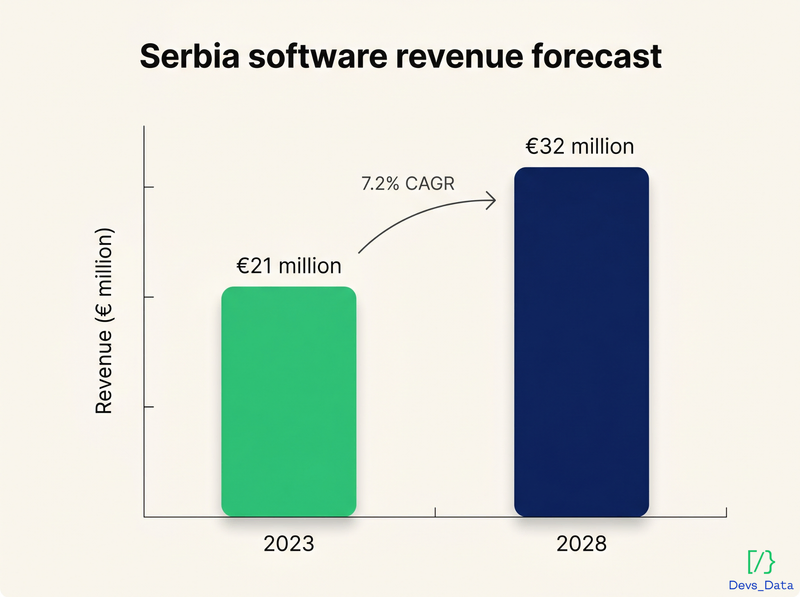
Developer compensation runs below Western European rates, and the professional IT workforce adds new graduates to the market each year. For the person deciding where to hire next, Serbia’s trajectory offers a data-backed option beyond the familiar nearshore and offshore alternatives.
DevsData LLC, an IT recruitment agency with direct placement experience in Serbia, produced this guide for organizations exploring cross-border Developer hiring.
A Software Developer’s output keeps paying off long after the initial build, which is what separates a development hire from a recurring service contract. How much that capacity returns depends on who builds the systems and where the organization sources them.
Organizations that build custom software gain systems shaped around their own operations, not around a vendor’s product roadmap. Off-the-shelf tools cover common ground, but every company runs processes that no generic platform fits. That same logic extends to speed: a dedicated development team ships product updates on the organization’s own timeline, not on a vendor’s release cycle. When a regulation shifts or a market window opens, the team with its own engineering capacity responds first.
AI-assisted coding tools have reshaped how fast individual engineers produce working software. Stack Overflow’s 2025 Developer Survey reports that 84% of Developers use or plan to use AI tools in their workflow, up from 76% in 2024. Those productivity gains have not reduced hiring demand. Organizations respond by clearing project backlogs that sat untouched when development hours were more expensive. The result follows a pattern economists call the Jevons paradox: cheaper coding leads to more code, not less.
Every application in production adds to the maintenance workload. Security patches and performance monitoring require ongoing attention. When an update to one system breaks something in another, a Developer diagnoses the failure and fixes the root cause. AI tools produce the initial output, but they do not make those judgment calls. The more software an organization runs, the more engineering hours go into keeping existing systems stable. That workload does not shrink when AI tools are introduced into the process.
Do you have IT recruitment needs?
Serbia’s technology sector now accounts for the largest net export contribution of any domestic industry, built on ICT exports that have risen tenfold since 2012. Computer services exports have climbed sharply over the same period. That volume means thousands of Serbian teams already deliver production-grade work for international clients.
Around 115000 people work in Serbia’s ICT sector across more than 4000 companies, and the US International Trade Administration puts the sector’s contribution at 7-8% of GDP, a figure covering ICT activity as a whole rather than software development on its own. Emerging Europe reports ICT employment in Serbia increased 39% between 2020 and 2024, a period when the broader labor market grew by 0.1%. ICT-related degree completions rose by 31% over the same period, while enrollment in ICT university programs rose by 11%. That growth rate gives international employers access to a widening talent pool, rather than a fixed group of candidates already claimed by other employers.
SeeNews reports that Serbia’s ICT exports rose 10% year-on-year in 2025 to a record €4.552 billion, a tenfold increase since 2012.
Serbia’s broader economic profile adds context to the ICT numbers above. The infographic below captures the country’s macroeconomic position with 2025 data.
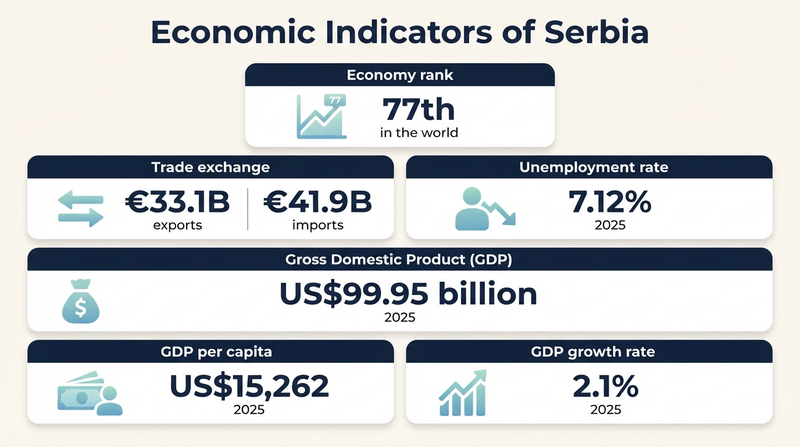
Sources: (IMF World Economic Outlook, October 2025, Statistical Office of the Republic of Serbia via EasyLink)
International technology firms operate R&D centers and distributed engineering teams inside Serbia, with Belgrade and Novi Sad as the primary hubs. The work coming out of those offices covers core product development and system architecture, not support functions. That distinction matters for whoever evaluates the market, since Serbian teams handle production-grade projects for global organizations.
According to trade.gov, the Serbian government has allocated more than $70 million for artificial intelligence and advanced technological research. Serbia assumed the chairmanship of the Global Partnership on Artificial Intelligence (GPAI) in December 2024, positioning the country’s AI policy agenda alongside those of larger tech economies.
On global indices, Serbia ranks 54th out of 139 economies in the WIPO Global Innovation Index 2025, placing 7th among 36 upper-middle-income economies. Those institutional commitments indicate that the sector’s growth rests on policy infrastructure, not on market demand alone.
These figures describe the market’s scale and direction. The sector has the depth to support international hiring at meaningful volume. What matters next is how Serbian Developers compare to candidates available in other sourcing regions.
The hiring question for business owners shifts from market size to the quality of individual talent at this stage. Do developers from Serbia meet the engineering and communication standards that international clients demand?
The infographic below summarizes the indicators that define Serbia’s profile as a source of development talent.
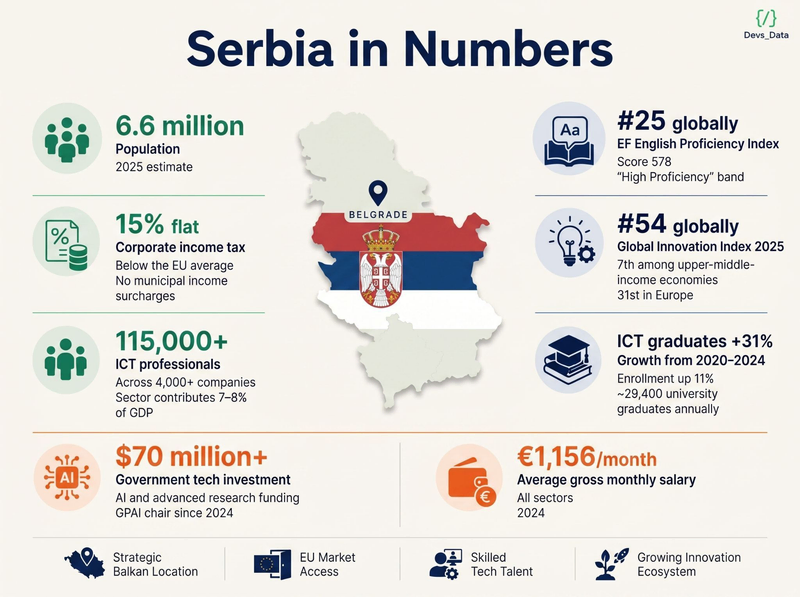
Sources: (Statistical Office of the Republic of Serbia via EasyLink, PwC Tax Summaries, US International Trade Administration, EF Education First, EPI 2025, WIPO Global Innovation Index 2025, Emerging Europe)
Serbia’s engineering workforce focuses on backend development and full stack roles, with growing specialization in AI and cloud-native architecture. The World Economic Forum’s Future of Jobs Report 2025 found that 63% of employers globally identify skills gaps as the primary barrier to business transformation from 2025 to 2030. Serbia addresses part of that gap through domestic graduates and an additional layer of senior talent.
According to EasyLink, the talent pool gained further depth after 2022, when IT specialists from Russia and Belarus relocated to Serbia, bringing senior-level experience in AI and cloud infrastructure. That influx gave the market a concentration of senior-level expertise that did not exist five years ago. International R&D offices in Belgrade and Novi Sad reinforce that quality: Developers who work on global-scale projects inside those teams carry the exposure into the broader market when they change employers.
The EF English Proficiency Index 2025 ranks Serbia 25th out of 123 countries with a score of 578, classified in the “High Proficiency” band.
That engineering depth operates in English. Serbia’s proficiency ranking places the country in the top quarter of the 123-nation index. Code review comments and sprint documentation arrive in fluent English without translation layers.
English-language engineering environments operate as a daily default for a large portion of that workforce, rather than as a second-language adjustment. The coordination overhead of a cross-border engagement drops when the development team communicates at a professional level in the client’s primary language.
Those English-speaking teams concentrate in defined urban centers. Belgrade hosts the largest concentration of IT firms and R&D offices. Novi Sad has developed as a secondary hub with a strong university-linked engineering community. Niš and Kragujevac serve as emerging centers.
IBISWorld estimates the Computer Programming industry in Serbia at €6.9 billion in 2026, with annual revenue growth of 29.6%. No single company holds more than 5% of that market. That fragmentation works in the hiring organization’s favor: candidates spread across thousands of small and mid-sized firms rather than concentrating inside a few dominant employers.
The regulatory and tax environment in those hubs lends additional structure to the cost argument. Serbia’s corporate income tax is a flat 15% with no municipal surcharges, below the EU average of approximately 21%. The country has held official EU candidate status since March 2012, and since January 2025, Serbia has participated in the European Digital Innovation Hubs network and the Digital Europe Program.
That regulatory proximity to the EU means data-protection rules track the bloc’s own standards, so European clients move data across the border with fewer transfer hurdles. For whoever approves the hiring budget, the tax structure and regulatory alignment reduce the administrative burden associated with international engagements in non-EU markets.
The workforce feeding those hubs draws on graduates from three universities with established computer science programs. The QS World University Rankings 2026 covers more than 1500 institutions globally, which gives context for the positions below.
These advantages matter during a hiring evaluation. They come paired with operational considerations that differ from domestic hiring, and the next section addresses those directly.
The advantages outlined above come with operational variables that differ from what most US and Western European employers expect. Tax structures and contract models need to be resolved before recruitment begins. Addressing these variables early in the process prevents complications after the offer stage.
The biggest regulatory risk for a foreign employer in Serbia is the risk of a permanent establishment. Serbian tax authorities apply a threshold below which a company’s local activity does not create a taxable presence in the country. Crossing that threshold triggers retroactive tax liability, and something as routine as a local hire who can sign contracts may be enough to cross it. The trigger points differ from US and Western European standards, so consulting a Serbian tax advisor before structuring the engagement is not optional.
On the cost side, Serbia applies a 15% flat corporate income tax with no municipal surcharges. VAT applies to service transactions at 20%. For whoever structures the engagement, an Employer of Record arrangement removes most of the compliance burden by handling payroll and tax filing through a local entity.
Experienced Serbian Software Developers tend to favor B2B contractor arrangements over full-time employment. The higher net income and operational independence that B2B structures provide explain the preference. A Developer who expects a B2B engagement will decline a full-time offer, regardless of the compensation. Clarifying the model before outreach begins prevents mismatches that waste time on both sides.
Full-time employment under Serbian labor law is the alternative. This path requires the employer to either register a local entity or work through an Employer of Record. Employer-side statutory contributions cover social insurance and healthcare, adding a percentage to gross salary. The total employment cost exceeds the figure on the offer letter, a detail that the person writing the budget needs to account for before making an offer.
For EU-based organizations, time zone alignment is barely an obstacle. Serbia operates on Central European Time (CET), the same offset as Berlin, one hour ahead of London. Daily standups and synchronous code reviews run without schedule adjustments.
The US offset is where coordination work begins. New York sits six hours behind Serbia. Chicago and Austin add another hour to that gap, and San Francisco sits nine hours behind. Teams on those schedules share a shrinking window of overlap as the client moves further west. Organizations managing that distance build asynchronous handoff protocols: structured sprint documentation and detailed ticket updates that allow one team to continue where the other stopped.
The following table compares the time difference between Serbia and common client locations.
| Location | Time Zone Difference |
|---|---|
| Berlin | No difference (CET) |
| London | 1 hour behind |
| New York | 6 hours behind |
| Chicago | 7 hours behind |
| Austin | 7 hours behind |
| San Francisco | 9 hours behind |
These operational variables fold into the total cost of engagement alongside the salary figures that shape each hire’s budget. The next section breaks down compensation by seniority level.
Do you have IT recruitment needs?
The operational variables from the previous section fold into the total engagement cost. Compensation sets the largest single line item. The table below draws on data from Glassdoor and Levels.fyi for 2025 and 2026 to compare annual salary ranges across five sourcing regions.
The following table breaks down Software Developer compensation by seniority level and region.
| Region | Annual cost for Juniors | Annual cost for Seniors |
|---|---|---|
| United States | $75000-$100000 | $130000-$195000 |
| Western Europe | $45000-$65000 | $80000-$120000 |
| Poland and CEE | $28000-$42000 | $48000-$85000 |
| Latin America | $18000-$35000 | $45000-$75000 |
| Serbia | $20000-$35000 | $45000-$72000 |
Figures reflect approximate gross annual compensation before employer-side contributions, converted to USD at Q1 2026 exchange rates. Ranges blend Glassdoor (broad market) and Levels.fyi (international tech companies).
For the annual cost of one Junior Developer in the United States, an organization hiring from Serbia could bring on three Junior Developers with budget remaining. At the Senior level, a Developer in Serbia earns $45000 to $72000, which is between one-quarter and one-half of what the equivalent US role commands. Organizations comparing Serbia to Poland will find Serbian rates running 15 to 25% below the Polish band, a gap driven largely by Serbia’s lower cost of living and a less mature local market for international R&D center salaries.
Within Serbia’s salary band, two variables drive most of the spread: specialization depth and seniority. A Senior Developer with production experience in AI or cloud-native systems sits at the upper end of the range. A mid-level generalist with two years of full stack experience sits closer to the midpoint.
Serbian developer compensation has moved upward at a pace that outstrips the broader economy. According to emerging-europe.com, average gross ICT salaries reached €2665 per month in 2024, representing 92% growth since 2020. That works out to roughly 17-18% compounded annual growth, a rate that makes salary data older than 12 months unreliable for the person building the hiring budget. International demand and competition from multinational R&D centers drive the upward pressure.
Those same forces point to further increases ahead. Global software spending keeps expanding, and multinational R&D centers in Belgrade and Novi Sad compete for the same senior profiles that international clients target. The domestic pipeline offers a partial counterweight, with ICT-related degree completions up 31% between 2020 and 2024, yet new graduates enter at the junior level and leave the senior band dependent on a smaller pool of experienced engineers. Nothing in the current data signals a decline in pay, so a hiring budget built today benefits from a margin for annual raises.
Belgrade commands the highest rates in the country. Novi Sad and Niš offer lower compensation, giving organizations sourcing candidates outside the capital a wider candidate pool at a reduced cost.
Salary benchmarking informs the sourcing budget, but the numbers alone do not produce a hire. The next section breaks the search process into defined stages.
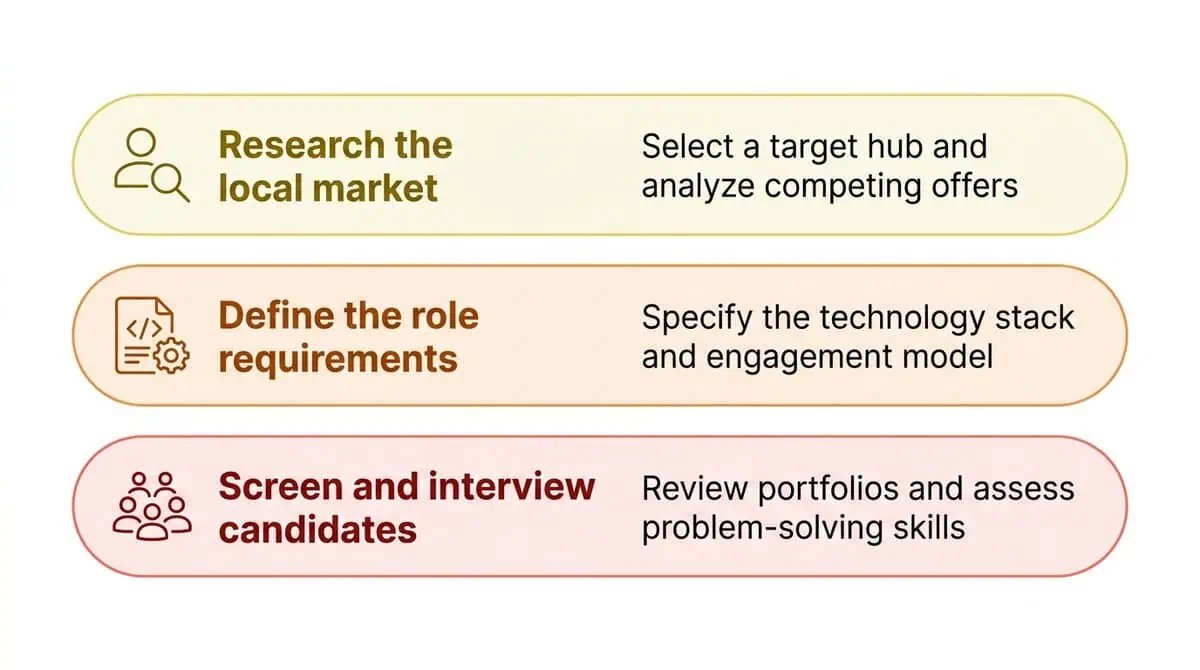
The salary data from the previous section sets the budget ceiling. Converting that number into a signed contract requires a search process with defined stages. Skipping the research stage and moving directly to candidate outreach often produces a weaker shortlist than the budget deserves.
Start by selecting a target hub. Belgrade hosts the largest share of Serbia’s 4000+ IT companies and offers the most concentrated talent pool. Novi Sad provides a strong secondary option with a university-linked engineering community. A distributed search across both cities widens the candidate base but adds coordination overhead.
Gauge salary expectations for the required level of seniority before posting. The compensation ranges in the previous section provide the starting frame, but active postings on Serbian job boards and developer communities show where the market has moved in real time. Look at what competing international employers offer for the same profile. If several organizations are recruiting Senior Java Developers in Belgrade, the salary floor for that candidate type has already shifted upward.
GitHub’s Octoverse 2025 report recorded more than 180 million developers on the platform, with over 36 million new accounts in the past year.
In a developer pool that size, the role requirements act as the primary filter.
Once the market research sets the context, the role brief needs to be precise. Specify the technology stack and seniority level the position requires. A backend role calling for Java and PostgreSQL attracts a different candidate pool than a full stack position built on React and Node.js. DevOps-oriented searches run on a separate track entirely, with their own sourcing channels and interview formats.
The engagement model belongs in the role brief, not in the offer letter. B2B contractor arrangements are the expected model among experienced Serbian Developers, which means the contract structure is a filtering criterion from the start. A candidate who expects a B2B engagement will not respond to a listing that describes only full-time employment.
A clear role brief communicates professionalism to the candidate. Experienced Serbian Developers evaluate the hiring organization as closely as the organization evaluates them. A vague posting that omits the technology stack or the engagement model signals a disorganized process, and top-tier candidates move on.
A precise role brief produces a better shortlist. The screening stage determines which candidates on that list belong in the interview pipeline.
Review each applicant’s portfolio and GitHub contribution history for projects that align with the engagement’s scope. Code quality and commit patterns reveal more about daily working habits than a resume does, from how often the Developer commits to whether each message explains the change. Technical interviews should test practical capabilities alongside communication skills. Running the interview in English serves a dual purpose for cross-border engagements: the technical assessment and the language evaluation happen in the same session. Coding tasks set under realistic time constraints show how a candidate works, not what they memorized.
Questions that probe how a Developer handles incomplete specifications are the strongest filter for seniority. Scripted assessment performance does not predict how someone operates when the requirements are ambiguous. Hand the candidate a ticket with a detail left out, then watch whether they ask for it or build on an unstated assumption.
For Senior Software Developer roles, direct search produces better results than job board postings. The strongest candidates at this level seldom maintain active profiles on public hiring platforms. Targeted outreach through professional networks and referrals reaches the people who would not apply on their own.
The engagement model shapes how the relationship operates, and the next section covers the options that dominate the Serbian market.
Finding the right candidate is one step. Structuring the working relationship is the next. The engagement model determines who manages the Developer day-to-day and who owns the code produced during the engagement. The right model depends on the organization’s structure and the level of direct oversight it requires.
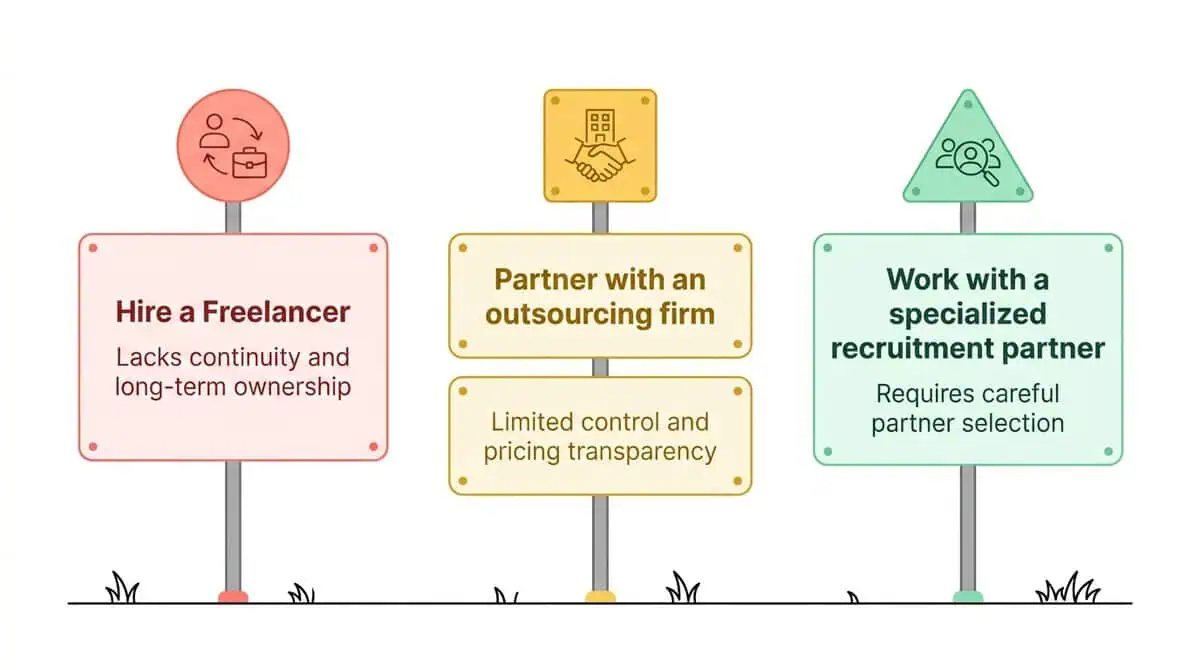
Engaging a Serbian Software Developer as a Freelancer removes the need for a formal employment contract. The arrangement runs on hourly or project-based rates with no employer-side statutory contributions. The hiring organization pays for output, not for a position.
This model fits early-stage companies that need short-term capacity for a defined deliverable. A startup building a prototype or a non-technical business owner commissioning a web application would both find the freelance arrangement practical.
The trade-off is continuity. When the project scope grows beyond the original deliverables, the freelance model breaks down. Long-term product development needs a Developer who stays with the codebase.
Organizations that need more than one Developer on the project often turn to an outsourcing firm. The vendor provides access to a pre-assembled group of Engineers at rates below the cost of building an equivalent in-house team. Recruitment and day-to-day team management stay on the vendor’s side.
The client has less influence over who works on the project, and pricing transparency varies by vendor, since some fold the management fee into the rate while others bill it separately. IP ownership does not transfer automatically under a standard outsourcing arrangement. Contractual safeguards covering non-disclosure and defined ownership clauses need to be in place before the engagement begins.
This model fits non-technology businesses where software supports operations rather than defines the core product. Organizations whose core product is software need more direct control over the engineering staff than an outsourcing arrangement provides.
The third option gives the hiring organization the capacity benefits of outsourcing with the control of a direct hire. A specialized Recruitment Partner handles sourcing and screening. The hiring organization retains full authority over who joins the team and how the work gets managed. IP rights remain with the client, and visibility into team composition and spending stays complete.
In practice, the Developer reports to the client’s engineering lead and works inside the client’s toolchain. Recruitment firms operating in the Serbian market handle back-office administration on the client’s behalf, covering payroll and contract management. The operational overhead shifts to the provider.
The trade-off is cost and timeline. The hiring organization pays a placement fee, and the search process typically runs two to four weeks before a qualified candidate reaches the offer stage. The quality of the shortlist depends on the Recruitment Partner’s sourcing depth in the Serbian market.
This model fits organizations that want to build a dedicated development team under their own direction. The Developers work as integrated members of the client’s engineering staff, not as contracted resources managed by a third party.
The choice among these models turns on how much direct oversight the organization wants over the engineering work. Freelance arrangements suit a defined deliverable with a clear end date, while outsourcing firms carry the management load for businesses where software supports operations. Both approaches reduce the client’s control over continuity or code ownership. A specialized Recruitment Partner keeps hiring authority and IP rights with the client and moves sourcing and administration to the provider, a combination that suits organizations building a long-term development team in Serbia.
That model forms the basis of DevsData LLC’s practice. The next section covers how the process works for Software Developer placements from Serbia.
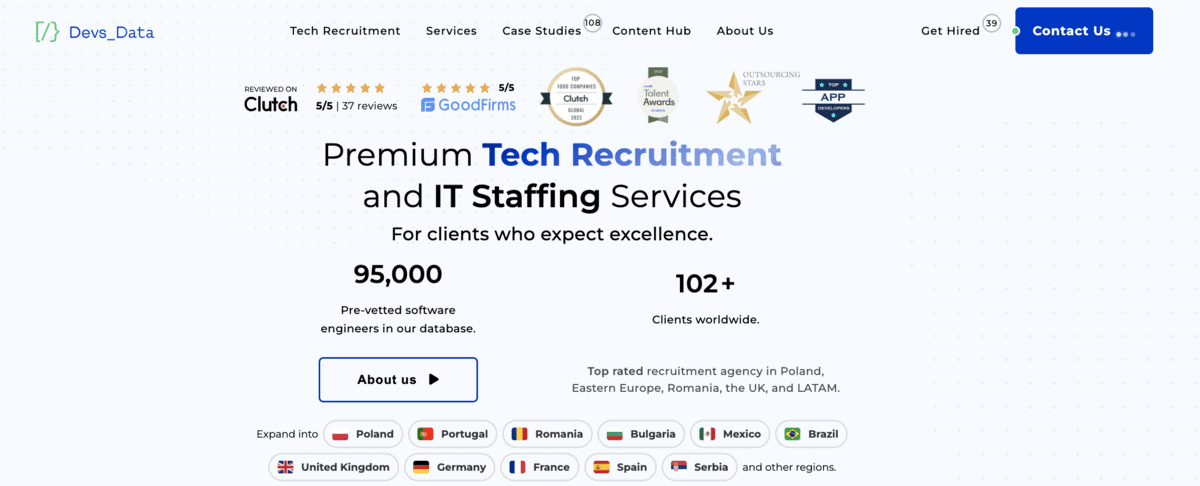
Website: www.devsdata.com
Team size: ~60 employees
Founded: 2016
Headquarters: Belgrade, Serbia, and Warsaw, Poland
The quality of a recruitment engagement depends on who designs the screening. DevsData LLC operates a recruitment division alongside an in-house engineering team. That dual structure means every Software Developer candidate goes through a technical evaluation designed by practitioners who write production code. The firm screens against the client’s technology stack and project requirements rather than filtering by listed credentials.
DevsData LLC maintains a verified candidate database of 95000 profiles and a team of over 60 professionals, with a track record in recruitment and technical consulting dating to 2016. Clients across the US and Europe have sourced Senior Software Developers through the firm’s Serbian recruitment pipeline. 5/5 ratings on Clutch and GoodFirms reflect that placement record.
The engagement follows a defined sequence. CV screening narrows the initial pool to profiles matching the client’s seniority and technology requirements. A behavioral interview evaluates organizational fit. The technical assessment is the most demanding stage: a 90-minute problem-solving challenge presents candidates with specification gaps in the brief and tracks whether they flag missing requirements or proceed on assumptions that introduce risk. In-house staff conduct English-language interviews and verify references before compensation discussions begin. A closing call between the candidate and the client’s Hiring Manager or Technical Lead completes the process.
This sequence closes in under two weeks for most engagements, and 50% of placements reach completion in under ten days. Placed candidates stay with their new employers for an average of two years or more, a retention figure tied to how the screening process weighs long-term compatibility alongside technical capability.
DevsData LLC’s full case studies page documents engagements across industries and hiring contexts. The three below involve recruitment placements relevant to sourcing Software Developers from Serbia and the broader Eastern European market.
Organizations seeking Software Developers from Serbia through a structured recruitment process, backed by technical screening by practicing Engineers, can reach DevsData LLC at general@devsdata.com or visit www.devsdata.com.
Recruitment and screening now have a framework in place. The next section moves to operational logistics: paying a Serbian contractor from abroad and reaching them by phone.
Do you have IT recruitment needs?
Once a Software Developer from Serbia joins the team, the operational focus shifts from screening to logistics. Compensation needs to be deposited into a Serbian bank account on a predictable schedule. Phone calls from abroad require Serbia’s country code and a dialing format that varies by the caller’s location.
The payment method depends on the engagement model. Organizations that hire through an Employer of Record provider pay the EoR directly. The provider takes over salary disbursement and all tax-related obligations under Serbian law, from withholding to statutory contributions. Organizations that engage a Developer on a B2B contractor basis pay the Developer’s registered company against invoices, and the contractor manages their own tax filings.
Several EoR providers operate in Serbia. DevsData LLC offers EoR services as part of its recruitment engagements, bundling payroll administration with placement. Deel and Remote are standalone platforms that manage payroll and compliance for employers without a Serbian entity. Oyster HR and Multiplier offer comparable coverage.
For B2B contractor payments, Wise and Payoneer support transfers in Serbian dinars (RSD). Both platforms display the exchange rate and total cost before the sender confirms the transfer.
Serbia’s country code is +381. The dialing format changes depending on where the call originates.
| Country | Dialing format |
|---|---|
| US and Canada | 011 + 381 + area code + local number |
| Australia | 0011 + 381 + area code + local number |
| UK | 00 + 381 + area code + local number |
Serbian Software Developers working with international clients already use VoIP tools for daily communication. Telegram and WhatsApp handle quick messages and voice calls. Google Meet covers scheduled video meetings. International dialing codes are only relevant for calls to landlines or when the Developer’s internet connection is temporarily down.
Serbia’s technology sector has outgrown the outsourcing label that defined the region a decade ago. The country now runs an export-driven IT industry. A growing engineering workforce and university programs feed new graduates into the pipeline each year. Salary levels sit well below Western European rates at comparable skill levels. EU candidate status aligns the regulatory trajectory with the bloc’s commercial framework. That combination of engineering depth and cost position is what makes the market work for Software Developer hiring.
The candidate pool has expanded in step with the sector. A larger pool means more variation in quality, and that variation is where the hiring process either pays off or costs the employer. DevsData LLC screens candidates through a 90-minute technical challenge designed around incomplete specifications, testing how Engineers respond when the brief leaves gaps.
A sourcing pipeline built on 95000 verified profiles and a government-approved recruitment license backs every search. Clients pay on a success-fee basis with no exclusivity clause, and every placement carries a three-month replacement-or-refund guarantee.
After the placement closes, the Developer works as part of the client’s engineering team, taking direction from the Technical Lead and using the client’s toolchain. The full process, from initial briefing to onboarding a team member, closes in under two weeks for most engagements.
Business owners ready to begin a Software Developer search in Serbia can reach DevsData LLC at general@devsdata.com or through www.devsdata.com.
Discover how IT recruitment and staffing can address your talent needs. Explore trending regions
like Poland, Portugal, Mexico, Brazil and more.
 Frequently asked questions (FAQ)
DevsData – your premium technology partner
DevsData is a boutique tech recruitment and software agency. Develop your software project with veteran engineers or scale up an in-house tech team of developers with relevant industry experience.
Free consultation with a software expert
🎧 Schedule a meeting
FEATURED IN


DevsData LLC is truly exceptional – their backend developers are some of the best I’ve ever worked with.”

Nicholas Johnson
Mentor at YC, serial entrepreneur


 Build your project with our veteran developers.
Explore the benefits of technology recruitment and tailor-made software.
Learn how to source skilled and experienced software developers.

Rebecca Botvin

Commercial Director

Tom Potanski
Manager




Categories: Big data, data analytics | Software and technology | IT recruitment blog | IT in Poland | Content hub (blog)
















careers@devsdata.com





general@devsdata.com

"I interviewed about a dozen different firms. DevsData LLC is truly exceptional – their backend developers are some of the best I've ever worked with. I've worked with a lot of very well-qualified developers, locally in San Francisco, and remotely, so that is not a compliment I offer lightly. I appreciate their depth of knowledge and their ability to get things done quickly."

Nicholas Johnson
CEO of Orange Charger LLC,
Ex-Tesla Engineer,
Mentor at YCombinator
"DevsData reached out to us, as we've been looking to grow our engineering team in Europe and Poland. Communicating efficiently and professionally, DevsData made a strong impression with their understanding of the recruitment challenges we were facing. They designed a tailored recruitment process for our needs. I was impressed with the technical depth of their approach."

Karim Butt
Co-Founder & CTO at GlossGenius, Inc.
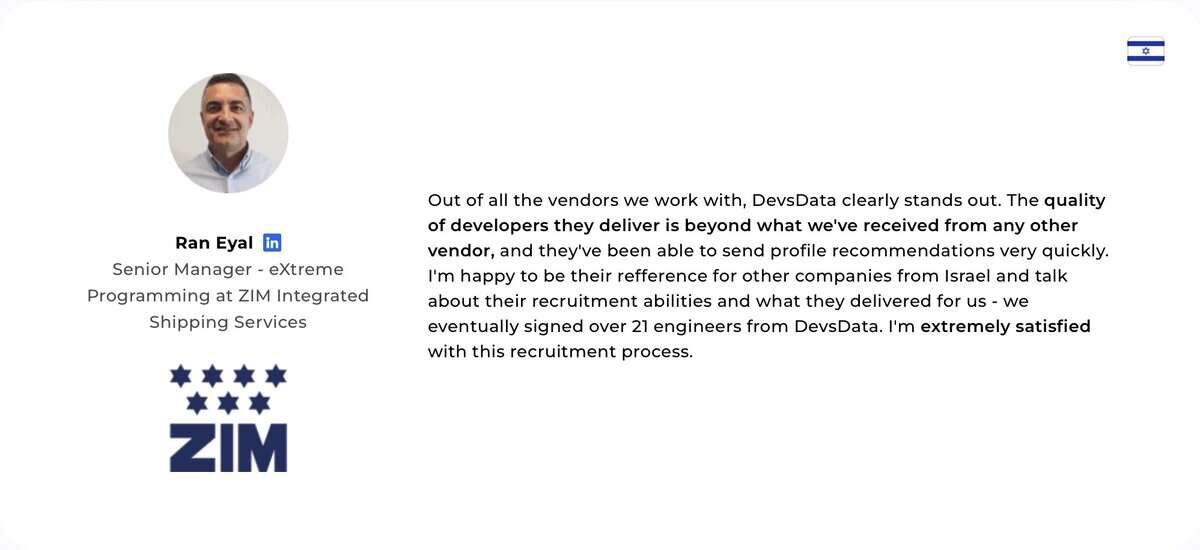
"Out of all the vendors we work with, DevsData clearly stands out. The quality of developers they deliver is beyond what we've received from any other vendor, and they've been able to send profile recommendations very quickly. I'm happy to be their reference for other companies from Israel and talk about their recruitment abilities and what they delivered for us."

Ran Eyal
Senior Manager at
ZIM Integrated
Shipping Services Ltd.
"DevsData demonstrated a strong degree of proactivity, taking time to thoroughly understand the problem and business perspective, and continuously suggesting performance and usability enhancements. Their app exceeded my expectations. I've worked with DevsData on numerous projects over the last 3 years and I'm very happy. Being both responsive and honest in communication."

Jonas Lee
Partner & Executive VP of Verus,
Financial LLC, Investor,
& Serial Entrepreneur
Acknowledgments