Thanks for subscribing.
Your gift is on the way.



Legacy eCommerce platforms rarely disappear quietly. They keep running because the businesses built on them still generate revenue. Replatforming is expensive, often a six-figure rebuild on top of months spent running the old and new systems side by side. That cost usually exceeds the cost of careful maintenance, and it stays higher for years longer than most modernization plans assume. osCommerce, an open-source PHP storefront that predates most of today’s SaaS commerce stack, sits squarely in this category. Stores still depend on it, customers still check out through it, and a smaller and smaller pool of developers still knows how to keep it healthy.
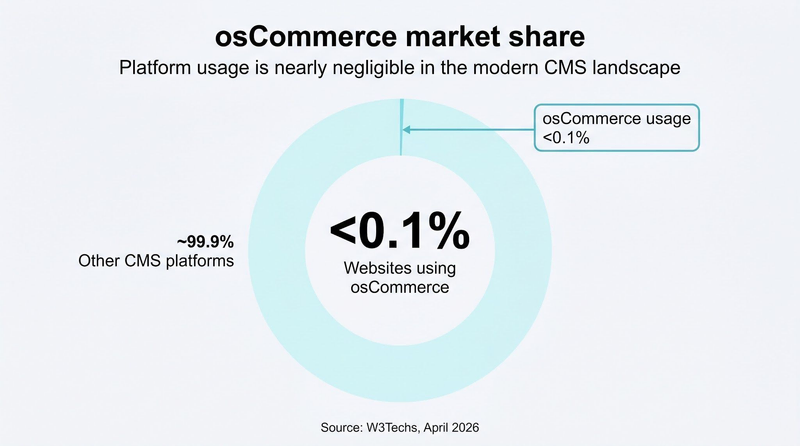
The structural picture explains why these stores persist. According to W3Techs usage statistics, osCommerce powers less than 0.1% of all websites whose content management system is known as of April 2026, which puts it firmly in the long tail of the eCommerce platform landscape rather than in any growth quadrant.
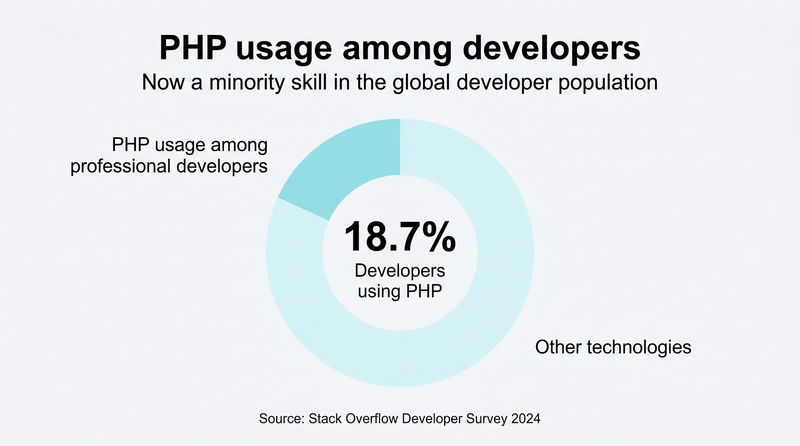
The talent picture sits on the same trajectory. The Stack Overflow Developer Survey 2024 reported that PHP was used by only 18.7% of all respondents, meaning roughly four out of five professional developers do not work in the language at all. The implication for hiring managers running an osCommerce store is straightforward: few developers work in PHP to begin with, and fewer still within that group have hands-on osCommerce experience.
This article walks through what osCommerce developers actually do, when a business genuinely needs to hire one, what the market looks like in 2025 and 2026, the hiring challenges that come with it, and how to evaluate a recruitment partner. The audience is technical: CTOs deciding whether to extend or migrate, eCommerce managers weighing operational risk, founders running legacy revenue streams, and talent acquisition teams trying to staff a role with shrinking external supply.
The work is more operational than aspirational. An osCommerce developer is responsible for keeping a PHP-based storefront running through the full lifecycle of small day-to-day fixes, periodic feature requests from the business, and the security patching that legacy platforms demand whenever upstream PHP, MySQL, or third-party module dependencies shift. In practice the responsibilities cluster into five distinct areas, each with its own risk profile and its own implications for how the role should be scoped.
This is the day-to-day spine of the role. Checkout errors, broken product filters, malfunctioning shipping calculations, and admin-panel quirks all surface continuously on a live store, and an osCommerce developer is expected to triage them quickly enough to protect revenue. The work involves reading existing PHP code that may have been modified by several previous developers, isolating the regression, and shipping a fix that does not break adjacent functionality. On a legacy platform, the cost of a failed maintenance change is unusually high because rollback paths are rarely as clean as they would be on a modern SaaS stack. Many osCommerce stores run without version control and deploy by editing files directly on the server, which leaves no reliable way to revert a bad change.
Most active osCommerce stores have drifted significantly from any stock release because they have been customized for years. Templates are tuned to specific brand requirements, modules have been adapted for non-standard pricing rules or shipping flows, and admin behavior has often been extended in ways that no longer match upstream documentation. The developer’s job is to extend or modify these customizations safely. Knowing how to read someone else’s legacy PHP and decide whether to refactor it or work around it is, in practice, a more valuable skill on osCommerce than the ability to write new code from scratch.
A live store rarely exists in isolation. Payment processors, ERP systems, accounting software, shipping carriers, and marketing tools all need to talk to the storefront, and most of those external systems have moved on to modern REST or GraphQL APIs that the original osCommerce architecture was not designed to consume. The developer builds and maintains the connectors, often layering custom PHP between the legacy core and the modern endpoint, and is responsible for making sure that data flows in both directions remain consistent when either side changes its contract.
Performance work on osCommerce typically targets database query patterns, caching layers, and server-level configuration. Stores that grew organically over the years often accumulate slow queries, redundant joins, and unindexed lookups that drag checkout latency and search response. The developer profiles the slow paths, optimizes where the platform allows, and accepts architectural trade-offs where it does not. Stability work runs alongside this and includes managing PHP version upgrades, MySQL migrations, and hosting transitions, each of which is materially riskier on a legacy platform than on a managed SaaS equivalent.
Security cannot be deferred indefinitely on a public-facing store, and on osCommerce it is structurally harder than on platforms with active vendor-managed security pipelines. The developer audits the codebase for known vulnerability patterns, applies patches to the PHP runtime and to third-party modules, hardens admin areas, and keeps the store in compliance with the payment and data regulations that apply in its market. This work is rarely visible to the business until something fails, which is precisely why it belongs in the core scope of the role rather than as an optional add-on.
None of this is glamorous, and that is precisely the point. Business continuity is the deliverable. A skilled osCommerce developer measures success not in new features shipped per quarter but in uptime preserved, revenue protected, and downstream systems like the warehouse management platform kept in sync while the rest of the technology stack evolves around the store.
Most businesses do not hire an osCommerce developer to build something new. They hire one because something existing must keep working, or because the cost of not acting is starting to climb. Six scenarios cover the bulk of the demand we see across the market.
| Scenario | What the business actually needs |
|---|---|
| Maintaining a legacy store | Continuous patching, bug fixes, and version compatibility work to keep an existing osCommerce storefront stable as PHP, MySQL, and third-party modules change underneath it. |
| Fixing performance issues | Database query optimization, caching review, and server-level tuning when checkout latency, search response, or page load times begin to drag on conversion. |
| Extending functionality | Module customization or new module development when the business needs features (loyalty, subscriptions, B2B pricing) that the stock platform never offered. |
| Integrating new systems | Connecting the store to modern payment processors, ERP or accounting platforms, shipping providers, or marketing tools through APIs the original platform was never designed to call. |
| Preparing for migration | Data audits, schema mapping, and parallel-platform planning before moving to a modern stack such as WooCommerce, Magento, or Shopify. |
| Security updates | Vulnerability remediation, hardening of admin areas, and PHP version upgrades that legacy platforms cannot defer indefinitely without risk. |
Reading down that list, a pattern emerges. The hiring trigger is rarely ambition. It is risk, friction, or a planned exit. Treating an osCommerce hire as a maintenance investment rather than a growth investment leads to better scoping, more accurate budgets, and a clearer view of where the engagement should end, usually the moment a migration project starts and the legacy store enters wind-down. For many owners that migration is the real endpoint, a planned move to a supported platform that handles payments and extensions natively, which lifts the maintenance burden osCommerce now carries.
Do you have IT recruitment needs?
The market for osCommerce developers can only be understood as the intersection of two declining curves: the install base of the platform itself, and the share of the global developer population that still works in PHP at all. Read together, they explain why the role is hard to fill and built around short-term contracts rather than long-term commitments.
On the platform side, W3Techs tracks osCommerce as accounting for 0.1% of all eCommerce systems whose technology is known. That figure is not a snapshot of momentum. It is a snapshot of residual presence: the platform is no longer a competitive choice for new builds, and almost every store still running on it has been running on it for years.
Cross-platform context matters here. BuiltWith data on the top one million eCommerce sites shows Shopify and WooCommerce dominating the space where new merchants make platform decisions today, while osCommerce sits well below the threshold of meaningful new adoption. The implication is that any company still running osCommerce in 2026 is, by definition, operating outside the modern platform mainstream and is therefore competing for a labor pool that the mainstream is not training.
The talent picture compounds this. The 2025 Stack Overflow Developer Survey drew responses from more than 49000 developers in 177 countries, and 76% identified as professional developers, with 66% of those aged 25 to 44. The active developer cohort, therefore, skews toward modern stacks rather than toward frameworks that have been in the field for two decades or more.
The scarcity is sharpest at the platform level. With osCommerce holding under 0.1% of the eCommerce market, the developers carrying current, hands-on experience with it number in the few rather than the many within any single hiring region, regardless of how large the surrounding web-development workforce is.
The economics behind these numbers show up clearly in executive survey data. Protiviti’s Global Technology Executive Survey, covering more than 1000 CIOs, CTOs, and other senior technology leaders, found that close to 70% of organizations see technical debt as heavily constraining their ability to innovate, with around 30% of IT budgets going to managing it. McKinsey‘s work on the same problem puts a number on where that budget comes from, since the CIOs it surveyed reported that 10% to 20% of the technology budget earmarked for new products gets pulled into resolving technical debt instead. For osCommerce stores, this is not an abstract finding. It is the reason hiring requests increasingly arrive bundled with modernization mandates. The store needs to keep running, and the cost of running it is rising relative to the cost of moving away from it.
Generative AI has started to alter the cost equation behind those modernization mandates. Gartner predicts that by 2027, generative-AI tools will be used to explain legacy business applications and create appropriate replacements, reducing modernization costs by 70%, which lowers the financial barrier that has delayed migration for many osCommerce stores. The forecast points in different directions for budgets and for staffing, since the tools that read and summarize unfamiliar code still rely on a developer who can tell whether the summary holds up.
Measured productivity gains stop short of removing that need. A McKinsey study found that developers using generative AI optimized existing code in nearly two-thirds the time and documented it for maintainability in half, though those gains fell below 10% on tasks the developers judged highly complex, such as work in an unfamiliar framework. osCommerce maintenance is mostly that kind of task. The code is undocumented custom PHP that no model encountered during training, and its behavior cannot be inferred from the public sources those tools learned from. AI now speeds up routine patches, while the hard, store-specific work still lands on an experienced developer.
Four forces now shape the hiring market, and none of them is reversing. A contracting install base meets a developer population that keeps training on modern stacks instead of legacy ones. CIO-level pressure to reduce technical debt adds to that, and generative AI has now joined as the fourth force, reshaping how teams staff legacy maintenance while its weakness on complex code keeps experienced developers essential. A realistic hiring strategy plans around all four at once, since none offsets the others. Reading the market is only half the picture, though. The practical difficulties surface during the hire itself, and the section below sets out the most common ones alongside how DevsData LLC handles each.
Legacy systems do not fail because they are old. They fail because the people who understood them stopped being replaced. Maintenance is a labor question before it is a code question.
The challenges of hiring for osCommerce break down into four recurring problems. Each one looks like a different issue at first glance, but all four trace back to the same underlying condition: a shrinking, aging install base served by a developer population that is moving on. The DevsData LLC approach to each addresses the labor problem rather than dressing up the technology problem.
PHP itself is now a minority skill in the global developer population, used by 18.7% of professional respondents in the Stack Overflow Developer Survey 2024. The osCommerce-specific pool sits inside that minority, narrowed further by the platform’s sub-0.1% share of the web. The practical effect is that traditional inbound hiring tactics, generic job boards, broad LinkedIn searches, and standard recruiter outreach, return very few qualified candidates and even fewer who are actively looking.
Sourcing for legacy PHP roles runs through a curated candidate database of more than 95000 vetted technical profiles, filtered for documented PHP and legacy eCommerce work history rather than self-reported keywords. The screening process includes a 90-minute structured problem-solving challenge designed to confirm that the candidate can actually read and modify legacy PHP code, not just describe it.
Most active developers train on modern frameworks because that is where the work is. The US Bureau of Labor Statistics projects 10% growth in employment of software developers, QA analysts, and testers from 2025 to 2035, with about 129200 annual openings, and the bulk of that demand is concentrated in cloud, mobile, and modern web stacks. Candidates who could plausibly learn osCommerce often choose not to, because the career trajectory points elsewhere.
The recruitment process targets two distinct candidate profiles rather than a single idealized one. The first is the experienced legacy specialist, often mid-to-senior, who has already spent years in PHP-based eCommerce. The second is the strong general PHP developer with the temperament for legacy work, sourced specifically because they are willing to be onboarded into osCommerce by an outgoing maintainer. This dual-track sourcing widens the realistic candidate set without compromising on technical screen quality.
osCommerce stores have typically been customized over many years by multiple developers, and documentation rarely keeps pace with the code. New hires inherit codebases where module behavior cannot be inferred from any single source of truth, which lengthens onboarding and increases the risk of regression bugs introduced during routine maintenance.
DevsData LLC writes the handover into the role scope before the search begins, so documentation is a defined deliverable rather than something the client has to chase. The developer placed through the firm produces it in the first weeks of work, capturing module dependencies and integration points along with the edge cases that are easy to miss. Delivered as a structured README and a module-dependency map committed alongside the code, it turns knowledge once held by one person into an asset the client owns.
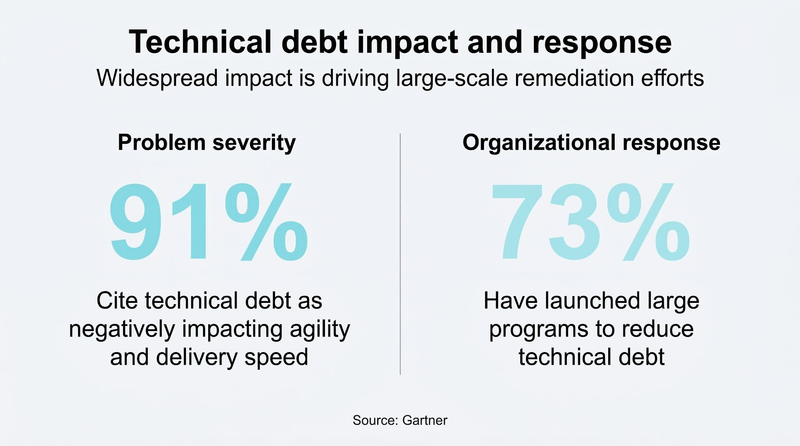
Hiring rarely stops at maintenance. The Gartner finding that 91% of surveyed CIO and infrastructure board members rate technical debt impact on agility as their primary challenge maps directly onto the request pattern we observe: clients want a developer who can keep the current store stable while also evaluating, planning, or executing a migration. The skill set required is unusually broad. The Robert Half 2025 Salary Guide reports that for roles that could be done remotely, 66% of managers would raise starting salaries to bring new hires into the office, and 59% of those managers offer up to 20% more pay for four or five days on site.
Candidate evaluation explicitly includes migration-readiness criteria: experience with target platforms such as Magento, WooCommerce, or Shopify; familiarity with data migration patterns; and exposure to phased replatforming projects. Clients receive shortlists where every candidate can credibly own both the current state and the future state of the storefront, not just one or the other.
In legacy eCommerce, the recruiter’s job is no longer matching a resume to a job description. It is finding the small number of people who can hold an aging system together long enough for the business to decide what comes next.
Do you have IT recruitment needs?
Most agencies can list PHP developers on a roster. Far fewer can place a candidate who will still be productive on an osCommerce codebase six months in. The difference shows up in the questions a recruitment partner can answer in detail rather than in general.
The evaluation framework below is the one we recommend to CTOs and talent acquisition leaders before signing any retainer or success-fee agreement with a vendor in this space.
| Evaluation step | Questions to ask the agency |
|---|---|
| Track record on legacy PHP roles | How many osCommerce or comparable legacy PHP placements have you completed in the last 24 months, and can you reference the engagement scopes? |
| Sourcing methodology | Do you rely on inbound applications, or do you actively source against a vetted candidate database with verified technical history? |
| Technical screening rigor | What does your technical screen look like, and does it test legacy code reading and modification, not only modern PHP fluency? |
| Geographic reach | Can you source across multiple regions if onshore supply is exhausted, and do you understand the compliance and contracting model in each? |
| Modernization expertise | Can your candidates credibly support both maintenance and a future migration to Magento, WooCommerce, or Shopify? |
| Commercial model | Do you operate on a success-fee or retainer model, and what guarantee period applies if the placement does not work out? |
| Process transparency | How do you report on pipeline progress, and how often do you share interim metrics rather than only final shortlists? |
| References and ratings | Can you provide independent client references and verifiable ratings on third-party review platforms? |
A partner who answers all eight questions in concrete terms is rare. A partner who answers them with documented examples is rarer still and is the one worth shortlisting.
Company size: ~60 employees
Founding year: 2016
Website: www.devsdata.com
Headquarters: Brooklyn, NY, and Warsaw, Poland
DevsData LLC operates as a specialist technical recruitment firm rather than a generalist agency. The model is built around legacy PHP and niche eCommerce engagements where the talent pool is narrow and the engagement risk is high, which is precisely the profile of an osCommerce hire. That specialization is reflected in the recruiter team itself, which has run mandates for legacy stacks repeatedly rather than treating them as one-off exceptions, and it shows up in how shortlists are calibrated against the realities of the platform rather than against generic PHP keywords.
The firm has spent more than 10 years in the technical recruitment market, working across stable enterprise environments and high-velocity startup hiring. That timeline matters in a niche like osCommerce. Most candidates who can credibly do the work began their careers before the platform fell out of mainstream adoption. Reaching them takes long-tail sourcing relationships built over years rather than months. DevsData LLC also keeps US specialists on the team, which shortens communication cycles for North American clients and removes friction during candidate calibration, particularly when stakeholders need to align on screening criteria across time zones.
Engagements span global corporate clients as well as high-growth startups from various countries, including the US and Israel. Sourcing runs against a proprietary database of more than 95000 candidates, with profiles vetted for verified technical history rather than self-described skills, and outreach is personalized at the individual candidate level rather than templated. The firm holds an official, government-approved license for recruitment services, which matters whenever placements involve regulated industries or cross-border employment arrangements.
Delivery is backed by a track record of more than 140 completed recruitment projects for over 100 clients across multiple industries and engagement types. The commercial model is structured around success fees, which aligns incentives with the client outcome rather than with unproductive search activity, and every placement is covered by a guarantee period that provides replacement coverage if the hire does not work out within the agreed window. Both elements are particularly relevant for legacy-stack hiring, where the cost of a misplacement is high and the available pool of replacements is small.
Technical screening is the part of the process where most agencies fall short on osCommerce, and it is where DevsData LLC invests most heavily. Every shortlisted candidate goes through a structured 90-minute problem-solving challenge designed to surface real engineering ability rather than rehearsed answers, and communication skills are evaluated as a first-class criterion alongside technical performance, not as an afterthought. The combined effect is shortlists that consistently hold up at the technical interview stage. External validation of the methodology is reflected in 5/5 ratings on both Clutch and GoodFirms, two independent third-party review platforms whose feedback comes from verified clients.
The clearest way to demonstrate how the methodology performs under pressure is to look at a real engagement where the constraints mirror those of an osCommerce hire: a narrow specialist pool, a high cost of misplacement, and a need for technical leadership that could stabilize a production system at scale.
The client was Easyship, a global eCommerce platform that powers shipping and logistics for merchants across multiple regions. The business operates at meaningful scale, with engineering teams distributed internationally and a production system that integrates with carriers, marketplaces, and merchant storefronts in real time. Hiring decisions at the technical-lead level therefore carry weight well beyond a single team, because each placement directly shapes how a high-traffic platform evolves.

The mandate was demanding for two compounding reasons. First, the role required senior engineers with verifiable Ruby production experience at scale, a pool that is structurally narrow in any market. Second, the client needed three placements in parallel rather than sequentially, which compressed the sourcing window and raised the bar on candidate calibration. Standard inbound channels would not have produced enough qualified candidates within the timeline, and a single misaligned shortlist round would have made the whole engagement slip.
Sourcing ran as targeted outbound work against the vetted 95000-candidate database, filtered specifically for documented Ruby production experience at the seniority level the client required, rather than against open-market applications. Every shortlisted candidate moved through the structured 90-minute problem-solving challenge, which surfaced real engineering depth and filtered out candidates whose CV signal exceeded their hands-on capability. After each shortlist round, recruiters aligned directly with the client’s engineering leadership on calibration, adjusting the screening criteria based on what the previous round had revealed about the role’s actual requirements rather than what the original brief had specified in writing.
All three technical-lead roles were closed within the agreed timeline, and the placements remained in seat well beyond the guarantee period. Beyond the headline numbers, the parallel-placement structure preserved the client’s engineering velocity at a critical phase of platform growth, because the team did not have to absorb a staggered onboarding load across multiple quarters. The methodology proved that a narrow, high-stakes mandate can be delivered without trading speed for quality, provided that the sourcing engine and the technical screen are both built for the niche.
The relevance to an osCommerce hiring brief is direct. Both engagement types share the same constraints: a narrow specialist pool, a high cost of a wrong hire, and a need for technical leadership that can stabilize a production system while planning what comes next. The methodology that delivered three Ruby technical leads for Easyship is the same methodology applied to legacy PHP and osCommerce mandates today.
Do you have IT recruitment needs?
Hiring an osCommerce developer in 2026 is a labor market problem before it is a technology problem. The platform’s residual share of the web, the contraction of PHP as a working language, and the macro labor pressure documented across CIO surveys and government statistics all point in the same direction: supply is finite, getting tighter, and not coming back.
That reality changes how the hire should be scoped. Treating the role as straight maintenance underestimates the migration pressure that will arrive within the engagement window. Treating it as a full modernization role overestimates the candidate pool that will accept it. The realistic posture is a hybrid one: hire for stability now, evaluate the case for migration in parallel, and choose a recruitment partner that can credibly source against both requirements at once.
DevsData LLC was built for exactly this kind of hire. The combination of specialist sourcing, structured technical screening, an aligned commercial model, and verified third-party ratings gives technical leaders a path through a market where the default options return very few usable candidates. For businesses still running revenue on osCommerce, that path is the difference between an aging store that holds and an aging store that quietly stops.
Any questions or comments? Let me know on
Twitter/X.
Discover how IT recruitment and staffing can address your talent needs. Explore trending regions
like Poland, Portugal, Mexico, Brazil and more.
 Frequently asked questions (FAQ)
DevsData – your premium technology partner
DevsData is a boutique tech recruitment and software agency. Develop your software project with veteran engineers or scale up an in-house tech team of developers with relevant industry experience.
Free consultation with a software expert
🎧 Schedule a meeting
FEATURED IN


DevsData LLC is truly exceptional – their backend developers are some of the best I’ve ever worked with.”

Nicholas Johnson
Mentor at YC, serial entrepreneur


 Build your project with our veteran developers.
Explore the benefits of technology recruitment and tailor-made software.
Learn how to source skilled and experienced software developers.

Rebecca Botvin

Commercial Director

Tom Potanski
Manager




Categories: Big data, data analytics | Software and technology | IT recruitment blog | IT in Poland | Content hub (blog)
















careers@devsdata.com





general@devsdata.com

"I interviewed about a dozen different firms. DevsData LLC is truly exceptional – their backend developers are some of the best I've ever worked with. I've worked with a lot of very well-qualified developers, locally in San Francisco, and remotely, so that is not a compliment I offer lightly. I appreciate their depth of knowledge and their ability to get things done quickly."

Nicholas Johnson
CEO of Orange Charger LLC,
Ex-Tesla Engineer,
Mentor at YCombinator
"DevsData reached out to us, as we've been looking to grow our engineering team in Europe and Poland. Communicating efficiently and professionally, DevsData made a strong impression with their understanding of the recruitment challenges we were facing. They designed a tailored recruitment process for our needs. I was impressed with the technical depth of their approach."

Karim Butt
Co-Founder & CTO at GlossGenius, Inc.
"Out of all the vendors we work with, DevsData clearly stands out. The quality of developers they deliver is beyond what we've received from any other vendor, and they've been able to send profile recommendations very quickly. I'm happy to be their reference for other companies from Israel and talk about their recruitment abilities and what they delivered for us."

Ran Eyal
Senior Manager at
ZIM Integrated
Shipping Services Ltd.
"DevsData demonstrated a strong degree of proactivity, taking time to thoroughly understand the problem and business perspective, and continuously suggesting performance and usability enhancements. Their app exceeded my expectations. I've worked with DevsData on numerous projects over the last 3 years and I'm very happy. Being both responsive and honest in communication."

Jonas Lee
Partner & Executive VP of Verus,
Financial LLC, Investor,
& Serial Entrepreneur
Acknowledgments