Thanks for subscribing.
Your gift is on the way.



Online retail operations have grown far beyond what most founding teams anticipated even five years ago. What started as a storefront and a payment gateway now includes inventory synchronization across marketplaces, multi-channel customer engagement, return logistics, listing optimization, and data-driven campaign management. Each of these functions demands consistent human attention; yet, hiring full-time staff for every operational layer strains budgets and slows decision-making.
The eCommerce Virtual Assistant (VA) role emerged from this tension between operational scale and resource constraint. Unlike a general Administrative Assistant, an eCommerce VA specializes in the platforms, tools, and workflows specific to digital retail. This person manages Shopify product catalogs, responds to Amazon buyer inquiries, coordinates with third-party logistics providers, processes refunds, updates pricing, and runs reporting dashboards – often across multiple time zones.
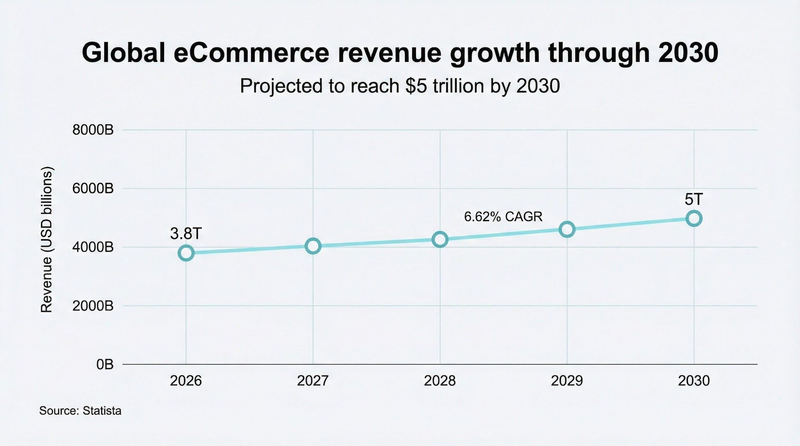
The market context reinforces the case. According to Statista, global eCommerce revenue is projected to grow at a 6.84% CAGR from 2026 to 2030, reaching $5 trillion. Revenue at that scale arrives with proportional operational load, since every additional order carries its own listing update, customer inquiry, and return to process.
This article provides a detailed framework for hiring eCommerce VAs. It covers what the role entails, when your business needs one, how to evaluate candidates, and where the market stands. It also addresses the recruitment challenges that commonly derail hiring efforts and explains how DevsData LLC approaches this problem with a structured, data-backed methodology.
An eCommerce VA combines digital commerce operations with remote administrative support, giving retail teams a single contributor who can keep both sides running without being pulled onto the payroll full-time. The role is defined not by a single task but by a range of responsibilities that keep an online retail business running smoothly behind the scenes.
One of the most time-intensive aspects of running an eCommerce store is managing the product catalog. VAs handle listing creation, including writing product descriptions, uploading images, setting pricing tiers, and configuring variants (size, color, material). On platforms like Amazon, this extends to keyword optimization within listings, backend search term management, and compliance with category-specific content requirements. Catalog maintenance also involves updating stock levels, deactivating discontinued items, and ensuring pricing parity across channels.
Customer inquiries arrive through multiple channels simultaneously: email, live chat, marketplace messaging, and social media. An eCommerce VA triages these inquiries, resolves common issues (order status, return requests, product questions), and escalates complex cases. The volume of multi-channel interaction is significant: McKinsey found that 75% of customers use multiple channels, requiring VAs to maintain consistent responses across each one.
VAs process incoming orders, verify payment status, generate shipping labels, and communicate tracking information to buyers. When working with third-party logistics (3PL) providers, they coordinate pick-and-pack schedules, manage inventory transfers between warehouses, and handle exception cases such as address corrections or customs documentation for international shipments.
For businesses selling on Amazon, eBay, Walmart Marketplace, or Etsy, VAs manage seller account health. This includes monitoring performance metrics (order defect rate, late shipment rate), responding to A-to-Z claims, filing brand registry cases, and managing sponsored product campaigns. Each marketplace has distinct rules, and an experienced VA understands these nuances.
Beyond day-to-day operations, VAs contribute to decision support. They compile sales reports, track competitor pricing, monitor review sentiment, and update spreadsheets or dashboards. Some VAs assist with market research for new product launches, identifying trending categories, or evaluating supplier options.
A growing share of the role sits in content production rather than administration. VAs draft and refresh product descriptions against keyword research, write A-plus content and enhanced brand pages for Amazon listings, and prepare copy for category pages on a Shopify storefront. Marketing support extends the same work outward, covering email campaign drafts, scheduled social posts tied to promotional calendars, and review response templates that hold a consistent brand voice. Quality here is commercially visible, since listing copy is often the only sales conversation a buyer has with the business.
The scope of the role varies based on business size. A single VA supporting a small Shopify store may handle all of the above. A larger operation might deploy a team of VAs, each specializing in one functional area.
Do you have IT recruitment needs?
Not every eCommerce business needs a VA from day one. The decision depends on operational volume, growth trajectory, and where internal resources are becoming bottlenecks. Some situations clearly warrant a VA hire, while others suggest the business is not yet at that stage.
The following table outlines common operational signals on both sides of that decision:
| Your business likely needs a VA | Your business likely does not (yet) |
|---|---|
| Founders or department heads spend more than 30% of their day on order processing, email responses, or listing updates – tasks that do not require senior decision-making | A single founder handles a manageable volume of orders and can respond to customer inquiries within platform SLA windows without strain |
| Marketplace response times are slipping and customer satisfaction (CSAT) scores are declining, with no internal capacity to recover | Customer communication volume is low enough that one team member covers it alongside other responsibilities |
| A new channel such as Amazon has launched, bringing seller account health metrics, A-to-Z claims, and case-log work that nobody currently owns day to day | Sales run through one owned storefront, where channel administration fits inside existing routines |
| The business is expanding to new marketplaces or geographies, each with distinct listing requirements, fee structures, and buyer expectations | Operations run on a single platform in one market, with no near-term expansion plans |
| Seasonal peaks (holiday periods, Prime Day, Black Friday) overwhelm current capacity for order processing, support, and returns | Order volume is relatively stable throughout the year, with no major seasonal surges |
| Sales reports are outdated, competitor monitoring is sporadic, and inventory reconciliation happens only when problems surface | Reporting cadences are consistent and data workflows are maintained by existing staff |
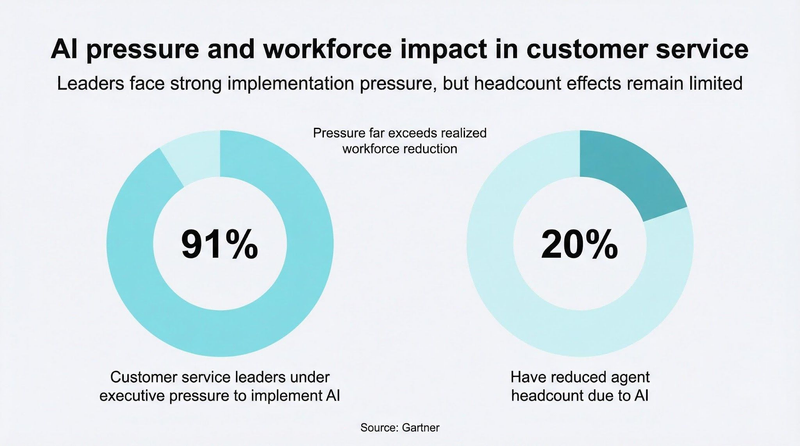
The operational signals above focus on workload volume and internal capacity. A separate factor worth weighing is the role AI plays in reshaping those same functions. According to Gartner, 91% of Customer Service Leaders face executive pressure to implement AI across their service operations. That figure might suggest automation will soon absorb the tasks a VA would handle.
The reality is different: a separate Gartner survey found that only 20% of organizations have reduced agent headcount as a result of AI adoption. The disparity between pressure to deploy AI and actual workforce reduction indicates that most companies still depend on human operators to manage customer-facing processes. For businesses evaluating whether to hire a VA, this gap reinforces the case. AI tools can streamline workflows that a VA executes daily, from automated ticket routing to inventory alerts, but they do not eliminate the need for a person who acts on those outputs, resolves edge cases, and maintains service quality across platforms.
The World Economic Forum’s research reinforces this trajectory: global digital jobs performable remotely are projected to grow roughly 25% to approximately 92 million by 2030, with customer service roles representing about 10% of that figure. With distributed digital work now standard practice, retailers can bring on VA support without building new management infrastructure, since the tools and workflows most teams already use were designed for remote contributors.
Hiring an eCommerce VA requires a more structured approach than posting a job listing and reviewing resumes. The role intersects operational execution, platform-specific expertise, and communication quality, a combination that is difficult to evaluate through traditional interview methods alone. The process outlined below reflects what we have seen work across hundreds of recruitment engagements at DevsData LLC, adapted for the specific demands of eCommerce operations.
Before evaluating candidates, document the specific tasks you need covered. Distinguish between core responsibilities (order processing, customer support, listing management) and supplementary tasks (reporting, research, campaign support). Define the platforms involved – Shopify, Amazon Seller Central, WooCommerce, BigCommerce – and the tools used (Gorgias, Zendesk, ShipStation, Helium 10). This scope definition becomes your evaluation framework: candidates who cannot demonstrate proficiency in your actual toolset are not operationally ready.
Three primary models exist. Freelance platforms like Upwork and Fiverr offer flexibility and fast onboarding, but require significant in-house management. VA agencies provide pre-vetted talent with supervisory structures but often limit customization. Dedicated recruitment firms like DevsData LLC source, vet, and match candidates against precise operational requirements, offering the depth of agency support with the specificity of direct hire. The right model depends on your volume, budget, and internal management capacity.
Resumes and self-reported skill lists are insufficient. Effective evaluation requires platform-specific assessments: can the candidate navigate Amazon Seller Central’s case log system? Can they configure Shopify discount codes with proper exclusion rules? Do they understand how to manage Fulfillment by Amazon (FBA) inventory reconciliation? Structured skills testing – not general interviews – separates capable VAs from candidates who overstate their experience. DevsData LLC uses proprietary assessment frameworks designed around actual eCommerce workflows, calibrated by marketplace and tool.
Before committing to a long-term engagement, assign a paid trial period with real (or realistic) operational tasks. Monitor not just task completion but quality signals: response accuracy, time to resolution, proactive issue flagging, and written communication clarity. A one-week trial at part-time hours provides more signal than a 60-minute interview.
VA costs vary significantly by geography. The Philippines and India represent the largest offshore talent pools for English-language eCommerce support. The Philippines alone employs 1.82 million IT-BPM professionals and is the world’s second-largest global service hub. India’s IT workforce exceeds 5.8 million. Latin American nearshore options offer time-zone alignment for US-based businesses. Hourly rates range from $5-8 for offshore to $15-25 for nearshore, with variation based on experience level and specialization.
A single VA hire should be designed as the first unit of a scalable model. Define processes with documentation (SOPs), implement shared tools with proper access controls, and establish communication cadences. The reason to build that way is that VA demand rarely stays flat. Order volume rises, a new marketplace goes live, a seasonal peak arrives, and each event adds hours to a workload already running at capacity. Without documented processes the only response is another slow search followed by weeks of informal training, which usually arrives after the peak has passed. Turnover creates the same pressure from the other direction, since operational support roles churn and an undocumented VA takes product knowledge and platform quirks with them when they leave. If the first VA succeeds, you should be able to onboard a second within days rather than weeks, and that difference is what determines whether you are building a team or repeatedly filling a gap.
The hiring model determines not just who you hire but how much operational overhead the process creates – and how much risk it carries. Each model serves a different stage of business maturity and a different tolerance for management involvement.
Platforms like Upwork and Fiverr offer the fastest path to a working VA, often within one to three days. They work well for businesses testing the VA model for the first time, handling a short-term project, or filling a narrowly defined task (product photo editing, one-time data migration, holiday-season listing uploads).
The trade-off is significant: vetting is self-reported, retention is unpredictable, and every aspect of management falls on the client. For smaller operations, for example businesses processing about 50 orders per day with a single marketplace presence, this model provides a low-commitment entry point.
Agencies provide pre-vetted candidates with built-in supervisory structures. The client receives a managed resource without needing to build internal oversight processes. This model suits mid-size eCommerce operations that need consistent, ongoing support but lack the internal HR capacity to recruit and manage independently.
The limitation is customization – agencies typically assign from an existing roster rather than sourcing against a precise operational specification. Businesses running steady-state operations on one or two platforms with predictable support volumes will find this model efficient.
Firms like DevsData LLC sit at the opposite end of the spectrum from freelance platforms. The hiring timeline is longer (two to four weeks), but the process includes operational scope definition, platform-specific skills testing, and structured candidate evaluation against the client’s actual workflows.
This model is designed for businesses where a bad hire carries measurable operational risk – missed service-level agreement (SLA) windows, degraded marketplace account health, or failed expansion into new channels. Companies scaling beyond two marketplaces, processing high order volumes, or building a multi-person VA team benefit most from this approach. The higher upfront investment in vetting yields lower turnover and stronger first-hire accuracy.
The following table summarizes the key decision factors across the primary hiring models for eCommerce VAs.
| Factor | Freelance platform | VA agency | Recruitment firm |
|---|---|---|---|
| Speed to hire | Fast (1-3 days) | Moderate (1-2 weeks) | Moderate (2-4 weeks) |
| Vetting depth | Low (self-reported) | Moderate (agency-vetted) | High (skills-tested) |
| Management burden | High (fully internal) | Low (agency-managed) | Low (firm-supported) |
| Cost per hour | $5-25 (variable) | $8-18 (bundled) | $10-30 (placed) |
| Customization | High (you choose) | Low (agency roster) | High (matched to spec) |
| Scalability | Limited by management | Moderate | High (systematic) |
| Retention risk | High | Moderate | Low (replacement built in) |
Each model has its place. Freelance platforms work for single-task, short-duration needs. Agencies suit businesses that want managed headcount without operational design input. A seller preparing an Amazon launch in a new category, where a suspended account would halt revenue, engages a recruitment firm such as DevsData LLC because the cost of the wrong hire exceeds the cost of vetting. The pattern holds across most of the engagements we run, with structured vetting justified by what a mistake would interrupt rather than by the size of the role.
Do you have IT recruitment needs?
The market for eCommerce virtual assistants sits at the intersection of two macro trends: the sustained growth of online retail and the structural expansion of outsourced business operations. Understanding both is critical for companies evaluating VA hiring as a strategic decision rather than a tactical fix.
Global eCommerce continues to expand at rates that exceed broader retail growth. Statista data shows eCommerce accounted for 19.4% of total retail sales worldwide in 2023, with projections reaching 22.6% by 2027. Cross-border eCommerce is accelerating even faster: the global B2C cross-border market, valued at $785 billion in 2021, is expected to approach $7.9 trillion by 2030. This nearly tenfold expansion means eCommerce businesses are not just selling more – they are selling across more geographies, platforms, and customer segments simultaneously.
Growth rates vary by region. Turkey, India, and Brazil lead with compound annual growth rates exceeding 11%, driven by mobile commerce adoption and expanding internet penetration. The US market, though more mature, is forecast to surpass $1.5 trillion by 2026. Each of these growth vectors generates operational demand – more listings, more orders, more customer interactions – that flows directly into VA workloads.
The global BPO market is tracking a parallel trajectory. Astute Analytica estimates the market at $367.64 billion, projecting growth to $861.45 billion by 2033 at a 10.35% CAGR. NLP systems now handle 45% of customer interactions in English-speaking markets, and RPA bots process 55% of repetitive tasks in finance and accounting BPO. The Asia Pacific region is the fastest-growing segment, with BPO revenues expected to reach $178.74 billion by 2033.
Deloitte’s 2024 Global Outsourcing Survey, based on responses from over 500 executives, reveals a significant shift in why companies outsource. Cost reduction, once the dominant driver at 70% in 2020, has fallen to 34%. Increasing customer demands (35%) and access to specialized talent now lead the list. This shift is strategically important for eCommerce VA hiring: companies are no longer seeking the cheapest option but the most operationally capable one.
The same survey found that 83% of executives now leverage AI as part of their outsourced services, while 78% operate Global In-house Centers. Half of executives use outsourced services for front-office capabilities – a significant expansion beyond traditional back-office functions. This front-office migration places eCommerce VAs squarely in the critical path of customer experience delivery.
Automation now sits underneath much of the work described above. Natural language processing systems handle 45% of customer interactions in English-speaking markets, and robotic process automation bots process 55% of repetitive tasks in finance and accounting outsourcing. Those figures describe volume absorbed rather than roles removed, which the adoption data confirms: 91% of Customer Service Leaders report executive pressure to deploy AI, while only 20% of organizations have reduced agent headcount as a result. For VA hiring, the practical effect is a change in the skill profile rather than the headcount. Routing, drafting, and reconciliation increasingly start with a machine output, and the VA’s value shifts toward judging that output and handling what falls outside it.
The labor market infrastructure supporting distributed VA operations has matured. BLS data shows 35.5 million US workers teleworked in Q1 2024, with the rate stabilizing at 20.8% for private-sector workers by April 2025. McKinsey’s American Opportunity Survey found that 40% of US workers now work fully or partly remotely. BLS research further confirms a positive relationship between total factor productivity and remote work across major industries.
The OECD reports that 63% of managers and 74% of workers assessed telework positively, with 2-3 days per week as the ideal arrangement. For eCommerce businesses, this normalized remote infrastructure means VA teams can operate across time zones with the same management tools, communication protocols, and performance expectations as in-house staff.
The balance behind outsourcing decisions is shifting. Cost is still a factor, though it is less often the decisive one. Companies are increasingly asking how outsourcing gives them access to talent and capabilities that improve customer experience.
Hiring an eCommerce VA is deceptively simple in concept and consistently difficult in execution. The challenges are structural, not incidental – rooted in how the role is defined, how talent is evaluated, and how operational continuity is maintained after the hire.
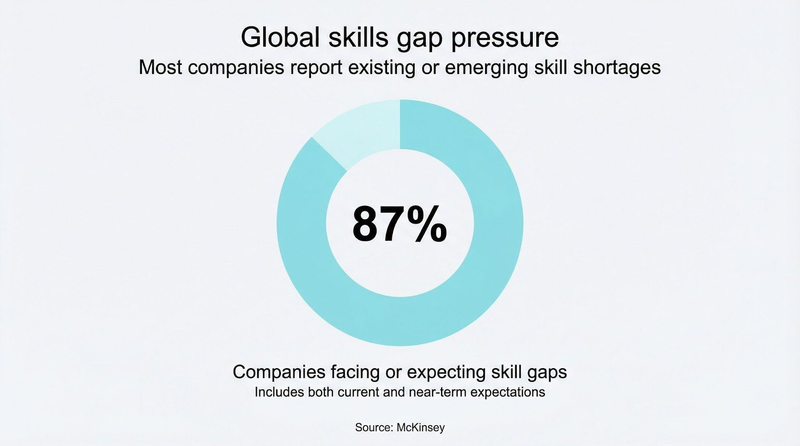
The term “virtual assistant” spans an enormous range of capabilities. One candidate’s experience may be limited to basic data entry, while another has managed multi-marketplace operations with six-figure monthly gross merchandise value (GMV). Without precise role scoping, hiring managers waste time evaluating candidates against criteria that do not match actual operational needs. McKinsey reports that 87% of companies either face skill gaps currently or expect them within a few years.
DevsData LLC addresses this by defining the operational scope with the client before sourcing begins. Every engagement starts with a requirements analysis covering which platforms, which tools, which workflows, and at what level of independence. Recording those answers is the starting point rather than the deliverable. Where a brief asks for capabilities that rarely coexist in one candidate, the recruitment team says so and proposes a split. Where a scope is priced below the market rate for the skills it describes, the team recommends either a narrower role or a revised budget. That advisory step eliminates the most common source of hiring failure, which is evaluating the wrong candidates against a role definition nobody challenged.
Self-reported experience is unreliable. Candidates frequently list platforms they have used briefly or at a superficial level. The difference between “used Shopify” and “managed a Shopify Plus store processing 500+ orders daily” is operationally significant. Traditional interviews rarely surface this distinction.
DevsData LLC uses task-based assessments calibrated to the client’s actual eCommerce environment. Candidates are evaluated on platform navigation, workflow execution, and problem resolution using realistic scenarios. This assessment methodology mirrors the operational demands the VA will face on day one.
Turnover in operational support roles is a persistent problem. Gallup estimates that replacing an employee costs between 0.5x and 2x annual salary, with US voluntary turnover costing businesses approximately $1 trillion per year. Critically, 52% of voluntarily exiting employees say their manager or organization could have prevented them from leaving. The problem compounds in VA roles because institutional knowledge – product details, customer patterns, platform quirks – is difficult to transfer.
DevsData LLC mitigates retention risk through structured onboarding support, SOP development assistance, and replacement guarantees. When a VA departure does occur, the documented processes and assessment frameworks ensure a replacement can be onboarded at a fraction of the original hiring timeline.
The eCommerce VA role is evolving rapidly. As AI tools are integrated into customer service and operations, VAs must demonstrate competence not just in manual workflows but in working alongside AI systems. McKinsey finds that 46% of leaders cite skill gaps as a major barrier to AI adoption, and job postings for agentic AI roles rose nearly 1000% from 2023 to 2024.
DevsData LLC’s assessment frameworks are updated continuously to reflect this evolution. Candidates are evaluated on their ability to use AI-assisted tools for ticket triage, content generation, and data analysis – not just on manual task execution.
Managing remote operational staff presents its own challenges. Gallup’s 2025 State of the Global Workplace report found that global employee engagement fell from 23% to 21% in 2024, with lost productivity from declining engagement costing the global economy $438 billion. Best-practice workplaces, by contrast, achieve 51% lower turnover and a 23% increase in productivity.
DevsData LLC supports clients in building the management infrastructure – communication cadences, performance tracking, and escalation protocols – that sustains engagement in distributed VA teams.
AI will reshape the VA role, but it will not eliminate it. Gartner predicts that by 2030, GenAI’s cost per resolution will exceed that of offshore human agents, making the human-AI hybrid model the economically rational choice for most eCommerce operations.
Do you have IT recruitment needs?
Selecting a recruitment partner for eCommerce VA hiring is a decision that directly affects operational quality. The wrong partner delivers candidates who look good on paper but fail in execution. The right partner understands the operational context well enough to evaluate candidates against real-world performance criteria.
The following evaluation framework identifies the dimensions that matter most when assessing potential hiring partners.
| Evaluation criterion | What to look for | Red flags |
|---|---|---|
| eCommerce domain expertise | Demonstrated experience recruiting for specific platforms (Shopify, Amazon, WooCommerce) | Generic recruitment claims without a marketplace-specific track record |
| Assessment methodology | Task-based evaluations using realistic eCommerce scenarios | Reliance on resumes and unstructured interviews only |
| Talent pool depth | Access to pre-vetted candidates across multiple geographies | Limited to a single country or a small roster |
| Retention support | Replacement guarantees, onboarding assistance, SOP development | No post-placement support or follow-up |
| Fee structure | A stated basis for the fee, whether a success fee on placement or a retainer, with the percentage or amount fixed in writing | Fees quoted only after a shortlist arrives, or a percentage that moves with the candidate’s salary without a cap |
| Commercial model | Payment tied to a started placement, with the guarantee period and replacement terms defined upfront | Upfront charges with no delivery commitment, or a guarantee that expires before a VA completes onboarding |
| Transparency | Clear pricing, process documentation, regular progress updates | Vague timelines, opaque pricing, limited communication |
| AI readiness | Evaluates candidates on AI tool proficiency alongside manual skills | No assessment of AI-adjacent capabilities |
| Client references | Verifiable case studies with measurable outcomes | Testimonials without specific metrics or context |
A partner who meets these criteria reduces the operational risk of VA hiring. They function not as a staffing vendor but as an operational extension of your team – understanding your workflows deeply enough to match candidates who perform from day one.
The recruitment market for eCommerce VAs is crowded with generalist agencies. What separates effective partners is specificity: they know the difference between a VA who can manage a Shopify store and one who can manage a Shopify Plus store with custom app integrations. They understand that Amazon Seller Central expertise is not transferable to Walmart Marketplace without retraining. This level of operational precision is what clients should demand.
Company size: ~60 employees
Founding year: 2016
Website: www.devsdata.com
Headquarters: Brooklyn, NY, and Warsaw, Poland
DevsData LLC is a technology-focused recruitment and outsourcing firm specializing in eCommerce virtual assistant hiring, with over ten years of experience placing operational and technical talent across global markets. The firm operates with US-based specialists on the team, ensuring alignment with the communication standards and business expectations that North American clients require.
DevsData LLC has completed over 140 recruitment projects for more than 100 clients, ranging from Fortune 500 corporations to high-growth startups across the US, Israel, and Europe. This breadth of experience means the firm understands how operational hiring needs differ between a scaling Direct-to-Consumer (DTC) brand and an enterprise retailer managing multi-marketplace operations.
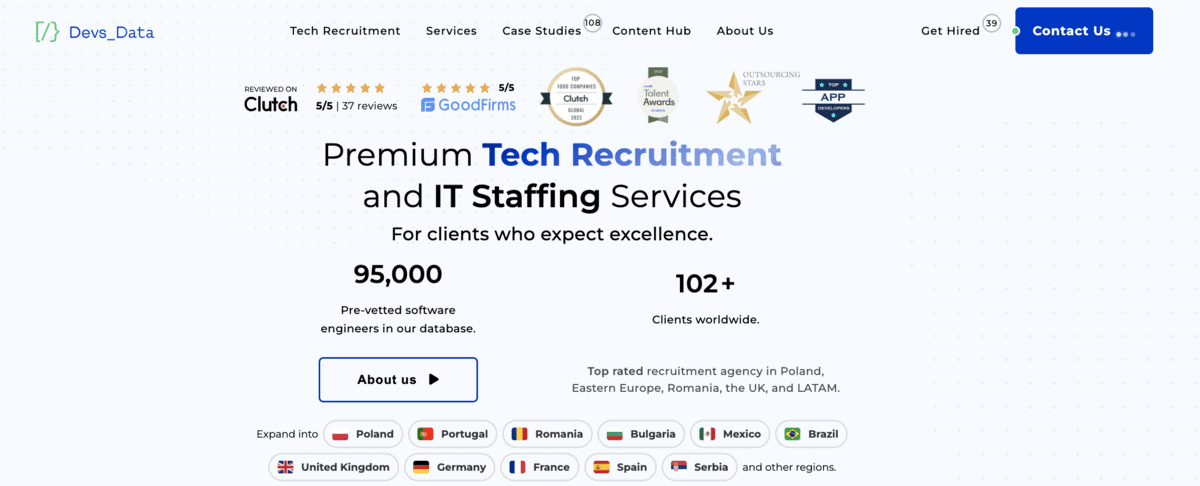
The firm’s candidate database exceeds 95000 professionals. Each candidate undergoes a rigorous evaluation process that includes a 90-minute problem-solving challenge designed to test platform-specific competence, analytical thinking, and real-time communication quality under pressure. This structured assessment ensures that candidates presented to clients are not only technically proficient but also capable of clear, professional communication in distributed team environments.
DevsData LLC operates on a success fee model, meaning clients pay only upon a confirmed hire. Every placement includes a guarantee period, providing a built-in safeguard against early attrition and reducing the financial risk associated with operational hiring decisions. The firm holds an official, government-approved license for recruitment services, adding a layer of regulatory compliance that distinguishes it from informal staffing marketplaces.
Independent review platforms confirm the firm’s track record: DevsData LLC maintains a rating of 5 out of 5 on both Clutch and GoodFirms, based on verified client feedback across recruitment and software development engagements.

While eCommerce VA recruitment is a core capability at DevsData LLC, the firm’s structured methodology applies equally to adjacent digital operations roles. A representative example is the recruitment of a Senior Marketing Specialist for a European B2B technology startup operating in the digital compliance and sustainability sector.
A fast-growing B2B startup headquartered in the Netherlands, with a hybrid team spread across Central Europe. The company builds cloud-based Digital Product Passport (DPP) solutions aligned with new EU sustainability regulations: an ISO 27001-certified, GS1 Digital Link-compliant platform serving major brands.
The startup needed a Senior Marketing Specialist with hands-on expertise in Google Ads, Meta campaigns, and SEO strategy – someone who could independently manage campaigns and contribute to go-to-market efforts from day one. The role required a six-week hiring window to avoid delays in regional expansion and investor communications. Cultural fit across European norms and remote-readiness added further complexity.
DevsData LLC implemented a full-cycle recruitment strategy. The team sourced candidates through LinkedIn Recruiter, AngelList, Indeed, and its own pre-vetted marketing talent pool, reviewing over 100 profiles. A multi-stage screening process evaluated real campaign results, technical skills across Google Ads and Meta, and the ability to work cross-functionally in a distributed setup. Weekly syncs with the client refined criteria mid-search, shifting toward stronger SEO expertise as the process evolved.
DevsData LLC filled the position within six weeks after five final-round interviews, reducing time-to-hire by approximately 25% compared to industry benchmarks for senior marketing roles. The placed candidate launched demand generation campaigns across Google and Meta, optimized SEO workflows, and introduced reporting dashboards that improved visibility into campaign effectiveness – all within the first month.
This case illustrates a principle that applies directly to eCommerce VA hiring: the same structured methodology – precise role scoping, multi-stage technical evaluation, and iterative client alignment – delivers measurable results whether the position is a Marketing Specialist, an eCommerce Operations Coordinator, or a multi-marketplace VA. The full case study is available on the DevsData LLC website.
The eCommerce VA role has moved well beyond basic administrative support. It now encompasses platform-specific operations, multi-channel customer engagement, logistics coordination, and increasingly, AI-augmented workflow management. For eCommerce businesses operating across multiple marketplaces and geographies, the VA function is not a cost center – it is operational infrastructure.
The market dynamics reinforce this positioning. With eCommerce revenues projected to reach $6.478 trillion by 2029 and BPO markets doubling within the decade, the operational demands on online retailers will only intensify. The World Economic Forum projects 170 million new jobs by 2030, with 63% of employers citing skills gaps as their primary transformation barrier.
The AI question is central but often misunderstood. Gartner finds that only 20% of customer service leaders have actually reduced headcount due to AI, and the firm predicts that half of the companies that cut staff will rehire by 2027. The economically rational model is not full automation but human-AI collaboration – skilled VAs working alongside AI tools to deliver outcomes that neither can achieve alone.
Hiring right matters more than hiring fast. The recruitment challenges – role ambiguity, skill verification gaps, retention risk, and the evolving AI skill requirements – are real and consequential. A structured hiring process, supported by a partner with domain-specific expertise, addresses these challenges at the source.
DevsData LLC offers that structure. With platform-specific assessments, global talent access, and post-placement support, the firm reduces the operational risk of eCommerce VA hiring while delivering candidates who are productive from day one. For CTOs, technical founders, and talent leaders building eCommerce operations that scale, this is the standard the market now demands.
Contact DevsData LLC by visiting their website at www.devsdata.com or by emailing them at general@devsdata.com to get more information.
Any questions or comments? Let me know on
Twitter/X.
Discover how IT recruitment and staffing can address your talent needs. Explore trending regions
like Poland, Portugal, Mexico, Brazil and more.
 Frequently asked questions (FAQ)
DevsData – your premium technology partner
DevsData is a boutique tech recruitment and software agency. Develop your software project with veteran engineers or scale up an in-house tech team of developers with relevant industry experience.
Free consultation with a software expert
🎧 Schedule a meeting
FEATURED IN


DevsData LLC is truly exceptional – their backend developers are some of the best I’ve ever worked with.”

Nicholas Johnson
Mentor at YC, serial entrepreneur


 Build your project with our veteran developers.
Explore the benefits of technology recruitment and tailor-made software.
Learn how to source skilled and experienced software developers.

Rebecca Botvin

Commercial Director

Tom Potanski
Manager




Categories: Big data, data analytics | Software and technology | IT recruitment blog | IT in Poland | Content hub (blog)
















careers@devsdata.com





general@devsdata.com

"I interviewed about a dozen different firms. DevsData LLC is truly exceptional – their backend developers are some of the best I've ever worked with. I've worked with a lot of very well-qualified developers, locally in San Francisco, and remotely, so that is not a compliment I offer lightly. I appreciate their depth of knowledge and their ability to get things done quickly."

Nicholas Johnson
CEO of Orange Charger LLC,
Ex-Tesla Engineer,
Mentor at YCombinator
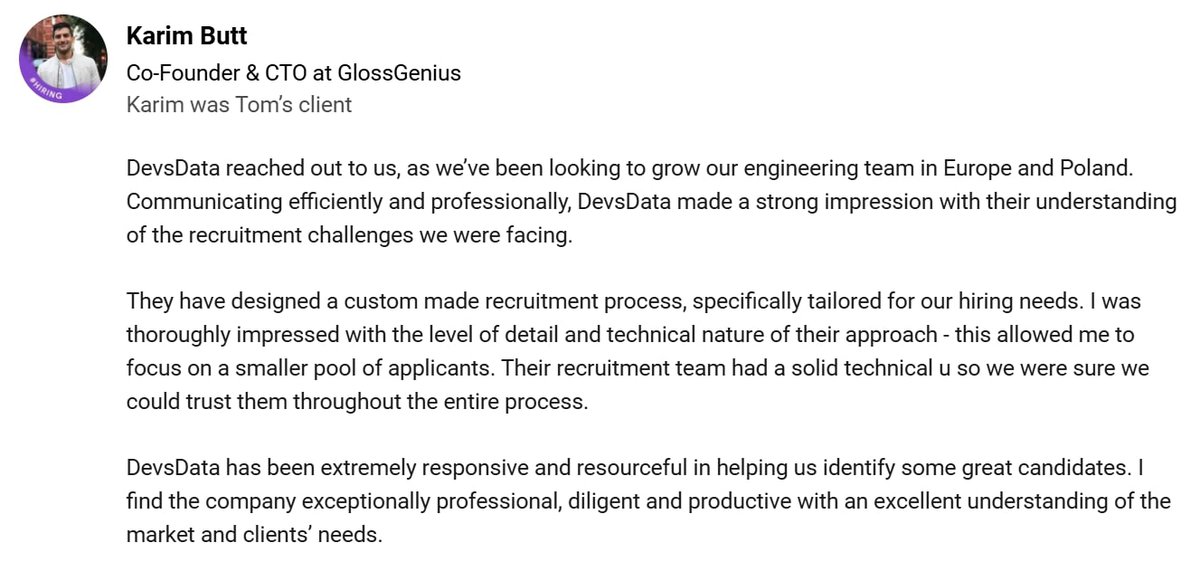
"DevsData reached out to us, as we've been looking to grow our engineering team in Europe and Poland. Communicating efficiently and professionally, DevsData made a strong impression with their understanding of the recruitment challenges we were facing. They designed a tailored recruitment process for our needs. I was impressed with the technical depth of their approach."

Karim Butt
Co-Founder & CTO at GlossGenius, Inc.
"Out of all the vendors we work with, DevsData clearly stands out. The quality of developers they deliver is beyond what we've received from any other vendor, and they've been able to send profile recommendations very quickly. I'm happy to be their reference for other companies from Israel and talk about their recruitment abilities and what they delivered for us."

Ran Eyal
Senior Manager at
ZIM Integrated
Shipping Services Ltd.
"DevsData demonstrated a strong degree of proactivity, taking time to thoroughly understand the problem and business perspective, and continuously suggesting performance and usability enhancements. Their app exceeded my expectations. I've worked with DevsData on numerous projects over the last 3 years and I'm very happy. Being both responsive and honest in communication."

Jonas Lee
Partner & Executive VP of Verus,
Financial LLC, Investor,
& Serial Entrepreneur
Acknowledgments