Thanks for subscribing.
Your gift is on the way.



Modern businesses increasingly face IT issues that cause real operational damage, such as unexpected downtime during peak traffic, failed backups, unpatched vulnerabilities, or cloud resources silently exceeding budget limits. Proactive IT services are designed to prevent these problems by continuously monitoring infrastructure, detecting early warning signals, and resolving risks before systems fail or users are affected. Instead of reacting to incidents after disruption occurs, this approach relies on 24/7 visibility, predictive analytics, and automated maintenance to keep performance, security, and availability stable as digital environments scale across cloud, hybrid, and on-prem systems.
The numbers show why this approach is gaining momentum. According to the Uptime Institute’s 2024 Outage Analysis, 54% of organizations reported that their most recent serious outage cost over $100000, with a notable share reporting losses above $1 million, underscoring the financial burden of reactive IT management.
In parallel, the global proactive services market stood at $9.47 billion in 2025 and is projected to reach approximately $61.49 billion by 2035, growing at a CAGR of 20.57%, according to Precedence Research.
That growth is not uniform across industries. Banking, financial services, and insurance (BFSI) accounted for the largest industry share at 22% in 2025, driven by the sector’s need for continuous uptime and regulatory compliance. On the technology side, analytics held over 53% of the technology segment revenue in 2025, while AI and machine learning adoption is accelerating as organizations shift from reactive troubleshooting toward predictive monitoring and automated remediation. The pattern is clear: businesses are treating prevention-oriented IT not as a cost center but as a competitive requirement, with demand concentrated in sectors where downtime carries the steepest financial and regulatory consequences.
At DevsData LLC, we have seen how proactive IT management transforms system reliability and allows businesses to scale confidently. Drawing on our experience across diverse industries, we have built an operating model that combines continuous monitoring, predictive analytics, automated remediation, and disciplined change management to keep client infrastructures resilient, secure, and future-ready.
In this article, we share our approach, insights from real projects, proven operational frameworks, and practical recommendations to help you determine whether proactive IT services are the right fit for your organization and how to choose a partner that can deliver measurable results.
Proactive IT services refer to the continuous process of monitoring, maintaining, and optimizing an organization’s digital infrastructure before problems occur. Unlike reactive IT support, which responds after an issue has already disrupted operations, the proactive approach focuses on prevention and prediction.
In essence, it’s about shifting from “repair and recover” to “anticipate and prevent.” Teams practicing proactive IT management track system performance and apply updates or configuration changes before downtime or security incidents happen. This requires integrated monitoring tools and specialists who interpret trends rather than waiting for alerts to escalate.
The philosophy behind proactive IT services is strategic rather than tactical. It aligns IT performance with business goals across reliability, cost efficiency, and scalability. Market spending patterns reflect this shift.
Managed services captured over 40% of the proactive services market in 2025, a sign that organizations are outsourcing prevention-focused IT operations as a long-term investment rather than handling them ad hoc internally.
Customer experience management held the largest application share at 27%, confirming that proactive IT spending increasingly ties back to end-user outcomes and retention rather than back-office maintenance alone. Large enterprises accounted for more than 60% of the market, though the SME segment is expected to grow at the fastest rate as cloud deployment lowers the barrier to entry for smaller organizations. By minimizing unplanned outages and optimizing resource usage, companies reduce operational risk while improving user satisfaction and employee productivity. When even a few minutes of downtime can translate into thousands of dollars in lost revenue, proactive IT support functions as a competitive differentiator rather than a technical option.
What makes proactive IT services distinct is their combination of real-time intelligence, automation, and human oversight.
Advanced analytics, AI-driven diagnostics, and continuous testing now play as much of a role as skilled engineers who understand the organization’s specific operational landscape. Successful proactive service delivery means uniting technology, process, and expertise to maintain business continuity and performance at scale.
The following table maps the core service areas within proactive IT management to their operational scope and measurable business outcomes.
| Service area | What it covers | Business impact |
|---|---|---|
| 24/7 monitoring and alerting | System visibility and anomaly detection | Faster response and reduced downtime |
| Preventive maintenance | Patching and configuration hygiene | Stable performance and fewer failures |
| Performance and capacity optimization | Resource analysis and right-sizing | Better scalability and cost control |
| Security and threat monitoring | Vulnerability detection and incident prevention | Stronger security posture and compliance readiness |
| Backup and disaster recovery | Data redundancy and restore testing | Business continuity and minimal data loss |
| Cloud and infrastructure governance | Cost controls, access reviews, policy enforcement, configuration audits | Lower cloud spend and reduced misconfiguration risk |
| User experience and availability tracking | Latency monitoring and uptime tracking | Consistent performance across regions |
| IT asset lifecycle planning | Planned upgrades, renewals, decommissioning, and capacity forecasting | Predictable budgeting and improved ROI |
Each service area addresses a different layer of infrastructure risk, from real-time anomaly detection to long-term capital planning. Gaps in one area compound risk across others: skipping patch cycles, for instance, weakens both security posture and compliance readiness simultaneously.
Do you have IT service needs?
Proactive IT services deliver measurable improvements across performance and cost efficiency. By detecting issues early and maintaining systems continuously, organizations can prevent downtime and optimize resources before problems occur. Below are some of the most significant benefits businesses gain when adopting a proactive approach to IT management.
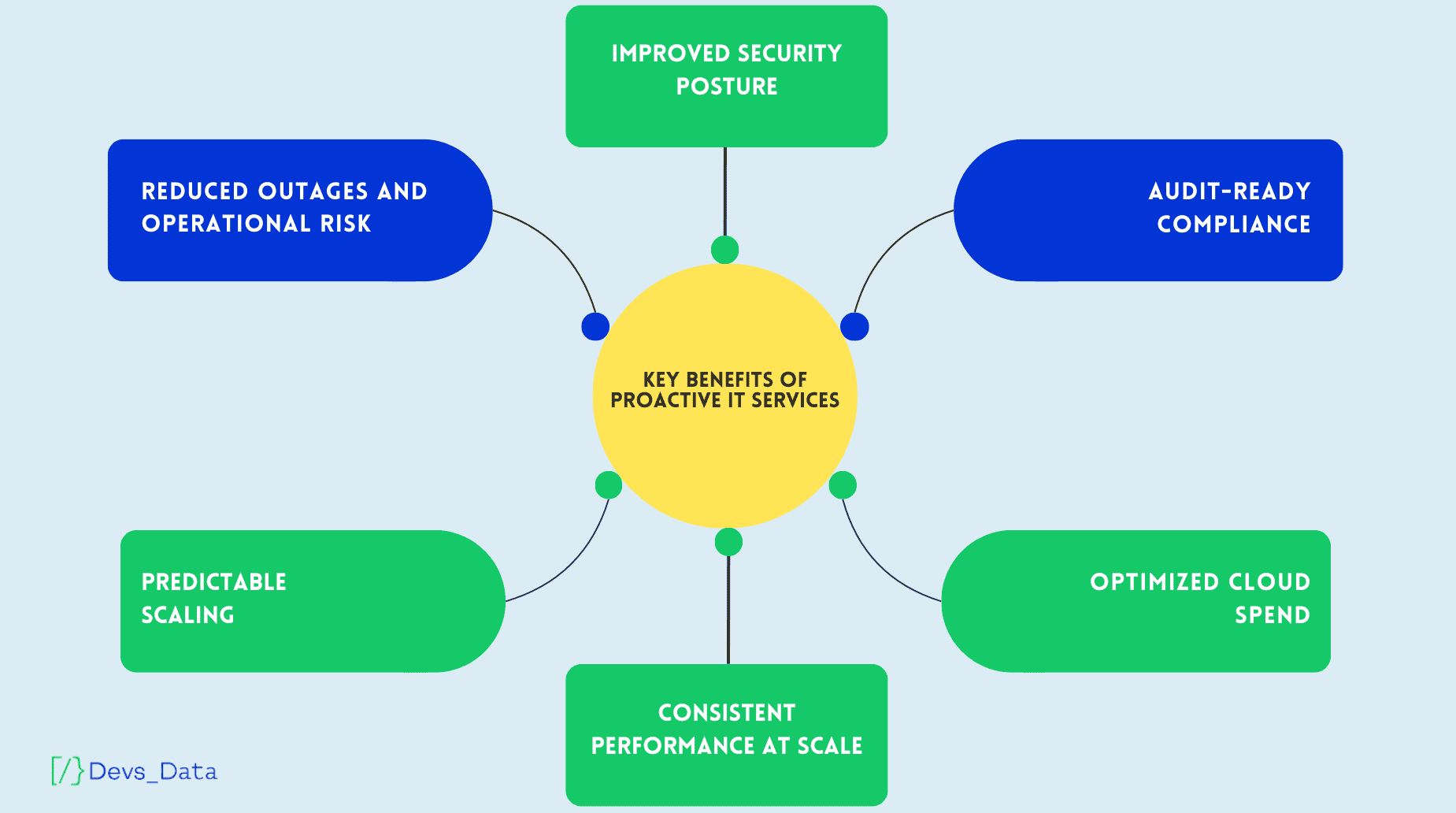
Proactive runbooks and continuous monitoring help catch issues before they escalate. Long-run evidence shows that human error accounts for between two-thirds and four-fifths of downtime incidents, indicating that disciplined prevention and training directly reduce risk.
Always-on threat monitoring, patch orchestration, and rapid response shrink the attack window. In 2023, ransomware payments reached a record ~$1 billion, underscoring the high cost of reactive security. Proactive controls reduce exposure and shorten recovery time.
Logging, configuration baselines (CIS-aligned), access controls, data-retention policies, and audit trails embedded into day-to-day operations significantly reduce the risk of regulatory and compliance violations. Regulators have continued to levy large penalties, such as the €310 million fine against LinkedIn in 2024 for GDPR breaches, underscoring the stakes for weak controls.
Capacity planning, right-sizing, and usage governance prevent runaway bills. A recent Gartner Pulse found 69% of organizations reported cloud budget overruns, highlighting why proactive monitoring and optimization matter for financial discipline.
Health checks, SLO tracking, and AI-assisted ops improve stability and staff efficiency. In Uptime Institute’s 2024 survey, the top drivers for AI deployments were improving facility efficiency (58%) and reducing human error (55%), aligning directly with proactive operations goals.
Proactive management creates clear baselines for capacity, resilience, and cost as cloud footprints grow.
Gartner projects worldwide public-cloud end-user spending to reach $675.4 billion in 2024 (up 20.4% YoY), reinforcing the need for structured governance rather than ad-hoc fixes.
Proactive IT services reduce unplanned downtime, stabilize operating costs, and give teams predictable control over system performance and risk. The benefits are most pronounced in industries where interruptions carry immediate financial or regulatory consequences. Financial services and insurance firms operate under strict uptime and compliance mandates, making continuous monitoring and automated patching a baseline requirement. Healthcare organizations depend on system availability for patient data access and clinical workflows, where even brief outages affect care delivery. eCommerce and retail businesses face direct revenue loss during downtime, particularly during high-traffic periods when infrastructure strain peaks. Telecommunications providers and government agencies manage large-scale, distributed networks where a single misconfiguration can cascade across regions. The common thread is operational dependency on digital systems: the more a business relies on continuous availability, the greater the return from prevention-driven IT management.
Do you have IT service needs?
Even with the clear advantages of proactive IT management, many organizations still struggle to make it work effectively in practice. Power disruptions, ransomware attacks, skill shortages, and stricter compliance requirements can all create unexpected gaps in protection.
Building a proactive framework takes more than tools and alerts. It requires discipline, operational structure, and deep technical experience.
DevsData LLC delivers proactive IT as a managed engagement that spans continuous monitoring, automated incident detection, preventive patching, capacity planning, and security oversight across cloud, hybrid, and on-premises environments. Its teams track metrics such as error-rate trends, latency percentiles, and resource saturation around the clock, intervening before performance degrades. Rather than treating DevOps, cloud infrastructure, and cybersecurity as separate support functions, the model integrates them into a single operational layer.
Below are some of the most common challenges companies face in this space and how DevsData LLC addresses each one through structured, data-driven operations.
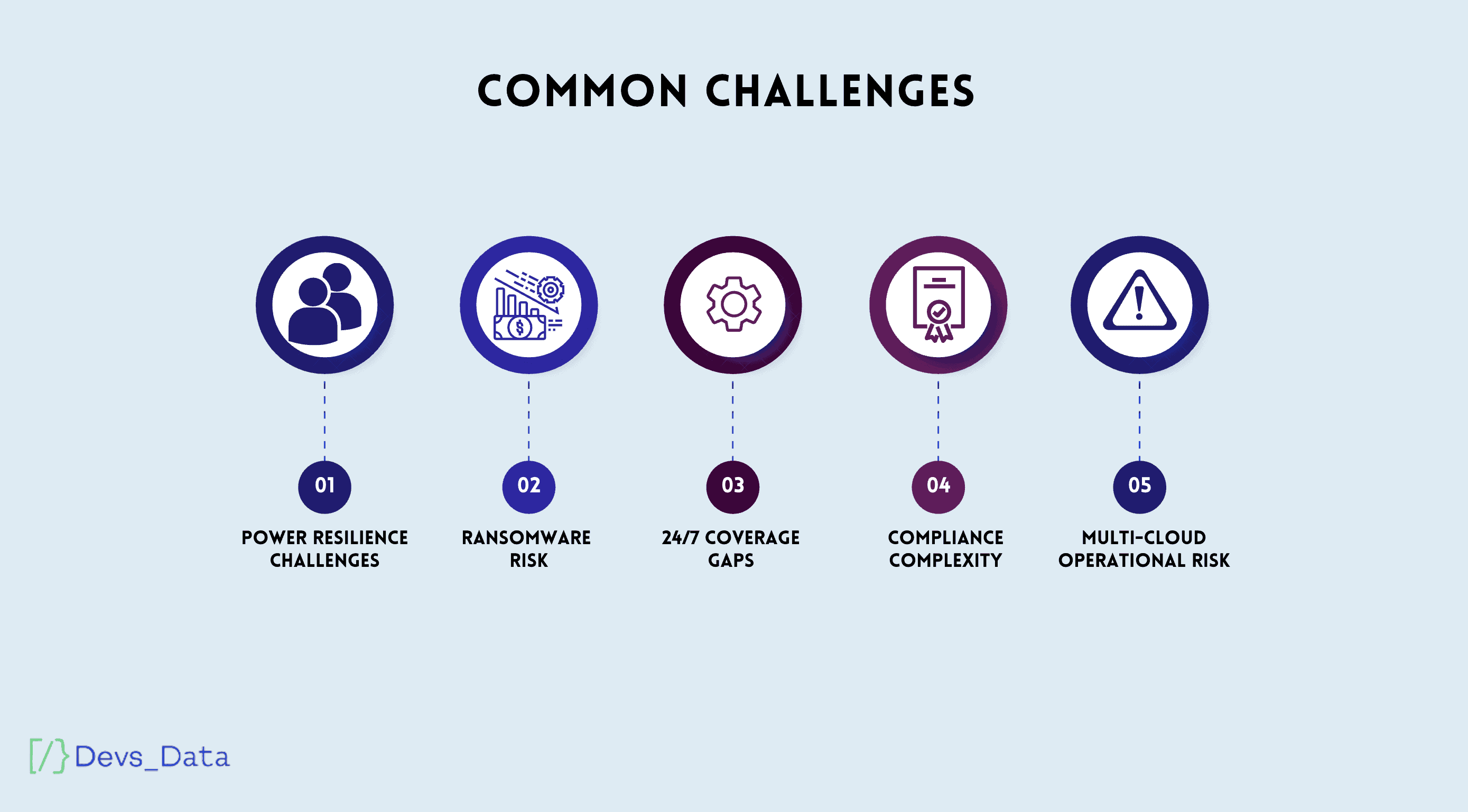
Even with mature cloud adoption, physical infrastructure remains a single point of failure. In 2024, disruptions to on-site power distribution accounted for 54% of impactful outages, making power the leading cause of downtime.
The DevsData solution
We design for failure: dual power paths where possible, runbook-driven failover tests, and capacity alerts tied to facility events. For critical workloads, we plan grid-aware contingencies and validate generator/UPS procedures with scheduled game days.
Attack intensity and extortion tactics continue to rise. In 2023, victims of ransomware attacks paid more than $1.1 billion, marking a record high in extortion payments.
The DevsData solution
We implement a 3-2-1 backup strategy with regular restore drills, harden identity (MFA everywhere, privileged access gating), patch on risk-based SLAs, and monitor for lateral movement. Incident runbooks include tabletop exercises and legal/communications workflows.
Security and reliability roles remain hard to fill. According to ISC², the global cybersecurity workforce gap reached 4.8 million professionals in 2024.
The DevsData solution
We standardize incident playbooks, automate first-response tasks using tools like PagerDuty and infrastructure-as-code workflows (Terraform, Ansible), and maintain a clear on-call and escalation model. Cross-training ensures reliable coverage even when specialist availability is limited.
Regulatory expectations keep increasing. In the United States, the US SEC’s rules, effective December 2023, require disclosure of material cyber incidents within four business days, and enforcement actions underscore the stakes, including a $10 million penalty for delayed notification in one case. Similar obligations exist globally under frameworks such as GDPR, NIS2, and sector-specific financial and critical-infrastructure regulations, all of which impose tight timelines and significant penalties for non-compliance.
The DevsData solution
We map controls to frameworks, centralize evidence (logs, configs, test results), and pre-draft incident-disclosure templates with legal review. Our runbooks align technical timelines with reporting clocks, reducing scramble and inconsistency.
Hybrid and multi-cloud footprints are growing, but it is hard to operate them cleanly. Uptime notes that IT and networking issues rose to 23% of impactful outages in 2024, reflecting misconfigurations and change errors as estates expand; industry reporting also shows multicloud adoption accelerating with new, purpose-built services.
The DevsData solution
We enforce change windows with automated checks (linting, policy-as-code), use golden patterns for network and IAM, and stage rollouts with canary and blast-radius limits. Post-change telemetry is tied to auto-rollback criteria to catch regressions fast.
While proactive IT services can dramatically improve reliability and resilience, they also demand consistent effort and expertise to maintain. Power instability, ransomware, talent shortages, and growing compliance requirements continue to test even well-prepared organizations. Addressing these issues requires structure and the right partners. At DevsData LLC, we address these challenges through the same managed engagement model: 24/7 monitoring, automated remediation, risk-based patching, and structured incident response, all operating as one integrated service layer rather than isolated fixes applied after the fact.
Selecting the right partner for proactive IT management is crucial, as their expertise will directly influence system reliability and overall business continuity.
A capable provider does more than monitor infrastructure: they anticipate risks and ensure smooth operation even under pressure.
Below are key tips to help you assess whether a potential partner has the depth and operational maturity to deliver truly proactive support.
| Key area | What to look for |
|---|---|
| Monitoring and response framework | Proven 24/7 system monitoring with defined escalation paths, SLAs, and automated alerting integrated with human oversight. |
| Security and compliance expertise | Certifications or demonstrated adherence to frameworks like ISO 27001, SOC 2, or NIST; ability to manage audits and evolving data-protection laws. |
| Performance analytics and reporting | Transparent dashboards and periodic reports that track uptime, performance, patching cadence, and improvement trends over time. |
| Automation and AI adoption | Use of predictive analytics, anomaly detection, and automation tools that reduce manual intervention and speed up resolution. |
| Proven track record | Case studies or testimonials showing measurable results such as reduced downtime, faster incident response, or improved system efficiency. |
| Scalability and flexibility | Ability to adapt services to business growth, hybrid infrastructures, and emerging technologies without disruptive transitions. |
| Communication and collaboration culture | Clear communication channels, dedicated account management, and structured feedback loops that keep clients informed and involved. |
No single criterion on this list is sufficient on its own. A provider with strong monitoring but weak compliance expertise still leaves gaps that surface during audits or regulatory reviews. The checklist works best as a combined filter: shortlist partners who score well across all seven areas, then validate their claims through reference calls and documented case outcomes.
Website: www.devsdata.com
Company size: ~60 employees
Founding year: 2016
Headquarters: Brooklyn, NY, and Warsaw, Poland
Founded in 2016, DevsData LLC supports proactive IT operations for organizations across multiple industries, with over 140 completed projects and long-term engagements that require continuous uptime and operational stability. The company’s proactive IT services include 24/7 infrastructure monitoring, automated incident detection and response, preventive patching, capacity planning, cloud cost optimization, security oversight, and disaster recovery management, all delivered as an integrated managed engagement across cloud, hybrid, and on-premises environments. By identifying potential risks before they escalate, DevsData LLC helps clients protect sensitive data and optimize infrastructure performance across cloud, hybrid, and on-premises environments.
DevsData LLC’s approach focuses on measurable reliability. Its team develops monitoring systems that combine predictive analytics, anomaly detection, and real-time alerts to catch and resolve issues before they disrupt operations. From optimizing cloud environments to managing ongoing patching, every process is designed to ensure continuous uptime.
What sets DevsData LLC apart is the integration of AI-driven insights within its managed IT services. Instead of generic alerts, we use metrics such as error-rate trends, latency percentiles, and resource saturation to detect incidents early and forecast capacity needs before performance degrades. Clients benefit from 24/7 visibility into system health, transparent reporting, and data-backed recommendations that support long-term scalability.
In addition to proactive IT management, DevsData LLC provides expert DevOps, cloud infrastructure, and cybersecurity solutions, ensuring every layer of technology, from backend systems to end-user access, remains secure and optimized. The company’s global portfolio includes over 140 successful projects and partnerships with 100+ satisfied clients across industries such as FinTech, Healthcare, eCommerce, logistics, and education. Its 5.0-star ratings on Clutch and GoodFirms reflect not only technical excellence but also a proven ability to anticipate client needs and deliver lasting impact.
The National Association of Realtors needed a secure, scalable digital payment portal capable of processing high transaction volumes with zero downtime. The challenge was balancing compliance with financial data standards, integrating multiple third-party systems, and ensuring continuous availability for thousands of daily users.
The DevsData solution: we designed a robust architecture focused on proactive monitoring, fault tolerance, and automated incident alerts. Continuous testing, redundancy layers, and predictive load-balancing were implemented to prevent service interruptions and ensure a smooth user experience.
Key learning: In financial platforms, proactive infrastructure monitoring and automated alerting are essential to prevent costly service outages and protect sensitive transactions.
Maersk Tankers, a global maritime logistics leader, partnered with DevsData LLC to strengthen its data-driven decision systems through AI and predictive analytics. The main challenge lay in processing large volumes of operational data while ensuring continuous system reliability and data security across distributed environments.
The DevsData solution: we deployed embedded data science and engineering teams that implemented proactive system monitoring, automated model retraining pipelines, and real-time analytics dashboards. These efforts reduced performance bottlenecks and improved predictive accuracy while maintaining full operational continuity.
Key learning: In AI-powered environments, proactive IT oversight and automated health checks are key to sustaining model accuracy and uninterrupted data operations.
Sysco required continuous development and support for multiple enterprise systems operating in a complex global environment. The challenge involved coordinating long-term software maintenance, ensuring high uptime across time zones, and preventing disruptions to mission-critical supply chain platforms.
The DevsData solution: we implemented a proactive support model with 24/7 monitoring, regular performance audits, and automated recovery mechanisms. Predictive diagnostics and scheduled infrastructure optimization ensured system stability and long-term scalability.
Key learning: For enterprise systems, sustained performance depends on consistent proactive maintenance, real-time monitoring, and disciplined version control practices.
Not sure whether your company truly needs proactive IT services? Take this short self-assessment. Answer the questions below and count how many times you respond “yes.”
Mostly “yes”: your business would strongly benefit from a proactive IT partner. Continuous monitoring, automated patching, and predictive analytics can prevent downtime, strengthen security, and reduce costs before issues escalate.
Mostly “no”: your current IT management likely covers most key areas effectively. Still, consider adopting proactive monitoring or auditing for mission-critical systems to ensure long-term reliability and resilience.
Do you have IT service needs?
Proactive IT services are not simply an extension of traditional technical support. They represent a complete shift in how organizations maintain stability, prevent risk, and ensure long-term performance. In today’s digital economy, waiting for problems to arise is no longer sustainable, as downtime, security breaches, and compliance failures can cause lasting financial and reputational damage.
The evidence is clear. Outages cost companies hundreds of thousands of dollars per hour, while businesses that adopt proactive monitoring and automation reduce incident frequency and improve overall resilience. For organizations that depend on uninterrupted operations, prevention and continuous oversight are no longer optional.
At DevsData LLC, we focus on what truly defines proactive IT success. We anticipate issues before they occur, implement continuous visibility through 24/7 monitoring, and apply AI-powered diagnostics to improve performance and reliability. With over 140 successful projects and 100 satisfied clients worldwide, we have proven that prevention-driven IT strategies create measurable business impact.
Whether your goal is to strengthen system uptime, secure complex infrastructure, or scale confidently across global operations, partnering with DevsData LLC ensures long-term reliability and peace of mind.
Learn more at www.devsdata.com or contact us at general@devsdata.com.
Discover how IT recruitment and staffing can address your talent needs. Explore trending regions
like Poland, Portugal, Mexico, Brazil and more.
 Frequently asked questions (FAQ)
DevsData – your premium technology partner
DevsData is a boutique tech recruitment and software agency. Develop your software project with veteran engineers or scale up an in-house tech team of developers with relevant industry experience.
Free consultation with a software expert
🎧 Schedule a meeting
FEATURED IN


DevsData LLC is truly exceptional – their backend developers are some of the best I’ve ever worked with.”

Nicholas Johnson
Mentor at YC, serial entrepreneur


 Build your project with our veteran developers.
Explore the benefits of technology recruitment and tailor-made software.
Learn how to source skilled and experienced software developers.

Rebecca Botvin

Commercial Director

Tom Potanski
Manager




Categories: Big data, data analytics | Software and technology | IT recruitment blog | IT in Poland | Content hub (blog)
















careers@devsdata.com





general@devsdata.com

"I interviewed about a dozen different firms. DevsData LLC is truly exceptional – their backend developers are some of the best I've ever worked with. I've worked with a lot of very well-qualified developers, locally in San Francisco, and remotely, so that is not a compliment I offer lightly. I appreciate their depth of knowledge and their ability to get things done quickly."

Nicholas Johnson
CEO of Orange Charger LLC,
Ex-Tesla Engineer,
Mentor at YCombinator
"DevsData reached out to us, as we've been looking to grow our engineering team in Europe and Poland. Communicating efficiently and professionally, DevsData made a strong impression with their understanding of the recruitment challenges we were facing. They designed a tailored recruitment process for our needs. I was impressed with the technical depth of their approach."

Karim Butt
Co-Founder & CTO at GlossGenius, Inc.
"Out of all the vendors we work with, DevsData clearly stands out. The quality of developers they deliver is beyond what we've received from any other vendor, and they've been able to send profile recommendations very quickly. I'm happy to be their reference for other companies from Israel and talk about their recruitment abilities and what they delivered for us."

Ran Eyal
Senior Manager at
ZIM Integrated
Shipping Services Ltd.
"DevsData demonstrated a strong degree of proactivity, taking time to thoroughly understand the problem and business perspective, and continuously suggesting performance and usability enhancements. Their app exceeded my expectations. I've worked with DevsData on numerous projects over the last 3 years and I'm very happy. Being both responsive and honest in communication."

Jonas Lee
Partner & Executive VP of Verus,
Financial LLC, Investor,
& Serial Entrepreneur
Acknowledgments