Thanks for subscribing.
Your gift is on the way.



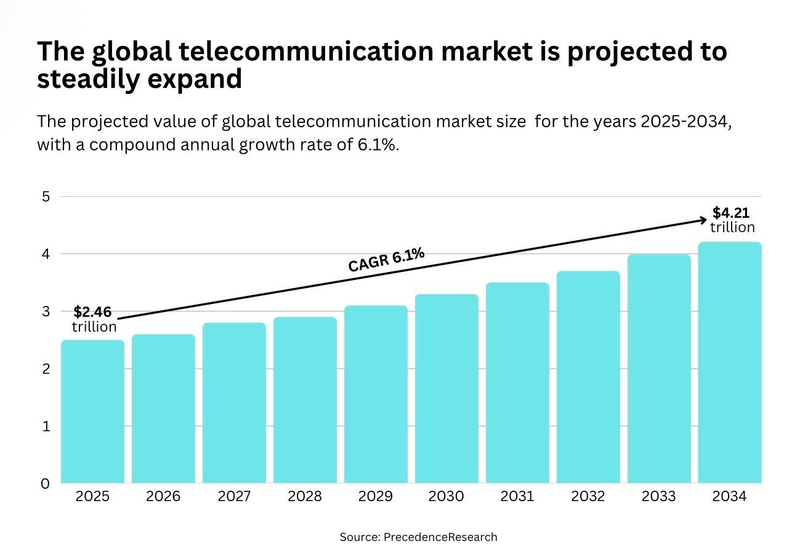
Reliable communication networks have become the foundation of how modern organizations operate. From cloud infrastructure and IoT ecosystems to customer-facing digital services, every sector now depends on telecom systems that are fast, secure, and continuously available. The global telecommunications market is projected to grow from roughly $2.46 trillion in 2025 to around $ 4.21 trillion by 2034, expanding at a 6.1% compound annual rate. Deloitte’s 2025 Telecom Outlook further notes that the rise of fixed-wireless access and generative AI will accelerate demand for specialized engineering and operations talent.
As networks evolve, so does the complexity of hiring. Companies rolling out 5G and 6G infrastructure, managing data-heavy service platforms, or building compliant IoT frameworks require professionals who can navigate both technical depth and regulatory rigor. A mis-hire or delay in recruitment can stall deployments, inflate budgets, and undermine service quality. This is where partnering with a specialized telecoms recruitment agency creates tangible value, providing access to a pre-vetted network of experts who understand the unique standards, technologies, and reliability expectations of the industry.
This article examines how telecoms recruitment agencies operate, the market forces shaping talent demand, and the advantages of working with a specialized partner. It also outlines common hiring challenges, provides guidance on selecting the right agency, and explains why DevsData LLC’s experience makes it a trusted choice for organizations building high-performing telecom teams.
Telecommunications covers the technologies that enable long-distance communication, from wired and wireless networks to satellites and internet systems, and hiring in this field often centers on specialists skilled in network design, infrastructure, and connectivity management. It underpins nearly every digital service that modern organizations rely on: from mobile connectivity and broadband infrastructure to cloud computing and IoT integration. Because telecom operations combine advanced engineering, regulatory compliance, and rapid technological change, hiring for this field requires a deep understanding of both IT and network-specific expertise.
Telecoms recruitment agencies specialize in sourcing professionals with this dual skill set. Unlike generalist recruiters, they understand the layered structure of the industry, spanning network design, software development, cybersecurity, and operations. Typical roles include:
For businesses, the advantage of turning to a specialized telecoms recruitment agency lies in precision and speed. These agencies maintain established candidate networks built through industry-specific channels, giving them direct access to scarce technical profiles that are often unavailable on open job markets. Their recruiters know how to assess not only technical proficiency, such as familiarity with 5G architecture or fiber-optic deployment, but also a candidate’s ability to operate in regulated, high-availability environments. In doing so, they help companies reduce hiring risks, shorten recruitment cycles, and secure professionals who can keep critical systems reliable and compliant.
Do you have IT recruitment needs?
As new network technologies and digital ecosystems emerge, telecom companies are rethinking their talent strategies to meet changing technical and operational demands. Below are four core trends shaping the industry, each of which also influences how organisations hire and structure their talent.
The push for fixed wireless access (FWA) and next-generation broadband is gaining ground, particularly in areas where fibre deployments are cost-prohibitive. According to Deloitte, FWA net additions globally could grow by about 20% annually in 2025-26. Telecom operators are therefore redeploying capital into transmission upgrades and new access technologies. At the same time, operators are preparing for the convergence of terrestrial and satellite connectivity, as low-Earth-orbit (LEO) constellations increasingly complement traditional access networks.
Implication for hiring: Organisations will require engineers with FWA deployment experience, hybrid access skill-sets, and an understanding of evolving network topologies. This now extends to expertise in integrating satellite and terrestrial networks, such as coordinating FWA infrastructure with LEO satellite services (e.g., Starlink or Kuiper), to ensure coverage continuity, latency management, and network resilience, making specialised recruitment around these profiles a strategic lever.
Telcos are undergoing a transition in their back-office systems: legacy OSS/BSS stacks are being replaced or augmented with AI-driven monitoring, automation, and real-time analytics. Studies note that operators are prioritising modernisation efforts to boost operational efficiency and customer experience. This shift increasingly includes the use of generative AI for network configuration, predictive maintenance, and automated fault resolution, moving these capabilities closer to core operational workflows rather than experimental pilots.
Implication for hiring: The talent mix has shifted: beyond classic RF or infrastructure roles, organisations now need candidates who blend telecom domain knowledge with automation, data platforms, and AI-ops experience; a niche that generalist recruiters may struggle to support.
Mergers and acquisitions, infrastructure rationalisation, and mounting cost pressures are reshaping the telecom landscape. Operators are consolidating service platforms and rationalising vendor relationships to extract efficiencies.
Implication for hiring: In such environments, professionals adept at change management, integration of systems, and streamlining operations become critical. Recruitment specialists must identify candidates who can navigate transitions, maintain stability, and drive transformation amid organisational restructuring.
Beyond consumer-facing connectivity, telecom operators are increasingly targeting enterprise services – IoT, edge computing, private networks – and embedding connectivity into vertical-industry workflows.
Implication for hiring: The staffing need goes deeper: firms are looking for engineers with vertical-industry insight (e.g., logistics, manufacturing, healthcare) combined with telecom/network expertise. A recruitment agency with a telecom‐specific focus is better positioned to match these hybrid profiles.
As 5G, edge computing, and AI redefine network architecture, the industry’s real bottleneck isn’t technology itself – it’s finding experts who can integrate these systems without disrupting critical connectivity.
Specialized telecoms recruiters go beyond traditional candidate sourcing. They compress hiring cycles for scarce skill sets, reduce the risk and cost of mis-hire, and help staff roles that directly affect uptime, security, and revenue delivery.
Internal teams often face long timelines for technical positions. Recent SHRM benchmarking indicates that non-executive roles at extra-large organizations take ~61 days to fill, with many companies prioritizing cost reduction and efficiency gains in 2024-2025. A specialist agency with ready talent benches (RF, OSS/BSS, FWA, edge/IoT, security) can significantly reduce this cycle through pre-screened pipelines and domain-specific assessments. Cutting even 2-3 weeks on critical builds speeds service launches and reduces vacancy drag on existing teams.
SHRM places the average cost-per-hire near $4700 (a baseline that excludes productivity loss and rework), and notes that organizations often peg the true cost of a bad hire at three to four times salary when downstream impacts are included. Structured, role-specific evaluation by a niche agency (scenario tasks, stack-specific interviews, reference calibration) reduces false positives and the expensive churn that follows them.
Telecom environments are high-availability by design; prolonged vacancies in NOC, network engineering, or security increase operational risk. Uptime Institute reports 54%+ of significant outages – events that lead to substantial service downtime or operational impact – now cost over $100000; their surveys also show two-thirds of major incidents exceed that threshold. Filling reliability and SecOps roles faster narrows the window of exposure. Meanwhile, IBM’s 2024 analysis pegs the average data-breach cost at ~$4.88M, underscoring the value of staffing security and compliance roles promptly.
As operators modernize OSS/BSS, deploy FWA, and embed AI into operations, the talent mix shifts toward hybrid profiles (network + data/automation). Agencies immersed in the domain can surface candidates who blend telecom fundamentals with AI-ops, automation scripting, and integration experience, accelerating time-to-value on strategic programs.
A specialized telecoms recruitment partner converts hiring from a slow, risk-prone process into a measurable business leverage, delivering earlier revenue capture, steadier operations, and fewer costly do-overs.
In telecoms, the cost of a delayed or misaligned hire can cascade into lost uptime, project overruns, and compliance exposure, making specialist recruitment a direct driver of operational stability.
Do you have IT recruitment needs?
Rapid technological shifts, strict regulatory environments, and high reliability expectations make talent acquisition both complex and time-sensitive. At DevsData LLC, we address these obstacles through structured, data-driven recruitment methods designed specifically for telecom projects, ensuring that every placement supports operational stability, compliance, and long-term scalability.
Telcoms are modernising operations (AI in service ops, analytics in OSS/BSS, automation at the edge), which raises demand for profiles that blend classic RF/network skills with software, data, and AI-ops experience. This is especially pronounced in NetDevOps roles, where engineers are expected to treat network infrastructure as code, using tools such as Terraform and Ansible to define, deploy, and validate network configurations through automated, version-controlled workflows rather than manual provisioning. Deloitte flags accelerated AI uptake and operational modernisation as priority areas, intensifying competition for such hybrids.
We maintain role-specific pipelines for “hybrid” talent (e.g., network engineers with Python/automation and data-ops exposure) and evaluate using scenario tasks drawn from AI-assisted monitoring, OSS/BSS events, and change windows. For NetDevOps positions, technical vetting explicitly assesses infrastructure-as-code proficiency, including change simulation, rollback logic, and compliance-aware deployments using Terraform and Ansible, ensuring shortlists reflect real operational competence rather than surface-level tool familiarity.
Telecom-adjacent tech skills decay quickly; global surveys show fast-evolving skill needs and rising reskilling urgency through 2027. Gartner also finds that hiring for “promise” (learnability + adjacent skills) can outperform strict proficiency-only filtering – critical when new stacks outpace credentials.
We pair stack checks (e.g., vendor certs) with capability signals: timed troubleshooting, config/readiness reviews, and learning agility screens. Calibrated scorecards allow adjacent-skill candidates with strong learning curves to pass, widening the pool without lowering the performance bar.
EU NIS2 raises the bar for security risk management across essential/important entities, with implementing guidance, tightening controls, and governance. Telecom and digital-infrastructure operators must evidence security measures and designate accountable roles, raising stakes for background, competency, and process fit in security-sensitive hires.
We run security-aware hiring flows: role scoping aligned to NIS2 control areas, experience verification in high-availability and incident response, and reference checks tailored to change control, access management, and audit evidence. For leadership roles (e.g., security officers), we validate governance exposure and reporting cadence.
Sector cycles, slower 5G spend phases, M&A, and platform rationalisation, create uneven demand and time-critical hiring during transitions. Recent headlines indicate that vendors and operators are adjusting their workforces as spending patterns shift, while operators continue to pursue cost efficiency and integration.
We maintain “ready benches” for surge needs (rollouts, migrations, integrations) and structure parallel interview tracks to compress time-to-fill when green-lit. For post-merger integration roles, we screen specifically for stack-consolidation and change-management experience to stabilise operations during reorgs.
Open seats in NOC, network engineering, or SecOps elevate operational risk. Uptime Institute reports that most significant outages now exceed $100K in cost; IBM’s data shows average breach costs around $4.4-$4.9M globally, underscoring the impact of delayed staffing in reliability and security functions.
We prioritise backfilling reliability-critical roles with pre-referenced candidates and run tabletop prompts (incident triage, rollback plans, ePHI/PII safeguards where applicable) to validate response readiness. For on-call environments, we assess change-freeze discipline and cross-team communication to reduce the mean time to recover risk after hire.
By aligning sourcing and assessment to real telecom constraints: AI-inflected operations, evolving skill mixes, regulatory guardrails, cyclical demand, and reliability exposure, DevsData LLC turns these market-wide challenges into structured, repeatable hiring outcomes.
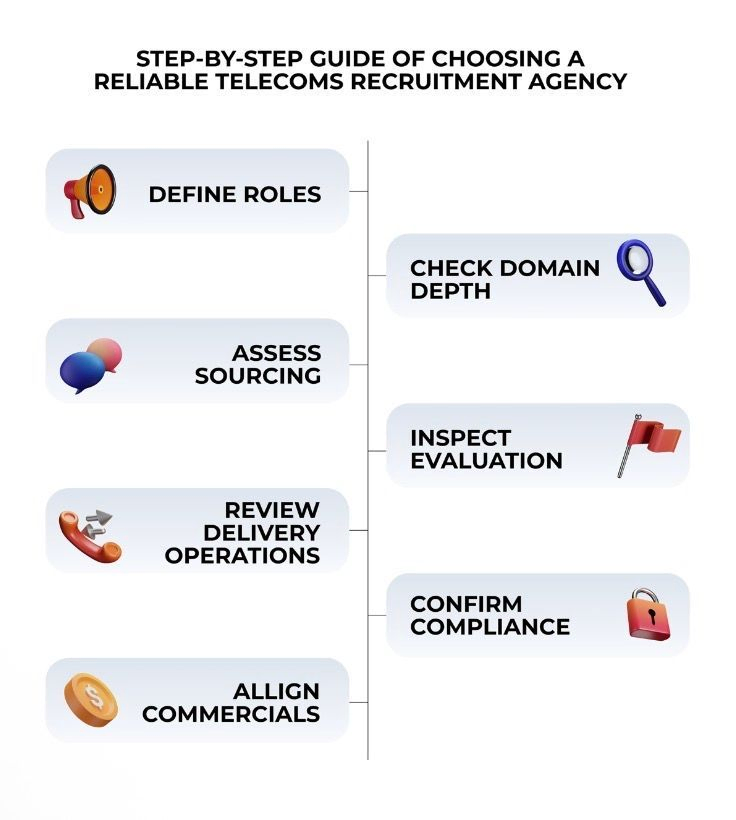
Use this as a practical sequence you can follow end-to-end. Each step clarifies what to verify and which questions to ask before you commit.
Write outcome-based role profiles (what the hire will deliver in 3/6/12 months), including stack specifics (e.g., 5G/FWA, OSS/BSS, NOC, security, RF) and constraints (on-call, coverage windows, clearance).
Prioritize agencies with demonstrated telecoms experience across operators, vendors, and systems integrators. Look for fluency in network layers, standards, and regulatory contexts (e.g., NIS2, lawful intercept, data retention). It is also important to ask how the agency evaluates and validates vendor-specific expertise, including experience with certification frameworks from major telecom vendors such as Cisco, Nokia, and Ericsson, which remain central to most production networks.
Confirm how they reach passive candidates (guilds, standards bodies, alumni, cleared communities) and whether they keep warm benches for surge needs (rollouts, migrations, M&A integrations).
Ask how they test capability beyond CVs: scenario tasks (change window, rollback plan, RF optimization), environment fit (HA, low-latency), and soft constraints (shift patterns, cross-team comms).
Clarify SLAs for shortlists, interview coordination, weekly reporting, and escalation. Verify the team you’ll work with (account manager + lead recruiter + sourcers) and their load.
Confirm background checks, reference standards, data protection (PII handling, ATS access), conflict-of-interest policies, and any sector-specific security screening.
Map pricing model (contingent/retained/hybrid), replacement guarantees, exclusivity windows, off-limits lists, and IP/NDAs. Agree on metrics (time-to-shortlist, time-to-offer, acceptance rate).
| Step | What to verify | Questions to ask |
|---|---|---|
| Role definition | Outcomes, stack, constraints | ● What will success look like at 90/180 days? ● Which standards/tools must they know (e.g., 3GPP, FHIR, NetConf/YANG, Kubernetes)? ● What coverage/on-call is required?” |
| Domain depth | Telecom track record | ● Show 3 recent telecom placements and their impact. ● Which operator/vendor stacks do you know best (OSS/BSS, EPC/5GC, RAN, SD-WAN)? ● How do you handle regulated environments? |
| Sourcing and bench | Access to scarce talent | ● Where do your best passive candidates come from? ● Do you keep ready benches for RF, NOC, SecOps, OSS/BSS? ● What is your average response rate from passive outreach? |
| Evaluation | How they test capability | ● Share a sample scenario task you use for NOC/Network/SecOps. ● How do you verify hands-on skills vs. tool familiarity? ● What’s your reference check template for change control or incident response? |
| Delivery ops | Speed, transparency, ownership | ● What’s your SLA for the first shortlist and total time-to-offer? ● Who is my day-to-day team, and how many searches do they run now? ● What does a weekly report include? |
| Compliance and risk | Security, privacy, conflicts | ● How is candidate data stored, and who can access it? ● Which background checks are standard? ● Can you meet clearance needs? ● Share your off-limits and conflict-of-interest policy. |
| Commercials | Cost, guarantees, KPIs | ● What are your fees by model (contingent/retained) and what’s included? ● What is the replacement guarantee and conditions? ● Which KPIs do you commit to (acceptance rate, dropout rate, TTH)? |
Selecting a telecoms recruitment partner is ultimately about verifying substance over promises. The right agency should demonstrate not only an understanding of telecom technologies but also transparent processes, measurable results, and accountability at every stage. Using the checklist above helps ensure your partnership is grounded in evidence and aligned with business needs, technical standards, and hiring efficiency from the start.
Company size: ~60 employees
Founding year: 2016
Website: www.devsdata.com
Headquarters: Brooklyn, NY, and Warsaw, Poland
DevsData LLC specializes in telecoms recruitment, helping organizations hire engineers, analysts, and project leaders who keep networks fast, reliable, and secure. With over ten years of experience in technical recruitment and software development, the company combines industry knowledge with data-driven methods tailored to the unique needs of the telecommunications sector.
Its team includes US-based specialists who work closely with international clients, ensuring full alignment across time zones and markets. DevsData LLC has successfully partnered with global corporate clients and high-growth startups across more than a dozen countries, including the US and Israel, providing access to both established and emerging telecom talent markets.
The company’s proprietary candidate database now exceeds 95000 verified professionals, allowing recruiters to deliver shortlists faster while maintaining precision in skill matching. Each recruitment process is licensed and government-approved, underscoring DevsData LLC’s compliance with professional and legal standards. To date, the firm has completed over 100 recruitment projects for 100+ clients, ranging from network operators and service providers to technology vendors supporting telecom infrastructure.
DevsData LLC operates on a success-fee model, meaning clients pay only when the right candidate is hired, and every placement is backed by a guarantee period to ensure long-term fit. Each candidate undergoes a rigorous multi-stage evaluation, including a 90-minute problem-solving challenge that tests analytical thinking, technical knowledge, and communication skills – attributes vital for telecom environments.
The firm’s commitment to transparency, quality, and measurable results is reflected in its 5/5 ratings on Clutch and GoodFirms, marking it as a trusted partner for organizations seeking specialized telecom talent with proven technical and interpersonal capabilities.

One of many examples that illustrates DevsData LLC’s telecom recruitment capabilities in practice is its collaboration with T-Mobile Germany. The client sought to expand its engineering capacity to strengthen real-time data infrastructure and analytics pipelines, requiring senior data engineers and backend specialists with experience in telecom-scale systems. The challenge lay in identifying professionals who combined deep technical proficiency in tools such as Apache Kafka and Spark with the agility to work within large, security-sensitive corporate frameworks.

To meet these demands, DevsData LLC deployed a specialized task force of telecom and data-engineering recruiters. Leveraging its database of 95000 pre-vetted candidates and structured evaluation framework, the team initiated rapid sourcing, technical screening, and client-calibrated interviews. Within weeks, the recruitment cycle produced high-quality shortlists, maintaining consistency with the client’s internal processes and compliance standards.
This project demonstrates how DevsData LLC combines telecom industry insight, agile recruitment methodology, and a global candidate network to deliver measurable outcomes, aligning with the same efficiency and precision emphasized throughout this article.
If your organization is looking to strengthen its telecom teams or accelerate large-scale network projects, contact DevsData LLC to discuss a tailored recruitment strategy designed for measurable, long-term success. Reach out to us at general@devsdata.com or visit our website at www.devsdata.com.
Do you have IT recruitment needs?
Telecommunications today forms the foundation of nearly every digital service, from 5G infrastructure to enterprise connectivity. As the sector continues to evolve, driven by network modernization, AI integration, and the expansion of IoT ecosystems, the need for qualified telecom specialists is becoming increasingly strategic. Recruiting these professionals is no longer a routine HR task but a decisive factor that influences operational reliability, innovation capacity, and service continuity.
Partnering with a specialized telecoms recruitment agency enables businesses to navigate this complexity effectively. Agencies with domain expertise understand the technical depth of roles, the regulatory pressures governing telecom systems, and the performance standards that define success in this field. They help organizations shorten hiring cycles, prevent costly mis-hires, and ensure access to candidates capable of managing both legacy systems and next-generation networks. In a sector where downtime and compliance failures translate directly into financial and reputational losses, targeted recruitment becomes a business advantage rather than an operational expense.
With more than ten years of experience, DevsData LLC exemplifies what an effective telecoms recruitment partner can deliver. The company combines a network of 95000 verified candidates, rigorous multi-stage evaluation processes, and a success-fee model backed by a guarantee period. Its proven track record includes over 100 completed projects, reflecting consistent results across global markets. By aligning technical precision with transparent communication and fast delivery, DevsData LLC helps telecom organizations secure the talent they need to build, modernize, and safeguard their critical infrastructure.
Any questions or comments? Let me know on
Twitter/X.
Discover how IT recruitment and staffing can address your talent needs. Explore trending regions
like Poland, Portugal, Mexico, Brazil and more.
 Frequently asked questions (FAQ)
DevsData – your premium technology partner
DevsData is a boutique tech recruitment and software agency. Develop your software project with veteran engineers or scale up an in-house tech team of developers with relevant industry experience.
Free consultation with a software expert
🎧 Schedule a meeting
FEATURED IN


DevsData LLC is truly exceptional – their backend developers are some of the best I’ve ever worked with.”

Nicholas Johnson
Mentor at YC, serial entrepreneur


 Build your project with our veteran developers.
Explore the benefits of technology recruitment and tailor-made software.
Learn how to source skilled and experienced software developers.
Build your project with our veteran developers.
Explore the benefits of technology recruitment and tailor-made software.
Learn how to source skilled and experienced software developers.

Rebecca Botvin

Commercial Director

Tom Potanski
Manager




Categories: Big data, data analytics | Software and technology | IT recruitment blog | IT in Poland | Content hub (blog)
















careers@devsdata.com









general@devsdata.com

"I interviewed about a dozen different firms. DevsData LLC is truly exceptional – their backend developers are some of the best I've ever worked with. I've worked with a lot of very well-qualified developers, locally in San Francisco, and remotely, so that is not a compliment I offer lightly. I appreciate their depth of knowledge and their ability to get things done quickly."

Nicholas Johnson
CEO of Orange Charger LLC,
Ex-Tesla Engineer,
Mentor at YCombinator
"DevsData reached out to us, as we've been looking to grow our engineering team in Europe and Poland. Communicating efficiently and professionally, DevsData made a strong impression with their understanding of the recruitment challenges we were facing. They designed a tailored recruitment process for our needs. I was impressed with the technical depth of their approach."

Karim Butt
Co-Founder & CTO at GlossGenius, Inc.
"Out of all the vendors we work with, DevsData clearly stands out. The quality of developers they deliver is beyond what we've received from any other vendor, and they've been able to send profile recommendations very quickly. I'm happy to be their reference for other companies from Israel and talk about their recruitment abilities and what they delivered for us."

Ran Eyal
Senior Manager at
ZIM Integrated
Shipping Services Ltd.
"DevsData demonstrated a strong degree of proactivity, taking time to thoroughly understand the problem and business perspective, and continuously suggesting performance and usability enhancements. Their app exceeded my expectations. I've worked with DevsData on numerous projects over the last 3 years and I'm very happy. Being both responsive and honest in communication."

Jonas Lee
Partner & Executive VP of Verus,
Financial LLC, Investor,
& Serial Entrepreneur
Acknowledgments