Thanks for subscribing.
Your gift is on the way.



Salesforce holds 23.8% of the global CRM market. According to 2022 IDC research, the ecosystem is projected to generate $2.02 trillion in business revenues and create 11.6 million new jobs by 2028, which explains why organizations across industries depend on this platform to manage sales, automate marketing, plus deliver personalized customer experiences. The hiring picture, though, is uneven. Entry-level Administrator and Developer roles in the US and Western European markets are oversupplied by roughly 330%, meaning more candidates than open positions. Senior Salesforce Architects, multi-cloud Specialists, and professionals with hands-on experience in industry-specific products such as Health Cloud or Financial Services Cloud remain in short supply across the same geographies, with demand consistently outpacing available talent.
Finding and hiring the right Salesforce expert can be the difference between a platform that delivers measurable ROI and one that accumulates technical debt – with failed implementations costing organizations an estimated $150 billion globally each year.
Demand dropped 37% in 2024 before rebounding with 8% growth in 2025. That shift points to a market correcting after the over-hiring cycle of 2020 to 2022 worked itself out. Companies hiring with precision now are better placed to secure talent at more favorable rates than they were two years ago.
This comprehensive guide from DevsData LLC draws from real-world recruitment experience to help you understand what Salesforce experts do, current market trends, and how to successfully hire the right talent for your organization. We’ll also introduce you to five leading recruitment agencies that specialize in Salesforce talent acquisition.
Salesforce has evolved from a cloud-based CRM tool into a comprehensive, AI-driven business platform that spans customer interactions, internal operations, and enterprise-wide data management.
Today, Salesforce offers a unified ecosystem that enables businesses to:
Salesforce has become an essential tool for businesses in diverse sectors, including financial services, healthcare, manufacturing, retail, and technology. The platform’s industry-specific solutions, such as Health Cloud for healthcare providers and Financial Services Cloud for banks and insurance companies, offer tailored features that address unique regulatory and operational requirements.
Do you have IT recruitment needs?
The Salesforce ecosystem represents one of the most significant economic forces in enterprise technology. According to IDC research, the economic impact of Salesforce and its partner network is staggering:
These figures have direct implications for hiring strategy. A talent pool growing at this rate means demand for certified Salesforce professionals is outpacing supply in most markets, which puts upward pressure on compensation and extends time-to-hire for companies relying on traditional recruitment. Organizations that treat Salesforce talent acquisition as a strategic priority rather than a reactive one are better positioned to secure skilled professionals before competitors do. For decision-makers evaluating platform investment, the scale of ecosystem growth also signals long-term commercial stability, making Salesforce expertise a relatively low-risk capability to build or expand. Whether you are staffing a first implementation or scaling an existing practice, the market conditions favor moving early and hiring with specificity.
The Salesforce job market has undergone a dramatic transformation since the pandemic era. Following years of aggressive, volume-driven hiring during 2020-2022, the market experienced a painful correction in 2023-2024. Understanding these dynamics is crucial for both employers and candidates.
As of 2025, the market has stabilized but remains competitive:
However, this saturation primarily affects generalist roles. The market shows extreme imbalance: while administrators and Junior Developers face fierce competition, organizations desperately need experienced architects and specialized experts.
In stark contrast to the general market saturation, Salesforce Technical Architects remain in critically short supply:
This shortage reflects the increasing complexity of Salesforce implementations, particularly as organizations adopt multi-cloud solutions combining platforms like Health Cloud, Data Cloud, and Marketing Cloud.
A Salesforce Expert is a professional who possesses deep knowledge of the Salesforce platform and can customize, develop, and optimize it to meet specific business objectives. However, “Salesforce Expert” is an umbrella term that encompasses various specialized roles, each with distinct responsibilities and skill requirements.
The Salesforce job market is evolving beyond generalist administrators. Modern organizations increasingly seek professionals who possess a broad understanding of the Salesforce ecosystem alongside deep expertise in a specific cloud or industry vertical.
This shift reflects the platform’s maturity and complexity. As Salesforce has evolved from a simple CRM tool to an AI-powered business platform, the skills required to deliver outcomes like faster sales cycles, improved customer retention, and automated workflows have become more specialized and sophisticated.
Salesforce Administrator
Salesforce Administrators manage day-to-day platform operations, user management, and configuration. They create custom objects, fields, and validation rules, and use low-code tools like Flow Builder to automate business processes. Modern administrators must master Flow, as organizations increasingly replace custom code with scalable, maintainable automation.
Salesforce Developer
Developers customize and extend the platform using code, working with Apex (Salesforce’s proprietary programming language for backend logic), Lightning Web Components (LWC) for responsive user interfaces, REST/SOAP APIs for system integration, and Data Cloud for unifying enterprise data.
Salesforce Business Analyst
Business Analysts bridge the gap between business stakeholders and technical teams by translating business needs into technical requirements, mapping complex workflows, and ensuring implementations deliver measurable ROI. Notably, Business Analysts were the only role in established markets to see salary growth (7%) in recent reports, reflecting their increasing importance.
Salesforce Architect
Architects design scalable, secure Salesforce solutions for organizations with multiple system integrations, large data volumes, and strict regulatory requirements. They manage multi-cloud implementations, ensure compliance with platform limits and security requirements, prevent technical debt accumulation, and provide strategic guidance on data architecture and system integration.
AI-Focused Roles
With the launch of Agentforce and Einstein GPT, organizations are beginning to hire for AI-focused capabilities, including professionals who can deploy autonomous AI agents, design data architectures that support AI functionality, and configure conversational AI interactions, though these responsibilities often extend existing developer and architect roles rather than creating entirely new positions.
Salesforce hiring decisions carry more weight than most technology roles because the platform spans architecture, automation, and business process design. Getting the requirements wrong at the start pushes every subsequent step in the wrong direction.
Before beginning your search, clearly articulate:
Different business needs require different staffing approaches:
Full-time in-house: best for ongoing platform management and when you need dedicated resources integrated with your team. Provides consistency but requires significant investment in salary, benefits, plus training.
Time and materials consultations: hourly or daily engagements with a Salesforce specialist on a defined scope. Suitable for advisory input, architectural reviews, or short builds where headcount is not justified.
Managed services: subscription-based access to a team of experts (administrators, developers, architects). Ideal for organizations needing broad skill coverage, proactive maintenance, and rapid scalability.
Where you look shapes the quality of who you find. Salesforce’s own AppExchange Partner directory lists certified consulting firms and independent contractors vetted by Salesforce directly. The Trailblazer Community connects hiring managers with active practitioners across every cloud specialty. Dedicated talent platforms such as Toptal, Proxify, and Andela maintain pre-screened Salesforce talent pools and can reduce time-to-match significantly. For senior or architect-level roles, specialist technology recruiters with Salesforce-specific practices tend to produce stronger shortlists than generalist agencies.
Salesforce certifications confirm foundational knowledge, but they do not substitute for delivery experience. A candidate holding a Salesforce Certified Platform Developer II credential means they passed a standardized exam; it tells you less about how they handle a multi-cloud data model under business constraints. When reviewing profiles, prioritize demonstrated project history over certification count. Ask specifically about org complexity, integration patterns used, and how they managed scope changes mid-project.
Generic technical tests rarely surface the judgment Salesforce roles actually require. Build your assessment around scenarios drawn from your own environment: a data migration involving duplicate records, an automation conflict between Flow and an Apex trigger, or a permission model that needs to serve three different user personas. Practical scenarios reveal how candidates think through trade-offs, not just whether they know the syntax.
Salesforce projects regularly sit at the intersection of IT and business operations, which means your hire will field requirements from non-technical stakeholders and translate them into platform decisions. A strong technical profile with poor communication creates bottlenecks at exactly the points where clarity matters most. During interviews, present a real business problem and ask the candidate to walk through how they would gather requirements, confirm scope, and manage expectations across teams.
Compensation benchmarking for Salesforce roles varies significantly by cloud specialty, certification tier, and geography. Salesforce-published salary data and platforms like Glassdoor and Levels.fyi provide current ranges by role and region. For contract engagements, settle delivery milestones, documentation standards, plus handover expectations before work begins. Onboarding should give the new hire org access from day one, paired with a walkthrough of existing customizations so they understand which parts of the platform are bespoke. From there, set a clear definition of done for the first deliverable, alongside the contacts they will need across IT, Sales, and Operations to unblock requirements. Gaps in any of these areas cost more time to recover than they save at the start, and they tend to surface only once the hire has been working blind for several weeks.
Given the complexity of the Salesforce talent market, with simultaneous saturation in some roles and critical shortages in others, partnering with a specialized recruitment agency can be a strategic advantage.
Consider working with a recruitment agency when you need specialized expertise, particularly for architect-level roles or industry-specific implementations like Health Cloud or Financial Services Cloud. Agencies with established candidate networks can significantly accelerate hiring timelines when time is critical.
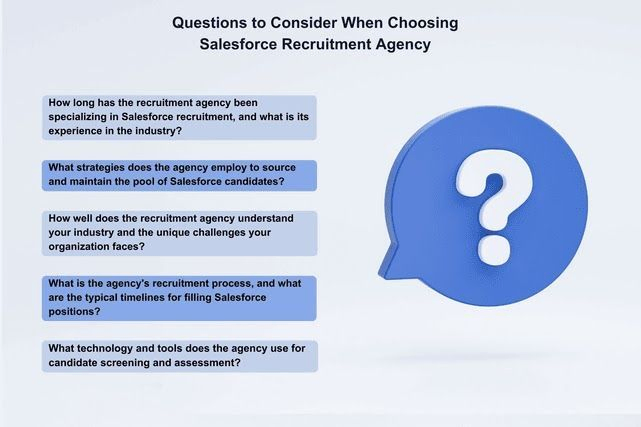
Small to medium businesses that lack internal recruitment capacity often benefit from agency partnerships, as they typically don’t have dedicated technical recruiters on staff. Specialized agencies also provide valuable market insights, including data on salary benchmarks, skill availability, and hiring trends that can inform your recruitment strategy.
Quality vetting is another key advantage; agencies conduct technical assessments and reference checks, reducing your screening burden and ensuring candidates meet your standards. Finally, when you’re building an entire team requiring multiple complementary roles such as administrators, developers, and business analysts, agencies can coordinate hiring across positions to ensure the right mix of skills and experience.
Based on industry experience, client satisfaction, and proven track records, here are five leading recruitment agencies specializing in Salesforce talent acquisition:
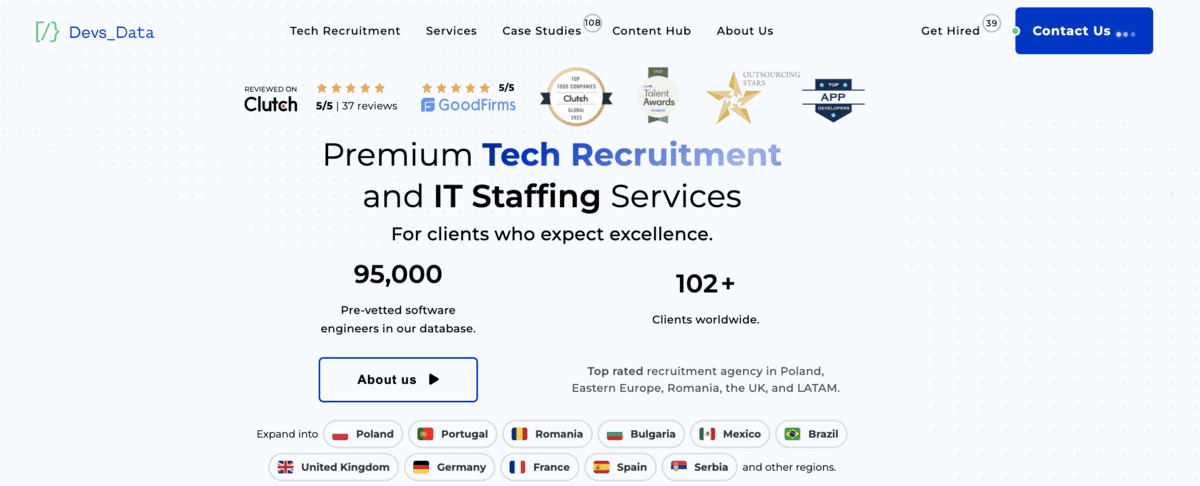
Website: www.devsdata.com
Company size: ~60 employees
Founding year: 2016
Headquarters: Brooklyn, NY, and Warsaw, Poland
Founded in 2016, DevsData LLC is a technology recruitment company with operational presence across Europe, the United States, and Latin America. The firm operates under a government-approved recruitment license in Poland, ensuring compliant, transparent hiring processes, an important factor for companies recruiting across borders. DevsData LLC works on a success-fee model and provides a placement guarantee, reducing hiring risk for clients filling senior or business-critical roles.
In one engagement, DevsData LLC partnered with Nearmap Inc., a leading US InsurTech company, to fill four critical senior positions, including a Senior Salesforce Developer who played a key role in system integration for the company’s AI-powered mapping platform. In another project, the firm supported a global pharmaceutical leader by recruiting a tech lead for a Salesforce-based public platform requiring deep expertise in customization, data compliance, and integration. The success led to expansion with four additional Salesforce roles across Boston, Singapore, London, Berlin, and Tel Aviv.
DevsData LLC holds 5-star ratings on both Clutch and GoodFirms, reflecting consistent delivery across recruitment projects. For companies hiring Salesforce Experts where technical expertise and business judgment directly affect implementation success, DevsData LLC prioritizes candidate quality and measurable outcomes.
Do you have IT recruitment needs?

Website: https://www.codleo.com/
Company size: ~200 employees
Founding year: 2019
Headquarters: Melbourne, Australia
Codleo is a Salesforce consulting and technology services company covering CRM implementation, architecture design, system integration, and ongoing optimization. Alongside its delivery work, the firm helps companies source Salesforce Developers aligned with the specific technical demands of each engagement.
Codleo’s hiring approach is closely tied to its consulting practice, making it suitable for organizations that want Salesforce Experts embedded directly into implementation or transformation projects. Rather than operating as a pure recruitment agency, Codleo focuses on Salesforce professionals with hands-on experience in Sales Cloud, Service Cloud, and platform customization.
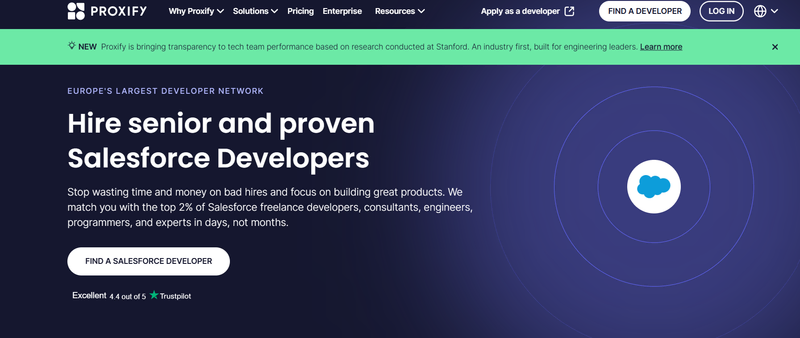
Website: https://proxify.io
Company size: ~200 employees
Founding year: 2018
Headquarters: London, UK
Proxify operates as a remote talent marketplace connecting companies with pre-vetted Salesforce Developers and other technology specialists. Over 20000 developers apply each month, and only around 1% gain entry to the network – a threshold enforced through multi-stage technical screening that includes real-world coding challenges under time pressure and live coding exercises conducted by Senior Engineers. For Salesforce specifically, this means clients receive candidates already tested on platform complexity, not generalist developers handed a Salesforce project after the fact.
The Client Engineering team, made up of Developers themselves, works alongside proprietary AI to deliver matched candidates within two days on average, taking the full process from intro call to onboarding to between two and 12 days. Contracts, payroll, and cross-border compliance are all handled by Proxify, so companies can scale without setting up a local entity. If the match does not work out, Proxify replaces candidates within 48 hours or provides ongoing coaching to sustain performance – a flexibility that suits companies needing short-to-mid-term Salesforce support without committing to a full recruitment cycle.
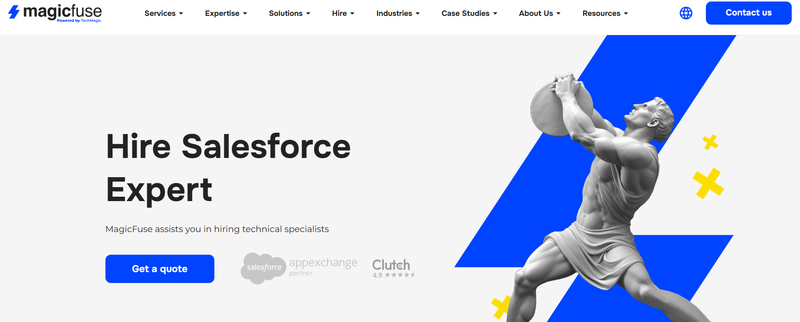
Website: https://magicfuse.co/
Company size: ~100 employees
Founding year: 2013
Headquarters: Lviv, Ukraine
MagicFuse is a Salesforce-focused development and consulting firm, not a recruitment agency. As part of the TechMagic ecosystem, the company provides Salesforce development services through its team of certified developers, architects, and consultants. Organizations looking to outsource Salesforce implementation work rather than hire in-house employees may find MagicFuse’s staff augmentation model suitable for complex enterprise and SaaS projects across multiple Salesforce clouds and CRM integrations.
MagicFuse is best suited for companies seeking delivery-oriented Salesforce expertise rather than pure recruitment services. Their strength lies in technical execution and Salesforce platform knowledge rather than a standalone hiring strategy.
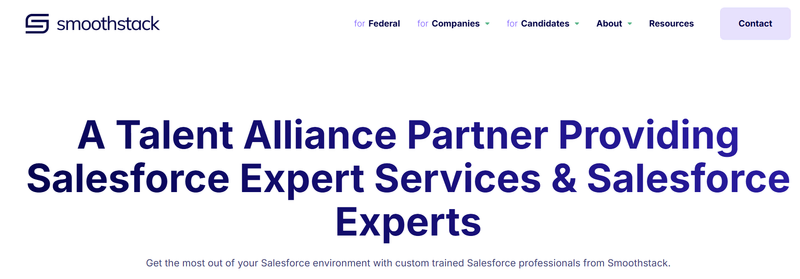
Website: https://smoothstack.com/
Company size: ~200 employees
Founding year: 2018
Headquarters: McLean, VA
Smoothstack offers a Hire-Train-Deploy model for Salesforce professionals, combining recruitment with structured training and workforce development. The company focuses on building Salesforce talent pipelines that clients can scale over time, particularly for enterprise environments with standardized CRM requirements.
The approach typically produces junior to mid-level Salesforce professionals rather than senior experts or architects. Organizations seeking entry-level administrators or developers who would grow into the role over time benefit most from Smoothstack’s training-focused setup. Companies needing immediate senior-level expertise or specialized skills for complex multi-cloud implementations will likely need to explore alternative recruitment options.
Do you have IT recruitment needs?
The Salesforce hiring landscape in 2026 offers major opportunity, but it also requires a far more deliberate approach than in previous years. As Salesforce evolves into an AI-driven business platform, demand has shifted from broad generalists to specialists with deep platform knowledge and strong business judgment. Successful organizations now focus on architectural thinking, data readiness, and real delivery experience rather than certifications alone.
Companies that invest early in experienced Salesforce architects, assess AI and Data Cloud maturity before filling AI-focused roles, and remain open to flexible and remote-first staffing models consistently achieve better outcomes. With remote work now the norm, access to global Salesforce talent has expanded, but so has the need for rigorous vetting to avoid technical debt and maximize long-term ROI.
Within the context of the $2 trillion Salesforce economy, hiring the right experts is a strategic business decision. Whether building internal teams or partnering with specialists such as DevsData LLC, success depends on aligning talent with platform complexity and business goals. DevsData LLC supports Salesforce hiring through a global pre-vetted talent network, deep technical evaluation, and a success-fee model with placement guarantee, helping companies secure Salesforce professionals who deliver impact from day one. If you’re planning to scale or optimize your Salesforce environment in 2026, now is the right time to start the conversation.
If you’re hiring Salesforce Experts in 2026 and need talent vetted for real-world delivery, architecture, and long-term impact, get in touch with DevsData LLC to discuss your requirements.
Visit www.devsdata.com or contact the team directly at general@devsdata.com to start the conversation.
Discover how IT recruitment and staffing can address your talent needs. Explore trending regions
like Poland, Portugal, Mexico, Brazil and more.
 Frequently asked questions (FAQ)
DevsData – your premium technology partner
DevsData is a boutique tech recruitment and software agency. Develop your software project with veteran engineers or scale up an in-house tech team of developers with relevant industry experience.
Free consultation with a software expert
🎧 Schedule a meeting
FEATURED IN

DevsData LLC is truly exceptional – their backend developers are some of the best I’ve ever worked with.”

Nicholas Johnson
Mentor at YC, serial entrepreneur


 Build your project with our veteran developers.
Explore the benefits of technology recruitment and tailor-made software.
Learn how to source skilled and experienced software developers.
Build your project with our veteran developers.
Explore the benefits of technology recruitment and tailor-made software.
Learn how to source skilled and experienced software developers.

Rebecca Botvin

Commercial Director

Tom Potanski
Manager




Categories: Big data, data analytics | Software and technology | IT recruitment blog | IT in Poland | Content hub (blog)












careers@devsdata.com









general@devsdata.com

"I interviewed about a dozen different firms. DevsData LLC is truly exceptional – their backend developers are some of the best I've ever worked with. I've worked with a lot of very well-qualified developers, locally in San Francisco, and remotely, so that is not a compliment I offer lightly. I appreciate their depth of knowledge and their ability to get things done quickly."

Nicholas Johnson
CEO of Orange Charger LLC,
Ex-Tesla Engineer,
Mentor at YCombinator
"DevsData reached out to us, as we've been looking to grow our engineering team in Europe and Poland. Communicating efficiently and professionally, DevsData made a strong impression with their understanding of the recruitment challenges we were facing. They designed a tailored recruitment process for our needs. I was impressed with the technical depth of their approach."

Karim Butt
Co-Founder & CTO at GlossGenius, Inc.
"Out of all the vendors we work with, DevsData clearly stands out. The quality of developers they deliver is beyond what we've received from any other vendor, and they've been able to send profile recommendations very quickly. I'm happy to be their reference for other companies from Israel and talk about their recruitment abilities and what they delivered for us."

Ran Eyal
Senior Manager at
ZIM Integrated
Shipping Services Ltd.
"DevsData demonstrated a strong degree of proactivity, taking time to thoroughly understand the problem and business perspective, and continuously suggesting performance and usability enhancements. Their app exceeded my expectations. I've worked with DevsData on numerous projects over the last 3 years and I'm very happy. Being both responsive and honest in communication."

Jonas Lee
Partner & Executive VP of Verus,
Financial LLC, Investor,
& Serial Entrepreneur
Acknowledgments