Thanks for subscribing.
Your gift is on the way.



Private equity deal activity gained momentum in 2025 after three subdued years. Global buyout deal value rose 44% year over year to $904 billion, according to Bain & Company’s 2026 Global Private Equity Report. That surge brought thousands of new portfolio companies under active management, intensifying the operational burden on general partners.
McKinsey’s 2025 Global Private Markets Report found that over 18000 companies, representing 61% of buyout portfolios, have been held beyond the four-year mark that defines the industry’s exit backlog.
Looking at hold times themselves, the average has stretched to 6.7 years, compared with a historical norm of 5.7 years. Longer holds mean more quarters of data collection, more reporting cycles, and more pressure on teams already stretched thin.
Many PE firms still rely on spreadsheets and manual processes for portfolio monitoring. As the number of active companies grows and regulatory reporting standards tighten, that approach breaks down. Errors multiply and reporting lags. Investment teams end up reconciling spreadsheets instead of sourcing new deals or supporting portfolio companies through growth phases and exit preparation. Portfolio monitoring software addresses this by centralizing data collection, automating performance analytics, and delivering real-time visibility across fund holdings.
DevsData LLC has built custom portfolio monitoring platforms for private equity clients, giving us direct experience with the technical and operational challenges involved. This article covers what PE portfolio monitoring software does, why it matters now more than ever, and how DevsData LLC approaches building these systems.
Private equity portfolio monitoring software is a category of tools that gives general partners continuous visibility into the financial and operational performance of their fund holdings. It replaces spreadsheets and manual processes with a centralized system for tracking portfolio company performance. Investment teams, operating partners, and back-office staff work from the same real-time data set, reducing reconciliation and reporting inconsistencies.
The typical system collects financial data directly from portfolio companies on a recurring basis. Revenue, EBITDA, net debt, working capital, headcount, and other KPIs flow into the platform through standardized templates or direct integrations with accounting software.
Once ingested, the data feeds into dashboards that display fund-level and company-level performance metrics side by side. General partners see how each investment is tracking against its original underwriting assumptions without waiting for a manually assembled report.
Beyond data collection, the software calculates returns at the deal and fund level, including IRR, MOIC, and DPI. It tracks valuation changes over time and flags deviations from plan, allowing deal teams to intervene earlier when a company underperforms. Reports for limited partners (LPs), board packages, and investment committee materials all draw from the same data set, reducing reconciliation work and the risk of inconsistent figures across documents. Some systems include investor portals where LPs view fund performance and capital account statements on demand.
Unlike general-purpose BI tools, these systems handle multiple funds along with the layered capital structures and the tiered profit splits between LPs and the GP that each fund requires, all within a single environment.
Do you have software development needs?
As fund portfolios grow larger and hold periods extend, the operational load on PE teams increases at a pace that manual processes cannot match. A firm managing 20 companies across two fund vintages faces a fundamentally different reporting challenge than one managing eight in a single fund. Each additional holding adds new data streams, new deadlines, and new stakeholders who need timely updates.
Spreadsheet-based monitoring breaks down under this weight. Version control becomes unreliable when multiple team members edit the same file. Data entry errors compound across quarters, and reconciling figures between internal reports and LP statements consumes hours that deal teams should spend on value creation.
Speed matters as well. When a portfolio company misses its revenue forecast or breaches a debt covenant, the general partner (GP) needs to know immediately rather than discovering the issue weeks later during a quarterly review. Delayed insight limits the firm’s ability to course-correct.
Portfolio monitoring software closes these gaps by automating data collection, standardizing KPI definitions across holdings, and generating reports from a single source of truth. The risk management case extends past cleaner reporting. Centralized monitoring surfaces covenant headroom, liquidity runway, and concentration exposure across the portfolio before any single position turns into a writedown. A firm tracking debt covenants in real time sees the cushion narrowing quarters ahead of a breach, which leaves room to renegotiate terms or inject capital while options remain open. Without that visibility, firms allocate capital and time exit decisions on data that lags the underlying reality, raising the odds of a missed intervention window or a markdown that arrives too late to manage.
The platforms differ in scope, but the features that drive day-to-day value overlap. The ones below map to the pressures already described, and their relative importance shifts with a fund’s size and structure.
The software pulls financial and operational data from portfolio companies on a set schedule. Standardized input templates reduce inconsistencies, and direct integrations with accounting systems like QuickBooks or NetSuite eliminate manual re-entry.
Interactive views display fund-level and company-level KPIs in one place. Deal teams monitor revenue growth, EBITDA margins, cash burn, debt levels, and other metrics without switching between files or waiting for a report to be compiled.
The platform calculates IRR, MOIC, and DPI at both the deal and fund level. It tracks valuation marks over time and highlights changes quarter over quarter, giving investment committees a clear picture of how each holding is performing relative to plan.
Built-in report generators produce quarterly letters, capital account statements, and performance summaries from the same data set used for internal analysis. Many platforms offer a self-service portal where LPs access documents and fund metrics on demand.
Configurable thresholds trigger notifications when a portfolio company deviates from its forecast or breaches a predefined limit. This gives operating partners early warning to intervene before a missed revenue target turns into a debt covenant breach or liquidity shortfall.
Some platforms let firms compare portfolio company performance against industry peers, prior fund vintages, or custom cohorts. This context helps teams assess whether underperformance is company-specific or driven by broader market conditions.
Firms managing several funds across geographies need a system that handles different waterfalls, fee structures, and currencies within a single environment.
Before committing to a build, most firms weigh the established platforms first, since a product that fits removes the cost and timeline of custom development. The tools below cover the bulk of the off-the-shelf market and serve PE firms at different scales and priorities. Each suits a particular profile, whether that is an emerging manager running a single fund or an institution operating across vintages and geographies. Where none maps cleanly to a firm’s fund structure or reporting needs, a custom platform becomes the practical alternative, a path covered later in this article
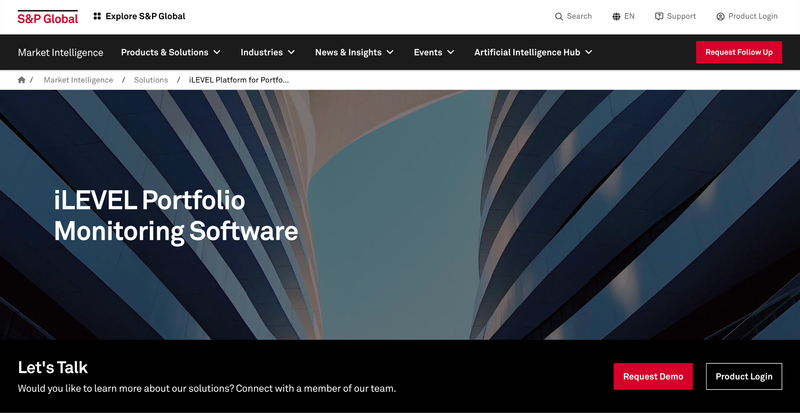
Used by more than 700 asset managers and allocators globally, iLEVEL centralizes data collection, maps financials to a standard chart of accounts, and includes native integration with Cambridge Associates benchmarks. Seven of the ten largest PE firms partner with S&P Global for data and technology solutions. The platform also offers managed data services for firms that want to outsource data processing and platform support.
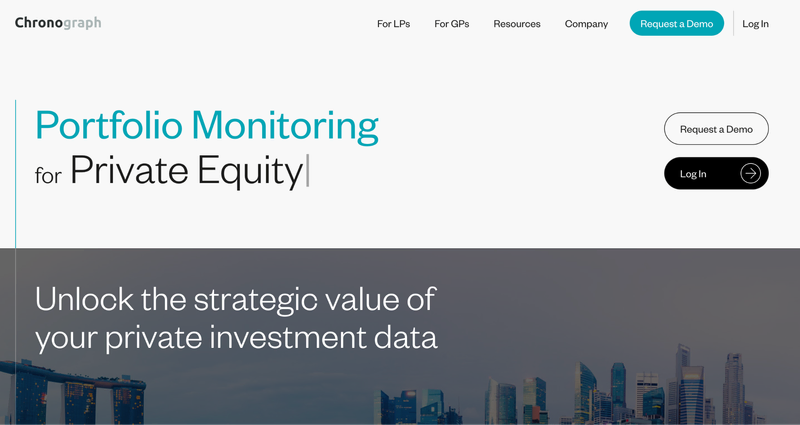
A cloud-based platform built by PE professionals, used by a majority of the world’s largest LPs and GPs. Chronograph automates data collection, valuations, and reporting across all private capital strategies. The Carlyle Group uses it to capture and structure more than seven million data points from its portfolio.
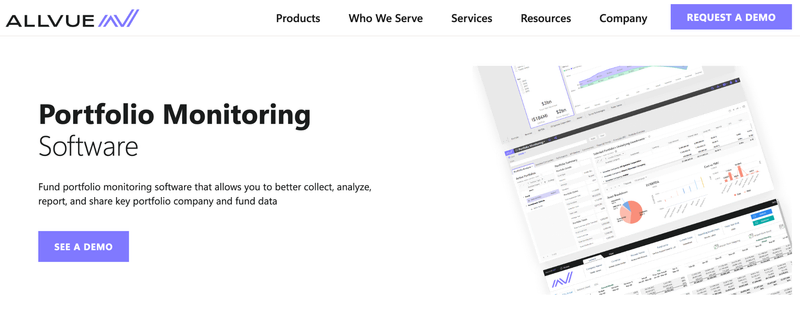
Allvue combines fund accounting, portfolio monitoring, and an investor portal in one suite. Built on Microsoft Dynamics 365 Business Central and Azure, it runs the full back office on a single enterprise stack rather than a proprietary platform, which sets it apart from monitoring-first tools that bolt accounting on through integrations. The suite spans the investment lifecycle from fundraising through fund accounting to investor relations, with an IRR Hub for performance forecasting and a Private Equity Essentials package for emerging managers holding less than $1 billion in committed capital.
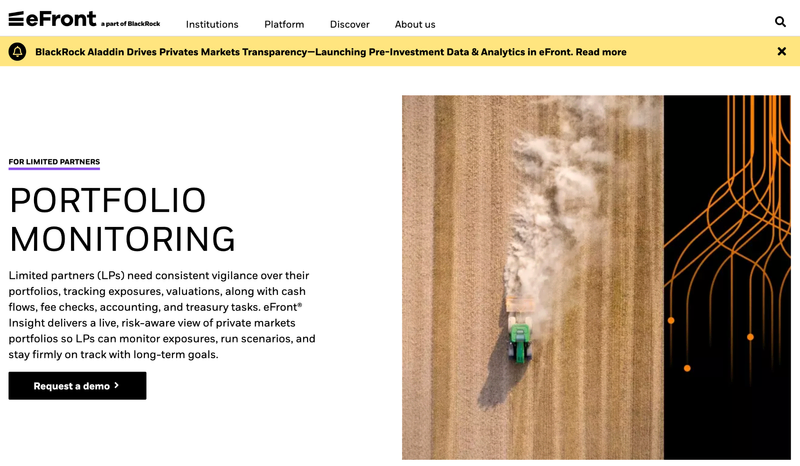
An enterprise-grade platform now part of BlackRock’s Aladdin ecosystem. eFront covers the full investment cycle across six modular products and integrates public and private asset class data onto a single platform. It is positioned for organizations that need an enterprise-wide operating system rather than a standalone monitoring tool.
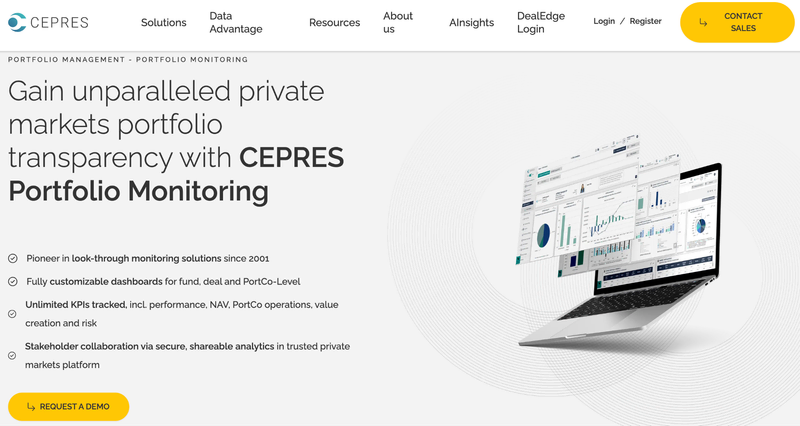
CEPRES focuses on interactive dashboards, benchmarking, and exposure analysis backed by what the company describes as the world’s largest private markets data ecosystem. The platform tracks KPIs at the fund, deal, and portfolio company level and includes analytics that allow users to query portfolio data in natural language, surface anomalies, and identify performance patterns across holdings.
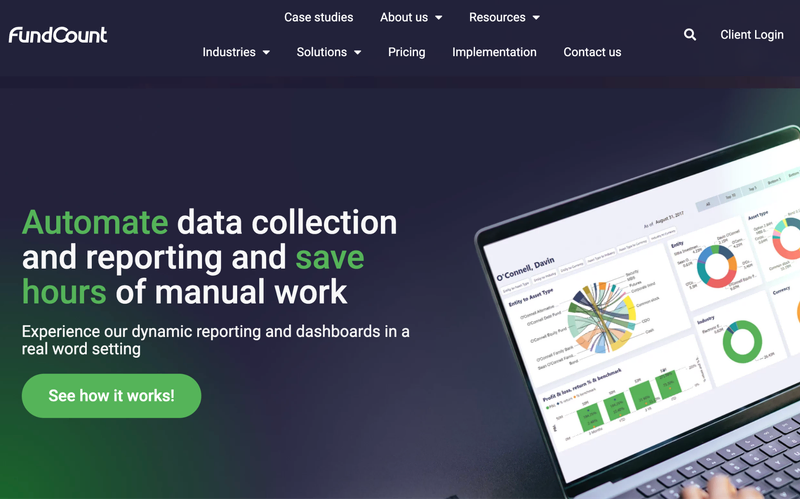
FundCount offers the deepest integration between monitoring and accounting among the tools listed here, combining portfolio accounting, partnership accounting, a general ledger, and an investor portal into a single system of record. It suits firms that want portfolio data tied directly to investor statements and financial records, reducing reconciliation work and accelerating quarterly closes.
Each of these platforms solves the monitoring problem for a particular type of firm, and for many the fit is close enough that buying beats building. The fit breaks down when a firm’s fund structures, KPI definitions, or reporting obligations sit outside what a standardized product handles. At that point the question shifts from which platform to license to whether a custom build serves the firm better, and that path carries its own set of technical demands. The next section covers the challenges that surface when firms build PE monitoring tools rather than buy them.
Do you have software development needs?
With six capable platforms on the market, building from scratch looks redundant. For most firms it is. The case for custom appears at the edges, where a standardized product forces the firm to bend its workflow to the software rather than the reverse. A fund with an unusual waterfall, a sector-specific KPI set, or reporting obligations shaped by a particular LP base often finds that off-the-shelf tools cover most of the need and leave the rest to manual workarounds, the exact problem the software was meant to remove. Firms running niche strategies, operating across jurisdictions with conflicting data residency rules, or carrying legacy systems that resist clean integration tend to reach the same conclusion. Building a custom platform means solving several recurring challenges, each requiring deliberate architectural decisions. The obstacles below are the ones we encounter most often, along with how DevsData LLC handles them.
Portfolio companies rarely use the same accounting systems, chart of accounts, or reporting formats. A manufacturing business tracks different KPIs than a SaaS company, and financial statements arrive in varying structures. Normalizing this data into a consistent format is one of the most time-consuming parts of building a monitoring platform.
Our approach
DevsData LLC builds flexible data ingestion layers that map incoming data to a unified schema regardless of the source format. We design configurable templates that adapt to each portfolio company’s reporting structure while still feeding into standardized fund-level dashboards.
Many PE firms and their portfolio companies run older ERP or accounting software that lacks modern API support. Connecting these systems to a new monitoring platform without disrupting existing workflows requires careful planning.
Our approach
We develop custom connectors and middleware that bridge the gap between legacy systems and the monitoring platform, reducing implementation time and avoiding disruptive system replacements. Where APIs are unavailable, we build automated file-based ingestion pipelines that pull data from exports on a scheduled basis.
Every GP has its own set of preferred KPIs, reporting cadences, and internal workflows. A platform that is too rigid frustrates users. One that is too open leads to inconsistent data and unreliable reporting.
Our approach
DevsData designs systems with a fixed analytical core and a configurable presentation layer. Fund-level calculations like IRR and MOIC follow locked formulas, while dashboards, report templates, and alert thresholds are adjustable per user or fund.
The platform must enforce strict role-based access so that LP-facing views, deal team dashboards, and back-office tools each expose only the appropriate data. Regulatory requirements around data residency add another layer of complexity for firms operating across jurisdictions.
Our approach
We implement role-based access control at the data layer, not just the interface level. Combined with encryption at rest and in transit, audit logging, and region-specific hosting where required, the architecture meets institutional-grade security standards from day one.
A platform built for a 10-company portfolio often struggles when the firm scales to 30 or 50 holdings across multiple fund vintages. Query performance degrades, dashboards slow down, and the data model becomes difficult to extend.
Our approach
DevsData builds on cloud-native architectures that scale horizontally as data volume increases. We design the data model with future growth in mind, making it straightforward to onboard new funds and portfolio companies without re-engineering the underlying system.
The thread running through every one of these challenges is the same tension: standardization against flexibility. A platform rigid enough to guarantee clean fund-level numbers tends to frustrate the teams that need it to bend, while one loose enough to fit every workflow produces data nobody trusts. Off-the-shelf products resolve that tension by choosing standardization and asking the firm to adapt. A custom build can hold both, but only when the architecture is deliberate about where it locks behavior and where it leaves room. DevsData LLC settles it by fixing the analytical core, where IRR and MOIC follow locked formulas, and keeping the outer layers configurable, so the platform enforces consistency without forcing every firm into the same mold. That is the line between a build that earns its cost and one that recreates the limits of the tool it replaced.
The right platform depends on where a firm sits today and where it expects to be in three to five years. A GP managing a single fund with eight portfolio companies has different requirements than one running four vintages across two geographies.
Starting from current portfolio size and projected growth narrows the field quickly, because a system built for emerging managers will hit performance limits once holdings multiply across funds.
Some platforms rely on standardized templates that portfolio companies fill in manually each quarter. Others offer direct integrations with accounting systems like QuickBooks or NetSuite. Firms whose portfolio companies run older ERP software with limited API support should confirm that the platform supports file-based ingestion or custom connectors, since a gap here creates the same manual bottleneck the software is supposed to eliminate.
IRR, MOIC, and DPI formulas should align with how the firm’s fund documents define those metrics. Waterfall modeling, fee offset treatment, and the handling of recallable distributions all vary by fund. Asking vendors to walk through a sample calculation using the firm’s actual terms exposes discrepancies before they reach LP reports.
Investor expectations around transparency continue to grow. The platform should generate quarterly letters, capital account statements, and performance summaries from the same data set used for internal dashboards. A self-service investor portal reduces the volume of ad hoc LP requests that burden investor relations teams.
Security architecture goes beyond checking a compliance certification box. Role-based access controls should operate at the data layer, not only at the interface level. Firms operating across jurisdictions need to confirm that the platform supports region-specific data residency requirements. Audit logging, encryption at rest and in transit, and SOC compliance are baseline expectations for any system handling fund-level financial data.
Licensing models range from per-fund pricing to per-user seats to flat annual fees. Implementation costs, data migration, training, and ongoing support often exceed the license itself. Firms should request a total cost of ownership breakdown that includes onboarding and at least two years of projected usage at their expected portfolio scale.
For firms whose workflows, KPI definitions, or reporting structures do not map cleanly to any standardized product, a custom-built platform becomes the more practical path. DevsData LLC works with PE clients to build monitoring solutions tailored to their specific fund structures, data environments, and reporting obligations.
Website: www.devsdata.com
Company size: ~60 employees
Founding year: 2016
Headquarters: Brooklyn, NY, and Warsaw, Poland
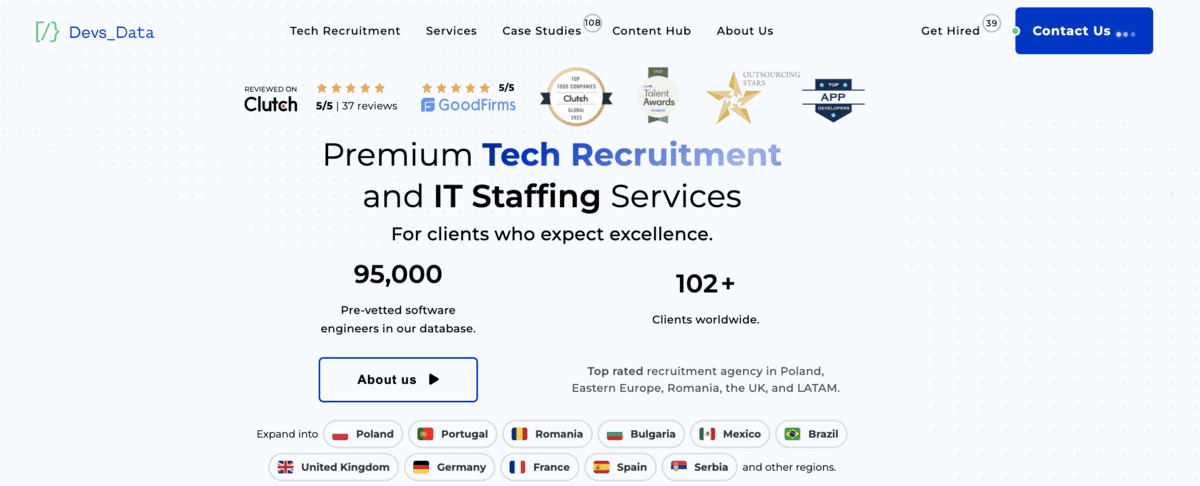
DevsData LLC works with companies across the US, Europe, and Israel, supporting startups and established organizations alike. We have direct experience working with PE and VC firms as well as proprietary investment funds, giving us a strong understanding of the operational and regulatory demands these organizations face. Our team maintains a proprietary database of over 95000 vetted IT professionals worldwide, and we operate with an official, government-approved recruitment license.
For portfolio monitoring projects, that background translates into teams that understand both financial modeling logic and distributed data architecture, enabling precise return calculations, KPI standardization, and secure, scalable system design. Developers need to work with complex financial data models, implement precise return calculations, and design systems that meet institutional-grade security requirements. DevsData LLC sources and vets engineers with direct experience in FinTech and investment management tooling, ensuring they contribute from day one. Recruitment engagements operate on a success-fee basis with a guarantee period covering early-stage turnover.
Across 100+ satisfied clients and 100+ technical engagements, we have helped organizations build reliable data platforms that reduce manual work and support better decision-making. With perfect 5.0 ratings on Clutch and GoodFirms, our focus remains on predictable delivery and long-term collaboration.
High-performance engineering recruitment for ExodusPoint Capital
ExodusPoint Capital, a New York-based hedge fund managing over $11 billion in assets, partnered with DevsData LLC to hire backend engineers and Big Data Specialists for its global trading infrastructure. The challenge was sourcing candidates with deep experience in distributed systems, low-latency optimization, and data-heavy environments, all within an aggressive timeline measured in weeks rather than months. Trading systems process millions of transactions per second, leaving zero margin for hires who need a long ramp-up period. DevsData deployed a four-person recruitment team and delivered shortlists from a pool of over 95000 pre-vetted candidates, filtering for profiles with proven experience in Java, Scala, Python, and Apache Spark.
Key learning: recruitment for investment firms operating high-throughput systems demands a vetting process that evaluates architecture instincts and real-time data fluency alongside coding ability. Speed and precision must work in parallel, not at each other’s expense.
Specialized team assembly for a London-based digital asset trading firm
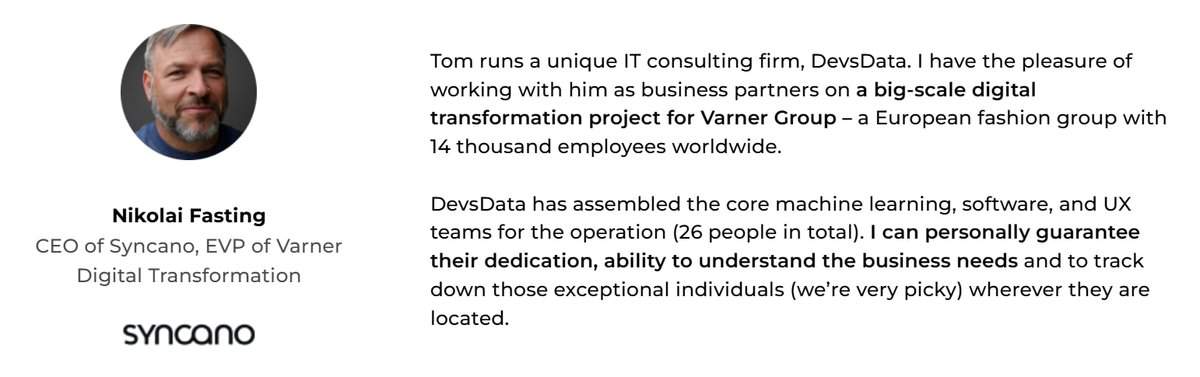
DevsData LLC partnered with a London-based investment fund operating in algorithmic trading and cryptocurrency exchange systems to build a specialized engineering team. The engagement started with a targeted search for Senior Backend Engineers and DevOps Specialists capable of supporting low-latency trading infrastructure. Candidates needed direct experience in real-time systems design, performance optimization, and fault-tolerant architecture. DevsData deployed a three-person recruitment team and ran a global sourcing campaign, filtering from over 250 assessed profiles to deliver shortlists that met the client’s technical and cultural standards. The collaboration grew from a single hire into a 20+ member engineering hub in Poland, supporting core platform components.
Key learning: trading and digital asset platforms require engineers who operate at the intersection of quantitative reasoning and systems-level programming. Recruitment for these roles demands domain-specific vetting that evaluates architecture instincts and real-time data fluency alongside coding ability.
AI-driven investment opportunities discovery for an NYSE-focused investor
DevsData LLC built an AI-powered system that automates the detection of management structure changes across NYSE-listed companies. The client, a private investor, had previously relied on a team of Research Analysts who manually scanned thousands of news articles, tweets, and social media posts to identify leadership transitions. DevsData replaced that workflow with a five-stage pipeline. The system scrapes online sources and aggregates them into a single feed, then applies text classification algorithms to filter out irrelevant content based on context. Named entity recognition extracts structured data points from each relevant article, including the company name, the position affected, and the reason for the change. From there, the AI layer prioritizes instances, finds correlations across the data set, and generates predictions about related market movements. A natural language generation module produces readable executive summaries that the investor uses to guide decisions. Most PE firms integrate the system via API into their internal reporting stack, while smaller teams opt for a standalone cloud deployment that supports direct Excel, CSV, and Word exports.
Key learning: investment research platforms that combine document classification with entity extraction and natural language generation move the analytical burden from manual scanning to structured, machine-driven output. The quality of that output depends on engineers who understand both NLP pipeline design and the financial context the data serves.
Do you have software development needs?
Private equity firms face growing pressure to move beyond spreadsheets and manual reporting. Longer hold periods, larger portfolios, and rising LP transparency requirements mean that spreadsheet-based reporting eventually breaks down, leading to version conflicts, reconciliation errors, and delayed quarterly closes. The platforms covered in this article address that need from different angles, with some offering turnkey SaaS solutions and others providing enterprise-grade systems that span the full investment lifecycle.
Choosing between an off-the-shelf tool and a custom-built platform comes down to how well standardized products fit a firm’s specific fund structures, data sources, and internal workflows.
Where the fit is strong, established platforms deliver fast time to value. Where that fit breaks down, a purpose-built solution avoids the workarounds that lead to inconsistent LP reports and repeated reconciliation cycles each quarter.
DevsData LLC brings direct experience building portfolio monitoring systems for investment firms, backed by a team that understands both the technical infrastructure and the financial logic these platforms demand. Firms exploring a custom approach or looking to extend an existing platform with tailored functionality can reach DevsData LLC at general@devsdata.com or visit www.devsdata.com.
Discover how IT recruitment and staffing can address your talent needs. Explore trending regions like Poland, Portugal, Mexico, Brazil and more.
 Frequently asked questions (FAQ)
DevsData – your premium technology partner
DevsData is a boutique tech recruitment and software agency. Develop your software project with veteran engineers or scale up an in-house tech team of developers with relevant industry experience.
Free consultation with a software expert
🎧 Schedule a meeting
FEATURED IN
DevsData LLC is truly exceptional – their backend developers are some of the best I’ve ever worked with.”

Nicholas Johnson
Mentor at YC, serial entrepreneur


 Build your project with our veteran developers.
Explore the benefits of technology recruitment and tailor-made software.
Learn how to source skilled and experienced software developers.
Build your project with our veteran developers.
Explore the benefits of technology recruitment and tailor-made software.
Learn how to source skilled and experienced software developers.

Rebecca Botvin

Commercial Director

Tom Potanski
Manager




Categories: Big data, data analytics | Software and technology | IT recruitment blog | IT in Poland | Content hub (blog)













careers@devsdata.com









general@devsdata.com

"I interviewed about a dozen different firms. DevsData LLC is truly exceptional – their backend developers are some of the best I've ever worked with. I've worked with a lot of very well-qualified developers, locally in San Francisco, and remotely, so that is not a compliment I offer lightly. I appreciate their depth of knowledge and their ability to get things done quickly."

Nicholas Johnson
CEO of Orange Charger LLC,
Ex-Tesla Engineer,
Mentor at YCombinator
"DevsData reached out to us, as we've been looking to grow our engineering team in Europe and Poland. Communicating efficiently and professionally, DevsData made a strong impression with their understanding of the recruitment challenges we were facing. They designed a tailored recruitment process for our needs. I was impressed with the technical depth of their approach."

Karim Butt
Co-Founder & CTO at GlossGenius, Inc.
"Out of all the vendors we work with, DevsData clearly stands out. The quality of developers they deliver is beyond what we've received from any other vendor, and they've been able to send profile recommendations very quickly. I'm happy to be their reference for other companies from Israel and talk about their recruitment abilities and what they delivered for us."

Ran Eyal
Senior Manager at
ZIM Integrated
Shipping Services Ltd.
"DevsData demonstrated a strong degree of proactivity, taking time to thoroughly understand the problem and business perspective, and continuously suggesting performance and usability enhancements. Their app exceeded my expectations. I've worked with DevsData on numerous projects over the last 3 years and I'm very happy. Being both responsive and honest in communication."

Jonas Lee
Partner & Executive VP of Verus,
Financial LLC, Investor,
& Serial Entrepreneur
Acknowledgments