Thanks for subscribing.
Your gift is on the way.



AI adoption in HR crossed 43% of teams in 2026, up from 26% in 2024. Inside those teams, Recruiters and HR professionals now treat AI as a production tool for sourcing, screening, writing, and decision review rather than a pilot-phase experiment.
General-purpose LLMs now handle complex document analysis and candidate write-ups alongside structured data extraction from CVs, a category that runs across Claude, OpenAI’s ChatGPT, Google’s Gemini, and Microsoft Copilot. Specialized platforms embed AI directly into applicant tracking. Notetakers like Fireflies and Fellow transcribe and summarize every interview automatically. Voice dictation tools like Wispr Flow let Recruiters draft emails and feedback at speaking speed rather than typing speed.
This overview covers the tools DevsData LLC‘s recruitment team uses and recommends in 2026, starting with the AI most central to the team’s day-to-day work and moving outward to the broader ecosystem. Each section includes practical guidance on where human judgment remains indispensable, because no tool in this list is a replacement for the Recruiter. They are accelerators for people who already know what good looks like.

At DevsData LLC, the recruitment team’s primary AI tool is Claude Cowork, built on Anthropic’s Opus 4.6 model. Opus 4.6 reached general availability through Anthropic in 2026. For recruitment teams, the release meant longer context windows and more reliable outputs on multi-step tasks such as CV batches, candidate write-ups, and kickoff note synthesis.
The practical distinction from ChatGPT matters for recruitment work. Claude Opus 4.6 handles up to 1 million tokens of context, while ChatGPT’s standard Plus tier caps conversations at 32000 tokens. For recruiters, the extra room means a full batch of CVs, the job description, the kickoff transcript, and client notes fit into one thread without chunking, which keeps write-ups grounded in the complete set of source material.
In live tests and community comparisons, Claude consistently delivers more structured, less hallucinated outputs than earlier models. European teams should confirm where each provider processes candidate data before adoption, since EU data residency is not guaranteed under default terms, and GDPR rules govern any candidate information handled inside the EU.
The following are specific, tested use cases from the DevsData LLC recruitment team. Each one reflects a workflow the team applies to real processes.
Before a candidate’s CV reaches a client, the team prepends a first page of recommendation bullets. Claude drafts these from a combination of sources fed into a single conversation: the candidate’s CV, the call transcript, the job description, the kickoff notes, and any additional context the Recruiter has collected. The goal is to surface the information most relevant to what the client cares about, aligned directly with the job description and the client’s stated priorities. A well-structured prompt asking Claude to prioritize against those specific requirements produces bullets in seconds that would otherwise take ten to fifteen minutes to draft manually. Across dozens of submissions per week, that time saving is significant.
A CV with visible errors reduces candidate credibility before the conversation starts. Claude can scan a PDF or Word version of a CV and flag typos, grammatical mistakes, and formatting inconsistencies. For candidates who lack strong written English, the team can make small corrections before submission. At scale, across high-volume processes, those corrections improve candidate presentation without changing the substance of the document.
AI can also flag potential inconsistencies that suggest a CV may not accurately represent the candidate. Claude can cross-reference claims across different sections of a document, checking for date gaps, implausible career progressions, qualification descriptions that do not match standard industry terminology, and formatting patterns associated with CV fabrication. This is not a definitive fraud check, and a Recruiter must apply judgment to any flags raised, but it gives the team an early-warning layer before a candidate advances in the process.
For roles where written communication in English is a core requirement, Claude can evaluate a candidate’s written English from CV text, covering letters, or written test responses. It can identify grammatical patterns, vocabulary range, and structural clarity, producing an indicative assessment that the Recruiter can factor into shortlisting decisions. This is particularly useful for high-volume processes where reviewing written English manually across a large applicant pool is time-consuming.
For volume roles, such as junior positions or certain Asian and Latin American recruitment processes, the team receives large numbers of applications at once. Claude can analyze a set of CVs and score them against the job description, generating a prioritized shortlist. The Recruiter still reviews all CVs, but starting from the AI-generated shortlist directs attention to the strongest candidates first. This workflow pairs well with tools that download all CVs from a portal and merge them into a single PDF for upload. Most LLMs accept between 10 and 20 PDF uploads simultaneously, so merging is a practical step before handing the batch to Claude.
For complex roles with niche skill requirements, Claude can generate Boolean search strings for LinkedIn sourcing beyond what a Recruiter would produce manually. The important caveat is that this is a supplement, not a starting point. Recruiters should build their own Boolean strings first, drawing on role-specific knowledge and market experience, and then use Claude to suggest additional variations.
Relying solely on AI-generated strings risks missing the precision that comes from a Recruiter’s understanding of how candidates in a given market describe their experience.
Some clients require candidates to complete technical or written home assignments as part of the process. Before the completed assignment reaches the client, Claude can check whether the candidate addressed every question and flagged any sections that appear incomplete. If something is missing, the Recruiter can alert the candidate before submission, reducing the risk of rejection on grounds of incomplete delivery rather than actual fit.
Claude can produce a draft job description from a combination of the client’s original JD, kickoff transcript, and notes on the client’s priorities. This is not a final output. The Recruiter must review, adjust, and improve it before use, and some of those adjustments can themselves be done with Claude’s help. AI-generated JDs frequently need corrections to tone, specificity, and alignment with how the market understands a given role. The draft compresses the blank-page stage of the writing process; it does not replace the Recruiter’s judgment about what the role actually requires.
At the start of a sourcing brief, Claude can suggest a list of companies likely to employ candidates with the relevant background. This is particularly useful for niche roles where the obvious target list is short. For this use case, Claude’s deep research mode produces stronger results than standard prompting, because it works through additional context and reasoning. As a free alternative, Gemini’s Deep Research feature is also viable. Claude cannot access platforms like LinkedIn or Glassdoor without integration with scrapers, so company suggestions draw on the model’s training knowledge rather than live market data.
Before a recommendation message reaches a client, Claude or another foundational model reviews the text for clarity and for consistency with the source materials. Those materials cover the CV and the call transcript, with the kickoff notes supplying further context. The prompt should direct the model to check the message against each source and flag any claim the underlying evidence does not support, which makes this a verification step rather than the primary drafting tool.
Do you have IT recruitment needs?
Running high-volume recruitment processes manually creates bottlenecks at every stage, from collecting applications to getting candidates into the ATS. The DevsData LLC recruitment team has addressed this with a set of workflow automations that handle the repetitive mechanics so Recruiters can focus on evaluation.
Candidate CV collection from job portals like Indeed is automated, removing the manual step of navigating, searching, and downloading resumes one by one. Once collected, resumes go through a structured screening pipeline: a local tool extracts text from PDFs and sets up role parameters, then a Claude-powered screener evaluates each candidate sequentially against role-specific criteria. Those criteria adapt to the process, covering job description requirements, company quality filters, or any custom rules the Recruiter defines. The pipeline tracks progress through log files, so work can be paused and resumed without losing position in a large candidate pool. Finally, shortlisted resumes are pushed into Ashby in bulk through an automated uploader that handles batching and pacing, so candidates appear in the ATS without manual forwarding.
The result is a screening workflow that scales to large applicant pools without degrading evaluation quality, and without the Recruiter spending hours on logistics that add no judgment value to the process.
Every candidate call produces information that a Recruiter has to capture, organize, and use later. Doing that manually while staying engaged in the conversation is a compromise. AI notetakers remove it.
The two most widely used tools for recruitment in this category are Fireflies and Fellow.
Fireflies generates AI-powered summaries from interviews with detailed overviews, bullet point notes, and action items, and saves twelve hours weekly by syncing interview notes and summaries directly into your ATS. A Recruiter opens Fireflies inside the ATS of their choice thanks to integrations with more than 31 platforms, runs the bot across interviews in 100 or more languages, and reviews scorecards built for recruiting teams, with transcript accuracy reaching 95% or higher when audio conditions are clean. The Pro plan starts at $10 per user per month. One practical consideration: the Fireflies bot appears as “Fireflies.ai Notetaker” in your participant list, so informing attendees beforehand avoids surprise or discomfort.
Leexi is an AI notetaker built and hosted in Europe, which makes it the closer fit for recruitment teams bound by EU data-residency requirements. Data storage and transit stay within France, and the platform carries ISO 27001 certification. End-to-end encryption protects every recording, keeping the workflow inside GDPR terms. A recruiter connects a calendar in three clicks and then lets the tool record video calls on Zoom and Teams, with Google Meet covered too, while a mobile app handles in-person interviews that sit beyond a bot’s reach. After each meeting Leexi sends a structured report that records the next steps and assigns them to the right person, and those summaries sync into CRM fields without manual entry. Automating note-taking and summarizing this way reportedly returns four to ten hours a month, and for European HR teams the GDPR and ISO posture weighs more than the time saved. More than 10000 businesses across Europe already rely on it.

Fellow is the preferred option for enterprise teams, offering SOC 2 Type II security, bot and botless recording options, and deep integrations with tools like Salesforce, HubSpot, Jira, and Asana. Fellow and Sembly AI generate highly organized summaries suitable for executive review, with clear sections for decisions, action items, and key discussion points. Pricing starts at $9 per user per month.
Both tools feed transcript data back into Claude workflows. A transcript from Fireflies or Fellow becomes an input for the recommendation bullet generation process described above, closing the loop between the call and the candidate write-up.
Do you have IT recruitment needs?
Ashby is an all-in-one recruiting platform that handles the entire recruiting workflow, including ATS, CRM and sourcing, scheduling, and analytics, while incorporating the latest AI advancements at every step.
Its AI-assisted application review lets Recruiters define objective criteria for a job and lets AI surface which applicants match those criteria, filtering out no-fit candidates and surfacing best-fit candidates. Ashby customers see a 46% lift in reply rate from AI-powered outreach campaigns.
Ashby’s native AI Notetaker records, transcribes, and summarizes interviews so Recruiters can fully engage candidates, deliver higher-quality feedback, and make faster, more confident hiring decisions. The platform uses AI to draft feedback form submissions for Recruiter review, and Ashby does not train any AI models on customer data.
On EU AI Act compliance, Ashby provides controls on how you disclose your use of AI during the recruitment process, with candidates able to opt out, and has conducted a bias audit compliant with the law’s requirements. Deployers, meaning the companies using Ashby, carry their own obligations as data controllers under both GDPR and the Act.
Wispr Flow is available on Mac, Windows, iOS, and Android, making it the only major AI dictation tool available on all four platforms simultaneously. Independent testers document consistent output of 150 to 184 words per minute with Wispr Flow, compared to average professional typing speeds of 60 to 80 WPM, translating to measurable time savings of one to two hours per day.
Wispr Flow automatically adjusts tone, punctuation, and formality based on the application you are dictating into: a Slack message comes out casual, the same words in Gmail become a professional email, with no mode switching required. For Recruiters who produce high volumes of written output across follow-up emails, candidate feedback, and client updates, voice dictation is one of the fastest practical gains available. A Pro subscription costs $12 per user per month on annual billing.
Granola is an AI notepad aimed at people who run back-to-back meetings, and its distinguishing trait is that no bot ever joins the call. The tool transcribes the computer’s audio directly, so an interview gets recorded without a third participant appearing in the attendee list, which removes the disclosure awkwardness that bot-based notetakers introduce. A recruiter types rough notes during the conversation the way they would in any notepad, and once the meeting ends Granola reworks that raw input into a clean, structured summary tied to the transcript. Customizable templates shape the output for recurring formats, whether a screening call or a one-on-one, so each note type returns in the structure the team expects. The latest AI models sit inside the app and turn the transcript into post-meeting action items, and sharing a finished note takes a single click into the platforms a team already uses. A desktop download covers the install, which suits recruiters who prefer notetaking that stays on their own machine.
Superhuman is an email client with built-in AI features for drafting, summarizing, and triaging correspondence. Its write feature generates email drafts from brief bullet inputs, and its summarize function condenses long threads into key points. For Recruiters managing high outreach volumes, the reduction in time per email adds up across a week. The tool integrates with Gmail and Outlook and is particularly effective for candidates at the later stages of a process where quick, personalized follow-ups matter for conversion.
Slack’s built-in AI features summarize channel threads and search across workspace history, reducing catch-up time on recruitment discussions that span multiple channels and contributors. Notion’s AI assists with notes, structured documentation, and summaries of long-form content. Both tools are embedded in daily workflows rather than requiring a separate interface, making them low-friction additions to existing processes.
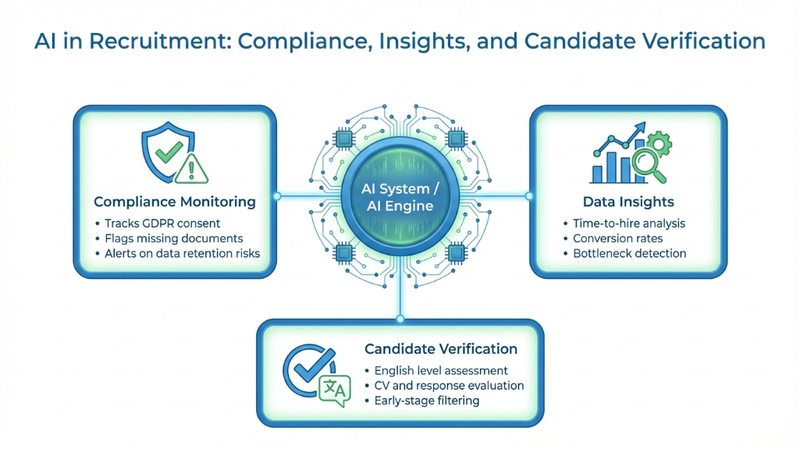
AI can function as an alerting layer for compliance in the recruitment process. By monitoring key parameters, such as candidate communication timelines, documentation completeness, data retention rules, and GDPR consent records, an AI-assisted system can flag deviations before they become violations. This is not a replacement for a compliance officer or legal counsel, but it adds a semi-automatic supervision layer that catches routine errors at scale, such as a candidate file missing consent documentation or a data retention period about to expire without review. For teams running multiple concurrent processes across jurisdictions, that alerting capability reduces the manual compliance burden significantly.
AI tools can surface patterns in recruitment data that inform hiring strategy. Analysis of time-to-hire by role, source, and geography; offer acceptance rates by candidate profile; and conversion rates at each stage of the process are all outputs that standard ATS reporting provides in raw form. Claude and similar LLMs can synthesize that data into structured analysis when fed the relevant export, identifying bottlenecks, stage drop-off patterns, and sourcing channels that consistently produce hires versus those that produce volume without conversion. For teams with access to performance data on placed candidates, the same approach applies to understanding what early-stage indicators predict long-term fit.
As the recruitment task section noted, Claude evaluates written English drawn from CV text and from covering letters, with test responses serving as a further source. The same read extends past English alone, since the model assesses written competency in any language a role demands and weighs the broader quality of a candidate’s written responses. For positions that turn on client-facing communication, this check works as an early-stage filter before a call is scheduled, pointing interview time toward candidates who clear the standard the role sets.
Beyond the tools used daily by the DevsData LLC team, the broader HR AI market has matured into distinct categories. The following represent the leading platforms by function in 2026.
In talent acquisition:
In workforce planning and internal mobility: Fuel50 uses AI to match employees with internal roles, mentorships, and learning paths. Beamery provides a talent CRM with skills-based matching for proactive pipeline building. Phenom connects candidate-facing career sites, onboarding, and internal mobility into a single platform.
For employee experience: Leena AI operates as an always-on HR chatbot handling policy questions, onboarding workflows, and IT tickets through natural language, integrating directly with HRIS systems.
For general HR content production, including job descriptions, email drafts, and company documents, the most widely used tools are Claude, ChatGPT, Microsoft Copilot, and Perplexity. Claude is recommended for complex multi-document tasks. For straightforward text generation, any of these tools perform adequately.
OpenClaw is a free and open source autonomous AI agent that executes tasks through large language models, with messaging platforms serving as its main interface. Users deploy persistent agents that communicate over Signal, Telegram, Discord, or WhatsApp, and configuration data, along with interaction history, is stored locally. By March 2026, some recruitment teams had run persistent sourcing agents out of messaging apps on it, the codebase having matured enough for HR ops to handle routine outreach and follow-up without heavy engineering support. For an HR setting that is regulated and GDPR-bound, and often corporate on top of that, an open source autonomous agent makes a poor default, and a governed option carries less exposure.
Anthropic’s answer is Dispatch inside Claude Cowork, a feature that lets you assign tasks to Claude from your phone and have the AI run them on your desktop while you are away. Claude Dispatch launched in March 2026 as a research preview, rolling out first to Max plan subscribers before reaching Pro plan access. For HR teams exploring agentic AI, Dispatch is the more governed and lower-risk entry point.
OpenClaw carries documented security risks: Cisco’s AI security research team tested a third-party OpenClaw skill and found it performed data exfiltration and prompt injection without user awareness.
Running candidate personal data through an LLM is a processing activity in its own right, and the legal obligations attached to it have grown more specific since 2024. What follows breaks the area down across the EU AI Act, the GDPR rules on personal data, the widening set of US state laws, and the practical work of holding hallucination risk down. Each carries duties that fall on the recruitment team rather than the model provider, and treating them as background instead of active requirements is where most exposure starts. DevsData LLC frames this work inside its wider approach to AI adoption.
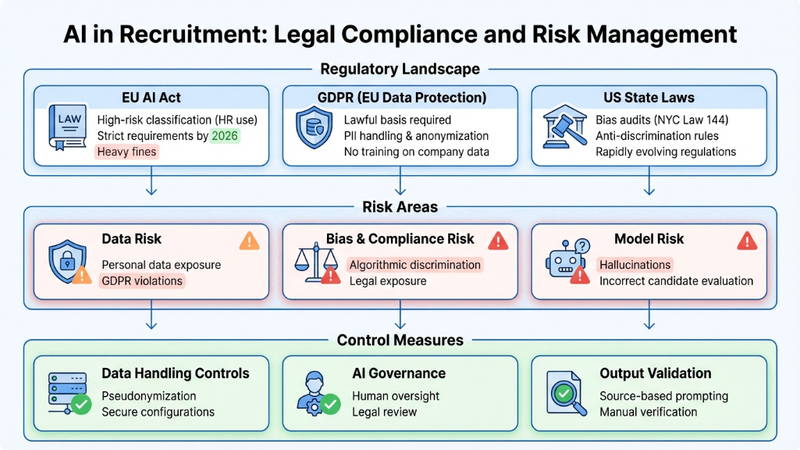
The EU AI Act’s risk-based structure classifies AI into four tiers. High-risk AI under Annex III covers employment and HR, and for organizations using AI in hiring decisions, high-risk classification is likely. High-risk AI providers and deployers must meet specific requirements before the August 2, 2026, deadline: a risk management system covering the full AI lifecycle, data governance measures to ensure training data is representative and bias-mitigated, technical documentation, human oversight mechanisms, accuracy and cybersecurity standards, logging and traceability systems, and pre-market conformity assessment. Fines reach €35 million or 7% of global annual turnover for the most serious violations.
The Act’s extraterritorial reach means US employers can be covered even without a physical EU presence if AI outputs are intended to be used in the EU, for example, recruiting EU candidates, evaluating EU-based workers or contractors, or deploying global HR tools used by EU teams.
For teams using Claude for CV analysis or scoring, Claude functions as a general-purpose AI tool rather than a dedicated automated employment decision system. If Claude outputs influence which candidates are interviewed or hired, the compliance picture becomes less clear, and legal review specific to the organization’s use case is advisable.
GDPR has been applied since 2018 and requires a lawful basis for every processing activity involving personal data. Candidate CVs, call transcripts, and contact details are personal data. Before feeding this information into any LLM, the Recruiter should strip or pseudonymize identifying details where the analysis task does not require them. Most scoring and draft generation tasks can be completed without including the candidate’s full name and contact information in the prompt.
A critical operational rule: no LLM should be used in a configuration that allows the model provider to train on company data. Claude Pro and the Claude API both include settings that prevent this. Teams should verify their configuration and not rely on default assumptions.
In 2025, US states introduced 1208 AI-related bills and enacted 145 of them. New York City’s Local Law 144 requires annual bias audits for automated employment decision tools used in hiring or promotion. Colorado’s AI Act, effective June 30, 2026, imposes reasonable care obligations on deployers of high-risk systems to prevent algorithmic discrimination. The compliance picture varies by state and is evolving quickly enough that a dedicated review is advisable before deploying AI scoring or ranking tools at scale.
For candidate write-ups and recommendation messages, hallucination is the most practically damaging failure mode. Providing Claude with source materials directly, the CV, transcript, JD, and kickoff notes, and instructing it to draw only from those sources reduces the risk significantly. Prompts that ask Claude to flag where it cannot find evidence for a claim, rather than inferring, produce more reliable outputs. A Recruiter reviewing the final output against the source materials before it reaches a client is the last and non-negotiable check.
Company size: ~60 employees
Founding year: 2016
Website: www.devsdata.com
Headquarters: Brooklyn, NY, and Warsaw, Poland
DevsData LLC is a technology recruitment and software development agency with offices in Brooklyn, Warsaw, and additional locations. The recruitment team operates across global processes spanning Europe, Asia, and Latin America, handling both niche senior searches and high-volume junior roles.
The team treats staying current with AI tooling as a deliberate professional practice. Claude Pro (Opus 4.6) is the primary tool for candidate write-ups, CV review, JD drafting, home assignment checking, and bulk CV scoring. AI notetakers capture call transcripts that feed directly into Claude-assisted recommendation bullets. Ashby handles applicant tracking with its native AI features active. Wispr Flow supports written output speed for Recruiters who prefer voice-first working. Superhuman handles email with AI-assisted drafting and triage.
The team applies each tool with human oversight at every step. AI outputs go through Recruiter review before reaching candidates or clients. Sourcing strings are written by the Recruiter first, with Claude adding variations. JDs drafted by AI are always revised before use. That approach reflects both the current limitations of LLMs and the professional standard the team holds for candidate and client experience.
Do you have IT recruitment needs?
The HR AI market in 2026 is no longer defined by whether tools work. It is defined by whether teams use them well. The gap between a Recruiter who applies Claude, a notetaker, and an AI-enabled ATS with discipline and human oversight, and one who does not, is now measurable in hours per week and in submission quality.
The tools covered here are not exhaustive. The market is moving at a pace that means new options appear faster than any overview can track. What holds constant is the principle behind all of them: AI accelerates the parts of the process that do not require judgment, freeing the Recruiter to apply judgment where it matters most, in understanding a candidate, reading a client, and making the connection between the two that closes a process.
DevsData LLC’s recruitment team will continue updating its tool stack as the market develops and will keep this overview current as new options reach the standard required for professional use. For more information, you can reach out to general@devsdata.com or visit their website www.devsdata.com.
Discover how IT recruitment and staffing can address your talent needs. Explore trending regions like Poland, Portugal, Mexico, Brazil and more.
 Frequently asked questions (FAQ)
DevsData – your premium technology partner
DevsData is a boutique tech recruitment and software agency. Develop your software project with veteran engineers or scale up an in-house tech team of developers with relevant industry experience.
Free consultation with a software expert
🎧 Schedule a meeting
FEATURED IN

DevsData LLC is truly exceptional – their backend developers are some of the best I’ve ever worked with.”

Nicholas Johnson
Mentor at YC, serial entrepreneur


 Build your project with our veteran developers.
Explore the benefits of technology recruitment and tailor-made software.
Learn how to source skilled and experienced software developers.
Build your project with our veteran developers.
Explore the benefits of technology recruitment and tailor-made software.
Learn how to source skilled and experienced software developers.

Rebecca Botvin

Commercial Director

Tom Potanski
Manager




Categories: Big data, data analytics | Software and technology | IT recruitment blog | IT in Poland | Content hub (blog)













careers@devsdata.com









general@devsdata.com

"I interviewed about a dozen different firms. DevsData LLC is truly exceptional – their backend developers are some of the best I've ever worked with. I've worked with a lot of very well-qualified developers, locally in San Francisco, and remotely, so that is not a compliment I offer lightly. I appreciate their depth of knowledge and their ability to get things done quickly."

Nicholas Johnson
CEO of Orange Charger LLC,
Ex-Tesla Engineer,
Mentor at YCombinator
"DevsData reached out to us, as we've been looking to grow our engineering team in Europe and Poland. Communicating efficiently and professionally, DevsData made a strong impression with their understanding of the recruitment challenges we were facing. They designed a tailored recruitment process for our needs. I was impressed with the technical depth of their approach."

Karim Butt
Co-Founder & CTO at GlossGenius, Inc.
"Out of all the vendors we work with, DevsData clearly stands out. The quality of developers they deliver is beyond what we've received from any other vendor, and they've been able to send profile recommendations very quickly. I'm happy to be their reference for other companies from Israel and talk about their recruitment abilities and what they delivered for us."

Ran Eyal
Senior Manager at
ZIM Integrated
Shipping Services Ltd.
"DevsData demonstrated a strong degree of proactivity, taking time to thoroughly understand the problem and business perspective, and continuously suggesting performance and usability enhancements. Their app exceeded my expectations. I've worked with DevsData on numerous projects over the last 3 years and I'm very happy. Being both responsive and honest in communication."

Jonas Lee
Partner & Executive VP of Verus,
Financial LLC, Investor,
& Serial Entrepreneur
Acknowledgments