Thanks for subscribing.
Your gift is on the way.



Game studios need developers proficient in C++ and real-time 3D rendering, yet hiring teams rarely have the technical background to evaluate these candidates. Unreal Engine, developed by Epic Games, is a production standard for graphically demanding projects. Unreal Engine organizes its codebase into isolated modules, so a patch to the networking layer does not introduce regressions in the rendering pipeline.
The global video game market was valued at USD 299.0 billion in 2024 and is projected to reach USD 600.7 billion by 2030, growing at a CAGR of 12.2%. This expansion drives demand for Unreal Engine Developers with production experience. Unreal Engine competes with Unity and other game engines for market share.
Unreal accounts for 28% of games released on Steam, reflecting continued adoption in commercial development.
Studios selecting Unreal prioritize rendering quality and physics simulation, but these features demand Developers with specialized skills. Finding qualified candidates remains challenging for teams unfamiliar with technical evaluation. This article examines Unreal Engine in practice before comparing it with Unity. Later sections address recruiting criteria and agency partnerships for organizations building Unreal development teams.
Epic Games created Unreal Engine for video game production and has refined it through continuous iteration over two decades. Two decades of iteration produced a toolset that covers 3D graphics creation alongside full-scale 3D environment construction. Studios building graphically demanding titles depend on this toolset to deliver the visual quality that current audiences expect.
Unreal Engine games account for 31% of Steam revenue, converting the engine’s market presence into measurable commercial returns.
Lumen, the engine’s global illumination system, drives much of the visual appeal through real-time indirect lighting and distance field soft shadows. Nanite’s virtualized geometry pipeline renders film-quality meshes without manual level-of-detail authoring, handling millions of polygons per scene. Physics processing handles fluid dynamics and destruction sequences at frame rates suitable for real-time gameplay, adding another dimension of realism to finished products.
The engine organizes its features into separate subsystems that handle specific functions. VFX tools process particle effects and post-processing through dedicated pipelines. Animation timelines synchronize with audio playback through shared event markers, keeping visual and sound elements aligned. Network protocols manage multiplayer connections through a data layer that operates independently from visual rendering.
For team members without programming backgrounds, Blueprints provides access to these systems through a visual scripting interface. Studios use Blueprints to prototype gameplay mechanics in hours rather than days, compressing the iteration cycle and reducing time-to-market for features that would otherwise wait for C++ implementation.
Adoption extends beyond the entertainment software industry. Architectural firms produce real-time building visualizations for client presentations. Film production teams build virtual sets using In-Camera Visual Effects (ICVFX), in which LED volumes display Unreal Engine environments that respond to camera movement in real time during shooting. VR projects and animated content share the same rendering systems and produce output in the same formats.
The engine’s capabilities become clearest through shipped titles. Each game below demonstrates a different application of Unreal’s architecture, from real-time multiplayer at a global scale to photorealistic character animation. The commercial outcomes attached to these releases explain why studios continue to invest in Unreal-trained development teams.
Epic Games built Fortnite on its own engine, making the title both a commercial product and a live proving ground for Unreal’s capabilities. The game has accumulated over 650 million registered players and more than $40 billion in lifetime revenue since its 2017 launch. Fortnite also operates as a creation platform: the Unreal Editor for Fortnite (UEFN) enabled external creators to earn $352 million in 2024. That scale tests every layer of the engine under real-world conditions, from networking infrastructure that handles millions of concurrent sessions to rendering systems that process constant visual updates across platforms.
Ninja Theory’s sequel arrived in May 2024 as one of the most technically accomplished UE5 releases to date. Performance capture reached a level of fidelity where in-game sequences are difficult to distinguish from live-action footage. Lumen’s global illumination system handled Icelandic-inspired environments built from photogrammetry scans and Quixel Megascans assets without pre-baked lighting, proving that UE5 performs at the highest tier for tightly scoped cinematic experiences, not just in large open worlds.
Bandai Namco released Tekken 8 on January 26, 2024, marking the franchise’s transition to Unreal Engine 5. The studio rebuilt all 32 character models from the ground up, with high-fidelity skin, hair, and muscle deformation rendered during combat sequences running at 60 frames per second. Stage environments react dynamically to fights, with surfaces cracking under impact and weather shifting over the course of rounds.
Hazelight Studios shipped Split Fiction in March 2025 as a cooperative adventure built on UE5 by a team of 80 people. The game sold over one million copies in its first 48 hours and surpassed four million units by early May. Two players control separate characters whose storylines merge and diverge, requiring the engine to render distinct visual themes while synchronizing gameplay across both screens.
Bloober Team rebuilt Konami’s 2001 psychological horror title from the ground up using UE5. The remake launched in October 2024 with an over-the-shoulder perspective and completely new visuals while preserving the original’s fog-heavy atmosphere. Nanite’s geometry system allowed the studio to construct detailed interiors at a density that earlier engine versions would have struggled to render, showing how a smaller studio can produce visually competitive output by leveraging UE5 rather than building custom technology.
Do you have IT recruitment needs?
These five titles span battle royale, narrative action, competitive fighting, cooperative adventure, and survival horror. That range illustrates why demand for Unreal Engine Developers extends across studio types and project categories rather than concentrating in a single genre.
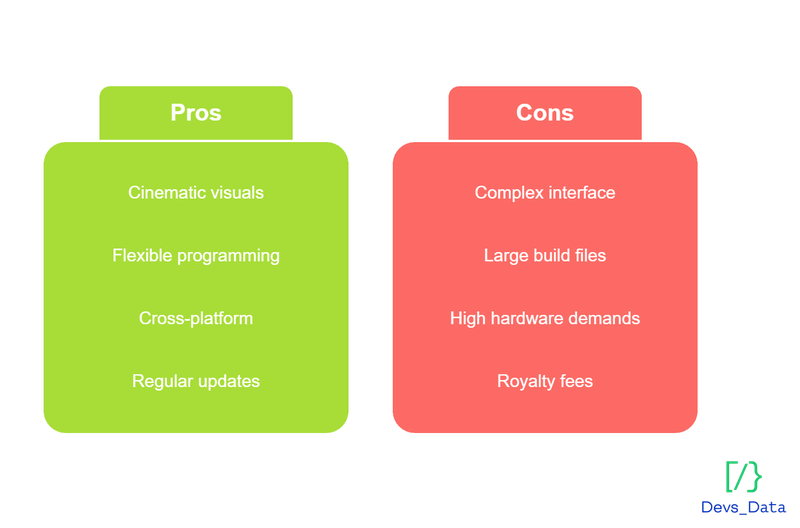
Visual realism sets Unreal Engine apart from competing platforms. Advanced shading methods produce materials that respond to environmental conditions with accuracy matching physical surfaces. Post-processing pipelines add depth of field and motion blur that match cinematic production standards.
Weather systems dynamically shift lighting conditions, affecting shadows and reflections across entire scenes. These rendering features give finished projects a level of polish that audiences associate with high-budget releases.
Flexibility in the development approach accommodates different team compositions. C++ programmers write custom systems when projects require functionality beyond standard toolsets. Blueprint-heavy projects that scale without C++ oversight risk accumulating tangled node graphs, a condition studios refer to as “Blueprint spaghetti,” where debugging and iteration slow to a pace that offsets the scripting speed Blueprints originally provided.
Teams without dedicated programmers still progress through Blueprints, the visual scripting system covered earlier. This dual approach means studios staff projects according to budget and timeline rather than engine limitations. Cross-platform deployment adds another dimension of flexibility, with export options spanning iOS, Android, Windows, PlayStation, and Xbox from a single project file.
Epic Games maintains the engine through regular update cycles. New releases introduce AI behavior systems that reduce manual animation work for character movement. VR compatibility continues to improve as headset technology advances. The update schedule keeps projects aligned with current hardware capabilities without requiring engine migration.
The learning curve presents a significant barrier for teams new to Unreal Engine. Subsystems such as the C++ Gameplay Framework and the Material Editor each carry their own terminology and workflow logic, requiring weeks of orientation before Developers work productively. Documentation covers a lot of ground, but applying that knowledge to specific project needs requires additional study. Studios hiring Developers without prior Unreal experience should account for this ramp-up period in project timelines.
Resource demands affect both development and distribution. Build processes generate large file packages that extend download times for end users. Runtime performance requires hardware configurations above entry-level specifications, limiting audience reach for some releases. Development workstations need substantial processing power and memory to run the editor at acceptable speeds.
Licensing terms introduce costs at a commercial scale. Non-commercial projects can access the full engine at no cost. Commercial releases trigger royalty obligations once revenue crosses a defined threshold. Studios that project significant revenues factor these calculations into financial planning from the project’s outset.
The official Unreal Engine Marketplace functions as a distribution hub where Developers purchase assets for their projects or sell creations to other studios. This exchange accelerates production timelines by providing ready-made components that teams integrate into active builds.
Measured by the percentage of titles released on major storefronts, Unreal Engine continues to gain market share year over year, while Unity has seen a slight decline since 2021.
The marketplace contributes to this adoption trend by reducing the resources required to complete projects. Asset categories span visual and functional elements. Full game environments provide level geometry with textures and lighting already configured. Character models arrive rigged for animation, cutting weeks from production schedules. Sound libraries cover ambient audio and effect triggers. Prebuilt C++ code handles common gameplay functions that would otherwise require dedicated programming time.
Epic Games populates the marketplace with additional resources beyond third-party contributions. Demo projects show implementation patterns for specific features. Tutorials walk through engine functionality with practical examples. Completed game templates give new teams a functional starting point rather than an empty project file. These resources target Developers at different experience levels, from those learning the platform to studios seeking reference implementations.
Purchased assets carry licensing terms that support commercial use. Buyers receive lifetime access and permission to modify files to meet their specific needs. Projects using marketplace content ship without per-title restrictions, allowing studios to deploy assets across multiple releases.
Educational institutions can access the engine at no cost. Schools and universities use the full toolset for curriculum development, removing budget constraints for programs that teach game development fundamentals.
Studios scaling their game production reach a point where in-house teams no longer cover all technical requirements. Custom rendering pipelines and complex physics implementations require developers who understand the Unreal Engine architecture in greater depth. Finding professionals with this combination of engine knowledge and production experience has grown more challenging.
Most candidates specialize in specific areas of development. Some focus on gameplay programming, while others concentrate on shader development or optimization. Hiring companies often need cross-functional expertise or the ability to architect systems that span multiple project phases. This mismatch between specialized candidates and broad role requirements complicates the screening process.
Project scope shapes whether contract or permanent hiring makes sense. Implementation projects with defined deliverables work well for fixed-term engagements. Ongoing engine optimization and feature expansion require developers to build knowledge of the codebase and project architecture over time.
Hiring managers sometimes assume Unreal Engine Developers possess uniform capabilities. Actual competencies vary widely between candidates. Some excel at building gameplay systems, while others bring experience implementing rendering optimizations. The engine covers extensive functionality, and practical project requirements often require a screening filter to identify relevant specializations.
Skills every candidate must demonstrate. For studios building RPG or action titles, familiarity with the Gameplay Ability System (GAS) belongs on the required list, as it governs how character abilities, buffs, and status effects interact within Unreal’s framework
| Required skills | Preferred skills |
|---|---|
| Proficiency with C++ programming, including memory management through pointers, smart pointers, and the Unreal Engine’s garbage collection system. | Experience shipping commercial titles built on Unreal Engine. |
| Understanding of Unreal Engine core systems, including Blueprints visual scripting. | Background in multiplayer networking and server replication systems. |
| Experience with game physics implementation and collision detection. | Knowledge of shader programming and custom rendering pipelines. |
| Working knowledge of 3D mathematics and spatial calculations. | Familiarity with version control workflows in large team environments. |
| Ability to debug performance issues and implement runtime optimization. | Experience with VR development or architectural visualization projects. |
| Ability to diagnose rendering bottlenecks and memory allocation issues within Unreal Engine projects. | Understanding of animation state machines and AI behavior trees. |
Organizations that have hired Backend Engineers or Frontend Developers often assume the same process transfers to Unreal Engine roles. The overlap is high-level, but game development introduces variables that standard IT pipelines overlook. Candidate evaluation in enterprise IT centers on system design interviews and algorithmic exercises. Unreal Engine hiring requires an assessment tied to the engine’s architecture: replication configuration, Nanite instance management, Lumen scene budgeting, and Gameplay Framework navigation. Evaluators without engine-specific knowledge cannot separate a Developer who has optimized a shipping title from one who has completed tutorial projects.
Role boundaries and timeline pressure compound the challenge further. An Unreal Engine Developer on a mid-sized team may handle gameplay programming, debug a shader issue, and review a Technical Artist’s material graph in a single day. Screening for that cross-functional adaptability requires interview formats that IT hiring templates do not cover.
Compensation structures also differ from published IT salary bands, with project completion bonuses and royalty participation shaping how candidates evaluate offers. Ship dates anchored to marketing campaigns and platform certification windows create urgency that enterprise software timelines rarely match.
The table below summarizes the key differences hiring managers encounter when moving from IT recruitment to game development staffing.
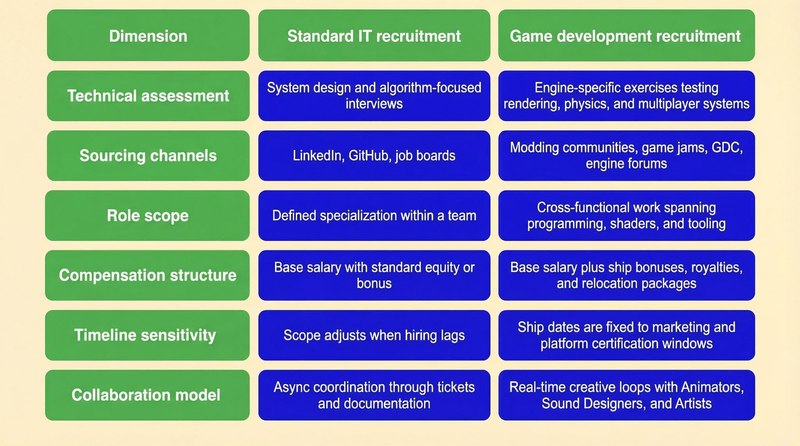
These differences explain why organizations entering game development benefit from recruitment partners with direct experience placing Unreal Engine professionals. Standard IT recruiters lack the sourcing networks and evaluation frameworks this market demands. The next section outlines how to evaluate agencies that specialize in game development staffing.
Staffing partner selection determines whether searches yield qualified candidates or drain budget without results. The agency handles candidate outreach and controls how the employer’s brand is perceived by Developers evaluating new opportunities. Communication timing is also within the agency’s control and affects how quickly top candidates move through the process. Evaluating agencies before signing contracts reduces the risk of misaligned partnerships.
Agencies that offer a defined service-level agreement covering response times and candidate quality metrics, along with a tech trial period in which the output of the placed Developer is evaluated before full commitment, reduce the risk of misaligned hires.
Selecting the right agency requires evaluation across several dimensions, from technical expertise to operational processes.
Position specifications must separate required technical skills from qualifications that develop after hire. Roles requiring C++ proficiency and Unreal Engine production experience are non-negotiable, while familiarity with specific project management tools may develop on the job. Budget limits prevent agencies from presenting candidates whose salary expectations exceed approved ranges. Timeline targets such as 30-day start dates guide agency prioritization across multiple searches.
Agencies develop expertise through repeated placements within specific technical domains. Game development specialists understand the Unreal Engine architecture requirements that generalist recruiters often overlook. Request placement examples from the past 12 months demonstrating experience with game programming roles. Agencies without documented experience in real-time rendering or interactive media lack the networks required for these specialized searches.
Contracts get signed with account managers, but sourcers conduct the actual candidate work. Conversations with practitioners reveal whether they understand technical requirements beyond keyword matching. Ask how they evaluate C++ code samples or assess Blueprint scripting proficiency, and whether their process includes a practical exercise such as a live debugging session in Visual Studio on an Unreal project. Response time expectations should align with markets where qualified Developers receive competing offers within days.
Time-to-hire figures show how quickly agencies fill positions. Interview-to-offer ratios indicate screening quality; lower numbers suggest agencies present qualified candidates rather than flooding clients with unsuitable applicants. 90-day retention rates indicate whether placements remain employed beyond probation. Offer acceptance percentages demonstrate whether agencies accurately gauge candidate interest before extending offers.
Written rate cards specifying hourly bill rates prevent surprises when invoices arrive. Temp-to-hire conversion fees should specify whether employers pay a flat amount or a percentage of salary. Direct-hire placements for Unreal Engine Developers typically cost 15% to 25% of first-year compensation. Agencies charging below-market rates often compromise on screening depth to maintain margins.
Digital platforms for managing candidate profiles and processing invoices improve administrative efficiency. Access rights should allow hiring managers to review candidate information without involving intermediaries. Agencies that rely on outdated manual processes create administrative burdens that consume HR staff time. Integration with applicant tracking systems reduces duplicate data entry when multiple positions remain open.
Agency relationships improve as recruiters learn which Unreal Engine subsystems the studio relies on most and how the team divides work between C++ programming and Blueprint scripting. That accumulated knowledge sharpens candidate matching with each successive search. Guarantee periods should specify the agency’s responsibility for addressing placement issues, including replacement timelines if hires depart before completing probation.
Unreal Engine Developers work across freelance marketplaces and game development communities. Each channel attracts different candidate profiles, from junior programmers building portfolios to senior engineers with shipped titles. This distributed talent pool means organizations often search multiple sources before identifying suitable matches. The list below covers IT recruitment agencies that connect companies with qualified Unreal Engine professionals.
Here’s our top five picks:

Team size: ~60 employees
Founded: 2016
Headquarters: Brooklyn, NY, and Warsaw, Poland
DevsData LLC recruits Unreal Engine Developers for organizations that need interactive applications and game projects built by professionals who understand both engine architecture and underlying production requirements. The firm also delivers software projects that require Unreal Engine development, enabling clients to address hiring and implementation needs through a single partner.
More than 60 professionals operate across these recruitment and technical consulting divisions, a team size shaped by ten years of continuous operations in the technical staffing market. Sourcing speed depends on database depth, and DevsData LLC maintains a database of 95000 verified candidates ready for specialized placements. Clients throughout the US, Israel, and Europe return for additional hires because placement outcomes remain consistent across engagements, a pattern reflected in verified 5/5 ratings on Clutch and GoodFirms.
Recruitment projects run from initial sourcing through onboarding coordination under a unified management structure. Candidate identification leads to technical evaluation, which in turn informs structured interviews designed to assess both skill proficiency and team compatibility. HR advisory and legal guidance accompany these stages, ensuring compliance with requirements throughout each hiring cycle. Game studios and enterprise visualization teams alike use these systems because the process scales without losing screening rigor.
DevsData LLC refined its hiring model over years of technical recruitment, developing assessment methods that separate qualified candidates from those who interview well but underperform on projects. Unreal Engine Developers complete practical exercises to test their command of C++ programming and Blueprint scripting before advancing to subsequent rounds.
Recruiters simultaneously evaluate collaboration style and communication clarity, since integration with existing teams matters as much as technical ability when new hires join active projects. In-house staff conduct English-language interviews that include reference verification, then manage offer negotiations once candidates clear all evaluation stages. Payment follows a success-fee structure, under which clients owe nothing until placement occurs.
The client roster spans established enterprises and high-growth startups, including BCG and venture-backed companies operating across multiple sectors. Academic partnerships and connections with game developer communities extend sourcing reach beyond conventional channels, which is valuable for roles in optimization and gameplay programming, where passive candidates often outperform active job seekers. Dedicated recruiters assigned to each search replace public job boards, adding precision that broad postings cannot achieve.
Technical consulting rounds out the service offering for clients who need more than recruitment support. Teams assist with engine optimization and performance tuning to keep game applications responsive as complexity increases.
Scalability planning and architecture audits help organizations prepare their Unreal Engine projects for expansion rather than discovering technical limitations after release. This combination of hiring expertise and software consulting means clients access skilled Developers and dependable project delivery through a unified service model.
Do you have IT recruitment needs?
Recent engagements on the case studies page demonstrate how DevsData LLC approaches technical recruitment in both studio and enterprise contexts.
Papaya Gaming needed Engineers in Poland with real-time application experience for its competitive gaming platform. DevsData LLC sourced candidates through gaming-specific channels and technical communities, filling roles that required low-latency optimization, including UDP-over-TCP networking decisions critical to real-time competitive synchronization skills directly relevant to interactive entertainment products.
UI.com required a Senior Cloud Engineer for its Krakow R&D office with expertise in AWS and distributed systems. DevsData LLC filled the role through targeted headhunting across Eastern European markets, delivering a candidate who now leads backend infrastructure initiatives serving millions of users worldwide.
Sea partnered with DevsData LLC to build a cross-functional engineering team in Poland. The project included Senior Programmers responsible for maintaining production systems and contributing to codebase modernization. DevsData LLC filled 11 roles in under four months, with over 85% retention among placed candidates.
Businesses seeking Unreal Engine Developers who match specific technical requirements can reach DevsData LLC at general@devsdata.com or visit www.devsdata.com to connect with a Recruiter experienced in game development roles.

Website: https://www.dotsquares.com
Team size: ~1000 employees
Founded: 2002
Headquarters: Brighton, United Kingdom
Dotsquares provides Unreal Engine development services alongside staff augmentation for game studios and enterprises building interactive applications. The company operates development centers in India with client-facing offices across the UK, US, and Australia. Developers on the team work with C++ and Blueprints visual scripting to build games for mobile platforms, consoles, and PC.
The company offers flexible hiring arrangements through bucket hours or dedicated Developer assignments. Bucket hours allow clients to purchase development time in blocks valid for six months, while dedicated hiring reserves specific Developers for ongoing project work. Dotsquares also handles applications beyond gaming, including architectural visualization and AR/VR experiences built on Unreal Engine.
Website: https://www.vaival.com
Team size: ~200 employees
Founded: 2010
Headquarters: Lahore, Pakistan
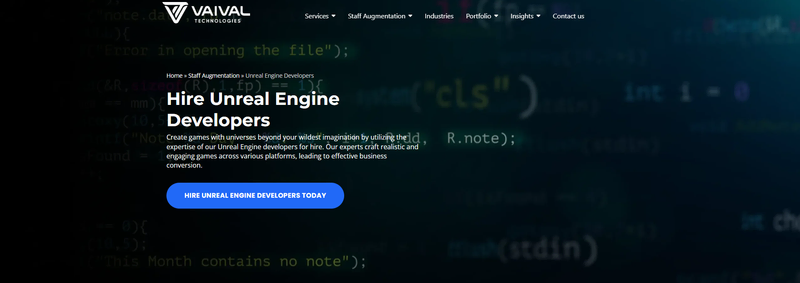
Vaival Technologies operates as a staff augmentation provider connecting clients with Unreal Engine Developers for game projects and interactive applications. The company has operated for over 16 years, serving startups and enterprise clients across multiple industries. Developers on the platform handle full-cycle game development from concept creation through deployment and post-launch support.
The hiring process follows a three-step structure. Clients shortlist candidates from a vetted pool, conduct interviews to assess technical alignment, and onboard selected Developers directly into project teams. Vaival offers engagement models ranging from dedicated teams for long-term work to project-based arrangements for defined deliverables. Cross-platform expertise covers PC, console, and mobile development with optimization for each target environment.

Website: https://www.devheaven.io
Team size: ~50 employees
Founded: 2024
Headquarters: Kiev, Ukraine
DevHeaven connects companies with vetted Ukrainian Developers through a subscription-based staffing model. The service matches clients with professionals in their preferred time zones, addressing coordination challenges common in distributed teams. Candidates undergo evaluation of technical expertise and communication skills before joining the network.
New engagements include a seven-day trial period with no charges if the match does not meet expectations. Pricing is transparent, with monthly rates and no recruitment fees, and a three-month cancellation option provides flexibility for evolving project needs. The company handles confidentiality through standard NDA and MSA agreements, with first candidates typically available within two business days of engagement.
Website: https://www.redappletech.com
Team size: ~150 employees
Founded: 2011
Headquarters: New Delhi, India (US office in Texas
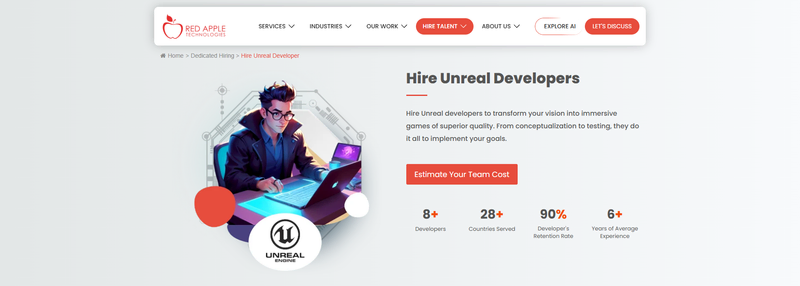
Red Apple Technologies delivers Unreal Engine development and staffing services from its headquarters in New Delhi with a development center in Kolkata. The company has established an additional presence in Texas to serve North American clients. Over a decade of operations has produced 500+ completed projects spanning game development, mobile applications, and enterprise software.
Unreal Engine capabilities include full-cycle development from prototype validation through post-launch maintenance. Developers on the team create in-game assets, design balanced game levels using UE5’s Procedural Content Generation (PCG) framework where applicable, and integrate AR/VR/XR functionality using the engine’s current features. The company works with additional technologies, including Unity and HTML5, providing flexibility for projects that require multiple technical approaches. Cross-platform deployment supports iOS, Android, Windows, and Xbox.
Hiring budgets for Unreal Engine roles require accurate compensation data before recruitment begins. Studios competing for this talent often find themselves bidding against other game companies, architectural visualization firms, and film production teams that have adopted the engine for real-time rendering work.
Experience level drives the largest variation in compensation. Entry-level Developers command different rates than mid-career professionals who have optimized rendering pipelines or built multiplayer systems from scratch. Geographic location adds another variable: salaries in major tech hubs exceed those in regions with a lower cost of living. Remote work arrangements have compressed some of these differences, though location-based pay adjustments remain common across the industry.
The table below provides an overview of typical earnings in the US market. For current salary data, sources such as Glassdoor remain useful.
| Experience | Salary Range (USD) |
|---|---|
| 0-1 years | $68000-$120000 yearly |
| 1-3 years | $75000-$133000 yearly |
| 4-6 years | $82000-$144000 yearly |
These figures reflect base compensation and additional pay components reported across the US market. Actual salaries vary based on factors such as studio size, project scope, and regional cost of living. Developers with shipped titles or specialized rendering-optimization skills often command rates at the higher end of their respective ranges.
Organizations budgeting for Unreal Engine roles should account for market competition when setting compensation targets. Staffing agencies with game development expertise provide current rate benchmarks specific to role requirements and candidate experience levels.
Do you have IT recruitment needs?
Studios building graphically demanding projects face a persistent challenge when scaling their development teams. Unreal Engine requires Developers who combine C++ proficiency with production experience, making technical screening a step that most hiring managers lack the background to conduct effectively. Agencies filling this role should deliver a structured technical scorecard for each candidate, documenting performance in C++ proficiency, Blueprint architecture, and engine subsystem knowledge, so that hiring teams can evaluate candidates against a consistent benchmark. The engine’s modular architecture and advanced rendering systems demand specialized knowledge that takes years to develop.
Finding qualified candidates through standard job postings rarely yields strong results because the best Unreal Engine Developers are often passive candidates already employed on active projects. Recruitment firms with game development expertise solve this problem by accessing talent networks that internal HR teams never reach.
DevsData LLC brings over ten years of technical recruitment experience to Unreal Engine hiring projects. The firm maintains a database of 95000 verified candidates and holds a government-approved license for recruitment services. Candidate data handling follows GDPR and CCPA requirements, covering the privacy obligations that apply when sourcing across European and US markets.
US specialists on the team coordinate searches for clients worldwide, including organizations across the US and Israel. Corporate enterprises and high-growth startups alike benefit from assessment methods that evaluate both C++ programming ability and Blueprint scripting proficiency before candidates advance to client interviews.
Reach DevsData LLC at general@devsdata.com or visit www.devsdata.com to start a conversation about Unreal Engine recruitment.
Discover how IT recruitment and staffing can address your talent needs. Explore trending regions
like Poland, Portugal, Mexico, Brazil and more.
 Frequently asked questions (FAQ)
DevsData – your premium technology partner
DevsData is a boutique tech recruitment and software agency. Develop your software project with veteran engineers or scale up an in-house tech team of developers with relevant industry experience.
Free consultation with a software expert
🎧 Schedule a meeting
FEATURED IN


DevsData LLC is truly exceptional – their backend developers are some of the best I’ve ever worked with.”

Nicholas Johnson
Mentor at YC, serial entrepreneur


 Build your project with our veteran developers.
Explore the benefits of technology recruitment and tailor-made software.
Learn how to source skilled and experienced software developers.
Build your project with our veteran developers.
Explore the benefits of technology recruitment and tailor-made software.
Learn how to source skilled and experienced software developers.

Rebecca Botvin

Commercial Director

Tom Potanski
Manager




Categories: Big data, data analytics | Software and technology | IT recruitment blog | IT in Poland | Content hub (blog)
















careers@devsdata.com









general@devsdata.com

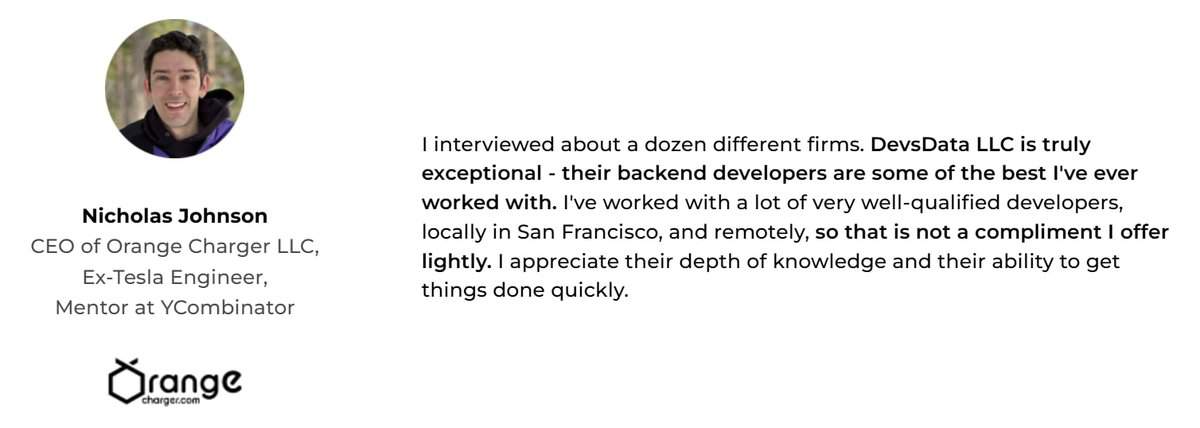
"I interviewed about a dozen different firms. DevsData LLC is truly exceptional – their backend developers are some of the best I've ever worked with. I've worked with a lot of very well-qualified developers, locally in San Francisco, and remotely, so that is not a compliment I offer lightly. I appreciate their depth of knowledge and their ability to get things done quickly."

Nicholas Johnson
CEO of Orange Charger LLC,
Ex-Tesla Engineer,
Mentor at YCombinator
"DevsData reached out to us, as we've been looking to grow our engineering team in Europe and Poland. Communicating efficiently and professionally, DevsData made a strong impression with their understanding of the recruitment challenges we were facing. They designed a tailored recruitment process for our needs. I was impressed with the technical depth of their approach."

Karim Butt
Co-Founder & CTO at GlossGenius, Inc.
"Out of all the vendors we work with, DevsData clearly stands out. The quality of developers they deliver is beyond what we've received from any other vendor, and they've been able to send profile recommendations very quickly. I'm happy to be their reference for other companies from Israel and talk about their recruitment abilities and what they delivered for us."

Ran Eyal
Senior Manager at
ZIM Integrated
Shipping Services Ltd.
"DevsData demonstrated a strong degree of proactivity, taking time to thoroughly understand the problem and business perspective, and continuously suggesting performance and usability enhancements. Their app exceeded my expectations. I've worked with DevsData on numerous projects over the last 3 years and I'm very happy. Being both responsive and honest in communication."

Jonas Lee
Partner & Executive VP of Verus,
Financial LLC, Investor,
& Serial Entrepreneur
Acknowledgments