Thanks for subscribing.
Your gift is on the way.



Businesses now compete for customer attention primarily through digital channels. As competition intensifies, search visibility and content performance have become critical drivers of revenue rather than supporting tactics. Market investment reflects this shift, with global digital marketing spending reaching USD 456.7 billion in 2025 and climbing to USD 1.18 trillion by 2033 at an 11.22% compound annual growth rate, as sales and customer acquisition increasingly depend on search engines, social media, and advertising algorithms.
Hiring specialists capable of managing this complexity has grown more competitive as technical requirements multiply. Qualified professionals interpret analytics across channels while adapting to algorithm changes and compliance frameworks that reshape campaign methods with each regulatory update.
Advertising expenditure in digital media grew 13%, a rate reflecting both opportunity volume and competitive intensity that make talent decisions more consequential for business outcomes.
Sections ahead examine marketing channel categories, explain advantages dedicated specialists provide over generalists, compare recruitment pathways including agency partnerships, present DevsData LLC’s client placement outcomes, and assess trends reshaping the profession.
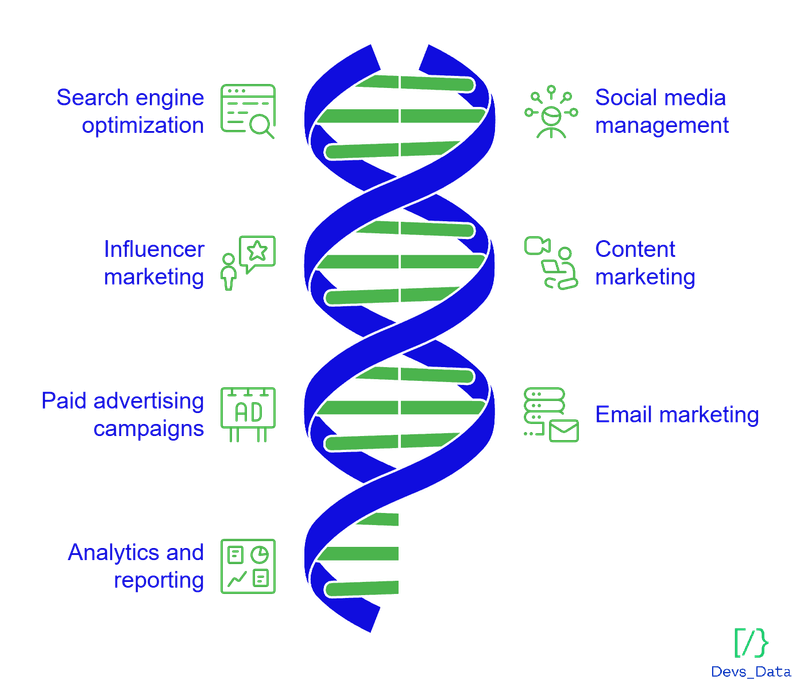
Channel specialization reflects how technical requirements diverge sharply across search optimization, paid advertising, and audience engagement.
Platform algorithms shifted toward visual content, with 21% of marketers reporting short-form video as their highest ROI format in 2025.
Content performance varies by platform. Short-form video leads distribution on channels like TikTok and Instagram, whereas text-led formats remain effective on platforms such as blogs and Medium, making format specialization a strategic, platform-specific decision.
While some professionals develop strength across multiple areas, expertise in one digital marketing discipline does not automatically translate to proficiency in others, complicating hiring decisions. The following categories represent core specializations within the field.
Organic search visibility depends on the technical site structure and the authority signals that search algorithms use to rank pages. SEO specialists conduct keyword research to identify the terms potential customers actually use when searching for products, then optimize page elements, including titles, meta descriptions, and internal linking patterns.
Technical audits address site speed and mobile responsiveness, as well as crawlability issues that prevent proper indexing. Visibility inside AI search surfaces now matters for the same reasons, as large language models pull content into answer panels rather than sending users to the source page.
Practitioners work primarily in Ahrefs, SEMrush, Google Search Console, and Screaming Frog for technical audits.
Platform algorithms determine which posts reach audiences, making expertise in the systems of Facebook, LinkedIn, Instagram, YouTube, and TikTok necessary for consistent visibility. Social media managers develop content calendars, craft posts optimized for each platform’s format, and analyze performance metrics to identify content types that drive follower growth.
Paid promotion often supplements organic reach, as platforms like Facebook and Instagram limit unpaid distribution, while LinkedIn and TikTok increasingly prioritize promoted or high-engagement content.
Scheduling and analytics run through tools such as Hootsuite and native platform dashboards like Meta Business Suite.
Content creators with established audiences offer brands access to engaged follower bases that traditional advertising struggles to reach. Influencer specialists identify creators whose audience demographics align with target customer profiles, negotiate partnership terms including deliverables and compensation structures, and coordinate campaign execution across social media platforms. Authentic endorsements from trusted voices generate higher engagement rates than branded content, particularly among audiences skeptical of direct advertising messages.
Campaign coordination relies on platforms such as CreatorIQ, Grin, and Aspire for creator discovery, outreach tracking, and performance measurement.
Written guides, video tutorials, infographics, and podcast episodes serve different stages of the customer journey. Content marketers research audience questions, produce assets that address those information needs, and distribute material through owned channels, including blogs and email lists. Quality content establishes brand authority within specific industries, attracting visitors who later convert into customers through trust built during the education process.
Production and distribution workflows center on CMS platforms like WordPress, editorial tools such as Notion or Asana, and distribution analytics in Google Analytics.
Google Ads, YouTube Ads, Facebook Ads, and LinkedIn campaign management require budget allocation decisions and ongoing performance testing. Specialists design ad creative variants, set bidding strategies that balance cost per acquisition with conversion volume, and pause underperforming campaigns while scaling successful ones. Attribution tracking links ad spend to revenue outcomes, enabling precise ROI calculations that justify continued investment.
Day-to-day management occurs in Google Ads, Meta Ads Manager, and LinkedIn Campaign Manager, with attribution tracked via Google Analytics or dedicated platforms like Supermetrics.
Direct inbox access enables personalized communication that social algorithms cannot interrupt. Email specialists segment subscriber lists based on behavior patterns, design automated drip sequences that nurture leads through decision stages, and test subject lines plus send times to improve open rates. Welcome series, cart abandonment reminders, and loyalty program updates represent common campaign types that drive repeat purchases.
Execution relies on platforms such as Klaviyo, Mailchimp, and HubSpot for automation, list segmentation, and A/B testing.
Performance data from multiple sources requires consolidation into dashboards that reveal patterns guiding strategy adjustments. Analytics professionals configure tracking implementations, interpret user behavior flows through conversion funnels, identify drop-off points causing revenue loss, and translate metric changes into actionable recommendations. Regular reporting cycles keep stakeholders informed about campaign performance and establish benchmarks for future optimization.
Standard tooling includes Google Analytics 4, Looker Studio, and Tableau for cross-channel dashboard consolidation.
Most businesses produce the strongest results by combining several of these disciplines rather than investing in one alone. A B2B SaaS company typically pairs SEO with content marketing and email nurture sequences: organic search drives trial signups, blog content builds category authority, and automated email flows convert trials into paying accounts.
An eCommerce brand leans on paid advertising alongside social media management and email marketing: paid campaigns acquire first-time buyers, social content keeps the brand visible between purchases, and abandoned-cart email sequences recover lost revenue.
A B2C brand launching a new product benefits from influencer marketing combined with paid social and analytics: influencer placements generate initial awareness, paid amplification extends reach beyond the creator’s audience, and attribution tracking connects spend to sales.
A professional services firm, such as a legal or consulting practice, relies on search marketing paired with thought-leadership publishing. Organic rankings capture buyers researching specific problems, and long-form articles build the credibility needed during extended decision cycles. The right combination depends on the sales cycle length, average deal size, and where target customers spend their attention.
Do you have recruitment needs?
Channel knowledge lays the foundation; the real value emerges when specialists apply those disciplines to deliver measurable business outcomes. Companies selling to other businesses (B2B) face different customer journeys than those selling directly to consumers (B2C), yet both benefit from digital methods that traditional advertising cannot match.
Content marketers show optimism about their field’s trajectory according to the State of Content Marketing Report, reflecting measurable advantages that justify continued investment regardless of business model.
Digital channels drive measurable topline growth by generating qualified leads and closing sales at a lower cost than offline media. The table below explains why organizations allocate larger budget shares to these channels.
| Benefit | Explanation |
|---|---|
| Global revenue reach | One campaign captures qualified leads across continents without the need for separate regional placements. |
| Lower cost per acquisition | Spend ties to tracked conversions, so acquisition cost drops as campaigns mature. |
| Pipeline attribution clarity | Platforms trace buyer behavior from the first click through to booked revenue. |
| High-intent lead capture | Budget flows toward the segments that data show are actually buying. |
| Continuous buyer nurture | Automated sequences move warm leads toward sales without manual outreach. |
| Faster sales conversion | Buyers go from the social feed to a completed order within a single session. |
| Direct link to revenue targets | Reporting ties marketing spend straight to closed-sales benchmarks. |
Recognizing digital marketing’s advantages does not automatically translate into successful implementation. The benefits described earlier require specialists who dedicate full attention to platform algorithm changes, compliance updates, and continuously shifting technical requirements. Generalists who manage marketing alongside other responsibilities may struggle to maintain the depth needed to optimize campaigns across SEO, paid advertising, content distribution, and analytics.
Dedicated professionals build expertise through daily exposure to platform-specific challenges. SEO specialists track algorithm updates that affect search rankings and adjust technical site elements accordingly. PPC managers test audience targeting parameters while monitoring cost-per-acquisition metrics.
Social media managers understand how each platform’s algorithm prioritizes content and adjust posting schedules to maintain visibility. Customer behavior analysis separates effective campaigns from wasted budget allocation, with specialists interpreting analytics to identify which traffic sources convert visitors and which advertisement creative variants drive clicks.
The following factors explain why organizations prioritize dedicated marketing hires over generalist arrangements.
A working digital marketing operation now spans ad managers, analytics suites, CRM platforms, SEO software, email tools, tag managers, and attribution systems that a non-marketer has little chance of learning on the side.
Dedicated hires live inside these stacks every day and know which combinations actually move results for a given business. Generalists covering marketing alongside other duties tend to default to the two or three tools they already know, leaving most available budget levers untouched.
Marketing messages that resonate in B2B software sales differ fundamentally from those that convert eCommerce fashion buyers. Dedicated specialists research competitor positioning, audience pain points, and decision-making patterns unique to each sector. Campaign relevance improves when strategists understand industry-specific buying cycles.
Effective spending requires ongoing experimentation across ad creative, targeting parameters, and landing page designs. Specialists allocate portions of the budget to testing new approaches while maintaining baseline performance with proven tactics. This iterative process maximizes returns only when someone monitors results daily.
Platform-native reporting tools provide surface-level metrics but miss the complexities of attribution across multiple touchpoints. Dedicated analysts configure tracking across channels, build custom dashboards revealing actual customer journey paths, and calculate metrics including customer lifetime value. The technical setup requires expertise beyond basic familiarity with analytics.
Platform capabilities now exceed what marketing teams could manage manually, even five years ago. Consumer expectations for personalized experiences rise in parallel with these technical advances, creating strategic tensions that shape how organizations allocate resources between automation investments and human oversight.
Privacy regulations simultaneously restrict the data-collection methods that power personalization engines, forcing adaptation in tracking approaches as demand for tailored content continues to climb.
Algorithmic systems process behavioral signals at scales that manual analysis cannot match. eCommerce recommendation engines adjust product displays using browsing patterns and purchase probability scores from similar customer segments. Performance depends on signal quality rather than data volume: clean behavioral indicators yield better targeting than massive, noisy datasets.
Smart speakers alter how users frame queries compared to typed searches. Spoken requests use complete sentences rather than keyword fragments, so content should be structured around conversational phrasing.
As voice search adoption continues to rise, optimizing for spoken queries will be critical in 2026.
Question-based formatting improves discoverability when voice systems parse pages seeking direct answers. Long-tail phrases matching natural speech patterns outperform shortened keyword variations that dominated earlier SEO practices.
AR lets customers visualize products in real spaces before purchasing. Furniture retailers offer room previews through smartphone cameras; fashion brands test virtual fitting rooms to reduce size-related returns. Device compatibility and rendering accuracy still limit widespread adoption, though brands that invest early gain differentiation in categories where visualization barriers have historically blocked online conversion.
Instagram and TikTok now process transactions without redirecting to external sites. Users discover products in the in-feed and complete purchases within the app, shortening customer journeys and reducing abandonment from multi-step checkouts. Younger demographics treat social feeds as primary shopping interfaces, shifting budget allocation toward platforms where discovery and purchase happen in a single session.
Campaign measurement spans devices and multi-week attribution windows. Multi-touch models replace last-click attribution, distributing credit across touchpoints. Privacy changes eliminate cross-site cookie tracking, forcing migration to first-party data collection and probabilistic modeling. Organizations without the infrastructure to consolidate data across platforms risk budget misallocation based on incomplete performance signals.
Marketing teams now apply generative models to ad copy variants and first-draft landing pages, with audience briefs drafted by the same tools. The workflow shifts toward prompt design and output review rather than writing from scratch, though brand voice consistency still needs human editing before publication.

Organizations that recognize the need for dedicated specialists face a second challenge: locating candidates whose skills match the posted requirements.
Careers in digital marketing are expected to grow 6% by 2032, creating competition among employers pursuing the same talent pool.
Internal recruiting teams without marketing expertise struggle to evaluate portfolios or verify claims of platform proficiency. Specialized agencies close that gap through pre-built candidate networks and practical screening. A candidate claiming Google Ads expertise might complete a campaign-structure exercise that tests audience segmentation, bidding logic, and conversion tracking before reaching the hiring manager.
This front-loaded validation compresses evaluation timelines and keeps marketing initiatives on schedule, while also filling open roles faster than internal teams sourcing through job boards alone. Beyond technical skills, agencies evaluate communication styles and collaboration approaches to determine long-term team integration.
Compensation decisions benefit from agencies’ market intelligence spanning geographic regions and industry sectors. For example, senior product and digital marketing roles at large global platforms can command USD 195000 – 220500 in base salary, highlighting how compensation expectations vary significantly by company scale and market. Recruiters track salary ranges for mid-level social media managers in specific cities, senior SEO specialists with eCommerce backgrounds, or PPC experts certified across multiple platforms.
International hiring introduces additional complexity, including variations in contracts and differences in employment law across jurisdictions. Agencies manage documentation and compliance requirements, allowing companies to expand talent searches beyond local markets without building internal expertise in cross-border employment logistics.
Beyond placing full-time hires, agencies often take on execution for scopes where in-house coverage is thin. No single marketer has a deep command of SEO, paid media, lifecycle email, and analytics engineering simultaneously, so outsourcing specific workstreams to specialist teams often makes more sense than stretching one internal generalist across all disciplines.
Website: www.devsdata.com
Team size: ~60 employees
Founded: 2016
Headquarters: Brooklyn, NY, and Warsaw, Poland
DevsData LLC specializes in recruiting digital marketing professionals for organizations scaling their online presence through SEO, paid advertising, content strategy, social media management, and analytics work. The firm employs more than 60 people and has operated for over ten years.
Its database of 95000 verified candidates provides rapid access to qualified marketing specialists. Clients worldwide, including businesses in the US and Israel, rely on DevsData LLC for consistent placement outcomes. Satisfaction remains at 100%, supported by verified 5/5 reviews on Clutch and GoodFirms.
Each recruitment engagement is fully managed from initial scoping through final onboarding. Services span candidate sourcing, skills evaluation, structured interviews, and integration coordination. Documentation complies with applicable immigration and employment regulations for international placements.
Clients receive HR advisory support alongside legal guidance that maintains compliance throughout hiring cycles. These systems serve both agencies that require marketing talent and enterprises that are building internal departments.
DevsData LLC refined its hiring model through years of marketing recruitment work. Digital marketing candidates complete practical assessments measuring campaign strategy development, analytics interpretation, and platform-specific execution capabilities.
Recruiters evaluate communication style alongside collaboration preferences to confirm candidates integrate smoothly with existing teams. In-house staff leads reference verification and English-language interviews while coordinating final negotiations. Work operates on a success-fee basis, with payment due only after placement.
The agency serves established enterprises and high-growth startups. Past clients include BCG, hedge funds, and venture-backed companies. Academic partnerships and connections to marketing communities worldwide extend its sourcing reach. DevsData LLC recruits specialists in SEO, paid advertising management, content marketing, social media operations, and marketing analytics. Dedicated recruiters complement traditional job boards by applying targeted sourcing and screening methods that add precision to each search.
Beyond recruitment, DevsData LLC delivers marketing consulting for campaign optimization and strategy development. Teams assist with SEO audits, paid advertising account reviews, content calendar planning, and analytics dashboard configuration.
The company supports scalability planning and performance analysis that strengthen long-term marketing effectiveness. Combining hiring expertise with marketing consulting gives clients access to both qualified specialists and dependable execution under a unified service model.
Businesses seeking digital Marketing Experts who match their technical and operational requirements can reach DevsData LLC at general@devsdata.com or visit www.devsdata.com to connect with a recruiter experienced in marketing talent placement.
Do you have recruitment needs?
DevsData LLC’s recruitment record reflects assignments requiring both speed and precision in candidate selection. The firm has placed digital marketing specialists across eCommerce platforms, SaaS companies, and B2B service providers.
Each engagement applied targeted sourcing alongside structured skills assessments, shortening hiring cycles while securing professionals who met strict performance requirements. Outcomes across these projects confirm the company’s capacity to deliver marketers who contribute immediately to campaign execution and revenue growth.
Advertising.Tech, a holding company operating AdTech businesses across the UK, US, and UAE, partnered with DevsData LLC after internal recruitment failed to identify specialists with expertise in DSP and SSP platforms and affiliate network management. The company needed senior professionals to optimize programmatic buying while maintaining ROI accountability across international markets.
DevsData LLC screened over 90 candidates through a multi-stage evaluation that went beyond resume review. Each shortlisted candidate completed a practical campaign strategy exercise simulating real budget allocation and audience targeting decisions across programmatic platforms.
This approach tested how each candidate handled live budget splits and conversion-tracking setups that a new hire would face in the first month, an evaluation method that the client’s previous internal search had not used.
The combination of targeted sourcing within AdTech-specific professional networks and scenario-based assessment produced a shortlist in which every candidate had demonstrated the capabilities required for the role before reaching the client. The table below summarizes the engagement details.
| Category | Detail |
|---|---|
| Role hired | One Performance Marketing Manager, one Programmatic Advertising Specialist, and one Affiliate Marketing Manager |
| Recruitment timeline | Six weeks |
| Key criteria | DSP and SSP platform expertise, high-budget campaign management experience, cross-market adaptability, and proven ROI delivery under performance pressure |
| Result | 90+ profiles screened, 18 interviewed, three hired, hires strengthened multi-channel campaign capabilities across global markets |

AiDigital LLC, a Miami-based AdTech company with approximately 400 employees and $65.6 million in annual revenue, partnered with DevsData LLC after prior recruitment efforts failed to identify senior marketing leaders with programmatic buying expertise. The earlier search relied on general job board postings that attracted candidates with broad digital marketing backgrounds, but not the specific depth of DSP platform expertise and multi-million-dollar budget management experience the roles required.
DevsData LLC shifted its sourcing strategy away from the broad channels used in the previous search. The team targeted programmatic advertising communities across Spain, Poland, and Romania, reaching senior professionals who were not active on general job boards. Candidates advanced through portfolio reviews and a practical assessment testing strategic planning capability at the budget levels AiDigital operates, an evaluation stage the prior recruitment process had not included. The table below summarizes the engagement details.
| Category | Detail |
|---|---|
| Role hired | One Senior Media Planner and one Digital Marketing Manager. |
| Recruitment timeline | Several weeks |
| Key criteria | Senior media buying experience with programmatic platforms, multi-million dollar budget management, autonomous remote work capability, and measurable ROI delivery across international campaigns |
| Result | Sourcing was concentrated in Spain, Poland, and Romania. Both offers were accepted immediately. Hires improved campaign efficiency within 90 days |

A Netherlands-based B2B startup in the Digital Product Passport sector partnered with DevsData LLC to hire a Senior Marketing Specialist capable of managing Google Ads, Meta campaigns, and SEO strategy independently. The company needed a professional who could operate autonomously in a hybrid team environment while supporting regional expansion timelines.
DevsData LLC reviewed over 100 candidate profiles through a multi-stage evaluation process, assessing candidates’ testing, management experience, and analytical capabilities. The position was filled within six weeks, bringing in a specialist who launched demand-generation campaigns and introduced improved performance-reporting dashboards within the first month of onboarding. The table below summarizes the engagement details.
| Category | Detail |
|---|---|
| Role hired | One Senior Marketing Specialist. |
| Recruitment timeline | Six weeks. |
| Key criteria | Google Ads and Meta campaigns expertise, SEO strategy experience, B2B SaaS background, independent campaign management capability, cross-functional collaboration in hybrid remote environments. |
| Result | Over 100 profiles reviewed, five final-round interviews conducted, hire launched campaigns, and reporting improvements within the first month. |
Do you have recruitment needs?
Digital marketing success depends on specialists who interpret algorithm changes and translate performance data into strategic decisions. Organizations attempting to hire these professionals face challenges extending beyond technical skill verification. Portfolio quality assessment requires marketing expertise that internal HR teams rarely possess. Distinguishing between candidates who execute predefined tactics versus those who develop data-driven strategies demands evaluation methods that most companies lack. Compensation benchmarks vary significantly across regions, making competitive offers difficult without market intelligence. Cultural fit and collaboration style determine whether hires integrate successfully into distributed teams or create friction that undermines campaign performance. These hiring complexities explain why businesses turn to specialized recruitment partners that maintain candidate networks and assessment frameworks tailored to marketing roles.
DevsData LLC brings more than ten years of digital marketing recruitment experience to these challenges. The firm employs US specialists and serves clients worldwide, including organizations in the US and Israel. A database of 95000 candidates supports rapid sourcing for specialized marketing roles.
The company operates under an official, government-approved recruitment license, providing compliant hiring across international markets. This combination of marketing expertise and recruitment infrastructure positions DevsData LLC as a reliable partner for businesses seeking dedicated digital marketing professionals who contribute to revenue growth immediately upon placement.
To learn more about DevsData LLC’s digital marketing recruitment services, reach out at general@devsdata.com or visit www.devsdata.com.
Any questions or comments? Let me know on
Twitter/X.
Discover how IT recruitment and staffing can address your talent needs. Explore trending regions
like Poland, Portugal, Mexico, Brazil and more.
 Frequently asked questions (FAQ)
DevsData – your premium technology partner
DevsData is a boutique tech recruitment and software agency. Develop your software project with veteran engineers or scale up an in-house tech team of developers with relevant industry experience.
Free consultation with a software expert
🎧 Schedule a meeting
FEATURED IN


DevsData LLC is truly exceptional – their backend developers are some of the best I’ve ever worked with.”

Nicholas Johnson
Mentor at YC, serial entrepreneur


 Build your project with our veteran developers.
Explore the benefits of technology recruitment and tailor-made software.
Learn how to source skilled and experienced software developers.
Build your project with our veteran developers.
Explore the benefits of technology recruitment and tailor-made software.
Learn how to source skilled and experienced software developers.

Rebecca Botvin

Commercial Director

Tom Potanski
Manager




Categories: Big data, data analytics | Software and technology | IT recruitment blog | IT in Poland | Content hub (blog)
















careers@devsdata.com









general@devsdata.com

"I interviewed about a dozen different firms. DevsData LLC is truly exceptional – their backend developers are some of the best I've ever worked with. I've worked with a lot of very well-qualified developers, locally in San Francisco, and remotely, so that is not a compliment I offer lightly. I appreciate their depth of knowledge and their ability to get things done quickly."

Nicholas Johnson
CEO of Orange Charger LLC,
Ex-Tesla Engineer,
Mentor at YCombinator
"DevsData reached out to us, as we've been looking to grow our engineering team in Europe and Poland. Communicating efficiently and professionally, DevsData made a strong impression with their understanding of the recruitment challenges we were facing. They designed a tailored recruitment process for our needs. I was impressed with the technical depth of their approach."

Karim Butt
Co-Founder & CTO at GlossGenius, Inc.
"Out of all the vendors we work with, DevsData clearly stands out. The quality of developers they deliver is beyond what we've received from any other vendor, and they've been able to send profile recommendations very quickly. I'm happy to be their reference for other companies from Israel and talk about their recruitment abilities and what they delivered for us."

Ran Eyal
Senior Manager at
ZIM Integrated
Shipping Services Ltd.
"DevsData demonstrated a strong degree of proactivity, taking time to thoroughly understand the problem and business perspective, and continuously suggesting performance and usability enhancements. Their app exceeded my expectations. I've worked with DevsData on numerous projects over the last 3 years and I'm very happy. Being both responsive and honest in communication."

Jonas Lee
Partner & Executive VP of Verus,
Financial LLC, Investor,
& Serial Entrepreneur
Acknowledgments