Thanks for subscribing.
Your gift is on the way.



Venture capital is built around the timely identification of suitable companies. Locating those companies, opening a dialogue prior to the circulation of a term sheet, and evaluating their suitability for backing represents the function known within the industry as deal sourcing. Get it wrong and the fund never gets near the returns it was built to deliver. It is the starting point for everything a VC fund does, from building its portfolio to generating returns for its limited partners.
Unlike public markets, where investors can screen thousands of listed companies through standardized filings and real-time pricing, private markets offer no such convenience. Startups do not trade on exchanges. Their financial data is rarely public. Their growth trajectories are difficult to benchmark. Many of the strongest investment opportunities never show up on a database or at a demo day – they travel through personal introductions, founder networks, or targeted outreach by investors who already know what they are looking for. This gap between what is publicly visible and what is actually available defines the deal sourcing challenge in venture capital.
That challenge has grown more acute in recent years. The market has shifted from a period of broad deal flow and abundant capital evident in 2020-2021 into a more concentrated environment where fewer companies raise funding, round sizes have grown larger, and most of the money targets a small number of themes. According to KPMG’s Venture Pulse Q4 2025 report, global VC investment surpassed $500 billion in 2025, with Q4 alone reaching $138 billion – the highest quarterly figure in 14 quarters. Yet, the global deal count fell 17% to 29501. More money going into fewer deals makes every sourcing decision matter more than it did even two years ago.
Do you have software development needs?
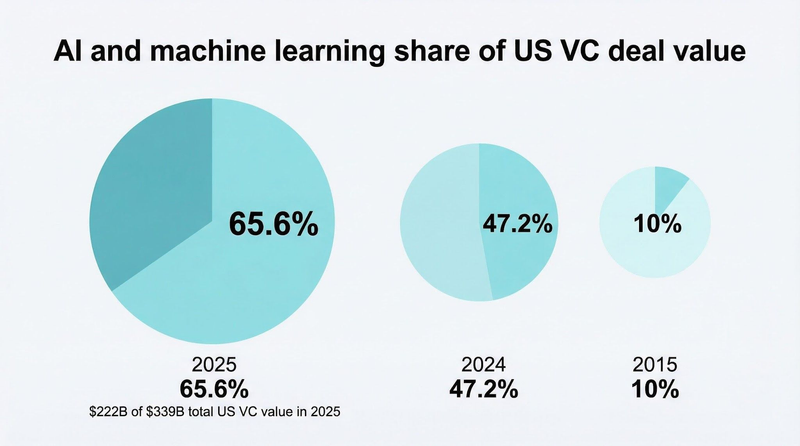
The concentration goes deeper at the sector level. The PitchBook-NVCA Q4 2025 Venture Monitor found that AI and machine learning deals captured 65.6% of all US VC deal value in 2025 – $222 billion out of $339 billion – up from 47.2% in 2024 and just 10% a decade earlier. For funds that are not AI-first, having two-thirds of all deployed capital concentrated in a single vertical means the pool of actively funded opportunities outside AI is smaller, LP attention is harder to hold, and quality non-AI deals draw disproportionate competition when they appear.
This article looks at how VC firms are approaching deal sourcing in this environment. It covers the economics driving competition, the main sourcing strategies in use today (proprietary, thesis-driven, scout-based, and data-driven), the practical role AI plays in sourcing workflows, forward-looking trends for 2025-2026, and the risks that come with increased automation. It closes with an implementation example from DevsData LLC, a software development company that builds AI-driven investment intelligence systems for institutional clients.
Before looking at specific sourcing approaches, it helps to understand the market conditions shaping them. The VC industry in 2025 faces a set of pressures that directly affect how (and how urgently) firms need to find deals. Record amounts of uncommitted capital sit alongside a declining number of investable companies, while the cost of missing a strong opportunity keeps rising.
Global VC dry powder reached $677 billion by 2024, with 53% held in pandemic-era funds now three to five years old – levels not seen since the 2008 financial crisis. At the same time, PitchBook reported that VC funds deployed only 18% of their dry powder annually over the 12 months ending September 2024, compared to a historical average of roughly 37% since 2010. Put simply, capital is piling up much faster than GPs can put it to work.
When deployment eventually picks up, likely once market conditions around AI-adjacent sectors and exit activity become more favorable, the overhang is expected to compress sourcing timelines and push more firms toward the same opportunities at once. Teams without a purpose-built sourcing stack, for example a well-maintained deal CRM paired with automated signal ingestion and a dedicated data function, will be competing on speed without the tools to deliver it.
US VC fundraising fell to $66.1 billion in 2025 – the lowest since 2018 – with only 537 funds closing, just 30% of the 2021 peak. First-time fund formation has slowed sharply too; only 77 new funds raised through November 2024, down from 215 the year before. Capital is consolidating into fewer, larger vehicles run by established firms.
This reshapes sourcing in a practical way. Fewer funds with bigger mandates means more competition for the limited number of deals that can absorb $50 million or more in a single round. Established firms benefit from brand-driven inbound flow. Emerging managers, on the other hand, need to differentiate through sector expertise, geographic focus, or technology-enabled screening to reach opportunities that do not come through standard channels.
CB Insights’ State of Venture 2025 report found that mega-rounds ($100 million or more) surged 77% to 738 deals, capturing $307 billion – roughly 65% of total venture funding globally. Capital concentration hit a 15-year high, with half of all venture dollars directed to just 0.05% of deals. Separately, Crunchbase reported that more than a third of global funding in 2025 went to 68 companies raising rounds of $500 million or more.
This creates two distinct sourcing challenges. Getting into the competitive mega-round tier demands established relationships, speed, and a willingness to pay up. Below that tier, the remaining 99.95% of the deal universe is a large, comparatively under-screened pool where methodical sourcing can turn up companies that consensus-driven capital has missed.
Competition shows up directly in pricing. According to the PitchBook Q3 2025 US VC Valuations and Returns Report, median pre-money valuations rose across every stage in 2025, with Series C up 36.4% year over year and Series D+ up 33%. AI companies commanded a clear premium: median AI pre-money hit $45 million versus $28 million for the general market. Databricks marked up 61.3% from its Series J to a $100 billion post-money valuation in just nine months.
These numbers reward early identification, even as a countercurrent runs underneath them. A growing number of operators and investors have flagged that AI exposure is pulling valuations downward in categories where automation erodes the moat, a dynamic that has become one of the dominant repricing forces in private markets. Capturing value at a $46.5 million Series A pre-money and holding through later markups remains attractive relative to entering at Series C or D, but the gain is contingent on the business surviving that revaluation pressure intact. Deal sourcing, in this context, is not an administrative task – it is a direct lever on fund performance.
In a market where two-thirds of capital flows to a single sector and half of all venture dollars concentrate in 0.05% of deals, the ability to source proprietary information – not proprietary capital – determines which firms generate returns and which merely participate.
VC firms source deals in different ways, and most successful funds use a combination of approaches rather than relying on any single channel. The four models described below – network-based, thesis-driven, scout-based, and data-driven – each address a different part of the sourcing problem: access, focus, reach, and scale. How a firm blends them depends on its size, stage focus, sector orientation, and the infrastructure it is willing to build.
Relationships remain the backbone of VC deal origination. The most comprehensive academic survey on how VCs make decisions, conducted by Gompers, Gornall, Kaplan, and Strebulaev and published in the Journal of Financial Economics, found that over 30% of deals come through professional networks, about 20% through other investor referrals, and roughly 8% through portfolio company introductions. Only 10% came from cold inbound outreach by founders. All told, around 90% of VC investments flow through some kind of network-mediated channel.
Do you have software development needs?
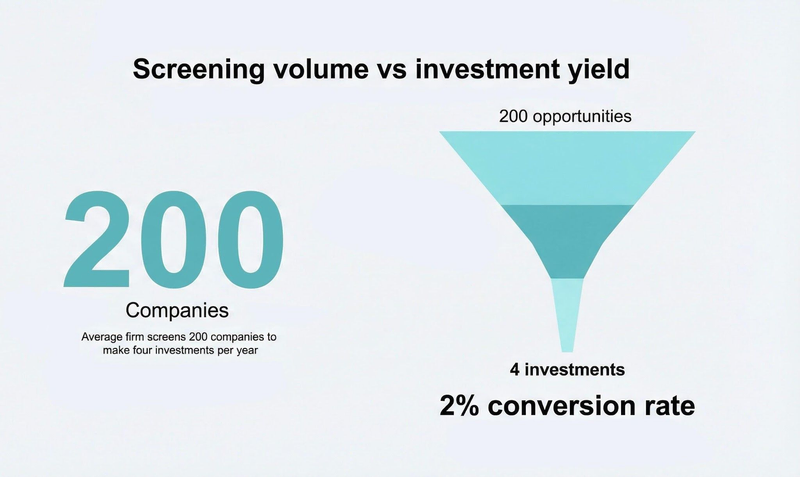
Partners surveyed in the study reported spending an average of 22 hours per week on networking and sourcing – about 40% of a 55-hour workweek. Despite that time commitment, the average firm screens 200 companies to make four investments per year. That 2% conversion rate highlights a core tension: the volume of opportunities coming through networks is large, but the signal-to-noise ratio is low.
Networks provide access, but access on its own does not guarantee selection quality. Firms that layer analytical screening on top of network-generated flow can keep the relationship advantage while improving how quickly and accurately they filter. That combination – personal access paired with systematic evaluation – is where the strongest proprietary sourcing operations tend to sit.
Thesis-driven sourcing works on a different logic. Rather than evaluating deals as they arrive, thesis-driven firms define their target sectors, technology categories, or market structures in advance and then systematically map the companies that fit. This converts deal sourcing from a reactive process into a focused research function.
The performance data behind this approach is strong. McKinsey’s Global Private Markets Report 2026 found that specialist buyout funds across 2010-2022 vintages generated higher pooled IRRs (17% versus 13% for generalists), higher total value multiples (2.2x versus 2.1x), and lower loss ratios (9% versus 12%). Specialists captured nearly four times more equity value from EBITDA margin expansion (43% versus 10%) and were far less reliant on multiple expansion (5% versus 35% for generalists).
In venture specifically, PitchBook analyzed 1306 funds across 2000-2020 vintages and found that specialists outperformed generalists by roughly four percentage points in IRR. For funds under $250 million, the gap was especially clear. Specialist fund share has also grown, from 22.2% of total fund count in 2014 to 26.4% by 2024 – a sign the market is pricing in this performance signal.
On the ground, thesis-driven sourcing lets a firm build proprietary databases and cultivate expert networks in specific technical domains. The framework that emerges from this work gives investment teams a consistent reference point when evaluating opportunities, replacing the broader, opportunity-by-opportunity assessment generalist funds tend to apply.
Scout programs extend a firm’s sourcing reach by giving small check-writing authority – typically for pre-seed or seed rounds – to operators, founders, and domain experts outside the core investment team. Sequoia Capital, Andreessen Horowitz, Accel, and Index Ventures all run structured scout programs that have evolved from informal setups into deliberate parts of their sourcing architecture.
The rationale is straightforward: a $50000 scout check buys information optionality. It gives the firm a first look at a company that might later raise a $10 million Series A. Scouts act as distributed sensors, spotting opportunities in communities and sectors that partners may not reach on their own.
The challenge is quality control. Scouts are usually compensated through carry on their individual investments, which can encourage volume over selectivity. Firms with well-run scout programs treat the scout’s identification as a lead-generation function, not an investment decision. The scout spots the signal; the core team validates it.
Data-driven origination is the biggest structural shift in deal sourcing over the past decade. Rather than relying on networks or thesis frameworks alone, data-driven firms build technology platforms that continuously scan, score, and rank potential targets against defined criteria.
In April 2025, Bloomberg reported that SignalFire raised over $1 billion – its largest fundraising ever – bringing AUM to roughly $3 billion. Its Beacon AI platform tracks 650 million employees and 80 million organizations across more than two million data sources. That raise came during the toughest VC fundraising market since 2018, a clear signal that LPs will pay for verifiable, systematic deal access.
The World Economic Forum reported that AI-powered deal sourcing can surface 195 relevant companies in the time it takes a junior analyst to evaluate one. EQT’s Motherbrain platform, cited in the same WEF piece, pulls together over 140000 data points for real-time M&A insights. These tools do not replace human judgment at the investment committee stage. They compress the research phase that comes before it, freeing investment professionals to spend their time on evaluation rather than data gathering.
Artificial intelligence has moved past the pilot stage at most institutional investment firms. But adoption rates tell only part of the story. What matters for deal sourcing professionals is where AI creates real operational value, where it falls short, and how the choice between off-the-shelf tools and custom-built systems affects long-term competitive positioning. The sections below break that down.
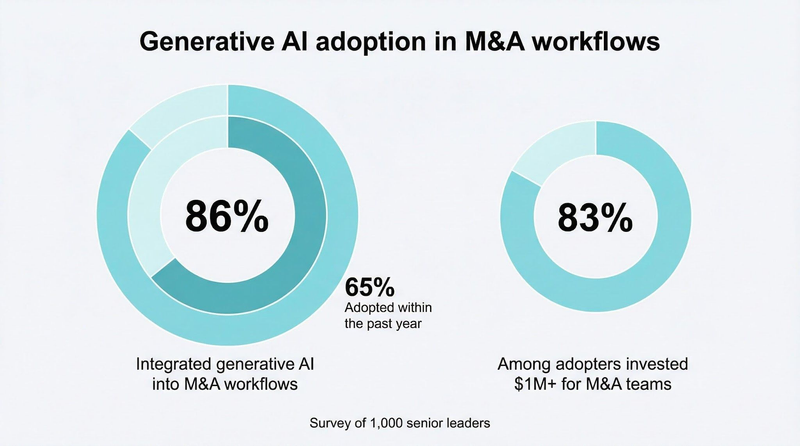
A Deloitte survey of 1000 senior leaders found that 86% of corporate and PE organizations have integrated generative AI into their M&A workflows, with 65% doing so within the past year. Among adopters, 83% invested $1 million or more specifically for their M&A teams. Patterns observed in private equity tend to reach venture capital with a lag, which makes these figures a useful leading indicator of where VC sourcing tooling is heading, even though the underlying transaction types differ. Broad adoption masks wide variation in how deeply these tools become embedded into day-to-day sourcing work.
AI’s strongest contribution to deal sourcing is at the top of the funnel: discovery and screening. The universe of potential targets numbers in the hundreds of thousands, while a typical VC firm invests in four companies per year. AI narrows that gap by ingesting structured data (funding histories, employee counts, patent filings, revenue estimates) alongside unstructured signals (product launches, technical publications, hiring patterns, open source activity) and scoring companies against the firm’s criteria.
According to Bain & Company’s 2025 M&A report, 40% of AI adopters apply generative AI to strategy and market assessment, while 35% use it for target screening and due diligence. When asked to look ahead 24 months, 37% identified strategy and market assessment as the area most likely to produce high returns. That pattern confirms AI’s operational value concentrates at the discovery stage, not at the point where the final investment decision gets made.
Signal extraction goes well beyond static database queries. Modern systems track hiring velocity as a growth proxy, monitor patent filings for IP development, analyze product review sentiment for early market-traction signals, and flag executive departures that may indicate organizational instability. On their own, individual signals are weak. Aggregated across thousands of companies and calibrated against historical outcomes, they become meaningful.
VC firms that have operationalized AI inside diligence offer the most direct evidence of how the workflow compresses. Correlation Ventures, a pure-play co-investor, runs a model trained on tens of thousands of historical VC financings, and MIT Technology Review documented one investment closed in under two weeks against a three-month industry baseline. EQT Ventures has been operating Motherbrain since 2016, applying it across sourcing, due diligence, and portfolio value creation, and the firm’s Head of AI Alexander Fred-Ojala has framed the discovery stage as where data-driven methods generate the clearest alpha.
That speed matters beyond just saving analyst hours. When deal teams look at 10 opportunities to find one worth pursuing, cutting evaluation time from weeks to days expands the total number of companies a firm can assess. Broader coverage raises the odds of landing the strongest investment in a competitive process.
Speed is especially critical in AI-focused transactions. About half of all global venture funding in 2025 went to AI companies – $211 billion, up 85% year over year from $114 billion in 2024. Silicon Valley Bank’s H2 2025 State of the Markets data shows AI companies accounting for 36% of US VC deals and 58% of total VC investment, with the six largest US VC funds capturing one-third of all US VC investment in the period through what SVB attributes almost entirely to massive AI deals. Firms bidding on these deals face tight timelines and high information requirements. AI-augmented diligence that processes technical documentation, competitive landscapes, and customer data in parallel gives those firms a real edge.
Whether to build proprietary AI infrastructure or license vendor solutions is a decision with long-term consequences. SignalFire has been building its Beacon AI platform since 2013, with the system now processing information on over 80 million organizations and 650 million employees from dozens of sources – the foundation of what founders Chris Farmer and Ilya Kirnos have described as a 12-year head start in applying machine learning across the VC process. Affinity’s 2025 survey of nearly 300 VC dealmakers found 92% of firms using AI somewhere in their workflow, with 76% applying it to daily-task automation and 64% to research acceleration, but only 13% still applying it to the investment decision itself – down sharply from 40% the year before, as firms reset expectations on what the technology can reliably support.
Firms that treat sourcing AI as an off-the-shelf purchase face a convergence problem: if competitors run the same tools on the same data, the resulting deal flow is not proprietary by definition. Custom systems offer a different value proposition. They can be trained on a firm’s own deal history, tuned to its specific thesis, integrated with its CRM and communication data, and updated as market conditions shift. Empirical work from HEC Paris and London Business School pointed to a constraint that survives the build-versus-buy decision entirely: VCs that adopt data-driven sourcing become more skilled at funding lookalikes of past successes and concurrently less likely to back the rare breakout startups responsible for outsized returns. Sourcing systems need to be designed to push against that tendency, not amplify it.
AI in deal sourcing works best when it speeds up the research process, not when it replaces the investment judgment that follows. Systems that compress screening timelines while keeping human authority over conviction-level decisions represent the standard for disciplined use.
Deal sourcing is evolving quickly, and several trends are taking shape that will influence how firms operate over the next 12 to 18 months. Some are technology-driven. Others reflect shifts in LP expectations and capital allocation patterns. Together, they suggest that the gap between firms with mature sourcing infrastructure and those without it is likely to widen.
The next frontier is AI that does not just analyze data but acts on it autonomously – identifying targets, conducting preliminary research, and pre-qualifying companies without human prompting. A Deloitte AI Institute survey of 3235 leaders found that regulatory compliance (38%) is now the top barrier to AI implementation, up 10 percentage points year over year, with risk management difficulties (32%) close behind. Only one in five companies has a mature governance model for autonomous AI agents. Agentic sourcing pipelines are technically possible today, but governance is the bottleneck. Firms that solve that problem first will unlock research throughput that manually operated systems cannot approach.
Limited partners are looking beyond track records and team pedigree. They increasingly want to understand how a GP actually finds its deals and whether that process can produce differentiated flow at scale. SignalFire’s $1 billion raise during the weakest fundraising period since 2018 is one illustration of where capital is heading inside the venture itself. The PitchBook-NVCA Venture Monitor for Q4 2024 reported that 30 firms collected 75% of all US VC capital raised that year, with just nine funds taking in 46% of the total and emerging managers raising only $15 billion across 245 funds – the lowest emerging-manager total since 2015.
Do you have software development needs?
Capital is concentrating around the most institutionalized, tech-built VC franchises, which is the form LPs’ preference takes when it is read through allocation behavior rather than survey response. Adams Street Partners’ 2025 Global Investor Survey reinforced the directional read, noting that AI is driving significant investment particularly inside venture capital and growth equity, and that two-thirds of LP respondents planned to increase commitments to existing managers. That LP-level shift in expectations favors technology-enabled sourcing over approaches that depend entirely on personal relationships.
The capital is concentrating geographically. The US share of global startup funding climbed to 64% in 2025, up from 56% in 2024 and 47-48% during 2019-2023, driven largely by US-based AI companies. For investors focused outside the US, that creates an interesting situation: less capital competition, but a greater need for on-the-ground intelligence to identify quality opportunities. Cross-border sourcing systems that pair global data coverage with region-specific evaluation criteria will become more valuable as capital eventually spreads back out.
Adoption is widespread, but depth of implementation is not. Affinity’s 2025 survey of nearly 300 VC dealmakers worldwide found 92% of VC firms using AI somewhere in the investment workflow, with 76% applying it to automate daily tasks and 64% to accelerate company research. Depth tells a different story: only 13% of firms now apply AI to the actual investment decision, down sharply from 40% in the previous year’s survey as practitioners recalibrated where the technology can be trusted.
Coller Capital’s 2024 ESG Report measured the maturity gap from the LP perspective, finding that just 15% of its underlying GPs currently use AI at the firm or fund level while another 45% intend to do so in the near future. That gap defines the competitive window for 2026: firms that move from pilot programs to production-grade AI sourcing now can build advantages that take time to replicate. Once most of the market reaches a similar level of technological capability, the edge shifts from having AI to having better data and sharper models.
AI brings real benefits to deal sourcing, but it also introduces risks that require deliberate management. At many firms, the rush to adopt AI has outpaced the development of the governance structures needed to use it responsibly. The sections below cover the most significant risk areas and their practical implications for sourcing teams.
Generative AI can produce outputs that are factually wrong or entirely made up. McKinsey warned that models trained on mixed public and private data can generate inflated income figures or fabricated bankruptcy histories – errors with obvious consequences in an investment context. Goldman Sachs, Citigroup, and JPMorgan Chase all flagged hallucination risks in their 2024 SEC filings. Deloitte found that 60% of companies exploring agentic AI have not yet conducted any risk assessment. In deal sourcing, a single fabricated data point that makes it into an investment memo can throw off the entire evaluation of a target.
The Federal Reserve published research in September 2025 titled “Financial Stability Implications of Generative AI”, raising questions about “model monoculture”: when many firms use similar AI tools, they can end up converging on the same decisions and increasing systemic risk. The paper found that AI agents, while more rational than humans at baseline, can be pushed toward herding behavior when optimizing for returns. There is already real-world evidence of this – 71% of all US VC equity investment in Q1 2025 went to AI companies, up from 45% in 2024 and 14% in 2020. When most firms run similar tools on similar data, the resulting deal flow stops being proprietary. Competitive advantage comes from differentiated inputs and proprietary signal models, not from AI adoption itself.
Kaplan and Lerner’s NBER working paper on venture capital data documented how leading VC funds have actively pressured pension LPs against reporting performance to commercial data providers, with some firms dropping institutions that refused to make those commitments. Coverage gaps follow directly: VentureSource systematically excludes funds that failed, producing an upward performance bias in any dataset built on it. The same problem surfaces in AI-generated sourcing outputs. The research at HEC Paris and London Business School found that VC firms relying on data-driven sourcing become better at identifying startups that resemble past winners and concurrently less likely to back the rare breakout companies that drive fund returns – a structural artifact of training models on a record of survivors. Sourcing teams need to account for these data-quality issues when relying on AI-generated outputs.
Regulatory attention is growing. The SEC’s 2025 examination priorities explicitly name AI as a focus area, stating that examiners may review compliance policies, procedures, and investor disclosures when advisers use AI in portfolio management, trading, marketing, or compliance. The SEC has also pursued enforcement actions against advisers for “AI washing” – making misleading claims about their AI capabilities. In Europe, the EU AI Act requires compliance for high-risk financial AI systems by August 2026, with penalties reaching 7% of annual global turnover. These rules create real obligations around how AI outputs inform investment decisions and how those outputs are disclosed to limited partners.
Website: www.devsdata.com
Company size: ~60 employees
Founding year: 2016
Headquarters: Brooklyn, NY
DevsData LLC is a software development company headquartered in New York, NY and Warsaw, Poland, specializing in the design and engineering of AI-driven systems for data-intensive industries. With over ten years of experience delivering custom technology solutions, DevsData LLC has completed more than 100 software projects for over 100+ clients, including global corporate organizations and high-growth startups across the US and Israel.
The engineering team at DevsData LLC includes US-based specialists and in-house engineers with over ten years of experience building AI-driven systems, with deep expertise in Big Data, Machine Learning, natural language processing, and distributed systems architecture. Team members bring backgrounds from leading global technology companies, ensuring that solutions meet enterprise-grade standards for reliability, scalability, and security.
Within venture capital deal sourcing, DevsData LLC builds the technical infrastructure that lets investment teams scale their research: automated data pipelines, NLP-based signal detection engines, entity resolution systems, and modular APIs that connect AI-generated insights to the firm’s decision-making process. The same engineering team designs generative AI components on top of that infrastructure, including agentic workflows that autonomously screen target companies against a fund’s thesis, draft preliminary investment memos for analyst review, and trigger follow-up research actions when specific market signals surface.
The company holds 5/5 ratings on both Clutch and GoodFirms, reflecting consistent client satisfaction across complex, multi-phase engagements. In the investment intelligence space, DevsData LLC builds custom software platforms that ingest diverse data sources, apply machine learning models for pattern detection, and deliver structured outputs that plug into existing analytical workflows.
Within venture capital deal sourcing, DevsData LLC builds the technical infrastructure that lets investment teams scale their research: automated data pipelines, NLP-based signal detection engines, entity resolution systems, and modular APIs that connect AI-generated insights to the firm’s decision-making process.

Signal Capital Ltd. is a London-based venture capital fund investing at the Series A and Series B stage in enterprise technology. The firm’s research team was responsible for monitoring a global pipeline of thousands of early-stage companies.
Before working with DevsData LLC, Signal Capital Ltd. sourced deals through a manual process that combined analyst desk research, news monitoring, and network referrals. Analysts spent roughly 60% of their working hours on data collection and preliminary screening – reviewing articles, tracking funding announcements, parsing filings, and cross-referencing company information across platforms. This capped throughput at about 40-50 companies per week, with uneven coverage across geographies and sectors. The bottleneck was not the team’s analytical skill but the logistics of assembling information: pulling data together from scattered sources left too little time for the evaluation and relationship work that actually drives investment outcomes.
DevsData LLC designed and delivered an AI-driven research intelligence system built around Signal Capital Ltd.’s investment thesis and daily workflow. The platform included four core components:
DevsData LLC delivered the production system within a 12-week timeline that covered requirements gathering, data source integration, model training, testing, and deployment. The platform cut the research team’s data collection workload substantially, freeing analysts to focus on direct company engagement, reference calls, and investment committee preparation.
Do you have software development needs?
The system was built for long-term scalability – capable of adding new data feeds, expanding geographic coverage, and incorporating more granular scoring models as the fund’s portfolio and thesis developed. DevsData LLC provided ongoing technical support and iterative refinement, treating the engagement as a continuous engineering partnership rather than a one-time delivery.
The VC deal sourcing landscape in 2025-2026 sits at an unusual intersection: record capital supply, declining deal volume, and extreme concentration into a handful of opportunities. These conditions make sourcing a strategic capability with direct impact on fund-level returns, not just an operational checkbox. Firms that find quality opportunities earlier, evaluate them faster, and build conviction before the market converges will capture value that is not available to those relying on passive or purely relationship-driven approaches.
The sourcing strategies covered in this article – network-based origination, thesis-driven specialization, scout programs, and data-driven platforms – are not mutually exclusive. The most effective investors blend them, using networks for access, sector theses for focus, scouts for reach, and AI systems for scale. What separates top performers is not which strategy they choose but how consistently they execute across the full sourcing funnel.
AI has moved from experimental to operational at most PE and VC firms. The evidence points in one direction: generative AI delivers its greatest value at the top of the funnel – discovery, market mapping, preliminary screening – while human judgment remains essential for conviction-level decisions. Firms that respect that division of labor gain meaningful efficiency without losing the qualitative edge that separates strong investments from crowd-following ones.
The risks are real and documented. Hallucination, signal herding, data bias, and tightening regulation all require governance frameworks built alongside AI systems, not added after the fact.
For firms ready to build or upgrade their sourcing infrastructure, the path forward requires purpose-built technology that reflects the firm’s thesis, data environment, and workflow. DevsData LLC provides the software engineering capability to deliver these systems – from NLP-based signal detection and entity resolution to modular, scalable data pipelines that connect to existing investment processes. In the next market cycle, the competitive edge will belong to firms that treat deal sourcing as an engineering problem, not just a relationship one.
Any questions or comments? Let me know on
Twitter/X.
Discover how IT recruitment and staffing can address your talent needs. Explore trending regions
like Poland, Portugal, Mexico, Brazil and more.
 Frequently asked questions (FAQ)
DevsData – your premium technology partner
DevsData is a boutique tech recruitment and software agency. Develop your software project with veteran engineers or scale up an in-house tech team of developers with relevant industry experience.
Free consultation with a software expert
🎧 Schedule a meeting
FEATURED IN


DevsData LLC is truly exceptional – their backend developers are some of the best I’ve ever worked with.”

Nicholas Johnson
Mentor at YC, serial entrepreneur


 Build your project with our veteran developers.
Explore the benefits of technology recruitment and tailor-made software.
Learn how to source skilled and experienced software developers.
Build your project with our veteran developers.
Explore the benefits of technology recruitment and tailor-made software.
Learn how to source skilled and experienced software developers.

Rebecca Botvin

Commercial Director

Tom Potanski
Manager




Categories: Big data, data analytics | Software and technology | IT recruitment blog | IT in Poland | Content hub (blog)
















careers@devsdata.com









general@devsdata.com

"I interviewed about a dozen different firms. DevsData LLC is truly exceptional – their backend developers are some of the best I've ever worked with. I've worked with a lot of very well-qualified developers, locally in San Francisco, and remotely, so that is not a compliment I offer lightly. I appreciate their depth of knowledge and their ability to get things done quickly."

Nicholas Johnson
CEO of Orange Charger LLC,
Ex-Tesla Engineer,
Mentor at YCombinator
"DevsData reached out to us, as we've been looking to grow our engineering team in Europe and Poland. Communicating efficiently and professionally, DevsData made a strong impression with their understanding of the recruitment challenges we were facing. They designed a tailored recruitment process for our needs. I was impressed with the technical depth of their approach."

Karim Butt
Co-Founder & CTO at GlossGenius, Inc.
"Out of all the vendors we work with, DevsData clearly stands out. The quality of developers they deliver is beyond what we've received from any other vendor, and they've been able to send profile recommendations very quickly. I'm happy to be their reference for other companies from Israel and talk about their recruitment abilities and what they delivered for us."

Ran Eyal
Senior Manager at
ZIM Integrated
Shipping Services Ltd.
"DevsData demonstrated a strong degree of proactivity, taking time to thoroughly understand the problem and business perspective, and continuously suggesting performance and usability enhancements. Their app exceeded my expectations. I've worked with DevsData on numerous projects over the last 3 years and I'm very happy. Being both responsive and honest in communication."

Jonas Lee
Partner & Executive VP of Verus,
Financial LLC, Investor,
& Serial Entrepreneur
Acknowledgments