Thanks for subscribing.
Your gift is on the way.



Apache refers to the Apache Software Foundation, a non-profit organization that maintains some of the most widely deployed open source software in production environments today, from the HTTP Server that serves web traffic to Kafka, which moves data across real-time systems at scale. The Apache HTTP Server alone powers 23.9% of all websites whose web server W3Techs identifies, and that figure only captures one project inside a much larger ecosystem. Behind that footprint is a commercial reality: banks rely on Kafka to settle transactions in sub-second windows, global retailers route checkout and inventory traffic through Apache HTTP Server, and logistics operators build their shipment visibility platforms on the Apache data stack. The business value sits in predictable delivery at scale, which is why procurement and engineering teams treat Apache expertise as infrastructure spend rather than discretionary tooling.
The Apache Software Foundation (ASF) now has more than 8400 committers contributing to 320+ active projects, including Apache Airflow, Apache Camel, Apache Flink, Apache HTTP Server, and Apache Kafka. Each of those projects represents a distinct technical specialization, which is why hiring “an Apache Developer” is rarely a single-profile search. More often, the question is which layer of the Apache stack a company needs to staff to support a specific business outcome: ad serving, fraud detection, real-time personalization, clinical data processing, or financial reporting pipelines run on different Apache projects and demand different engineering profiles.
This article covers what Apache Developers actually do, how to evaluate them, where the hiring process typically breaks down, and what DevsData LLC has learned from placing engineers with Apache expertise across client engagements.

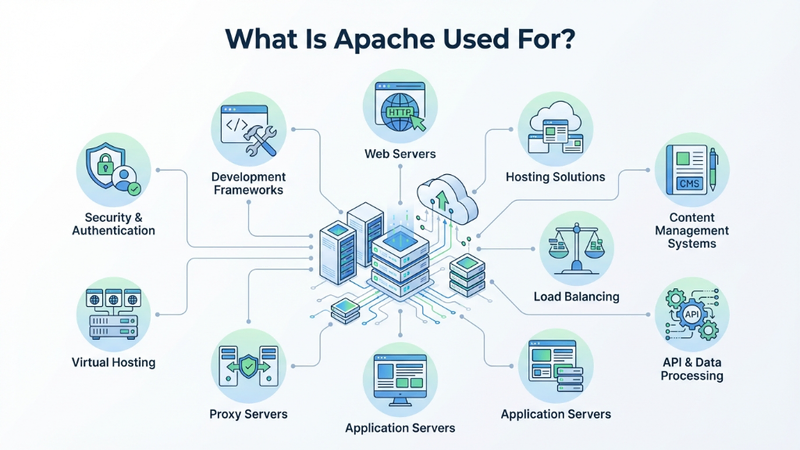
The term Apache Developer does not map to a single role. In practice, it refers to engineers who build, configure, maintain, or extend systems that a business depends on for revenue, customer experience, or operational continuity. The projects dominating most hiring conversations tie directly to commercial function: Apache HTTP Server sits under the websites and storefronts that generate traffic and transactions, Apache Kafka moves the event data behind fraud detection and real-time personalization, while Apache Hadoop backs large-scale reporting and analytics programs. Around that core sit adjacent tools whose business relevance is just as concrete, among them Apache Spark for ad tech and risk analytics, Apache Airflow for finance and data science pipelines, Apache Cassandra for user-facing services that cannot tolerate downtime, and Apache Flink for low-latency decisioning in payments and telecom.
The clearest way to categorize these roles is by the commercial workload they support. Web infrastructure engineers work primarily with Apache HTTP Server and keep customer-facing traffic moving, handling request routing, TLS, virtual hosts, module configuration, and performance tuning for sites where downtime has a direct revenue cost. Data Engineers and Data Architects work with Kafka, Hadoop, Spark, or Flink to build the pipelines that feed business intelligence, machine learning, and regulatory reporting. Platform Engineers and DevOps Specialists integrate Apache tools into containerized delivery stacks that product teams rely on to ship features.
Depending on the role, the shared Apache foundation is either the primary skill or one component inside a larger backend or data engineering profile.
A company advertising for an Apache Developer without specifying the domain will attract a wide range of candidates with very different strengths, and a screening process built for one specialty will filter out qualified candidates from another.
A strong Apache HTTP Server candidate will have made real Multi-Processing Module (MPM) selection decisions, not just configured a default setup. The choice between event-driven, worker-threaded, and prefork models reflects trade-offs around traffic patterns, concurrency, and OS compatibility that only surface in production contexts, and a candidate who cannot explain their reasoning on this question has likely not operated the server at scale. Industries where these decisions carry the highest commercial weight include digital publishing, where ad impressions depend on millisecond response times, eCommerce, where checkout availability ties directly to revenue, and SaaS companies running customer-facing dashboards.
Production work includes TLS setup via mod_ssl, virtual host configuration, HTTP/2 activation via mod_http2, rewrite rules, and containerized deployment. That operational scope matters in the context of market position: Apache ranks second overall at 26.4% of identified web servers, behind Nginx at 33.8%, meaning most active Apache deployments are already in production and require experienced engineers who can maintain and upgrade them, not only build new configurations from scratch.
Kafka Developers design and manage distributed event streaming pipelines. Work at this layer shows up across financial services firms that depend on Kafka for transaction processing and fraud detection, logistics operators using it for shipment tracking and supply chain visibility, and media companies running Kafka as the backbone of real-time recommendation and ad-serving systems. Inside those deployments, the day-to-day work involves producer and consumer configuration, partition strategy, replication factor decisions, offset management, schema registry integration, stream processing with Kafka Streams or Apache Flink, and connector setup with Kafka Connect. Kafka sits at the center of many real-time data architectures, feeding downstream systems that range from analytics platforms to microservices.
Hadoop Developers and Data Engineers working in the broader Apache data stack deal with distributed storage, MapReduce or Spark-based processing, job scheduling with Apache Oozie or Airflow, resource management through YARN, and data cataloging with tools like Apache Atlas or Apache Hive. These roles overlap heavily with Data Engineering and Data Architecture functions. The projects that most benefit from this stack tend to involve large historical datasets under regulatory scrutiny, which is why the profile appears frequently in banking risk reporting, pharmaceutical research analytics, and telecom network intelligence.
Hiring for any Apache specialization rarely ends with knowledge of one project. The broader ecosystem around Apache work shapes what a productive engineer actually looks like in production.
Apache expertise alone rarely reflects what a productive engineer looks like in production. The Stack Overflow 2025 Developer Survey puts Docker usage at 71.1% among professional developers, up 17 percentage points from 2024, which reflects how thoroughly containerized deployment has become the baseline rather than an advanced capability. PostgreSQL leads at 58.2% for databases, and Java sits at 29.6% among professional developers, reinforcing the expectation that Apache Engineers operate within a broader stack rather than in isolation.
Those figures matter for Apache hiring because the engineers most capable of adding value are rarely those who know Apache configuration in isolation. An Apache HTTP Server engineers who perform well in production tend to also own containerized deployment, TLS configuration, and monitoring tooling as part of their normal work. Kafka Developers with strong production track records reason comfortably about schema evolution, consumer group behavior, and lag monitoring across distributed services. At the senior level, Hadoop and Spark engineers typically arrive with cloud-native orchestration and workflow tooling already in their practice, which reflects where the market has moved rather than a stretch requirement.
The practical hiring implication: screen for the Apache project first, then evaluate depth in the adjacent stack it connects to.
Apache HTTP Server‘s 26%+ market share among identified web servers represents tens of millions of active deployments, most of which need ongoing maintenance, security patching, performance tuning, and modernization. An engineer with genuine Apache HTTP Server depth brings more than configuration knowledge: they carry institutional familiarity with how the server behaves under load, how its behavior changes across major versions, and where the documented defaults diverge from what production environments actually require.
For data-focused roles, the Apache data ecosystem is even more dominant. Kafka has become the standard event streaming backbone for financial services, retail, logistics, and media. Spark is the primary distributed processing engine at most large data organizations. Airflow is widely adopted for workflow orchestration. An engineer with depth in any of these tools joins a talent pipeline built on widely deployed, actively maintained open source software.
Apache HTTP Server supports HTTP/2, SSL/TLS, modern reverse proxying patterns, and a modular extension model that allows teams to add functionality without replacing the server. Version 2 runs on 99.8% of all Apache sites tracked by W3Techs, which means the vast majority of active deployments are on a maintained release line. Developers who know the current version well can apply their skills directly rather than working around legacy constraints.
Apache tools run on bare metal, virtual machines, containers, and managed cloud services. An Apache HTTP Server engineer can work inside a Kubernetes cluster, behind a CDN, or on a traditional Linux host. A Kafka engineer can manage a self-hosted cluster, connect to a managed Kafka service, or integrate with cloud-native messaging alternatives. For Apache HTTP Server specifically, that portability means the same engineer can configure the server inside a Kubernetes pod, behind a CDN, or on a bare-metal Linux host without needing to relearn a proprietary abstraction at each layer.
Taken together, the benefits of hiring Apache Developers come down to production scale, protocol maturity, and deployment flexibility. Engineers working inside this ecosystem operate on widely deployed, continuously maintained software, which gives companies access to talent whose skills transfer across infrastructure choices and remain applicable as the underlying deployment model shifts.
Do you have IT recruitment needs?
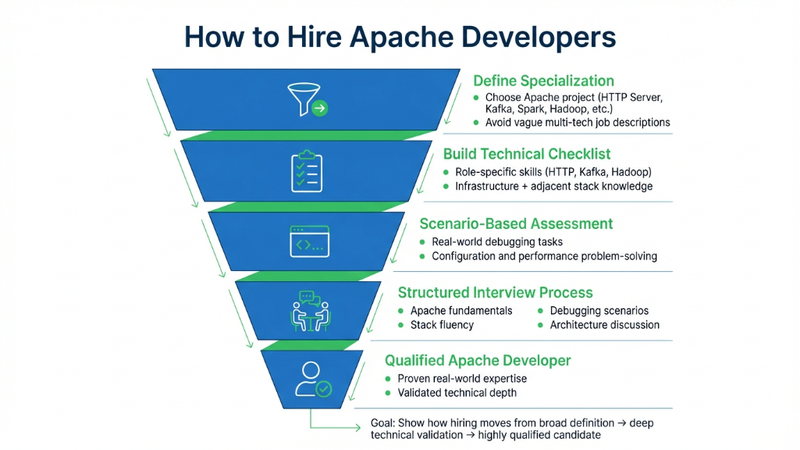
Define the specialization first
Before writing a job description, confirm which Apache project is at the center of the role. Apache HTTP Server, Kafka, Spark, Hadoop, Airflow, Flink, and Cassandra each require different skill sets, attract different candidate profiles, and should be screened differently. A job posting that lists multiple Apache technologies without prioritizing them will generate a large volume of weakly matched applications.
From our experience at DevsData LLC, roles described only as “Apache Developer” with no project specified generate candidate pools where a significant portion are screened out at the first technical stage for specialization mismatch. Naming the project in the title alone meaningfully improves application quality.
Build a technical skills checklist by role
For Apache HTTP Server roles, the core checklist should include MPM selection and tuning, virtual host configuration, TLS setup and certificate management, reverse proxy patterns, mod_rewrite usage, HTTP/2 enablement, logging configuration, monitoring integration, and containerized deployment. Adjacent stack skills to verify include Linux systems experience, Nginx comparison knowledge, CI/CD pipeline familiarity, and observability tooling.
For Kafka roles, look for partition and replication design, consumer group management, Kafka Connect, Kafka Streams or Flink integration, schema registry experience, lag monitoring, and at least one producer/consumer language at production scale. Java remains the dominant language in this space.
For Hadoop and data pipeline roles, prioritize distributed storage fundamentals, YARN resource management, Spark job optimization, partitioning strategies, workflow orchestration experience, and data governance tooling.
In our screening process, the checklist items that most reliably separate strong from weak candidates are MPM selection reasoning for Apache HTTP Server roles and partition strategy design for Kafka roles. Candidates who can walk through their actual decision-making on either question have almost always worked at production scale.
Design scenario-based assessments
Generic coding challenges do not reveal Apache-specific competence. Better evaluation tasks include: diagnosing a slow response behind a reverse proxy setup, identifying a TLS misconfiguration in a provided config file, explaining how to enable HTTP/2 without breaking existing SSL termination, designing a Kafka partition strategy for a given throughput requirement, or debugging a Spark job that runs out of memory on large datasets. These tasks test real-world problem-solving rather than theoretical recall.
At DevsData LLC, all shortlisted candidates complete a 90-minute problem-solving challenge built around realistic Apache scenarios before any profile reaches the client. This single step has been the most reliable signal in our process for identifying engineers with genuine production depth versus those who know the documentation without having operated the tools under real conditions.
Structured interview process
The interview process should move from foundational Apache knowledge to real-world debugging scenarios, then to adjacent stack fluency, and finally to architecture discussion. Each stage narrows the candidate pool on meaningful technical criteria rather than surface familiarity.
At DevsData LLC, we have found that the architecture discussion stage in particular separates mid-level engineers from senior ones. Candidates who can reason about trade-offs demonstrate the kind of judgment that production environments require and that no resume line item reliably signals.
Qualified Apache Developer
A qualified Apache Developer is not defined by tool familiarity alone. The combination of proven real-world expertise across the relevant Apache project, depth in the adjacent stack it connects to, and the ability to operate under production conditions is what distinguishes a hire who adds value immediately from one who requires significant ramp time.
From our placements, the engineers who performed best in the first 90 days were those who had already handled failure scenarios in production – a Kafka broker going down, a TLS certificate expiring in a live environment, or a Spark job degrading under unexpected data volume. Behavioral questions targeting those specific experiences, rather than hypothetical ones, are the most direct route to identifying this profile.
A specialized hiring partner tightens every step of that process. DevsData LLC narrows specialization upfront, builds role-specific checklists from live client engagements, runs scenario-based assessments calibrated to real production incidents, and conducts the structured interviews in partnership with internal teams. For companies without an in-house panel of Apache experts, that support replaces guesswork with a screening pipeline that has already filtered for production depth before any candidate reaches the final stage.
The CNCF and SlashData State of Cloud Native Development report found that cloud native adoption has reached 15.6 million developers globally, with 77% of Backend Developers using at least one cloud native technology.
That shift directly affects Apache hiring in concrete ways: organizations that once staffed for standalone server administration now need engineers who can configure Apache HTTP Server inside Kubernetes, integrate Kafka with managed cloud services, and operate Airflow across hybrid environments. The practical consequence is a higher baseline skill requirement and a narrower qualified candidate pool for the same nominal Apache role.
Engineers who understand only the Apache tool, and not the deployment infrastructure around it, are progressively less useful in production.
The ASF now stewards more than 320 active open-source projects and initiatives, with new projects regularly graduating from the incubator. That growth means Apache Developers increasingly need to track dependency changes across more tools, evaluate new ASF projects for adoption, and work with community-driven software at a faster update cadence than proprietary alternatives. The engineering profile for senior Apache roles is shifting toward engineers who are comfortable with open source governance, not just configuration and tuning. For businesses, that means dependency management, license review, and contribution workflow are becoming part of the expected skill set, and engineers who treat Apache projects as black boxes will require more oversight on teams working at the ASF ecosystem’s edge.
Generative AI workloads have become a direct driver of Apache hiring demand. Retrieval-augmented generation pipelines pull their event data through Kafka. Training and feature engineering jobs run on Spark clusters. Airflow orchestrates the data preparation and model evaluation runs that sit beneath most production LLM deployments. Businesses building internal AI products are extending job requirements accordingly, asking Apache Engineers to work comfortably alongside vector databases, embedding pipelines, and inference infrastructure. The practical hiring consequence is that candidates with exposure to AI-adjacent data work are rising faster in shortlist rankings than those with pure platform depth.
Apache tools are active targets within that exposure: critical CVEs in Apache HTTP Server, Kafka, or Spark have historically affected thousands of production systems simultaneously, and engineers responsible for these deployments need to own patching cadence and upgrade planning as a regular part of the role.
Conflating “Apache” across specializations
The most common sourcing mistake is treating Apache expertise as a single profile. A Kafka expert and an Apache HTTP Server engineer do not share the same skill set, and screening one against criteria designed for the other wastes time on both sides. Job descriptions must be specific about the Apache project, the adjacent stack, and the deployment context.
Underestimating operational depth
Apache tools at production scale require more than installation and basic configuration. HTTP server deployments need performance tuning, MPM selection appropriate for traffic patterns, and structured upgrade management. Kafka clusters need capacity planning, consumer lag monitoring, replication recovery procedures, and connector lifecycle management. Spark jobs need memory tuning, partition optimization, and performance profiling. Engineers who have only run these tools in development environments often lack the operational depth that production support requires.
Security visibility gaps
Apache workloads typically involve large dependency trees, and engineers who have not thought through provenance tracking or package validation will leave gaps that only become visible under incident conditions. During screening, asking candidates how they manage dependency updates and what their process is for evaluating third-party packages before integration will surface whether security discipline is part of their practice or an afterthought.
Weak interview design
Apache expertise is easy to misread from a resume. Candidates can list Apache tools without having worked with them at production depth. Scenario-based evaluation, as described in the hiring section above, separates candidates who have done real troubleshooting from those who have only read documentation.
A recruitment partner adds the most value when the Apache role combines multiple specializations or sits inside a complex delivery context. Agencies with established offshoring capabilities also give companies access to qualified Apache Engineers in lower-cost markets without managing the legal and contractual complexity of cross-border hiring directly. For organizations operating under regulatory frameworks that require documented hiring practices or specific employment classifications, working with a compliant recruitment partner shifts that legal burden away from the internal team.
Speed is another factor. When a project is blocked on a specialized hire and internal HR cannot assess technical depth, the time cost of a mis-hire exceeds the cost of using a specialist recruiter. Apache tooling changes frequently enough that sourcing from a warm candidate network, rather than cold posting, produces better results faster.
A recruitment company with technical screening capability is also justified when the organization cannot verify whether a candidate genuinely has production experience with the relevant Apache tool, as opposed to having used it in a course or side project. The difference between those two profiles is significant in production, and behavioral interview techniques rarely surface reliably without domain expertise on the interviewer’s side.
Cost structure is often underweighted in this decision. Running a prolonged in-house search consumes engineering management time on intake calls, resume reviews, and first-round screens that rarely produce qualified finalists in specialized Apache searches. A recruiter operating on a success fee absorbs that front-end cost and only becomes payable against a confirmed hire, which aligns incentives around outcome rather than activity.
Scope creep inside the role itself is another signal. When the job description grows to include adjacent data platforms, security responsibilities, or leadership expectations, a recruitment partner with a multi-discipline candidate pool finds matches that a narrow internal search typically misses. The same logic applies in reverse for niche Apache specializations, where the qualified candidate pool is small enough that a warm network relationship is the deciding factor between filling the role in weeks versus quarters.
Finally, the retention picture changes when a specialist recruiter is involved upfront. Candidates placed through technical screening by a domain-aware partner tend to stay longer because the initial match accounts for architecture context, team dynamics, and scope clarity rather than keyword overlap alone, which reduces the hidden cost of replacement and ramp inside the first year.

Website: www.devsdata.com
Team size: ~60 employees
Founded in: 2016
Headquarters: Brooklyn, NY, and Warsaw, Poland
DevsData LLC places backend, data, and infrastructure engineers with Apache expertise across a range of client types: companies that run Apache HTTP Server on significant traffic volumes, organizations building Kafka-based event streaming pipelines, and data-heavy businesses working with the Apache data stack including Spark, Hadoop, and Airflow. The company operates on a success fee model, meaning clients pay for successful placements rather than for the search process itself. A guarantee period is included with each placement. DevsData LLC holds a 5/5 rating on Clutch and GoodFirms.
Our sourcing process focuses on verified production experience rather than self-reported familiarity. DevsData LLC operates under a government-approved license for employment services, which means our process meets documented regulatory standards for talent placement. For Apache HTTP Server roles, that means asking candidates to demonstrate MPM configuration decisions, describe real TLS troubleshooting scenarios, and walk through a reverse proxy architecture they designed or maintained. All shortlisted candidates complete a 90-minute problem-solving challenge built around realistic Apache scenarios before any profile reaches the client.
We work with companies that need to move quickly, with internal teams that cannot validate technical depth across Apache specializations, and with organizations that have had expensive mis-hires from generic job boards and want a different approach. The engagement model is straightforward: we source from our existing network first, run technical screening before any candidate reaches the client, and provide replacement support within the guarantee window if a placement does not work out.

The T-Mobile Germany recruitment engagement illustrates what this looks like at scale. T-Mobile Germany needed data engineers and backend specialists with hands-on experience in Apache Kafka, Spark, and distributed data architecture – roles that required both technical depth and the ability to perform through a rigorous five-stage evaluation process. DevsData LLC placed eight senior engineers in 3.5 months, delivering the first shortlist within seven days of project launch.
The engagement expanded beyond its original scope, with T-Mobile Germany extending the collaboration by three additional hires after the initial placements. It has since grown into a long-term partnership, with DevsData LLC continuing to support data engineering and backend hiring across the organization.
Do you have IT recruitment needs?
If your search involves an Apache role with multiple technical layers or a timeline that internal recruiting cannot support, contact us to discuss whether our network is the right fit.
Apache technologies span web infrastructure, distributed data systems, stream processing, and workflow orchestration. The engineers who work with them are not a single profile, and a hiring process that treats them as one will miss qualified candidates and produce mis-hires. The strongest Apache hiring processes start with a precise definition of the relevant project, build screening criteria from real production requirements, and evaluate candidates through scenario-based tasks rather than generic assessments.
As cloud-native deployment models become the default and security pressure on open source dependencies increases, the value of Apache Engineers who can operate across the full delivery stack, not just configure a single tool, continues to grow. That is the standard DevsData LLC screens against, and the profile worth prioritizing in any Apache hire.
Discover how IT recruitment and staffing can address your talent needs. Explore trending regions
like Poland, Portugal, Mexico, Brazil and more.
 Frequently asked questions (FAQ)
DevsData – your premium technology partner
DevsData is a boutique tech recruitment and software agency. Develop your software project with veteran engineers or scale up an in-house tech team of developers with relevant industry experience.
Free consultation with a software expert
🎧 Schedule a meeting
FEATURED IN


DevsData LLC is truly exceptional – their backend developers are some of the best I’ve ever worked with.”

Nicholas Johnson
Mentor at YC, serial entrepreneur


 Build your project with our veteran developers.
Explore the benefits of technology recruitment and tailor-made software.
Learn how to source skilled and experienced software developers.
Build your project with our veteran developers.
Explore the benefits of technology recruitment and tailor-made software.
Learn how to source skilled and experienced software developers.

Rebecca Botvin

Commercial Director

Tom Potanski
Manager




Categories: Big data, data analytics | Software and technology | IT recruitment blog | IT in Poland | Content hub (blog)
















careers@devsdata.com









general@devsdata.com

"I interviewed about a dozen different firms. DevsData LLC is truly exceptional – their backend developers are some of the best I've ever worked with. I've worked with a lot of very well-qualified developers, locally in San Francisco, and remotely, so that is not a compliment I offer lightly. I appreciate their depth of knowledge and their ability to get things done quickly."

Nicholas Johnson
CEO of Orange Charger LLC,
Ex-Tesla Engineer,
Mentor at YCombinator
"DevsData reached out to us, as we've been looking to grow our engineering team in Europe and Poland. Communicating efficiently and professionally, DevsData made a strong impression with their understanding of the recruitment challenges we were facing. They designed a tailored recruitment process for our needs. I was impressed with the technical depth of their approach."

Karim Butt
Co-Founder & CTO at GlossGenius, Inc.
"Out of all the vendors we work with, DevsData clearly stands out. The quality of developers they deliver is beyond what we've received from any other vendor, and they've been able to send profile recommendations very quickly. I'm happy to be their reference for other companies from Israel and talk about their recruitment abilities and what they delivered for us."

Ran Eyal
Senior Manager at
ZIM Integrated
Shipping Services Ltd.
"DevsData demonstrated a strong degree of proactivity, taking time to thoroughly understand the problem and business perspective, and continuously suggesting performance and usability enhancements. Their app exceeded my expectations. I've worked with DevsData on numerous projects over the last 3 years and I'm very happy. Being both responsive and honest in communication."

Jonas Lee
Partner & Executive VP of Verus,
Financial LLC, Investor,
& Serial Entrepreneur
Acknowledgments