Thanks for subscribing.
Your gift is on the way.



At DevsData LLC, a significant portion of our recruitment work involves placing developers under contract arrangements rather than formal employment. These engagements go by different names depending on the jurisdiction. In Europe, particularly in Poland, Germany, and the Netherlands, the standard term is B2B (business-to-business). In the US, the same concept is more commonly referred to as C2C (corp-to-corp) or a 1099 arrangement with an independent contractor. Across all of these arrangements, the core benefit for the client is the same: work gets delivered under a service agreement, with no payroll taxes, benefits costs, or employer obligations on their side. Companies operating under a hiring freeze or headcount freeze often turn to this model as well, since contractor spend sits outside payroll budgets and bypasses restrictions tied to permanent employee counts.
The model is not limited to short-term or part-time work. Some of our placements are three-month sprints for a product launch. Others become long-term collaborations that last years.
The defining characteristic is not the duration or hours worked but the legal structure: no formal employment relationship exists between the developer and the hiring company. The developer invoices the client, manages their own tax obligations, and retains full control over how they structure their business affairs.
Over the past 10 years of recruitment across the US, Israel, and Europe, we have placed hundreds of developers under these arrangements. The following article draws on that experience to explain why companies choose this model, how the mechanics differ across regions, what risks to anticipate, and what separates a contract engagement that runs smoothly from one that requires active intervention to stay on track.

“Hiring on contract” is a legal distinction before it is a practical one. A service agreement replaces the employment contract, and the developer or their registered entity becomes the counterparty. Income tax, social security contributions, and other statutory obligations fall entirely on the developer. The client receives an invoice and pays for services delivered, with no employer-side obligations attached.
This structure has a few practical consequences. The client avoids the overhead costs tied to formal employment: payroll taxes, benefits, paid leave, severance obligations, and HR administration. The developer invoices the client, manages their own tax obligations, and retains full control over how they structure their business affairs. The same structural arrangement governs our placements across other technical profiles, including product designers, QA leads, and infrastructure specialists, even though this article centers on Software Developers.
Different regions frame this arrangement through different legal lenses.
In Poland and across much of Central and Eastern Europe, including the Czech Republic and Romania, the B2B contract is the dominant arrangement in the IT sector. A developer registers a sole proprietorship (jednoosobowa działalność gospodarcza in Polish), signs a service agreement with the client company, and invoices monthly for their work.
Roughly 65% of Software Developers in Poland work under B2B contracts, with the proportion rising among senior-level professionals.
The preference is driven largely by the significant difference in net income: a developer earning a monthly total budget of 15000 PLN (approximately $3700 USD) takes home around 11000 PLN under a B2B arrangement, compared to roughly 9000 PLN under an employment contract.
B2B contracts in Poland are governed by the Polish Civil Code, not by labor law. Paid leave, sick pay, and other employment protections are not guaranteed by statute. Both parties negotiate these terms individually within the contract. For international companies hiring Polish developers through B2B, this provides operational flexibility but demands careful contract drafting to address intellectual property ownership, confidentiality, and termination procedures.
The Polish government has periodically attempted to restrict B2B contracts to prevent companies from using them to disguise employment relationships and avoid the associated tax and social security obligations. A recent draft bill under review would grant the State Labour Inspectorate (PIP) powers to reclassify B2B arrangements into employment contracts, with immediately enforceable decisions and potential retroactive liabilities for up to three years. Companies hiring developers on B2B in Poland need to monitor these regulatory developments and structure their agreements to demonstrate genuine independence rather than a disguised employment relationship. In practical terms, this means the contract should establish that the developer sets their own working hours within agreed delivery windows rather than being bound to fixed office hours, and that they bear financial responsibility for deliverables through warranty clauses that cover defective work.
In the US, the equivalent arrangement comes in two forms. A C2C (corp-to-corp) relationship involves two business entities: the hiring company contracts with the developer’s incorporated business (typically an LLC or S-Corp). Payment flows between the two corporations, and no 1099 form is required since the relationship exists between legal entities rather than between a company and an individual.
A 1099 arrangement, by contrast, involves the hiring company engaging a developer directly as an independent contractor. The company reports payments using IRS Form 1099-NEC, and the developer is responsible for all self-employment taxes, including Social Security and Medicare. The IRS applies specific tests to determine whether a worker is genuinely independent or should be classified as an employee. Misclassification carries penalties for both parties.
The distinction between C2C and 1099 is meaningful for tax planning and liability. Under C2C, the developer’s corporation handles all employment taxes and benefits administration. Under 1099, the individual bears this burden directly. Both models offer the hiring company relief from payroll taxes and benefit costs, and both require clearly defined scopes of work to withstand regulatory scrutiny.
When a US company engages a foreign developer (for example, a developer based in Poland or another European country), the relationship often falls into a hybrid category. The US company typically treats this as an international service contract, and the developer operates under whatever local business structure is appropriate in their jurisdiction. For US tax purposes, this is neither a standard W-2 employment nor a domestic 1099 arrangement. The company files no 1099 for payments to non-US persons, though other reporting obligations (such as Form 1042-S for certain payments) apply depending on the tax treaty between the two countries. Companies that do not want to work through these jurisdictional differences internally often rely on an outsourcing or hiring partner to manage the contract structure, advise on classification, and coordinate with local tax specialists on both sides of the border.
Do you have IT recruitment needs?
The most immediate driver is cost. A full-time developer in the US earning a base salary of $120000 generates a total employer cost of approximately $150000 to $168000 once benefits, insurance, retirement contributions, and payroll taxes are included. A contract developer performing the same work bills a fixed rate for hours or deliverables, with no additional overhead for the hiring company. The difference becomes more pronounced when the engagement is short-term: paying full-time employment costs for six months of specialized work is financially inefficient compared to a contract engagement of the same duration.
In our experience at DevsData LLC, clients who expand their search to Eastern Europe or Latin America reduce hiring costs by 40 to 60%. The contract model amplifies this advantage, since the developer handles their own local tax and social security obligations.
Contract arrangements accommodate fluctuating workloads. A company launching a new product might need 15 developers for six months, then only five for ongoing maintenance. Formal employment makes this pattern expensive and legally complicated, especially in jurisdictions with strong employee protections. Contract engagements scale up and wind down according to project needs, with termination governed by the service agreement rather than by labor law.
Certain skills are needed only for specific phases of a project, whether that is machine learning model training or cloud migration architecture. Recruiting a full-time specialist for a four-month need rarely makes financial sense. Contract hiring gives companies access to these niche capabilities without committing to a permanent position. It also opens the door to senior professionals who will only consider contractual engagements, often because a B2B or C2C structure produces a materially better net income than a salaried arrangement in their local tax regime.
Traditional hiring cycles for experienced developers often take three to six months from job posting to start date. Contract developers, particularly those sourced through a recruitment partner with a pre-vetted talent pool, start within days. At DevsData LLC, we maintain a database of over 95000 pre-screened professionals, which allows us to deliver candidate shortlists within 48 hours for many roles.
The contract label covers several distinct structures. Choosing the right one depends on how much scope is defined in advance, how the client wants to manage the developer’s work, and how long the engagement will last.
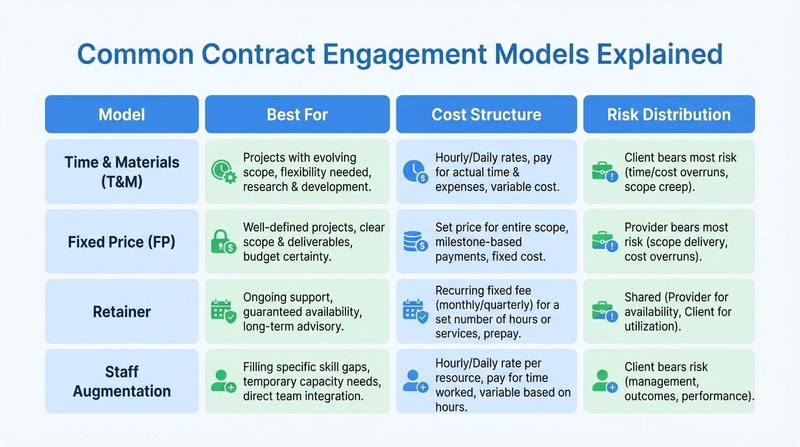
T&M suits companies that are building in an exploratory phase, where requirements shift as the product takes shape. The client pays for actual hours worked and can redirect priorities week by week without renegotiating scope. This flexibility comes with a trade-off: without disciplined project management, hours accumulate and budgets drift. For a company running iterative development cycles or maintaining a live product, T&M is often the most practical choice. For one with a tight fixed budget and no dedicated project oversight, it carries real cost risk.
A company that has fully defined what it needs built, a specific feature set, a database migration, and an MVP with a locked spec, benefits most from a fixed price. The scope, deliverables, and total cost are agreed before work begins, and payments are tied to milestones rather than hours logged. The risk shifts to the developer: if the work runs longer than estimated, the cost overrun is theirs to absorb. That shift only holds when the scope is genuinely stable; requirement changes mid-engagement create friction unless the contract includes a structured change management process.
For a company running a long-term product build or maintaining a complex platform, the dedicated resource model functions closest to a full-time hire without the employment overhead. The developer integrates closely with the client’s team, aligns with its workflows and tooling, and collaborates within its existing structure for the duration of the contract. The legal structure remains a service agreement, but operationally, the developer is indistinguishable from a permanent team member. This model suits companies that need continuity and close collaboration over months or years rather than a defined deliverable with a clear endpoint.
When a company is considering a permanent hire but wants to reduce the risk of a poor long-term fit, contract-to-hire provides a structured evaluation period. The developer works under a service agreement for an initial three to six months, and both parties retain the option to convert to formal employment at the end of that period. It is particularly useful for senior roles where qualities like responsiveness in code reviews, judgment in technical discussions, and working rhythm with the existing team are difficult to assess through interviews alone.
The right engagement model depends on scope clarity and intended duration. T&M fits exploratory builds where priorities evolve, fixed-price works when requirements are locked before the contract begins, dedicated resource arrangements suit long-running products that benefit from embedded team members, and contract-to-hire answers the question of whether a senior candidate belongs on the permanent team. Clients we work with at DevsData LLC most often use dedicated resource structures for sustained platform work and contract-to-hire for senior roles where fit is the decisive factor.
Every contract engagement carries a set of risks that sit outside the technical work itself, from legal classification questions to the operational gaps that appear when a developer leaves. Our recruitment team at DevsData LLC encounters these patterns across hundreds of placements each year, and the sections below outline the ones most likely to affect a hiring company along with the practices we apply to reduce their impact.
The single largest legal risk in contract hiring is misclassification: treating a worker as an independent contractor when the nature of the relationship more closely resembles employment. In the US, the IRS examines factors such as who controls how the work is done, who provides the tools, and whether the worker serves multiple clients. In Poland, the State Labour Inspectorate applies similar criteria.
The consequences of misclassification are severe: retroactive tax liabilities, penalties, back payment of benefits, and potential lawsuits.
The best defense is a well-drafted contract that reflects the actual working arrangement, combined with operational practices that preserve the developer’s independence.
Cross-border contracts introduce additional friction that domestic arrangements rarely face. Time zone gaps affect how closely a client can direct day-to-day work, which itself becomes relevant evidence in any misclassification inquiry. Communication barriers, particularly where a developer operates primarily in a language other than the client’s, can complicate both contract clarity and ongoing coordination. Payment logistics add another layer: currency conversion costs, international wire fees, and varying payment timelines all require explicit terms in the agreement to avoid disputes later.
Contract developers are not automatic employees. Without explicit contractual provisions, ownership of the code and other work products remains ambiguous. Every contract engagement should include clear IP assignment clauses, confidentiality agreements, and provisions for returning or destroying proprietary materials when the engagement ends.
A contract engagement ends when the scope is complete or the term expires. If the departing developer holds undocumented institutional knowledge, the client faces a gap. Structured handover processes, code documentation requirements, and overlap periods with incoming team members reduce this risk.
Not all contract developers deliver the same standard. Vetting is the deciding factor. At DevsData LLC, every candidate goes through a rigorous 90-minute technical interview conducted by senior engineers. This process evaluates problem-solving ability under realistic conditions, not theoretical knowledge alone. We assess communication skills and cultural fit alongside technical competence. A developer who writes excellent code but struggles to collaborate with the client’s team delivers diminished value.
The majority of developers we place work under B2B, C2C, or 1099 arrangements, depending on the region and the client’s preferences. Several elements distinguish our approach.
A database of over 95000 pre-screened professionals
We do not start from zero with each engagement. Our existing database, built over 10 years of recruitment across Europe, the US, and Latin America, gives us a head start on every search. For many contract roles, we present qualified candidates within 48 hours of briefing.
Success-fee model with a guarantee
We charge only when a candidate is successfully placed. If the developer leaves within a specified guarantee period, we replace them at no additional cost or provide a refund. This aligns our incentives with the client’s long-term success, not with filling a seat quickly.
Cross-border expertise
Many of our clients are US or Israeli companies hiring developers in Poland or other European markets. These engagements involve working through different tax systems, IP protection frameworks, and contract law standards. Our team includes US-based specialists who coordinate with local consultants to structure agreements that work for both sides.

That cross-border structure was exactly what was at play in one of our engagements with a US client. A US-based hedge fund managing over $11 billion in assets needed six senior developers (four Backend Developers and two Big Data Engineers) under contract for its global trading infrastructure. The roles demanded both deep technical expertise and the ability to work across time zones with distributed teams. Using our candidate database and a multi-stage technical screening process, DevsData LLC filled all six positions and delivered shortlists within 48 hours. The engagement evolved into an ongoing advisory relationship.
In another case, we recruited three Senior Java Developers on B2B contracts for Pragmile, a Polish FinTech consultancy. The developers needed more than 10 years of experience each, the ability to stabilize a legacy monolith while guiding its transition to microservices, and availability within one month. We screened over 80 candidates and placed three engineers who remained with the client throughout the full two-year engagement.
Do you have IT recruitment needs?
Several practical decisions determine whether a contract engagement succeeds or fails.
The more precisely a company describes the technical requirements, deliverables, and timeline, the more accurately the recruitment process targets the right candidates. Vague briefs produce vague results. Our consultants help clients translate early-stage ideas into a brief that yields usable candidate shortlists.
A three-month sprint to build an MVP calls for a different arrangement than an ongoing staff augmentation for an enterprise platform. Mismatched models create friction, usually around cost predictability or scope management. We advise on the structure that best fits the delivery timeline and budget profile before the search begins.
IP assignment, confidentiality, termination terms, payment milestones, and dispute resolution should be documented before work begins. For cross-border engagements, the contract should specify governing law and account for differences in local regulations. Our legal-savvy recruitment team coordinates with local consultants to structure agreements that hold up in both jurisdictions.
Do not assume the developer will stay indefinitely. Documentation, code reviews, and overlap periods should be part of the standard workflow, not an afterthought when the contract ends. We help clients build these practices into the engagement terms so institutional knowledge stays with the team.
A strong portfolio and a good interview impression are necessary but not sufficient. Technical assessments under realistic conditions reveal far more about a developer’s ability to deliver in a production environment. This is why DevsData LLC invests 90 minutes per candidate in problem-solving interviews rather than relying on resume screening alone.
Governments worldwide are scrutinizing contract and gig-work arrangements more closely. Poland’s proposed legislation to empower the State Labour Inspectorate to reclassify B2B contracts is one example. In the US, the Department of Labor has revised its guidance on independent contractor classification under the Fair Labor Standards Act. The European Union’s Platform Workers Directive, adopted in 2024, targets primarily gig economy platforms but signals a broader interest in regulating non-employment work arrangements.
For companies hiring developers on contract, these trends point to two imperatives. First, contracts need to reflect genuine independence, not label a de facto employment relationship as B2B or 1099. Second, working with a recruitment partner that understands local regulations and structures engagements to comply with them reduces the risk of retroactive reclassification and the financial penalties that follow.
Website : www.devsdata.com
Company size: ~60 employees
Founding year: 2016
Headquarters: Brooklyn, NY, and Warsaw, Poland
Contract-based hiring is not a workaround or a temporary fix. For many companies, particularly those scaling engineering teams, accessing specialized skills, or operating across borders, the contract model is the most efficient and flexible way to engage developer talent. The structure varies by jurisdiction: B2B in Poland and Europe, C2C or 1099 in the US, and hybrid arrangements for international engagements. What remains constant is the core principle: the developer operates independently, manages their own tax obligations, and delivers work under a service agreement rather than an employment contract.
Finding contractors who meet that standard, technically and legally, is where most hiring efforts stall. DevsData LLC’s recruitment team works specifically within this space, sourcing developers who are already structured for independent engagement: registered business entities, experienced with cross-border service agreements, and vetted for the technical depth that contract roles demand.
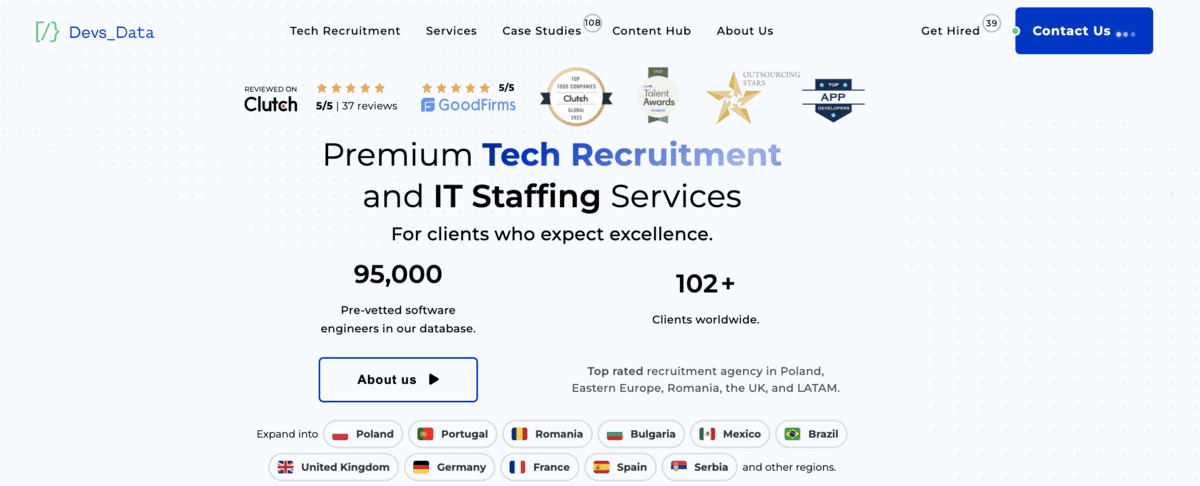
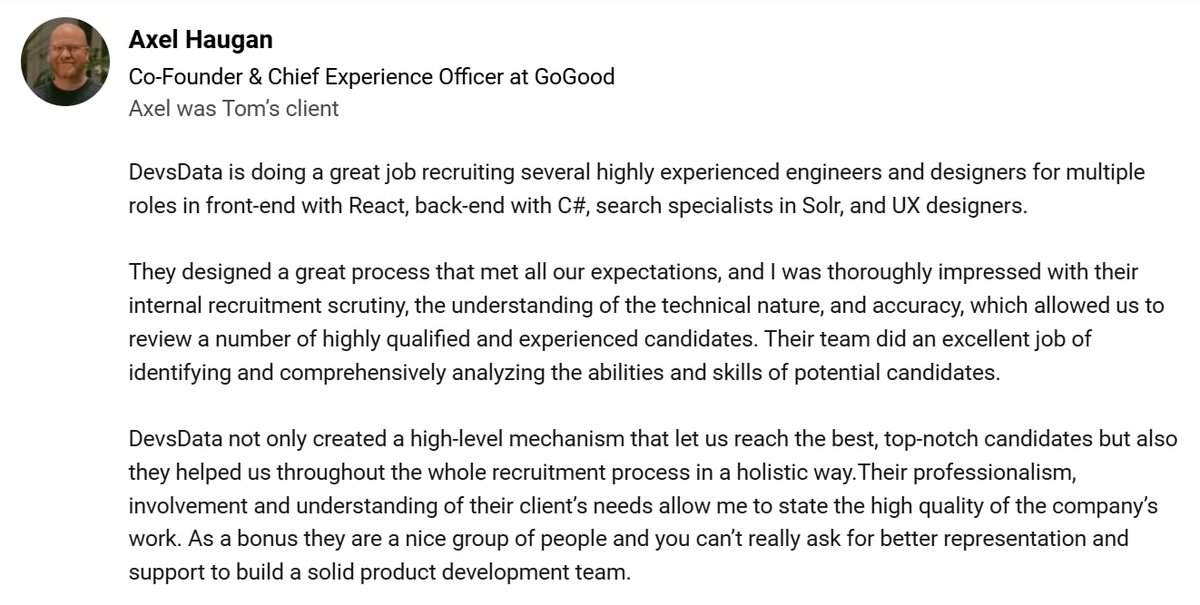
DevsData LLC has spent over 10 years refining its approach to contract developer recruitment. With a database of 95000+ pre-screened professionals, a rigorous technical interview process, a success-fee model with placement guarantees, and cross-border expertise spanning Europe, North America, and Latin America, we are positioned to help companies find the right developers under the right contractual structure. Clients who have gone through that process have documented their experience publicly: DevsData LLC holds a 5/5 rating on Clutch and a comparable standing on GoodFirms, with reviews that speak to both the technical quality of placements and the reliability of the engagement process
For organizations evaluating contract hiring, the first step is a clear understanding of the role, the required engagement model, and the regulatory environment. The second step is to recruit a partner with the ability to deliver qualified candidates quickly, vet them thoroughly, and support the contractual framework that makes the engagement work.
Do you have IT recruitment needs?
As regulatory scrutiny increases across the US, Europe, and the markets in between, the companies with well-structured contract arrangements and experienced recruitment partners are the ones best positioned to keep using this model without disruption.
The companies that get the most out of this model are those that treat contract hiring with the same rigor they apply to permanent recruitment. Clear scope definitions, well-drafted contracts, structured onboarding, and thorough technical vetting are not optional steps. They are what separate a productive, long-lasting engagement from one that ends in disputes or disappointing results.
Companies that invest in proper classification, compliant contracts, and experienced recruitment partners position themselves to benefit from the flexibility of contract hiring without exposing their organizations to legal or financial risk.
Discover how IT recruitment and staffing can address your talent needs. Explore trending regions
like Poland, Portugal, Mexico, Brazil and more.
 Frequently asked questions (FAQ)
DevsData – your premium technology partner
DevsData is a boutique tech recruitment and software agency. Develop your software project with veteran engineers or scale up an in-house tech team of developers with relevant industry experience.
Free consultation with a software expert
🎧 Schedule a meeting
FEATURED IN

DevsData LLC is truly exceptional – their backend developers are some of the best I’ve ever worked with.”

Nicholas Johnson
Mentor at YC, serial entrepreneur


 Build your project with our veteran developers.
Explore the benefits of technology recruitment and tailor-made software.
Learn how to source skilled and experienced software developers.
Build your project with our veteran developers.
Explore the benefits of technology recruitment and tailor-made software.
Learn how to source skilled and experienced software developers.

Rebecca Botvin

Commercial Director

Tom Potanski
Manager




Categories: Big data, data analytics | Software and technology | IT recruitment blog | IT in Poland | Content hub (blog)
















careers@devsdata.com









general@devsdata.com

"I interviewed about a dozen different firms. DevsData LLC is truly exceptional – their backend developers are some of the best I've ever worked with. I've worked with a lot of very well-qualified developers, locally in San Francisco, and remotely, so that is not a compliment I offer lightly. I appreciate their depth of knowledge and their ability to get things done quickly."

Nicholas Johnson
CEO of Orange Charger LLC,
Ex-Tesla Engineer,
Mentor at YCombinator
"DevsData reached out to us, as we've been looking to grow our engineering team in Europe and Poland. Communicating efficiently and professionally, DevsData made a strong impression with their understanding of the recruitment challenges we were facing. They designed a tailored recruitment process for our needs. I was impressed with the technical depth of their approach."

Karim Butt
Co-Founder & CTO at GlossGenius, Inc.
"Out of all the vendors we work with, DevsData clearly stands out. The quality of developers they deliver is beyond what we've received from any other vendor, and they've been able to send profile recommendations very quickly. I'm happy to be their reference for other companies from Israel and talk about their recruitment abilities and what they delivered for us."

Ran Eyal
Senior Manager at
ZIM Integrated
Shipping Services Ltd.
"DevsData demonstrated a strong degree of proactivity, taking time to thoroughly understand the problem and business perspective, and continuously suggesting performance and usability enhancements. Their app exceeded my expectations. I've worked with DevsData on numerous projects over the last 3 years and I'm very happy. Being both responsive and honest in communication."

Jonas Lee
Partner & Executive VP of Verus,
Financial LLC, Investor,
& Serial Entrepreneur
Acknowledgments