Thanks for subscribing.
Your gift is on the way.



A growing shortage of skilled developers is forcing companies to rethink how they build software. McKinsey reports that 87% of companies already face or expect talent gaps, while budgets remain tight and demand for digital transformation accelerates. Leaders are under pressure to deliver more with less, often struggling to scale their teams without delays or spiraling costs.
Agile has become the default response.
The Pulse of the Profession 2024 shows that 53% of IT companies rely on it regularly, and the State of Agile Report confirms that 71% of organizations use Agile practices across their development cycles.
Yet many firms find that simply adopting Agile internally is not enough to keep pace. This is where nearshore partnerships enter the picture. By combining Agile workflows with access to nearby talent pools, businesses close skill gaps, align working hours, and improve collaboration.
This guide explores the principles, benefits, and strategies behind nearshore Agile development. It shows how organizations can address talent shortages, improve delivery speed, and make informed decisions about the right development model for their needs.
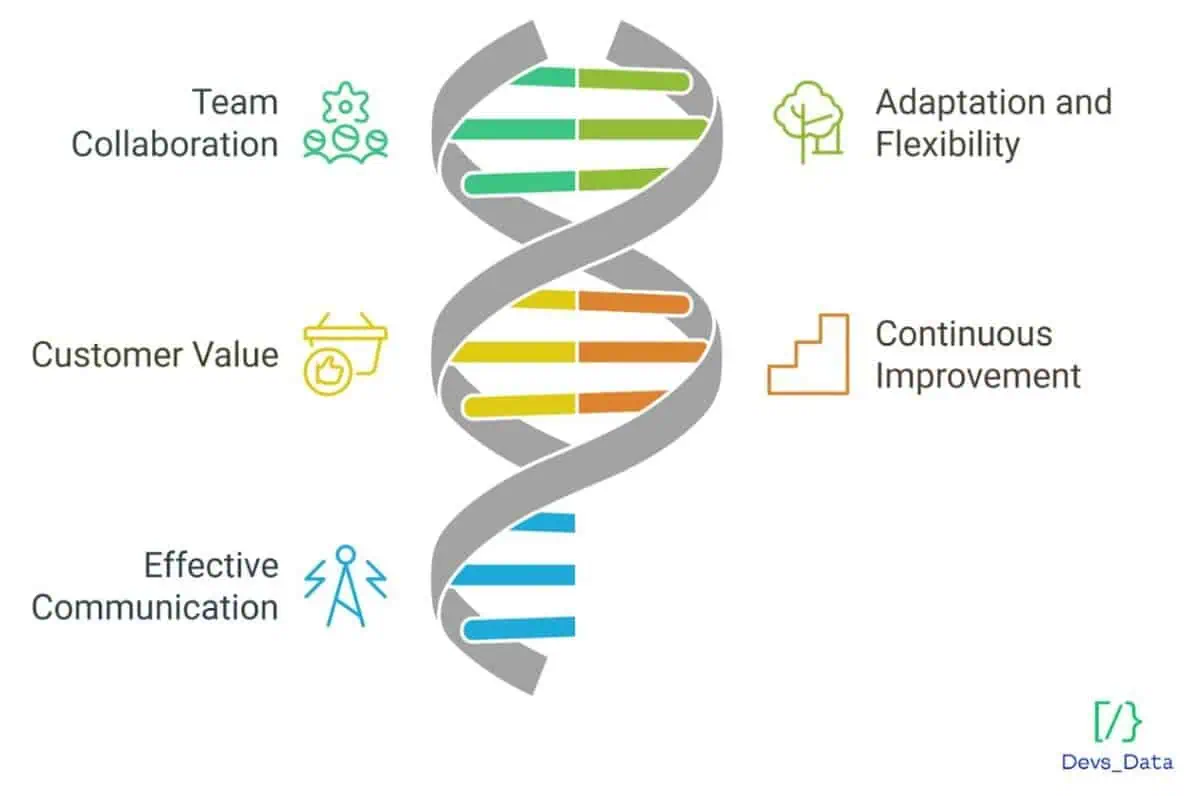
Agile is a way to organize work and deliver results in short cycles, first used widely in software development and now applied to many other types of projects. Teams release small, working parts, gather feedback, then adjust the plan for the next cycle. The focus is on steady progress, quick learning, and features that users value most. A team defines a time-boxed sprint with a narrow scope, usually 1 or 2 weeks, and holds frequent check-ins to remove blockers. At the end, they present working software so stakeholders respond to a real product, not slides. Leaders choose Agile to reduce rework and make progress visible through frequent demos.
The foundation of Agile software development rests on twelve core principles established in the Manifesto for Agile Software Development. These principles emphasize adaptability, teamwork, and delivering value to customers. Here are the essential guidelines that shape successful Agile development:
Taken together, these principles shift attention from plans on paper to learning from real outcomes and adjusting course quickly. Teams use them to align product decisions with real user needs and reduce wasted work. Predictable delivery over time follows from that discipline.
Nearshoring means working with a software team in a nearby country. Time zones overlap, travel is practical, and cultural and language gaps are smaller. For a company in Germany or the UK, Poland is a common choice. For the US, partners in Latin America fit well. The model strikes a balance. Costs are lower than hiring fully onshore, yet collaboration feels smoother than with distant offshore teams. Reviews, demos, and incident response happen inside shared working hours, so feedback loops shorten and misalignment drops.
Legal and holiday calendars are closer too, which reduces friction in everyday operations. In many setups, the product owner and Scrum Master stay in-house. The nearshore team runs sprints, daily standups, code reviews, and releases from their location, using shared tools and frequent video calls. The result is faster iteration without overnight delays and a better fit to local customer expectations.
According to Clutch, 84% of SMBs already outsource operations to external providers, with technology services among the top functions targeted.
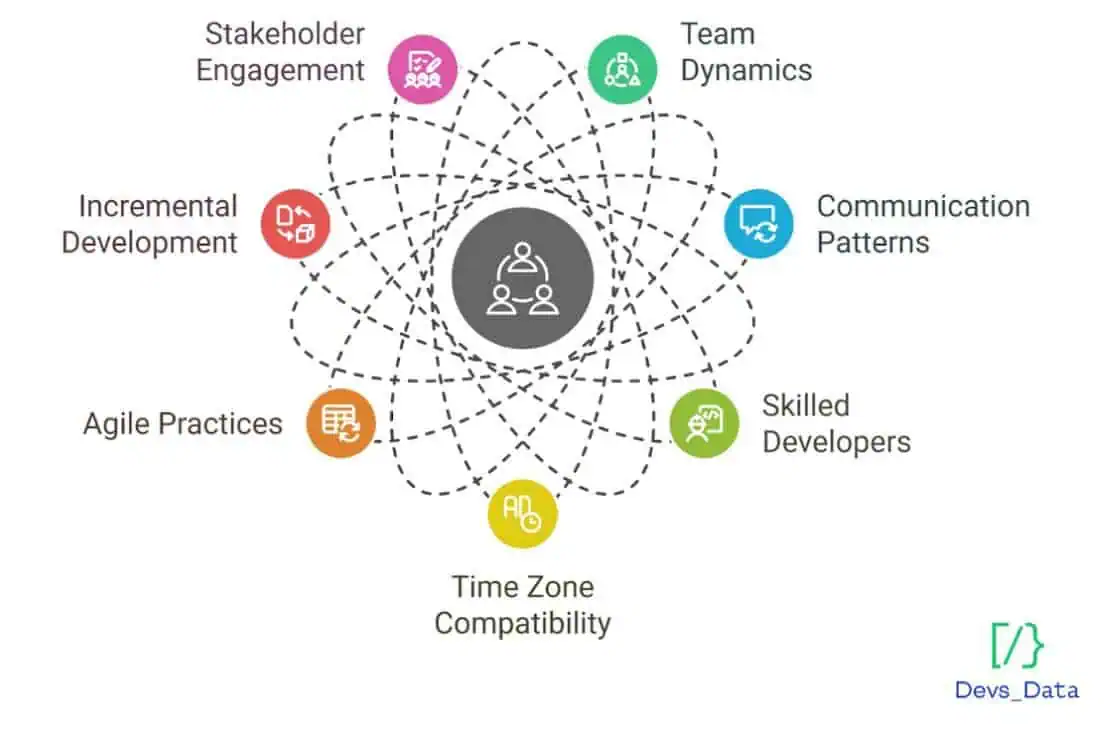
Nearshore Agile aligns nearby talent with iterative delivery to cut lag and reduce rework. The elements below describe how the model runs each day, covering people, communication, practice, and proof of progress. Use this as a quick map before the specifics.
Team dynamics
One squad works across locations under one backlog. Roles stay clear, with product decisions on the client side and delivery ownership in the nearshore squad. Trust grows through predictable routines and shared wins.
For example, a product owner in New York and engineers in Krakow review the same board every Monday and close stories against one shared sprint goal.
Communication patterns
Daily check-ins run during overlapping hours. Nuanced topics move to short video calls, while decisions land in writing for full visibility. Fewer handoffs, fewer misunderstandings.
For example, a 15-minute standup on video in the afternoon is followed by written decisions in a shared project tool so nobody loses context after handoff.
Skilled developers
Nearshore hubs supply engineers with domain depth plus strong English. Cross-functional squads include QA and DevOps from day one. Ramp-up is faster than hiring locally, yet code quality stays high.
For example, a backend developer in Portugal works with QA in Spain, and a DevOps specialist who joins from the first sprint and owns deployment scripts.
Time zone compatibility
Shared working hours keep feedback loops short. Reviews, demos, and incident response happen without overnight lag. Travel remains practical for planning or workshops.
For example, a client in London and a team in Prague share several business hours, so issues raised before noon receive a first fix or clear plan on the same day.
Agile practices
Work proceeds in short sprints with a stable cadence. The Definition of Ready and Definition of Done guide quality from the start. Continuous integration and frequent releases reduce risk.
For example, each Friday, the squad ships a minor checkout update behind a feature flag and adjusts the next sprint based on metrics from the weekend.
Incremental development
Teams ship thin slices, learn from usage, and adjust scope based on evidence. Progress stays visible, budget ties to outcomes, and waste drops.
For example, instead of releasing a full analytics module at once, the team launches a single chart, tracks adoption, then extends or removes features based on real usage.
Stakeholder engagement
Stakeholders see working software often and steer priorities through backlog order. Product decisions rely on data from users, not slide decks. Alignment improves because everyone reviews progress in real time.
For example, sales and customer success join a regular demo, request changes based on recent client calls, and reorder backlog items during the session.
Do you have IT outsourcing needs?
The mix of nearshore delivery and Agile practices creates distinct advantages. Shared hours, cultural alignment, and iterative cycles make collaboration smoother and results stronger. Below are the core benefits that stand out when the two models work together.
Agile emphasizes constant collaboration and transparency, so issues surface before they grow costly. Teams handle risks as they appear, stabilizing delivery and avoiding late-stage fixes.
Scenario: A nearshore squad shares a lightweight risk list with a client during each standup and notices rising response times after a new release. The team pauses rollout to remaining users for one sprint and fixes the performance issue before customers start opening support tickets.
Short cycles and frequent feedback let teams refine both process and product. Skills grow, and quality rises as each iteration builds on the previous one.
Scenario: After every sprint, a nearshore group reviews the cycle time with the product owner and picks one change to test, such as clearer acceptance criteria. The team records the effect on defect counts during the next sprint.
Regular interaction with stakeholders keeps features aligned with real needs. This alignment produces higher-quality products that deliver business value, not shelfware.
Scenario: During a review, stakeholders watch a new onboarding flow and describe friction points from recent customer calls. The nearshore team shifts the next sprint toward removing those barriers instead of low-impact visual tweaks.
Proximity lowers overhead, and Agile workflows reduce waste. Smart allocation of people and tools means projects hit goals without bloated budgets.
Scenario: A company keeps strategy and architecture in-house and moves feature delivery with QA to a nearshore squad in a nearby region. The leadership team tracks spend per released feature, so low-value initiatives leave the roadmap early.
Priorities shift without derailing delivery. Teams pivot quickly to new requirements, cutting the rework typical in rigid models.
Scenario: When a new regulatory rule appears mid-quarter, the product owner reorders the backlog with the nearshore team and swaps a planned marketing feature for a compliance update so the release date stays realistic.
Work is sliced into manageable segments that reach production quickly. Companies release changes sooner and gather feedback earlier from real users.
Scenario: Instead of waiting for a full portal rebuild, a client asks the nearshore squad to launch a limited version of a new dashboard to a small user group, then reviews usage data after one week to decide on expansion or redesign.
Consistent updates and open workflows keep clients informed. Visible metrics support predictable progress and honest collaboration.
Scenario: The nearshore team maintains a single digital board that shows status for every story and shares a short written summary after each standup so stakeholders understand progress without separate status meetings.
Nearshore regions offer strong engineering pools with aligned culture and time zones. This setup raises productivity and speeds problem-solving.
Scenario: A fintech firm partners with a region known for backend expertise in payments and adds several senior developers with that background to an existing in-house group. The product reaches production-readiness faster than a long local-hiring campaign.
While nearshore Agile development offers numerous advantages, organizations must navigate several key challenges to ensure project success. Understanding and preparing for these potential obstacles allows teams to implement effective strategies and maintain productive development cycles across geographical boundaries.
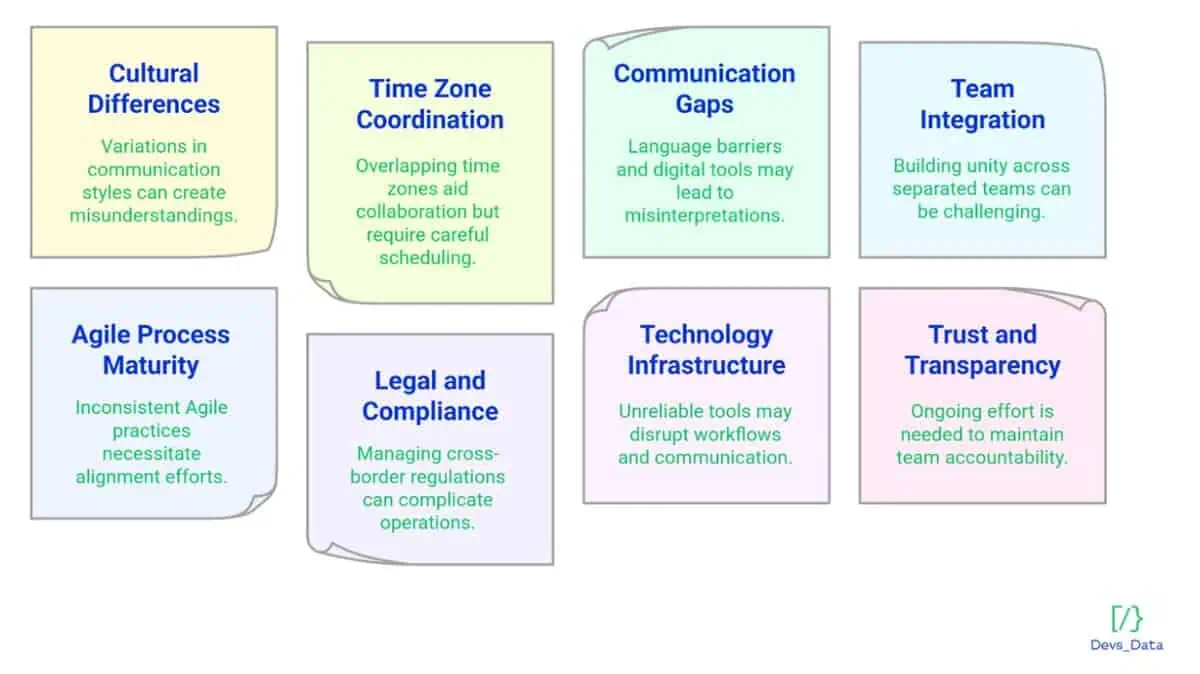
Taken together, these challenges show that nearshore Agile work depends on deliberate choices about communication and structure. When teams address them early through clear agreements and reliable tools, cross-border collaboration becomes more predictable and easier to control.
Successful nearshore Agile development depends on a small set of disciplined practices that guide work from first idea through long-term support. The focus shifts from ticking off phases to building habits that keep teams aligned, predictable, and responsive.
Clear product outcomes and backlog
The client defines concrete business outcomes and a prioritized backlog instead of a vague list of features. Nearshore leads help translate those outcomes into user stories with acceptance criteria, so every sprint links to a visible result.
Aligned ownership between the client and the nearshore team
Product direction stays with the client, execution sits with the nearshore squad. Roles, decision rights, and escalation paths are written down at project start, which prevents confusion once pressure rises.
Structured communication and overlap
Teams agree on shared working hours, standup time, and channels for urgent topics. Status lives in one place, such as a single board and summary notes after each sprint review, so stakeholders do not chase updates across tools.
Integrated quality from day one
QA and DevOps join from the first sprint instead of arriving late. Automated tests, version control rules, and deployment steps enter the Definition of Done, which prevents defects from piling up near release dates.
Data-driven planning and feedback
Velocity, defect rates, and lead time are tracked over time. The client and nearshore leads review these data points regularly and adjust scope, staffing, or process when trends move in the wrong direction.
Team continuity and knowledge retention
Core engineers stay on the product long enough to build deep context. Handover plans, shared documentation, and regular pairing sessions reduce the risk that knowledge walks away with a single person.
Support and evolution after release
Nearshore squads agree on clear support hours, response targets, and a path from bug fix to new feature work. Production insights flow back into the backlog, so the product keeps evolving instead of stalling after launch.
Selecting the right development model depends on budget, control, and access to talent. In-house teams offer direct oversight but come with high costs. Onshore partners provide smoother collaboration at a premium. Nearshore strikes a balance, giving access to skilled talent in nearby regions while keeping communication practical. Offshore delivers the lowest costs and broadest talent pool, though often with greater cultural and time zone gaps.
The table below compares these four approaches across cost, distance, collaboration, talent, and cultural alignment to help organizations weigh trade-offs.
| Factor | In-house | Onshore | Nearshore | Offshore |
|---|---|---|---|---|
| Cost | Typically high and requires long-term investment. | High labor expenses. | Moderate costs. | Lower labor expenses. |
| Geographical distance | Local presence. | Local presence. | Relatively close. | Distant location. |
| Collaboration | Direct interaction within in-house teams. | Smooth, real-time communication. | Frequent overlap with minimal delays. | Limited collaboration due to time zone differences. |
| Access to talent | Restricted to local job markets. | Restricted to local job markets. | Skilled professionals from nearby regions. | Access to a vast talent pool. |
| Cultural compatibility | Strong alignment. | Strong alignment. | Varies depending on the region. | Varies depending on the region. |
In-house and onshore setups bring strong cultural alignment and direct collaboration, yet keep costs high and talent pools restricted to one country. Nearshore models reduce expenses, extend access to skilled engineers in nearby regions, and still preserve overlapping hours for real-time work. Offshore arrangements reach the broadest pools at the lowest rates, though distance and cultural gaps demand tighter processes and documentation.
Choosing nearshore development or establishing an internal team depends on specific organizational circumstances and objectives.
A nearshore partnership proves particularly valuable when organizations face these scenarios:
Organizations that opt for internal development teams often prioritize different strategic advantages. According to a recent industry analysis, two factors stand out in maintaining in-house development: enhanced quality control and strategic capability development. The following data highlights key motivations for companies choosing insourcing over external partnerships:
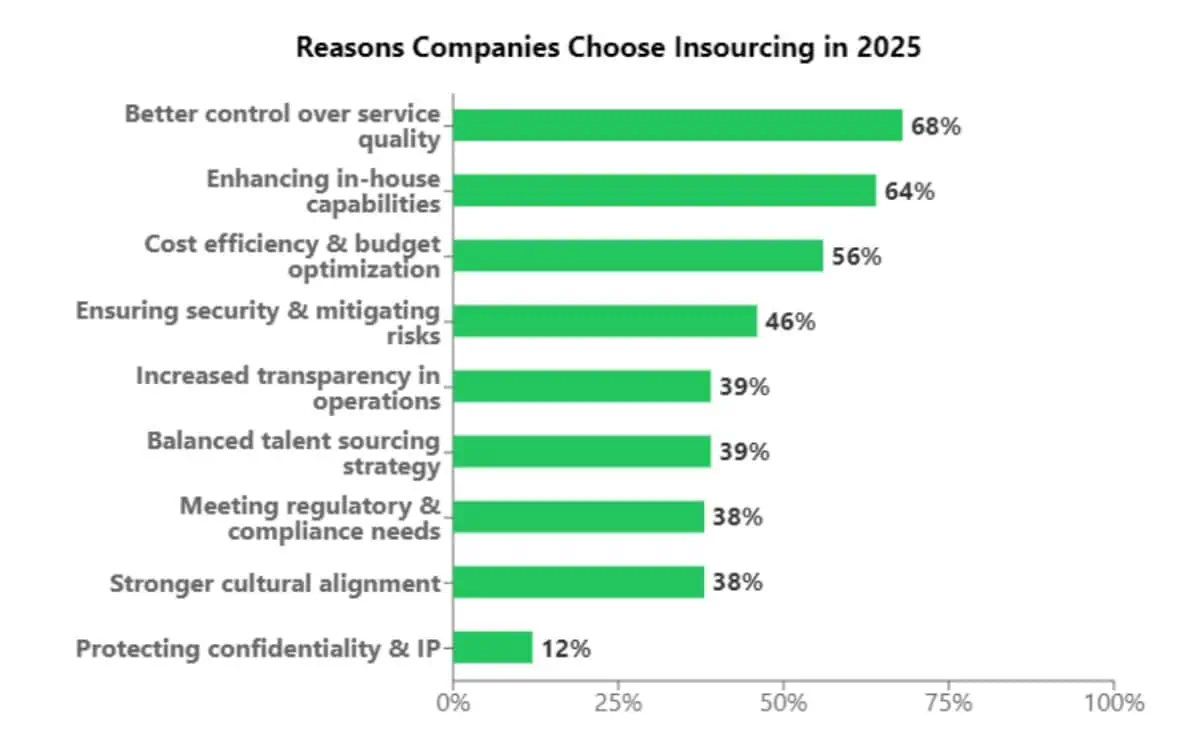
Source: Deloitte Global Outsourcing Survey 2024
Recent Deloitte Global Outsourcing Survey 2024 findings reveal shifting priorities in vendor partnership decisions. While cost reduction previously dominated decision-making, it now ranks third among key motivators. According to the survey, organizations primarily pursue partnerships to access skilled talent pools (42%), with growing customer expectations (35%) emerging as the second most significant factor.
Do you have IT outsourcing needs?
Website: www.devsdata.com
Company size: ~60 employees
Founding year: 2016
Headquarters: Brooklyn, NY, and Warsaw, Poland
Organizations seeking nearshore agile development partners benefit from collaborating with teams that combine technical expertise with systematic implementation methodologies. DevsData LLC transforms traditional nearshore development through its comprehensive approach, offering clients access to Google-level engineering talent while maintaining clear communication channels across time zones. With headquarters in Brooklyn, NY, and Warsaw, Poland, and strategic office locations throughout Latin America, DevsData LLC provides global development capabilities while maintaining the benefits of nearshore collaboration.
With over nine years of specialized experience, DevsData LLC has established a proven track record in software development, particularly excelling in nearshore agile implementations. Their technical foundation includes developers with over 10 years of experience in agile methodologies, supported by specialists in Big Data and Machine Learning applications. This expertise enables seamless integration of advanced technologies within agile development cycles.
This expertise is exemplified in their work with a pharmaceutical company that needed an advanced idea generation platform. DevsData LLC developed “iPipe,” a web platform enabling global collaboration and knowledge sharing for innovation initiatives. The system allows teams to create detailed business ideas on strategic topics, with features for feedback, challenges, and voting on the most promising concepts. Their focus on user experience and scalability led to wide organizational adoption, with the solution implemented across six divisions. The platform fostered creativity and productivity while supporting long-term strategic planning through its voting system that facilitated meaningful exchanges between managers and innovators.
The company’s US-based specialists work alongside their international team to deliver consistent results through transparent development processes. Their portfolio encompasses 100+ successfully delivered software projects for more than 80 clients worldwide, including organizations from the US and Israel. This global experience strengthens their ability to navigate cultural nuances and communication challenges often associated with nearshore development.
DevsData LLC’s approach to nearshore agile development emphasizes clear project milestones and iterative delivery. Their in-house engineers maintain systematic communication protocols that bridge geographical distances while preserving agile principles. This methodology has proven particularly effective for businesses requiring rapid development cycles without compromising code quality.
Their comprehensive understanding of nearshore development complexities and expertise enables clients to leverage advanced technical capabilities while maintaining agile practices. This balance has contributed to their consistent 5/5 client satisfaction ratings on both Clutch and GoodFirms platforms, reflecting their ability to deliver complex technical solutions through effective nearshore collaboration.
DevsData LLC provides a structured partnership model for organizations exploring nearshore agile development options, emphasizing technical excellence and clear communication. Their experience serving diverse industries, from global corporate enterprises to high-growth startups in the US and Israel, demonstrates their adaptability across business contexts and development requirements.
Key features:
For further details on DevsData LLC’s nearshore agile development services, contact them at general@devsdata.com or explore their website at www.devsdata.com.
Integrating agile methodologies with nearshore development gives organizations a powerful framework for achieving their software objectives. This strategic approach enables companies to maximize development efficiency while ensuring consistent quality across projects. Finding the right implementation partner is critical in unlocking the full potential of nearshore agile development.
DevsData LLC transforms nearshore agile development through its unique combination of expertise and proven methodologies. Their team of Google-level in-house engineers, supported by US specialists, brings over nine years of specialized experience to every project. Having successfully delivered over 100 software projects for more than 80 clients worldwide, they demonstrate consistent excellence in navigating the complexities of nearshore development while maintaining agile principles.
For further details on DevsData LLC’s nearshore development services, contact them at general@devsdata.com or visit www.devsdata.com.
Any questions or comments? Let me know on
Twitter/X.
Discover how IT recruitment and staffing can address your talent needs. Explore trending regions
like Poland, Portugal, Mexico, Brazil and more.
 Frequently asked questions (FAQ)
DevsData – your premium technology partner
DevsData is a boutique tech recruitment and software agency. Develop your software project with veteran engineers or scale up an in-house tech team of developers with relevant industry experience.
Free consultation with a software expert
🎧 Schedule a meeting
FEATURED IN

DevsData LLC is truly exceptional – their backend developers are some of the best I’ve ever worked with.”

Nicholas Johnson
Mentor at YC, serial entrepreneur


 Build your project with our veteran developers.
Explore the benefits of technology recruitment and tailor-made software.
Learn how to source skilled and experienced software developers.
Build your project with our veteran developers.
Explore the benefits of technology recruitment and tailor-made software.
Learn how to source skilled and experienced software developers.

Rebecca Botvin

Commercial Director

Tom Potanski
Manager




Categories: Big data, data analytics | Software and technology | IT recruitment blog | IT in Poland | Content hub (blog)













careers@devsdata.com









general@devsdata.com

"I interviewed about a dozen different firms. DevsData LLC is truly exceptional – their backend developers are some of the best I've ever worked with. I've worked with a lot of very well-qualified developers, locally in San Francisco, and remotely, so that is not a compliment I offer lightly. I appreciate their depth of knowledge and their ability to get things done quickly."

Nicholas Johnson
CEO of Orange Charger LLC,
Ex-Tesla Engineer,
Mentor at YCombinator
"DevsData reached out to us, as we've been looking to grow our engineering team in Europe and Poland. Communicating efficiently and professionally, DevsData made a strong impression with their understanding of the recruitment challenges we were facing. They designed a tailored recruitment process for our needs. I was impressed with the technical depth of their approach."

Karim Butt
Co-Founder & CTO at GlossGenius, Inc.
"Out of all the vendors we work with, DevsData clearly stands out. The quality of developers they deliver is beyond what we've received from any other vendor, and they've been able to send profile recommendations very quickly. I'm happy to be their reference for other companies from Israel and talk about their recruitment abilities and what they delivered for us."

Ran Eyal
Senior Manager at
ZIM Integrated
Shipping Services Ltd.
"DevsData demonstrated a strong degree of proactivity, taking time to thoroughly understand the problem and business perspective, and continuously suggesting performance and usability enhancements. Their app exceeded my expectations. I've worked with DevsData on numerous projects over the last 3 years and I'm very happy. Being both responsive and honest in communication."

Jonas Lee
Partner & Executive VP of Verus,
Financial LLC, Investor,
& Serial Entrepreneur
Acknowledgments