Thanks for subscribing.
Your gift is on the way.



The modern workplace has reshaped how we define employment, creating new opportunities beyond traditional roles. Research indicates that 29% of men and 19% of women now work outside the traditional permanent, full-time employment model, which is characterized by fixed schedules, steady salaries, and company benefits. This marks a significant shift from the conventional nine-to-five paradigm that dominated the 20th century.
“According to a 2024 Fast Company article citing FlexJobs and Owl Labs surveys, 40% of US workers would switch jobs if denied hybrid or remote options, highlighting strong demand for flexibility.”
This shift in work patterns requires employers to evaluate which employment types best align with their operational needs. In this article, we explore the various categories of employment, each with its own set of rights, responsibilities, and legal frameworks that govern the modern workplace relationship.
Employment today extends beyond the standard 9-to-5 schedule, though many professionals still value fixed hours for the stability, predictable income, and clear separation between work and personal life. While full-time positions remain important, many people now seek arrangements that offer greater flexibility and fit diverse lifestyles. Part-time, contract, freelance, and gig work have become increasingly common, giving employees more control over their schedules and career paths.
Asynchronous work takes flexibility a step further by removing the expectation that team members are online at the same hours. GitLab, which operates without physical offices and employs people in over 60 countries, published its Remote Playbook to standardize this approach.
The model relies on written documentation as the primary communication channel, with live meetings reserved for discussions that require real-time input. Companies with teams spread across time zones adopt asynchronous practices to reduce meeting fatigue and keep projects moving without waiting for overlapping work hours.
Flexible work options, including freelance, contract, and gig roles, are increasingly popular among students, parents, caregivers, and individuals with multiple commitments or planning a gradual transition into retirement. Below is a comparison of modern employment types and their benefits.
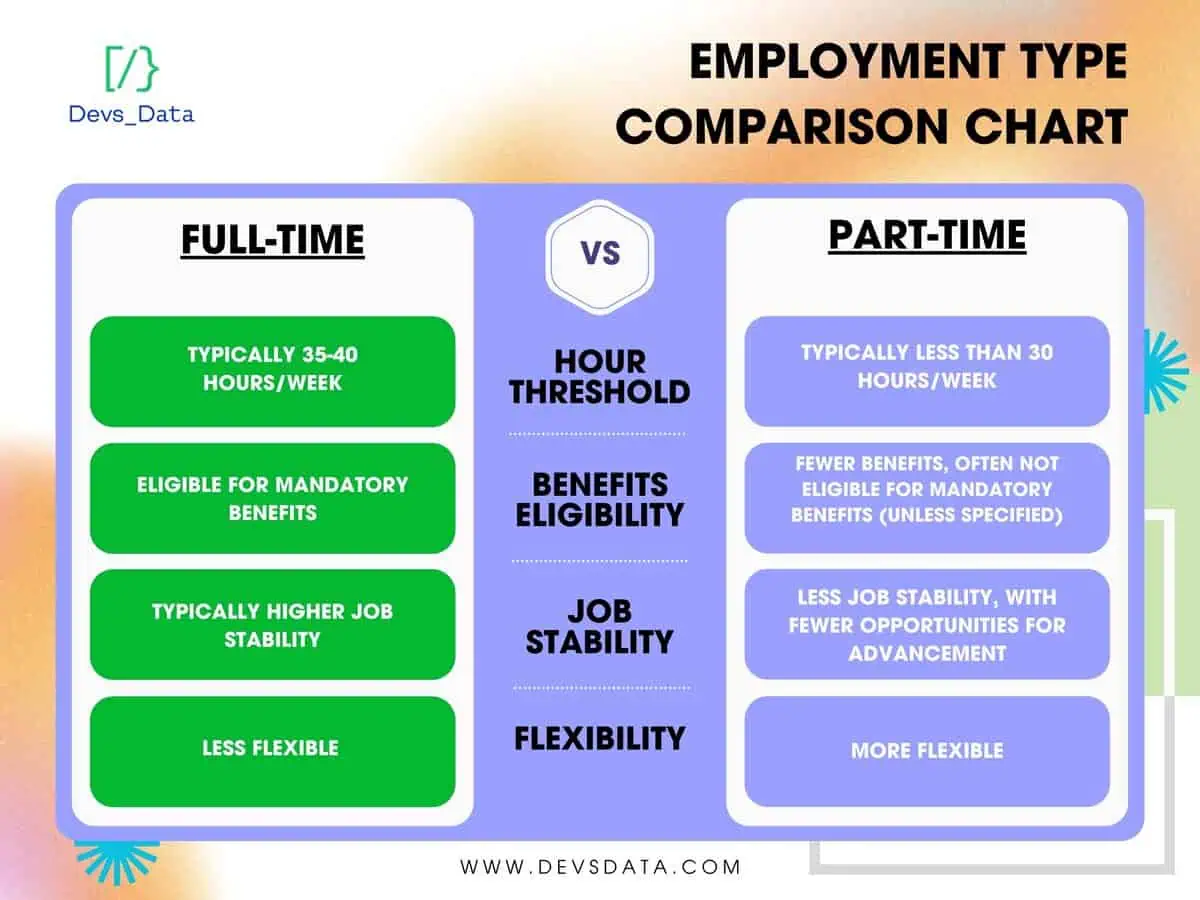
Contract, freelance, temporary, and gig roles give workers more control over schedules and projects, while employers gain access to skills without permanent commitments.
Temporary staffing plays a key role in project work, and the two most common structures differ in where management authority sits.
In staff augmentation, external professionals join the client’s team and follow its processes. The client’s Project Manager assigns tasks and reviews output as if the augmented staff were permanent hires. This arrangement closes a capacity gap without changing how the team operates day to day.
Project outsourcing transfers execution to an external firm. The client provides requirements and acceptance criteria, and the outsourcing partner takes ownership of delivery, including planning, development, and testing. Businesses that lack in-house technical leadership for a given technology stack often choose this path.
Recruitment agencies connect specialists with organizations for both approaches, matching workforce size to project demands while avoiding permanent hiring costs. Workers benefit from higher pay rates, diverse project experience, and the freedom to choose their assignments.
Multi-party employment relationships have proliferated, particularly in sectors such as construction and technology, where specialists often engage with multiple employers simultaneously. In this model, professionals may be employed by staffing agencies or similar intermediaries while working for various firms, each carrying its own responsibilities for legal compliance and workplace safety.
Dependent contractors, by contrast, typically work with a single primary client but remain legally self-employed. They function much like dedicated external staff, offering stability without formal employment. B2B professionals differ further in that they manage multiple client relationships independently, operating entirely as service providers rather than employees. This arrangement is typical in fields like consulting, IT, and design.
This shift toward non-traditional employment has also fueled the rise of freelance and independent contracting arrangements, offering professionals more autonomy over how and when they work.
Do you have recruitment needs?
The terms ‘independent contractor’ and ‘freelancer’ are often used interchangeably, though freelancer is more informal and common in creative or digital fields, while independent contractor is the broader legal category covering anyone self-employed and working on a contract basis.
“Nearly 1.57 billion people worldwide fall into this category, accounting for almost half (46.6%) of the global workforce”
This type of self-employment is prevalent in fields such as IT, marketing, media, design, consulting, logistics, and construction, which rely on specialized, project-based work. These professionals have the flexibility to choose assignments and control their workflow.
For contractors and freelancers, this model offers higher earning potential through favorable tax structures, while businesses benefit from easy access to skilled talent and simplified payment arrangements. However, independent contracting also presents challenges, including inconsistent income, a lack of employment benefits, legal complexity, and the burden of self-managing taxes, insurance, and retirement planning.
To better understand the distinct characteristics that set independent contractors apart from traditional employees, let’s examine the key differences in their working arrangements:
| Aspect | Employees | Independent contractors |
|---|---|---|
| Employment relationship | Work mainly for one employer, may have side projects | Work for multiple clients on a project basis |
| Work structure | Follow the schedules and instructions set by the employer | Decide how and when to complete tasks |
| Tools and resources | Use the tools and equipment provided by the employer | Use and maintain their own tools |
| Financial risk | Face little financial risk; expenses are usually covered | Cover their own costs and business risks |
| Benefits | Receive benefits such as healthcare and paid leave | Do not receive standard employee benefits |
| Intellectual property ownership | Work product belongs to the employer by default under employment law in most jurisdictions | IP remains with the contractor unless a written assignment clause explicitly transfers ownership to the client. Contracts without this provision create legal exposure for both parties. |
A growing number of startups and scaling companies hire senior executives on a part-time or contract basis rather than committing to a full-time C-suite salary. A Fractional CTO, for instance, sets the technical strategy, evaluates architecture decisions, and mentors the engineering team while working 10 to 20 hours per week across two or three clients. Fractional CPOs and CFOs follow the same pattern.
This model operates through B2B contracts. The executive invoices for hours worked or a fixed monthly retainer, thereby avoiding the cost of a full-time salary that early-stage budgets rarely support. Startups gain access to leadership experience that would otherwise be out of reach, while the Fractional Executive builds a portfolio of advisory roles without the single-employer commitment required by a permanent position.
Businesses should evaluate their operational needs, considering work volume, project duration, and required skill sets. The rise of hybrid working models and technological advancements in 2024 has created more flexibility in employment forms, from full-time permanent positions to gig economy contractors. Companies must also assess their ability to provide benefits, including healthcare, paid vacation, and sick leave, which vary significantly between employment types.
Organizations must consider employee well-being, upskilling opportunities, and cybersecurity requirements when making decisions. The cybersecurity dimension deserves particular attention for roles filled by contractors. Unlike permanent staff who receive company-managed devices, contractors typically use personal laptops with inconsistent security configurations. Source code repositories, client databases, and internal communication channels accessed from unmanaged hardware represent a data governance gap that grows with each external engagement.
Virtual Desktop Infrastructure (VDI) mitigates this risk by hosting the work environment on company servers. The contractor views and interacts with the desktop remotely, but no files are stored locally. Mobile Device Management (MDM) takes a different approach by installing a management profile on the contractor’s device to enforce encryption, restrict application installs, and enable remote wipe. Companies selecting between VDI and MDM weigh the sensitivity of the data against the cost and friction each solution introduces for the contractor’s workflow.
The modern workplace demands a balance between organizational efficiency and workforce preferences, as employees increasingly seek flexibility and work-life balance.
“Businesses opt for temporary staffing or independent contractors for specialized projects or temporary needs, while core operations require full-time permanent employees.”
The decision should align with immediate operational needs and long-term strategic goals, while ensuring compliance with industry regulations and employment laws.
An Employer of Record (EoR) is a third-party organization that legally employs workers on behalf of another company. This arrangement allows businesses to hire full-time staff in countries where they have no registered legal entity, with the EoR handling payroll, tax filings, and compliance with local labor law.
The table below summarizes the pros and cons of traditional and gig-based employment:
| Aspect | Traditional employment | Gig/Independent contracting | Employer of Record (EoR) |
|---|---|---|---|
| Hiring flexibility | Less flexible, termination may require notice or severance | Highly flexible, contracts can end quickly | Hire full-time staff abroad without a local entity |
| Employment costs | Higher total costs (salary, benefits, insurance, taxes) | Lower overall cost, pay only for work delivered | Salary plus statutory benefits plus EoR management fee |
| Administrative burden | Ongoing payroll, benefits, and compliance management | Minimal administration, fewer ongoing obligations | EoR handles payroll, tax, and local compliance |
| Control over work | Direct supervision; can set working hours and methods | Less direct control; only the outcome and deadlines matter | Client directs daily work; EoR holds the legal contract |
| Legal obligations | Must comply with labor laws, provide benefits, and risk of legal disputes | Fewer legal requirements, less risk of labor claims | EoR assumes local labor law compliance |
| Retention | Typically, long-term relationships, investment in training | Short-term or project-based, limited retention focus | Full-time status with benefits supports retention |
| Talent access | Limited to available employees or local hires | Access to a broader, often global talent pool | Global hiring, limited by EoR country coverage |
Determining the right employment model can be complex, especially for companies navigating hybrid structures or scaling across regions. DevsData LLC offers tailored consultations to help organizations assess their needs and select the most effective employment structure for each role.
Website: www.devsdata.com
Team size: ~60 employees
Founded: 2016
Headquarters: Brooklyn, NY, and Warsaw, Poland
Partnering with a recruitment agency offers several advantages for your hiring process. Agencies have access to a vast talent pool and can quickly identify suitable candidates for your open positions, saving you valuable time. Their recruitment expertise covers the entire hiring process, from sourcing candidates to scheduling interviews. DevsData handles all employment types – full-time, B2B, temporary, and project-based work – while providing market insights and salary benchmarks for each model. This comprehensive approach helps businesses find the right talent for any employment structure.
DevsData LLC distinguishes itself in this landscape with over ten years of specialized experience and a comprehensive database of 95000 pre-screened professionals. Their rigorous selection process, including 90-minute technical interviews and problem-solving assessments, results in an acceptance rate of less than 6%, ensuring only the highest caliber candidates are presented to clients. With headquarters in New York and Warsaw, they leverage their international presence to connect businesses with top talent across various regions and employment arrangements.
The agency’s impressive track record spans diverse clients, from hedge funds to innovative startups, including countries like the US and Israel. Its consistent 5/5 client satisfaction rating on platforms like Clutch and GoodFirms reflects its commitment to excellence in talent acquisition. Operating with a government-approved recruitment license, DevsData LLC maintains transparent communication throughout the hiring process, ensuring successful matches between clients and candidates, whether for temporary positions, independent contracting roles, or other flexible work arrangements.
Building on this record of successful placements, DevsData LLC supported a global fashion corporation undergoing a $9 million digital transformation to counter declining revenues and increasing competition. The agency sourced elite specialists in machine learning, UX/UI design, and logistics, assembling remote and on-site teams from the US, Canada, Germany, and Sweden. These professionals helped develop intelligent pricing and logistics tools, transforming internal operations and exceeding the company’s first-year performance goals.
Do you have recruitment needs?
For further details on DevsData LLC’s services, contact them at general@devsdata.com or explore their website at www.devsdata.com.
The evolution of employment types reflects the dynamic nature of today’s workforce, where traditional and flexible arrangements coexist to meet diverse organizational needs. As businesses navigate these various employment structures, the ability to choose and implement a suitable employment model has become crucial for managerial success and sustainable growth.
DevsData LLC stands at the forefront of modern recruitment solutions, leveraging its database of 95000 pre-screened professionals and eight years of specialized experience. Their impressive client portfolio spans hedge funds, multinational corporations, and innovative startups across the US and Israel, including prominent names like Cubus, Skycatch, Varner, and Novartis. With headquarters in New York and Warsaw, DevsData serves clients worldwide through a rigorous selection process and comprehensive technical assessments, having completed over 80 successful partnerships. Their acceptance rate of less than 6% ensures only the highest caliber candidates are presented to clients, maintaining their reputation for excellence in talent acquisition.
Any questions or comments? Let me know on Twitter/X.
Discover how IT recruitment and staffing can address your talent needs. Explore trending regions like Poland, Portugal, Mexico, Brazil and more.
 Frequently asked questions (FAQ)
DevsData – your premium technology partner
DevsData is a boutique tech recruitment and software agency. Develop your software project with veteran engineers or scale up an in-house tech team of developers with relevant industry experience.
Free consultation with a software expert
🎧 Schedule a meeting
FEATURED IN

DevsData LLC is truly exceptional – their backend developers are some of the best I’ve ever worked with.”

Nicholas Johnson
Mentor at YC, serial entrepreneur


 Build your project with our veteran developers.
Explore the benefits of technology recruitment and tailor-made software.
Learn how to source skilled and experienced software developers.
Build your project with our veteran developers.
Explore the benefits of technology recruitment and tailor-made software.
Learn how to source skilled and experienced software developers.

Rebecca Botvin

Commercial Director

Tom Potanski
Manager




Categories: Big data, data analytics | Software and technology | IT recruitment blog | IT in Poland | Content hub (blog)















careers@devsdata.com









general@devsdata.com

"I interviewed about a dozen different firms. DevsData LLC is truly exceptional – their backend developers are some of the best I've ever worked with. I've worked with a lot of very well-qualified developers, locally in San Francisco, and remotely, so that is not a compliment I offer lightly. I appreciate their depth of knowledge and their ability to get things done quickly."

Nicholas Johnson
CEO of Orange Charger LLC,
Ex-Tesla Engineer,
Mentor at YCombinator
"DevsData reached out to us, as we've been looking to grow our engineering team in Europe and Poland. Communicating efficiently and professionally, DevsData made a strong impression with their understanding of the recruitment challenges we were facing. They designed a tailored recruitment process for our needs. I was impressed with the technical depth of their approach."

Karim Butt
Co-Founder & CTO at GlossGenius, Inc.
"Out of all the vendors we work with, DevsData clearly stands out. The quality of developers they deliver is beyond what we've received from any other vendor, and they've been able to send profile recommendations very quickly. I'm happy to be their reference for other companies from Israel and talk about their recruitment abilities and what they delivered for us."

Ran Eyal
Senior Manager at
ZIM Integrated
Shipping Services Ltd.
"DevsData demonstrated a strong degree of proactivity, taking time to thoroughly understand the problem and business perspective, and continuously suggesting performance and usability enhancements. Their app exceeded my expectations. I've worked with DevsData on numerous projects over the last 3 years and I'm very happy. Being both responsive and honest in communication."

Jonas Lee
Partner & Executive VP of Verus,
Financial LLC, Investor,
& Serial Entrepreneur
Acknowledgments