Thanks for subscribing.
Your gift is on the way.



Software development is accelerating as a profession and industry. In the United States alone, employment of software developers, quality assurance analysts, and testers is projected to grow 15% between 2024 and 2034, nearly four times faster than the average across all occupations. As a result, software development has gained significant momentum over the past few decades, becoming a critical driver of innovation across industries. According to SlashData’s Developer Nation report, the total number of developers worldwide reached approximately 47.2 million as of early 2025.
This significant growth highlights the rapidly expanding role of software-related positions in the economy. It underscores the urgency for organizations to establish well-structured teams that can attract, manage, and retain the growing talent pool, ensuring efficient collaboration, reliable project delivery, and alignment with business objectives.
To meet this demand, organizations must build efficient and well-structured software development teams. In this article, we’ll explore how software development teams are structured and examine the key factors that contribute to their success. Our goal is to help you navigate the complexities of building effective teams that foster innovation and support sustainable growth.
The strength of a software development team lies not just in the skills of its individual members, but in how effectively those skills are organized and aligned. A well-structured team provides clarity on responsibilities, prevents duplication of effort, and ensures that design, coding, testing, and deployment activities work together seamlessly. When structure is lacking, even highly talented groups can face miscommunication, delays, and costly inefficiencies. Core team members typically include project managers, frontend and backend developers, DevOps engineers, UI/UX designers, and quality assurance testers. Their shared goal is to deliver scalable, secure, and high-performing software solutions.
However, success in software development depends on more than just technical skills; it requires a well-organized team structure.
Without clearly defined roles, responsibilities, and workflows, even highly skilled teams can encounter miscommunication, project delays, and inefficiencies. A structured approach eliminates confusion, streamlines collaboration, and creates accountability. It helps each team member understand how their work contributes to the bigger picture, leading to more focused execution and better results.
The benefits of a well-structured team are backed by data:
According to a study by McKinsey, well-structured development teams are 30% more productive than loosely organized ones, allowing businesses to deliver software faster and more reliably.
A Gallup study found that employees who strongly agree they know what is expected of them are 27% more likely to report “excellent” performance in their roles. A clear structure directly enhances this understanding, boosting job satisfaction and morale.
According to the Society for Human Resource Management (SHRM), organizations with a strong onboarding process improve new hire retention by 58% and productivity by over 50%, facilitating smoother scaling and growth.
The Project Management Institute (PMI) reports that inaccurate requirements gathering is a primary cause of project failure, accounting for 37% of such instances. Effective team structuring addresses this issue by ensuring clear goals and role clarity.
In summary, an effective team structure is foundational to building resilient, high-performing development teams capable of adapting to changing needs, managing complexity, and delivering measurable business value.
When forming a software development team, one of the most important decisions is choosing the right project management style. This choice directly impacts how the team is structured, how responsibilities are distributed, and how collaboration unfolds throughout the project lifecycle.
Broadly, project management approaches fall into two main categories: traditional (Waterfall) and Agile. Each has its own methodology variants, suited to different types of projects, team dynamics, and business needs.
| Approach | Team structure characteristics |
|---|---|
| Waterfall | Hierarchical, function-specific teams; rigid handoffs; separation by role and phase. |
| Agile (Scrum, XP, Kanban, etc.) | Cross-functional, empowered teams working in timeboxed iterations; shared responsibility across roles. |
| Scaled Agile (SAFe, LeSS) | Multiple Agile teams aligned via program-level roles; hybrid structure combining cross-functional squads with portfolio governance. |
Waterfall is a linear, phase-driven approach where each stage i.e., requirement analysis, planning, design, development, testing, and deployment follows the previous one without overlap. It works best when the project scope is fixed and predictable, such as in government contracts, banking systems, or medical devices, where strict documentation and regulatory compliance are essential. Teams in Waterfall environments tend to be siloed, with roles like analysts, developers, and testers working sequentially. Decision-making is centralized, often led by a project manager, and communication follows a top-down model.
Agile emphasizes adaptability, continuous feedback, and rapid delivery. Work is done in short iterations, allowing teams to adjust quickly to changing requirements and user feedback. It’s particularly effective in fast-evolving industries like eCommerce, FinTech, and consumer apps, where products need to respond quickly to user behavior or market shifts.
Agile isn’t a single method; it includes several frameworks:
Across all Agile models, teams are typically flat, collaborative, and built around shared ownership of outcomes.
Scaled Agile frameworks like SAFe (Scaled Agile Framework) and LeSS (Large-Scale Scrum) extend Agile principles to large organizations running multiple teams in parallel. These approaches align several cross-functional squads under program-level roles, portfolio governance, and shared objectives. They combine the adaptability of Agile with structured coordination mechanisms, ensuring consistent delivery across distributed teams while maintaining a unified product vision. For example, a global telecom company rolling out a 5G platform might use SAFe to coordinate dozens of teams working on network infrastructure, customer apps, and security modules simultaneously. This ensures that while each squad delivers in short iterations, the overall program remains strategically aligned and integrated.
A 2023 study comparing structured and Agile teams found that Agile teams exhibited stronger team cohesion and improved productivity, though sometimes at slight trade-offs in functional sufficiency or documentation quality. Agile leadership, rooted in trust, autonomy, and continuous feedback, has been shown to enhance innovation efficiency, team effectiveness, and employee performance in empirical studies.
Selecting the right project management approach is not a one-size-fits-all decision; it depends on your project’s complexity, industry requirements, team composition, and the degree of flexibility you need. Each model offers distinct advantages and trade-offs, so it’s important to evaluate them in the context of your goals, constraints, and stakeholder expectations. Opt for Waterfall when working in regulated environments with predictable requirements, where documentation and sequential control are key. Choose Agile when flexibility, rapid feedback, and iterative delivery are essential, especially in fast-evolving product contexts. For enterprise-scale environments, Scaled Agile (SAFe, LeSS, etc.) can help maintain alignment across multiple Agile teams and strategic priorities.
Do you have IT outsourcing needs?
Once you choose the management approach that best suits your company, you can focus on the specifics of building your team. Below, we will explore the three common types of software development team structures you might want to consider.
In this software development team structure, professionals bring diverse skill sets and experience from various areas of software development. Their expertise allows them to contribute to different aspects of the project, from frontend and backend coding to testing, deployment, and even basic design work. This versatility enables teams to adapt quickly to shifting priorities and resource constraints, making generalist-heavy teams especially valuable in early-stage startups or projects where requirements are still evolving. However, while they excel in flexibility and problem-solving across domains, generalists may lack the deep specialization required for highly complex or niche technical challenges.
In a specialist team structure, the team consists of professionals who focus solely on one area of software development, such as frontend development, backend development, or quality assurance. This structure can be an excellent fit for mid-budget companies because it allows for highly focused expertise within each specialized area, reducing the need for broad skill sets across the team. As a result, these companies can achieve higher efficiency and quality in specific aspects of the project while managing costs more effectively.
A hybrid team structure combines the deep expertise of specialists with the flexibility of generalists. This approach enables companies to benefit from specialized knowledge in key areas, such as backend development or UI/UX design, while also having team members who can handle a variety of tasks across different domains. The hybrid model offers a balanced solution, making it ideal for organizations looking to scale efficiently. It allows businesses to address complex challenges while maintaining the flexibility to adapt to changing needs and priorities without overburdening the team.
| Team structure | Description | Strengths | Best for |
|---|---|---|---|
| Generalist | Team members have broad skills across multiple areas of development. | – High flexibility; – Easier collaboration; – Good for early-stage startups. |
Small teams, MVPs, or early-phase projects where adaptability is key. |
| Specialist | Team members focus on a specific area (e.g., frontend, backend, QA). | – Deep expertise; – Higher quality in specialized areas; – Efficient execution within domains. |
Mid- to large-sized projects needing precision and technical depth. |
| Hybrid | Mix of generalists and specialists working together. | – Balanced expertise and flexibility; – Scalable and adaptable; – Efficient for complex, evolving projects. |
Companies looking to scale or handle diverse, fast-changing project demands. |

Successful software development goes beyond coding, relying on a team of specialists whose complementary skills align to achieve a common objective. Each role, from project management to design, development, operations, and testing, contributes a unique perspective that shapes the final product. Clear role definitions ensure accountability, smoother collaboration, and higher-quality outcomes.
Below is a breakdown of the core roles typically found in a high-performing software development team and how they interact throughout the development lifecycle:
The Project Manager is the central coordinator of the development process. In Agile contexts, some of the PM’s responsibilities are redistributed. A Scrum Master facilitates Agile ceremonies and team efficiency, while a Product Owner manages priorities and backlog. However, in larger or hybrid setups, a PM may still play a broader coordinating role across multiple teams or external stakeholders.
Responsibilities:
Collaboration:
PMs interact daily with all team members to ensure alignment and resolve blockers while also managing stakeholder expectations and client communication.
In Agile teams, the Product Owner (PO) is accountable for defining the product vision, setting priorities, and ensuring the team delivers value aligned with business goals.
Responsibilities:
Collaboration:
The PO works closely with developers, designers, and the Scrum Master to translate business objectives into actionable user stories and to validate outcomes against stakeholder expectations.
In more traditional setups, the Business Analyst (BA) plays a similar but slightly broader role in bridging business and technology. BAs are often responsible for gathering, analyzing, and documenting requirements in detail, especially where projects demand extensive upfront planning.
Responsibilities:
Collaboration:
BAs typically work with PMs, system architects, and QA to ensure requirements are fully understood and accurately implemented.
Frontend developers focus on the user interface and experience, building everything the user sees and interacts with.
Responsibilities:
Collaboration:
They work closely with designers and backend developers to ensure a seamless connection between visual design and backend logic.
Backend developers manage the core functionality, data processing, and integration of the application.
Responsibilities:
Collaboration:
Collaborates with frontend developers and DevOps engineers to build scalable and robust systems.
DevOps engineers bridge the gap between development and operations, focusing on automation, infrastructure, and deployment.
Responsibilities:
Collaboration:
DevOps works across the development team to streamline deployment and ensure the product is stable and scalable from development to production.
Designers play a vital role in shaping the user journey and ensuring visual consistency.
Responsibilities:
Collaboration:
Designers collaborate early with product owners and PMs, and then work closely with frontend developers to implement their designs.
QA engineers are responsible for testing the product to identify bugs, usability issues, and performance bottlenecks.
Responsibilities:
Collaboration:
They work alongside developers throughout the development process and provide feedback loops before release.
A high-functioning software team operates as an interconnected unit, where collaboration replaces silos. Each role contributes to an ongoing feedback loop that drives the product forward:
Beyond the core team, successful delivery also hinges on proactive communication with external stakeholders, including investors, executive leadership, clients, and end users. These stakeholders shape priorities, provide feedback, and often influence funding and strategic direction. It’s the responsibility of roles like the Product Owner and PM to ensure that stakeholder needs are understood, prioritized, and effectively translated into the product roadmap.
Effective collaboration strategies, such as daily standups, sprint planning, stakeholder demos, and cross-functional retrospectives, keep the team aligned, responsive, and accountable. Clear role definitions don’t just improve efficiency; they also foster a culture of ownership, transparency, and shared responsibility.

The structure of your team directly affects its ability to communicate effectively, adapt to change, and deliver quality outcomes on time.
Building a high-performing software development team goes beyond simply hiring talented individuals. It requires thoughtful structuring, a focus on collaboration, and the right processes to ensure long-term scalability and alignment with business goals.
Below are actionable best practices that companies can follow to create efficient, scalable, and collaborative software development teams:
Start by understanding the scope, complexity, and timeline of the project. A startup MVP may benefit from a generalist-heavy team, while a large enterprise platform may require a specialist-heavy or hybrid structure.
Tip: Use a hybrid team model when building complex or evolving systems, as it offers the flexibility to scale and the expertise to solve domain-specific challenges.
Ensure that teams are composed of professionals with complementary skills, such as developers, designers, QA engineers, and DevOps, working toward shared objectives.
Tip: Facilitate regular cross-functional ceremonies (e.g., sprint planning, reviews, and retrospectives) to keep communication transparent and decisions collaborative.
Ambiguity in roles leads to duplicated effort or missed tasks. Clearly define the responsibilities of each role and establish ownership of specific components, features, or deliverables.
Tip: Maintain a RACI matrix (Responsible, Accountable, Consulted, Informed) for clarity and accountability across functions.
Empower teams to take ownership of outcomes, not just tasks. When teams are given autonomy along with clear KPIs or OKRs, they make better decisions and deliver higher value.
Tip: Avoid micromanagement, focus on defining clear goals, and let the team determine the best approach to execution.
Use well-defined channels and tools to prevent communication breakdowns, especially in distributed or hybrid setups.
Tip: Combine async tools (e.g., Slack, Notion, Jira) with regular sync points (e.g., standups, demos) to keep teams aligned without constant interruptions.
Teams grow faster and become more resilient when knowledge is shared openly. Foster a culture of documentation and mentoring, especially during onboarding or team scaling.
Tip: Implement a shared knowledge base (such as Confluence or Notion) where team members contribute best practices, architecture decisions, and coding standards.
As projects evolve, so should your team structure. Regularly assess whether the current setup is still aligned with business needs, timelines, and technical challenges.
Tip: Conduct quarterly team structure reviews to ensure the right mix of roles, capacity, and skills are in place for upcoming priorities.
Do you have IT outsourcing needs?
Website: www.devsdata.com
Company size: ~60 employees
Founding year: 2016
Headquarters: Brooklyn, NY, and Warsaw, Poland
DevsData LLC, established in 2016, is a software development company renowned for its innovative approach to building highly efficient, well-structured development teams. In terms of its team structure, the company incorporates the hybrid model and has both in-house professionals and remote outsourced talent who deliver exceptional software solutions.
With over nine years of experience, DevsData LLC specializes in building tailored, high-performing software development teams that align closely with each client’s unique technical and business goals. Rather than offering one-size-fits-all solutions, the company focuses on deeply understanding each project’s requirements, technical stack, domain context, team dynamics, and scalability needs, before assembling a custom team from its vetted network of top-tier engineers.
The teams assembled by DevsData LLC span core areas such as mobile and web app development, cloud infrastructure, DevOps, AI, big data, and machine learning, and are often distributed across the US and Europe to combine deep domain expertise with timezone-aligned collaboration. The company has successfully supported clients across the globe, from hedge funds to fast-scaling startups in Israel and the US, by building dedicated teams that operate as seamless extensions of their internal operations. This approach ensures faster ramp-up, tighter alignment, and long-term delivery excellence.
What makes the company stand out among its peers is its flexible and personalized approach. It offers competitive pricing for its services as there are no overhead costs. The company’s extensive experience and expertise in the industry make it a top choice for software development.
Furthermore, DevsData LLC has successfully partnered with many companies worldwide. Moreover, it heavily concentrates on client satisfaction, as reflected in its public testimonials. It also enjoys a perfect 5/5 rating on Clutch and GoodFirm, showcasing its commitment to quality services worldwide.
One notable case involved a collaboration between DevsData LLC and an international fashion corporation navigating a complex digital transformation. A key challenge was structuring a cohesive team that could operate across different business units, brand silos, and technical domains. DevsData LLC responded by carefully assembling a cross-functional team of machine learning experts, senior UX/UI designers, and experienced developers, each selected for their domain fit and collaborative capabilities.
Close attention was given to team composition, communication flow, and aligning Agile processes with the client’s internal structure. Despite the complexity, the team quickly established a high-velocity development rhythm and delivered a unified online platform that integrated all brands and streamlined eCommerce operations. Key features included a pricing strategy BI tool powered by NLP, and a logistics module that optimized fleet performance. This collaboration highlights how DevsData LLC excels not only at software development but also at building well-structured, high-performing teams capable of executing complex, business-critical initiatives with precision and speed.
Key features:
Do you have IT outsourcing needs?
Learn more about DevsData LLC at www.devsdata.com or reach their team directly at general@devsdata.com.
Building a well-structured software development team is crucial for ensuring project success. It enhances efficiency, boosts performance, and leads to high-quality outcomes. It is vital to recognize that each role within the team, from developers and testers to project managers, plays a vital role in having streamlined workflows.
Navigating the complexities of a software development team and establishing a clear organizational structure allows companies to enhance productivity.
This approach helps deliver solutions that meet the unique needs of their clients.
By leveraging a well-structured software development team, companies like DevsData LLC empower businesses to enhance their project efficiency, streamline workflows, and deliver high-quality solutions. With a keen focus on balancing specialized expertise and collaborative teamwork, the company ensures that every project is executed with precision, meeting the unique needs of its clients. This approach helps businesses thrive in a competitive landscape, driving innovation and delivering results that maximize value and operational efficiency.
DevsData LLC has successfully partnered with many companies worldwide. The company places a strong emphasis on client satisfaction as reflected in its public testimonials. It also enjoys a perfect 5/5 rating on Clutch and GoodFirm, showcasing its commitment to quality services worldwide.
Ultimately, a well-structured development team is essential for translating strategic objectives into effective execution. It is the foundation for building software that not only functions reliably but also delivers lasting value.
Discover how IT recruitment and staffing can address your talent needs. Explore trending regions
like Poland, Portugal, Mexico, Brazil and more.
 Frequently asked questions (FAQ)
DevsData – your premium technology partner
DevsData is a boutique tech recruitment and software agency. Develop your software project with veteran engineers or scale up an in-house tech team of developers with relevant industry experience.
Free consultation with a software expert
🎧 Schedule a meeting
FEATURED IN
DevsData LLC is truly exceptional – their backend developers are some of the best I’ve ever worked with.”

Nicholas Johnson
Mentor at YC, serial entrepreneur


 Build your project with our veteran developers.
Explore the benefits of technology recruitment and tailor-made software.
Learn how to source skilled and experienced software developers.
Build your project with our veteran developers.
Explore the benefits of technology recruitment and tailor-made software.
Learn how to source skilled and experienced software developers.

Rebecca Botvin

Commercial Director

Tom Potanski
Manager




Categories: Big data, data analytics | Software and technology | IT recruitment blog | IT in Poland | Content hub (blog)










careers@devsdata.com









general@devsdata.com

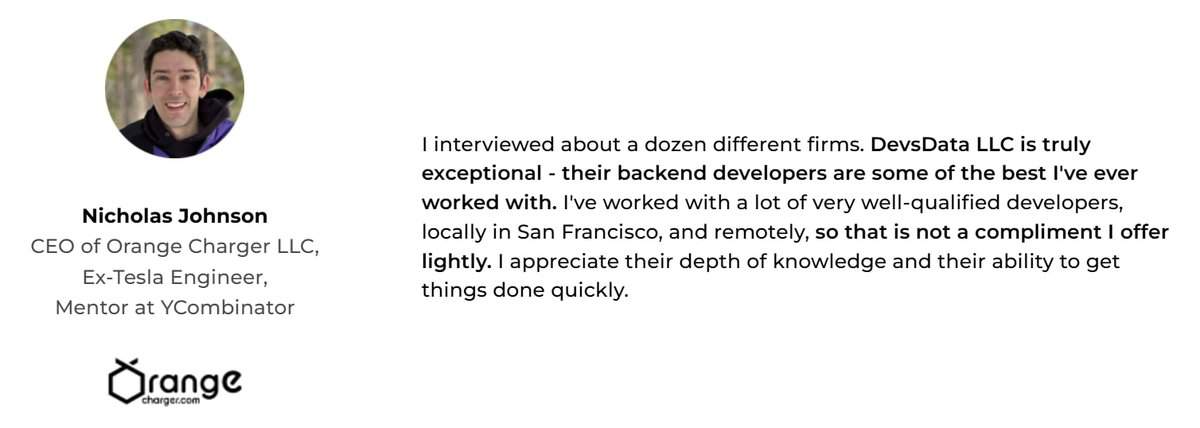
"I interviewed about a dozen different firms. DevsData LLC is truly exceptional – their backend developers are some of the best I've ever worked with. I've worked with a lot of very well-qualified developers, locally in San Francisco, and remotely, so that is not a compliment I offer lightly. I appreciate their depth of knowledge and their ability to get things done quickly."

Nicholas Johnson
CEO of Orange Charger LLC,
Ex-Tesla Engineer,
Mentor at YCombinator
"DevsData reached out to us, as we've been looking to grow our engineering team in Europe and Poland. Communicating efficiently and professionally, DevsData made a strong impression with their understanding of the recruitment challenges we were facing. They designed a tailored recruitment process for our needs. I was impressed with the technical depth of their approach."

Karim Butt
Co-Founder & CTO at GlossGenius, Inc.
"Out of all the vendors we work with, DevsData clearly stands out. The quality of developers they deliver is beyond what we've received from any other vendor, and they've been able to send profile recommendations very quickly. I'm happy to be their reference for other companies from Israel and talk about their recruitment abilities and what they delivered for us."

Ran Eyal
Senior Manager at
ZIM Integrated
Shipping Services Ltd.
"DevsData demonstrated a strong degree of proactivity, taking time to thoroughly understand the problem and business perspective, and continuously suggesting performance and usability enhancements. Their app exceeded my expectations. I've worked with DevsData on numerous projects over the last 3 years and I'm very happy. Being both responsive and honest in communication."

Jonas Lee
Partner & Executive VP of Verus,
Financial LLC, Investor,
& Serial Entrepreneur
Acknowledgments